Page 324 of 468

Driving habits have a great deal to
do with your tire mileage and
safety.
• Observe posted speed limits
• Avoid fast starts, stops andturns
• Avoid potholes and objects on the road
• Do not run over curbs or hit the tire against a curb when
parking
Highway Hazards
No matter how carefully you drive
there is always the possibility that
you may eventually have a flat tire
on the highway. Drive slowly to the
closest safe area out of traffic.
This may further damage the flat
tire, but your safety is more
important.
If you feel a sudden vibration or
ride disturbance while driving, or
you suspect your tire or vehicle
has been damaged, immediately
reduce your speed. Drive with
caution until you can safely pull
off the road. Stop and inspect the
tires for damage. If a tire is
under-inflated or damaged,
deflate it, remove the wheel and
replace it with your spare tire and
wheel (if provided). If you cannot
detect a cause, have the vehicle
towed to the nearest repair facility
or tire dealer to have the vehicle
inspected. Tire and Wheel Alignment
A bad jolt from hitting a curb or
pothole can cause the front end
of your vehicle to become
misaligned or cause damage to
your tires. If your vehicle seems to
pull to one side when you’re
driving, the wheels may be out of
alignment. Have an authorized
dealer check the wheel alignment
periodically.
Wheel misalignment in the front
or the rear can cause uneven and
rapid treadwear of your tires and
should be corrected by an
authorized dealer. Front-wheel
drive vehicles and those with an
independent rear suspension (if
equipped) may require alignment
of all four wheels.
The tires should also be balanced
periodically. An unbalanced tire
and wheel assembly may result in
irregular tire wear.
Tire Rotation
Note:
If your tires show uneven
wear ask an authorized dealer to
check for and correct any wheel
misalignment, tire imbalance or
mechanical problem involved
before tire rotation.
321
Wheels and Tires
Page 442 of 468
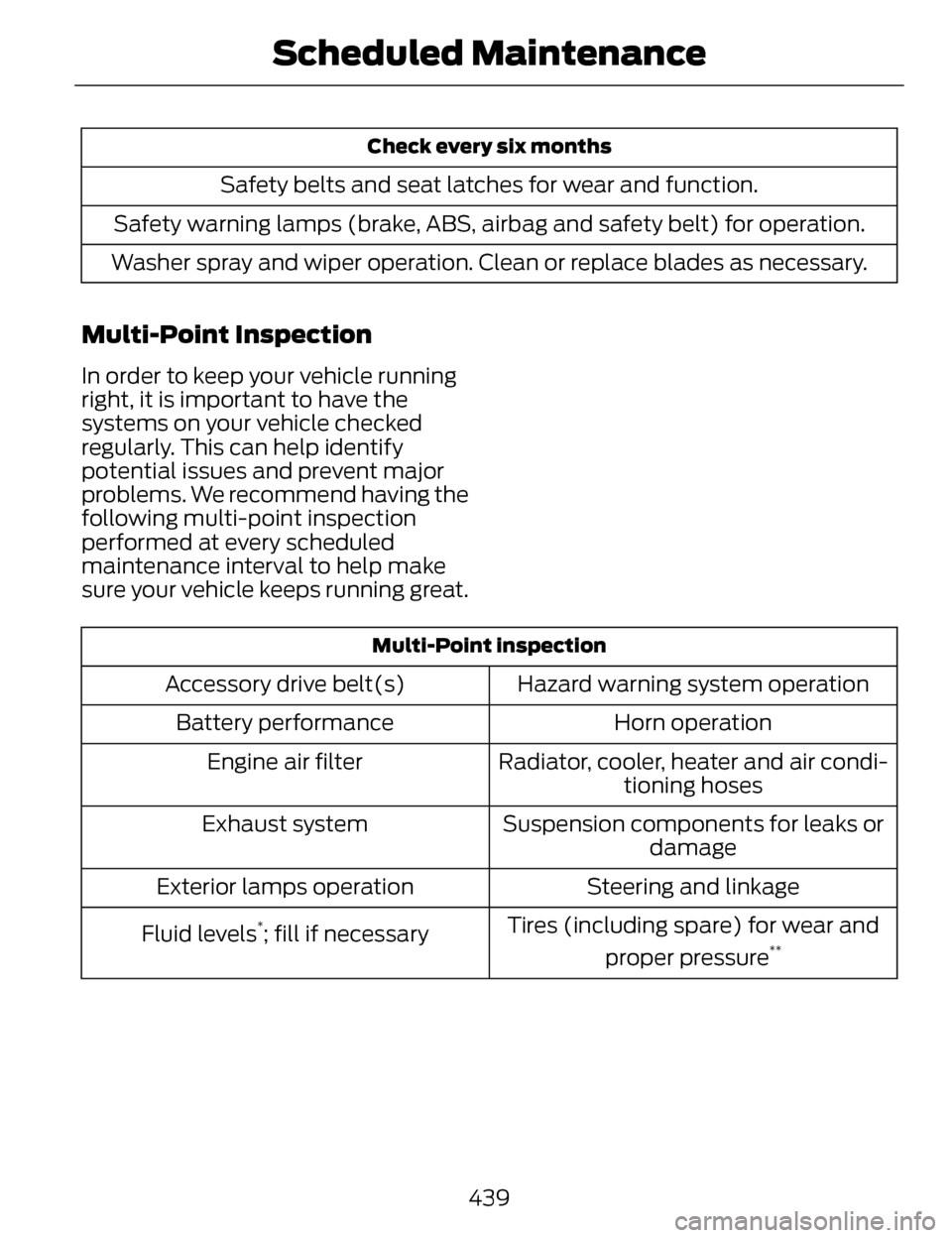
Check every six months
Safety belts and seat latches for wear and function.
Safety warning lamps (brake, ABS, airbag and safety belt) for operation.
Washer spray and wiper operation. Clean or replace blades as necessary.
Multi-Point Inspection
In order to keep your vehicle running
right, it is important to have the
systems on your vehicle checked
regularly. This can help identify
potential issues and prevent major
problems. We recommend having the
following multi-point inspection
performed at every scheduled
maintenance interval to help make
sure your vehicle keeps running great.
Multi-Point inspection
Hazard warning system operation
Accessory drive belt(s)
Horn operation
Battery performance
Radiator, cooler, heater and air condi-tioning hoses
Engine air filter
Suspension components for leaks ordamage
Exhaust system
Steering and linkage
Exterior lamps operation
Tires (including spare) for wear andproper pressure
**Fluid levels*; fill if necessary
439
Scheduled Maintenance
Page 445 of 468

At every oil change interval as indicated by the information display*
Inspect the steering linkage, ball joints, suspension, tire-rod ends, driveshaft
and U-joints. Lubricate any areas with grease fittings (All-wheel drive vehicles).
Inspect the tires, tire wear and measure the tread depth.
Inspect the wheels and related components for abnormal noise, wear, loose-
ness or drag.
* Do not exceed one year or 10000 miles (16000 kilometers) between service
intervals.
** Reset the Intelligent Oil-Life Monitor after engine oil and filter changes. See
Engine Oil Check (page 271).
Other maintenance items 1
Replace cabin air filter.
Every 20000 miles
(32000 km)
Replace engine air filter.
Every 30000 miles
(48000 km)
Change engine coolant.
2At 100000 miles
(160000 km)Replace spark plugs.
Every 100000 miles
(160000 km) Inspect accessory drive belt(s).
3
Change automatic transmission fluid.
Every 150000 miles
(240000 km)
Replace accessory drive belt(s).
4
1
Perform these maintenance items within 3000 miles (4800 kilometers) of
the last engine oil and filter change. Do not exceed the designated distance for
the interval.
2 Initial replacement at six years or 100000 miles (160000 kilometers), then
every three years or 50000 miles (80000 kilometers).
3 After initial inspection, inspect every other oil change until replaced.
4 If not replaced within the last 100000 miles (160000 kilometers).
442
Scheduled Maintenance