2014 LEXUS LX570 roof rack
[x] Cancel search: roof rackPage 127 of 956

1271-7. Safety information
1
Before driving
LX570_OM_OM60L21U_(U) Your vehicle is equipped with AD VANCED AIRBAGS designed based
on the US motor vehicle safety st andards (FMVSS208). The airbag sen-
sor assembly (ECU) controls airbag deployment based on information
obtained from the sensors etc. show n in the system components diagram
above. This information includes cras h severity and occupant informa-
tion. As the airbags deploy, a chemica l reaction in the inflators quickly fills
the airbags with nontoxic gas to help restrain the motion of the occu-
pants. ■
If the SRS airbags deploy (inflate) ●
Bruising and slight abrasions may result from contact with a deploying (inflating)
SRS airbag. ●
A loud noise and white powder will be emitted. ●
Parts of the airbag module (steering wheel hub, airbag cover and inflator) as
well as the front seats, second seats, and parts of the front, center and rear pil-
lars, and roof side rail, may be hot for several minutes. The airbag itself may also
be hot. ●
The windshield may crack. ●
For Safety Connect subscriber s, if the SRS airbags deploy or in the event of a
severe rear-end collision, the system is designed to send an emergency call to
the response center, notifying them of the vehicle’s location (without needing to
push the “SOS” button) and an agent will attempt to speak with the occupants
to ascertain the level of emergency and assistance required. If the occupants
are unable to communicate, the agent automatically treats the call as an emer-
gency and helps to dispatch the necessary emergency services. ( P. 7 2 2 )
Page 132 of 956

1321-7. Safety information
LX570_OM_OM60L21U_(U) CAUTION■
SRS airbag precautions
Observe the following precautions regarding the SRS airbags.
Failure to do so may cause death or serious injury. ●
The driver and all passengers in the vehicle must wear their seat belts properly.
The SRS airbags are supplemental devices to be used with the seat belts. ●
The SRS driver airbag deploys with considerable force, and can cause death or
serious injury especially if the driver is very close to the airbag. The National
Highway Traffic Safety Administration (“NHTSA”) advises:
Since the risk zone for the driver’s airbag is the first 2 - 3 in. (50 - 75 mm) of infla-
tion, placing yourself 10 in. (250 mm) from your driver airbag provides you with a
clear margin of safety. This distance is measured from the center of the steering
wheel to your breastbone. If you sit less than 10 in. (250 mm) away now, you can
change your driving position in several ways:
• Move your seat to the rear as far as you can while still reaching the pedals
comfortably.
• Slightly recline the back of the seat.
Although vehicle designs vary, many dr ivers can achieve the 10 in. (250 mm)
distance, even with the driver seat all the way forward, simply by reclining the
back of the seat somewhat. If reclining the back of your seat makes it hard to
see the road, raise yourself by using a firm, non-slippery cushion, or raise the
seat if your vehicle has that feature.
• If your steering wheel is adjustable, ti lt it downward. This points the airbag
toward your chest instead of your head and neck.
The seat should be adjusted as recomm ended by NHTSA above, while still main-
taining control of the foot pedals, steerin g wheel, and your view of the instrument
panel controls. ●
The portion of the front, side and rear pil-
lars or roof side rail garnishes (padding)
containing the curtain shield airbags is
inside scratched, cracked, or otherwise
damaged.
Page 135 of 956

1351-7. Safety information
1
Before driving
LX570_OM_OM60L21U_(U) CAUTION■
SRS airbag precautions
●
If a vinyl cover is put on the area where the SRS knee airbag will deploy, be sure to
remove it. ●
Do not use seat accessories which cove r the parts where the SRS side airbags
inflate as they may interfere with inflation of the airbags. ●
Do not strike or apply significant levels of force to the area of the SRS airbag
components.
Doing so can cause the SRS airbags to malfunction. ●
Do not touch any of the component parts immediately after the SRS airbags have
deployed (inflated) as they may be hot. ●
If breathing becomes difficult after the SR S airbag have deployed, open a door or
window to allow fresh air in, or leave the vehicle if it is safe to do so. Wash off any
residue as soon as possible to prevent skin irritation. ●
If the areas where the SRS airbags are stored, such as the steering wheel pad and
front and rear pillar garnishes, are damaged or cracked, have them replaced by
your Lexus dealer. ●
Do not attach anything to or lean anything
against areas such as the dashboard, steer-
ing wheel pad or lower portion of the
instrument panel.
These items can become projectiles when
SRS driver, front passenger and knee air-
bags deploy. ●
Do not attach anything to areas such as a
door, windshield glass, side door glass,
front, center and rear pillars, roof side rail
or assist grip. ●
Do not hang coat hangers or other hard
objects on the coat hooks. All of these
items could become projectiles and may
cause death or serious injury, should the
SRS curtain shield airbag deploy.
Page 438 of 956

4383-1. Using the touch screen
LX570_OM_OM60L21U_(U) ■
When using the microphone ●
It is unnecessary to speak directly into the microphone when giving a command. ●
Wait for the confirmation beep before speaking a command. ●
Voice commands may not be recognized if:
• Spoken too quickly.
• Spoken at a low or high volume.
• The roof or windows are open.
• Passengers are talking while voice commands are spoken.
• The air conditioning speed is set high.
• The air conditioning vents are turned towards the microphone. ●
In the following conditions, the system may not recognize the command prop-
erly and using voice commands may not be possible:
• The command is incorrect or unclear. Note that certain words, accents or
speech patterns may be difficul t for the system to recognize.
• There is excessive background noise, such as wind noise.■
When searching for a track ●
A USB memory or iPod must be connected to enable track searching and play-
back. ( P. 5 4 8 , 5 5 8 )●
When a USB memory or iPod is connec ted, recognition data is created so
tracks can be searched using voice commands. ●
Recognition data is updated under the following conditions:
• When the USB memory or iPod data has changed.
• When the voice recognition language is changed. ( P. 4 1 5 )●
While the recognition data is being cr eated or being updated, a track search
cannot be performed using a voice command. ●
While “Play Music” is displayed in the “Shortcut Menu” screen, say “Play music”
to display the music screen from which searching for a track using a voice com-
mand can be performed. ●
When “Play Music” is dimmed in the “Shortcut Menu” screen, it is not possible
to search for a track using a voice command. In this situation, reduce the
amount of music data in the USB memory or iPod and update the recognition
data to enable searching by voice command.
Page 905 of 956
9016-1. Specifications
6
Vehicle specifications
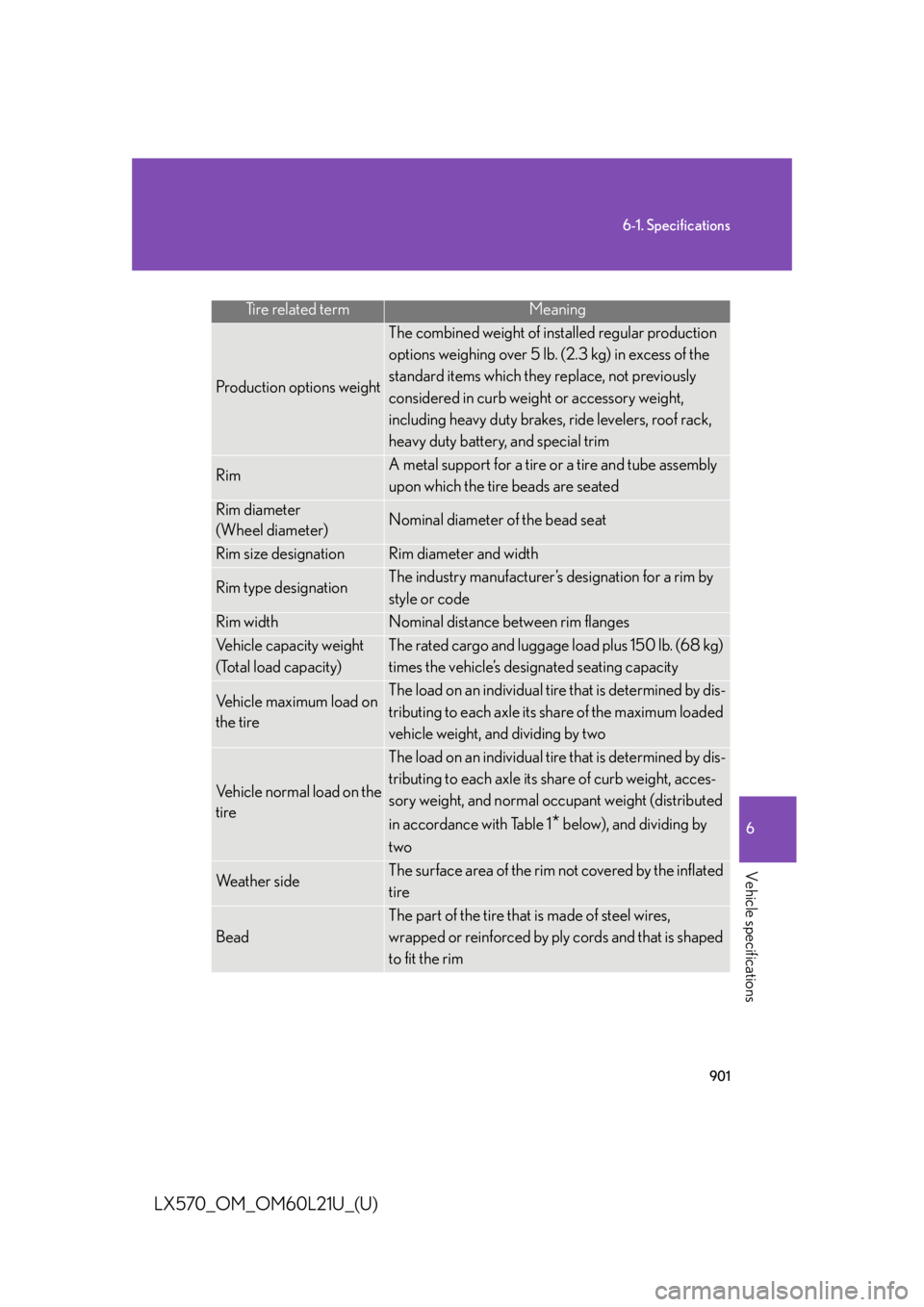
LX570_OM_OM60L21U_(U) Tire related term Meaning
Production options weight The combined weight of installed regular production
options weighing over 5 lb. (2.3 kg) in excess of the
standard items which they replace, not previously
considered in curb weight or accessory weight,
including heavy duty brakes, ride levelers, roof rack,
heavy duty battery, and special trim
Rim A metal support for a tire or a tire and tube assembly
upon which the tire beads are seated
Rim diameter
(Wheel diameter) Nominal diameter of the bead seat
Rim size designation Rim diameter and width
Rim type designation The industry manufacturer’s designation for a rim by
style or code
Rim width Nominal distance between rim flanges
Vehicle capacity weight
(Total load capacity) The rated cargo and luggage load plus 150 lb. (68 kg)
times the vehicle’s designated seating capacity
Vehicle maximum load on
the tire The load on an individual tire that is determined by dis-
tributing to each axle its share of the maximum loaded
vehicle weight, and dividing by two
Vehicle normal load on the
tire The load on an individual tire that is determined by dis-
tributing to each axle its share of curb weight, acces-
sory weight, and normal occupant weight (distributed
in accordance with Table 1
* below), and dividing by
two
We a t h e r s i d e The surface area of the rim not covered by the inflated
tire
Bead The part of the tire that is made of steel wires,
wrapped or reinforced by ply cords and that is shaped
to fit the rim