2014 Lexus ES300h read
[x] Cancel search: readPage 714 of 918
ES350_300h_OM_OM33A60U_(U)
7136-3. Do-it-yourself maintenance
6
Maintenance and care
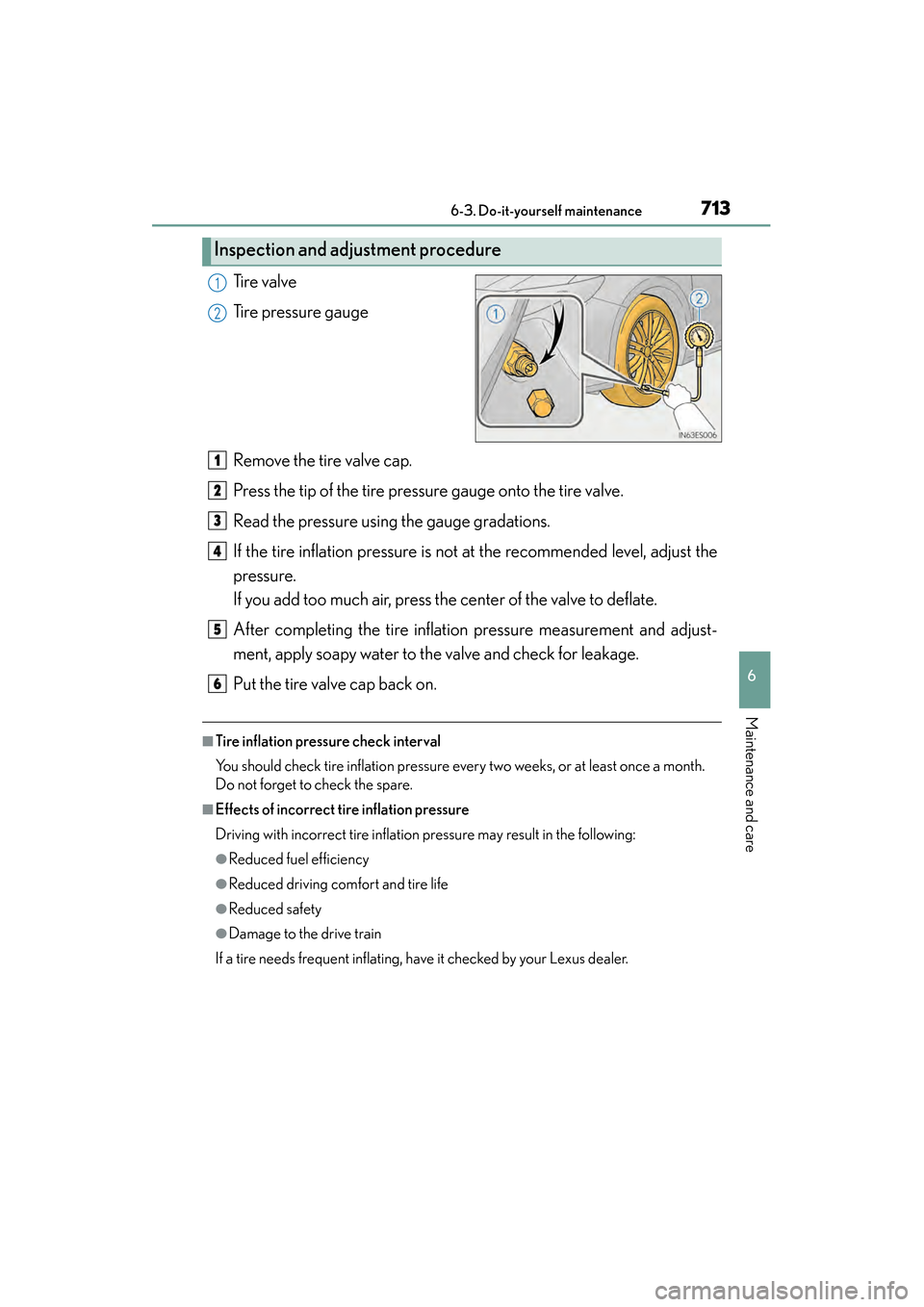
Ti r e v a l v e
Tire pressure gauge
Remove the tire valve cap.
Press the tip of the tire pressure gauge onto the tire valve.
Read the pressure using the gauge gradations.
If the tire inflation pressure is not at the recommended level, adjust the
pressure.
If you add too much air, press the center of the valve to deflate.
After completing the tire inflation pressure measurement and adjust-
ment, apply soapy water to the valve and check for leakage.
Put the tire valve cap back on.
■Tire inflation pressure check interval
You should check tire inflation pressure every two weeks, or at least once a month.
Do not forget to check the spare.
■Effects of incorrect tire inflation pressure
Driving with incorrect tire inflation pressure may result in the following:
●Reduced fuel efficiency
●Reduced driving comfort and tire life
●Reduced safety
●Damage to the drive train
If a tire needs frequent inflating, have it checked by your Lexus dealer.
Inspection and adjustment procedure
1
2
1
2
3
4
5
6
Page 715 of 918
714
ES350_300h_OM_OM33A60U_(U)
6-3. Do-it-yourself maintenance
■Instructions for checking tire inflation pressure
When checking tire inflation pressure, observe the following:
●Check only when the tires are cold.
If your vehicle has been parked for at least 3 hours or has not been driven for more
than 1 mile or 1.5 km, you will get an accurate cold tire inflation pressure reading.
●Always use a tire pressure gauge.
The appearance of the tire can be misleading. In addition, tire inflation pressure that
is even just a few pounds off can affect ride quality and handling.
●Do not reduce tire inflation pressure after driving. It is normal for tire inflation pres-
sure to be higher after driving.
●Never exceed the vehicle capacity weight.
Passengers and luggage weight should be placed so that the vehicle is balanced.
CAUTION
■Proper inflation is critical to save tire performance
Keep your tires properly inflated. Otherwise, the following conditions may occur
and result in an accident causing death or serious injury:
●Excessive wear
●Uneven wear
●Poor handling
●Possibility of blowouts resulting from overheated tires
●Poor sealing of the tire bead
●Wheel deformation and/or tire separation
●A greater possibility of tire damage from road hazards
NOTICE
■When inspecting and adjusting tire inflation pressure
Be sure to put the tire valve caps back on.
Without the valve caps, dirt or moisture could get into the valve and cause air leak-
age, which could result in an accident. If the caps are lost, replace them as soon as
possible.
Page 749 of 918

748
ES350_300h_OM_OM33A60U_(U)
7-1. Essential information
Emergency flashers
Press the switch.
All the turn signal lights will flash.
To turn them off, press the switch once again.
■Emergency flashers
Gasoline vehicles: If the emergency flashers are used for a long time while the
engine is not operating, the 12-volt battery may discharge.
Hybrid vehicles: If the emergency flashers are used for a long time while the hybrid
system is not operating (while the “READY” indicator is not illuminated), the 12-volt
battery may discharge.
The emergency flashers are used to warn other drivers when the vehi-
cle has to be stopped in the road due to a breakdown, etc.
XTy p e AXType B
Page 768 of 918

7677-2. Steps to take in an emergency
ES350_300h_OM_OM33A60U_(U)
7
When trouble arises
CAUTION
■Maintenance of the tires
Each tire, including the spare (if provided), should be checked monthly when cold
and inflated to the inflation pressure recommended by the vehicle manufacturer on
the vehicle placard or tire inflation pressure label (tire and load information label).
(If your vehicle has tires of a different size than the size indicated on the vehicle
placard or tire inflation pressure label [tire and load information label], you should
determine the proper tire inflation pressure for those tires.)
As an added safety feature, your vehicle has been equipped with a tire pressure
monitoring system (TPMS-tire pressure warning system) that illuminates a low tire
pressure telltale (tire pressure warning light) when one or more of your tires is sig-
nificantly under-inflated. Accordingly, when the low tire pressure telltale (tire pres-
sure warning light) illuminates, you should stop and check your tires as soon as
possible, and inflate them to the proper pressure. Driving on a significantly under-
inflated tire causes the tire to overheat and can lead to tire failure. Under-inflation
also reduces fuel efficiency and tire tread life, and may affect the vehicle’s handling
and stopping ability.
Please note that the TPMS (tire pressure warning system) is not a substitute for
proper tire maintenance, and it is the driver’s responsibility to maintain correct tire
pressure, even if under-inflation has not reached the level to trigger illumination of
the TPMS low tire pressure telltale (tire pressure warning light).
Your vehicle has also been equipped with a TPMS (tire pressure warning system)
malfunction indicator to indicate when the system is not operating properly. The
TPMS (tire pressure warning system) malfunction indicator is combined with the
low tire pressure telltale (tire pressure warning light). When the system detects a
malfunction, the telltale will flash for approximately one minute and then remain
continuously illuminated. This sequence will continue upon subsequent vehicle
start-ups as long as the malfunction exists. When the malfunction indicator is illumi-
nated, the system may not be able to detect or signal low tire pressure as intended.
Page 769 of 918

7687-2. Steps to take in an emergency
ES350_300h_OM_OM33A60U_(U)
CAUTION
TPMS (tire pressure warning system) malfunctions may occur for a variety of rea-
sons, including the installation of replacement or alternate tires or wheels on the
vehicle that prevent the TPMS (tire pressure warning system) from functioning
properly. Always check the TPMS (tire pressure warning system) malfunction tell-
tale after replacing one or more tires or wheels on your vehicle to ensure that the
replacement or alternate tires and wheels allow the TPMS (tire pressure warning
system) to continue to function properly.
NOTICE
■Precaution when installing a different tire
When differently constructed tires or tires of different makers, models or tread pat-
terns are installed, the tire pressure warning system may not operate properly.
Page 800 of 918

7997-2. Steps to take in an emergency
ES350_300h_OM_OM33A60U_(U)
7
When trouble arises
CAUTION
■Replacing a flat tire
●Observe the following precautions.
Failure to do so may result in serious injury:
• Do not try to remove the wheel ornament by hand. Take due care in handlingthe ornament to avoid unexpected personal injury.
• Do not touch the disc wheels or the area around the brakes immediately after the vehicle has been driven.
After the vehicle has been driven the disc wheels and the area around the
brakes will be extremely hot. Touching these areas with hands, feet or other
body parts while changing a tire, etc. may result in burns.
●Failure to follow these precautions could cause the wheel nuts to loosen and the
tire to fall off, resulting in death or serious injury.
• Never use oil or grease on the wheel bolts or wheel nuts.Oil and grease may cause the wheel nuts to be excessively tightened, leading
to bolt or disc wheel damage. In addition, the oil or grease can cause the
wheel nuts to loosen and the wheel may fall off, causing a serious accident.
Remove any oil or grease from the wheel bolts or wheel nuts.
• Have the wheel nuts tightened with a torque wrench to 76 ft•lbf (103 N•m, 10.5 kgf•m) as soon as possible after changing wheels.
• Do not attach a heavily damaged wheel ornament, as it may fly off the wheel while the vehicle is moving.
• When installing a tire, only use wheel nuts that have been specifically designed for that wheel.
• If there are any cracks or deformations in the bolt screws, nut threads or bolt holes of the wheel, have the vehicle inspected by your Lexus dealer.
Page 819 of 918

8187-2. Steps to take in an emergency
ES350_300h_OM_OM33A60U_(U)
Connect a positive jumper cable clamp to the positive (+) battery
terminal on your vehicle.
Connect the clamp on the other end of the positive cable to the pos-
itive (+) battery terminal on the second vehicle.
Connect a negative cable clamp to the negative (-) battery terminal
on the second vehicle.
Connect the clamp at the other end of the negative cable to a solid,
stationary, unpainted metallic point away from the 12-volt battery
and any moving parts, as shown in the illustration.
Start the engine of the second ve hicle. Increase the engine speed
slightly and maintain at that level for approximately 5 minutes to
recharge the 12-volt battery of your vehicle.
Open and close any of the doors of your vehicle with the “POWER”
switch off.
Maintain the engine speed of the second vehicle and start the hybrid
system of your vehicle by turning the “POWER” switch to ON mode.
Make sure the “READY” indicator comes on. If the indicator does not
come on, contact your Lexus dealer.
Once the hybrid system has started, remove the jumper cables in the
exact reverse order from which they were connected.
Once the hybrid system starts, have the vehicle inspected at your Lexus
dealer as soon as possible.1
2
3
4
3
4
5
6
7
Page 828 of 918

8277-2. Steps to take in an emergency
ES350_300h_OM_OM33A60U_(U)
7
When trouble arises
Start the hybrid system and check for the multi-information display.
If the message does not disappear:
Stop the hybrid system and contact your Lexus dealer.
If the message is not displayed:
Have the vehicle inspected at the nearest Lexus dealer.
CAUTION
■When inspecting under the hood of your vehicle
Observe the following precautions.
Failure to do so may result in serious injury such as burns.
●If steam is seen coming from under the hood, do not open the hood until the
steam has subsided. The engine compartment may be very hot.
●After the hybrid system has been turned off, check that the indicator on the
“POWER” switch and the “READY” indicator are off.
When the hybrid system is operating, the gasoline engine may automatically
start, or the cooling fan may suddenly operate even if the gasoline engine stops.
Do not touch or approach rotating parts such as the fan, which may lead to fin-
gers or clothing (especially a tie, a scarf or a muffler) getting caught, resulting in
serious injury.
●Do not loosen the radiator cap or the coolant reservoir cap while the hybrid sys-
tem and radiator are hot. High temperature steam or coolant could spray out.
NOTICE
■When adding engine/power control unit coolant
Add coolant slowly after the hybrid system has cooled down sufficiently. Adding
cool coolant to a hot hybrid system too quickly can cause damage to the hybrid
system.
■To prevent damage to the cooling system
Observe the following precautions:
●Avoid contaminating the coolant with foreign matter (such as sand or dust etc.).
●Do not use any coolant additives.
6