Page 339 of 457
Driving your vehicle
62
5
E140000AFD
If you are considering towing with
your vehicle, you should first check
with your country's Department of
Motor Vehicles to determine their
legal requirements.
Since laws vary the requirements for
towing trailers, cars, or other types of
vehicles or apparatus may differ. Ask
an authorized Kia dealer for further
details before towing.
Your vehicle can tow a trailer. To
identify what the vehicle trailering
capacity is for your vehicle, you
should read the information in
“Weight of the trailer” that appears
later in this section.Remember that trailering is different
than just driving your vehicle by itself.
Trailering means changes in han-
dling, durability, and fuel economy.
Successful, safe trailering requires
correct equipment, and it has to be
used properly.
This section contains many time-
tested, important trailering tips and
safety rules. Many of these are
important for your safety and that of
your passengers. Please read this
section carefully before you pull a
trailer.
Load-pulling components such as
the engine, transaxle, wheel assem-
blies, and tires are forced to work
harder against the load of the added
weight. The engine is required to
operate at relatively higher speeds
and under greater loads. This addi-
tional burden generates extra heat.
The trailer also adds considerably to
wind resistance, increasing the
pulling requirements.
TRAILER TOWING
CAUTION
Pulling a trailer improperly can
damage your vehicle and resultin costly repairs not covered byyour warranty. To pull a trailercorrectly, follow the advice inthis section.WARNING- Towing a trailer
If you don't use the correct
equipment and/or drive improp-
erly, you can lose control when
you pull a trailer. For example, if
the trailer is too heavy, the
brakes may not work well - or
even at all. You and your pas-
sengers could be seriously or
fatally injured. Pull a trailer only
if you have followed all the
steps in this section.
WARNING- Weight limits
Before towing, make sure the
total trailer weight, GCW (gross
combination weight), GVW
(gross vehicle weight), GAW
(gross axle weight) and trailer
tongue load are all within the
limits.
Page 345 of 457
Driving your vehicle
68
5
E140600BFD
If you do decide to pull a trail-
er
Here are some important points if you
decide to pull a trailer:
Consider using a sway control. You
can ask a hitch dealer about sway
control.
Do not do any towing with your car during its first 2,000 km (1,200
miles) in order to allow the engine
to properly break in. Failure to heed
this caution may result in serious
engine or transaxle damage.
When towing a trailer, be sure to consult an authorized Kia dealer for
further information on additional
requirements such as a towing kit,
etc.
Always drive your vehicle at a mod- erate speed (less than 100 km/h
(60 mph)).
On a long uphill grade, do not exceed 70 km/h (45 mph) or the
posted towing speed limit, whichev-
er is lower.
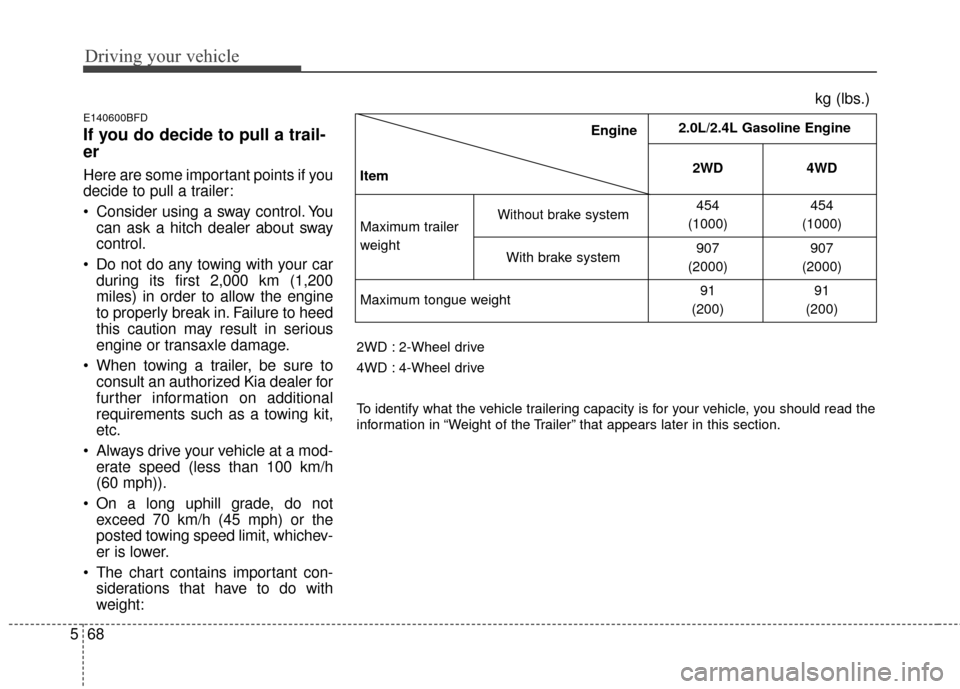
The chart contains important con- siderations that have to do with
weight:
Engine
Item 2.0L/2.4L Gasoline Engine
2WD 4WD
Maximum trailer
weight
Without brake system 454
(1000) 454
(1000)
With brake system 907
(2000) 907
(2000)
Maximum tongue weight 91
(200) 91
(200)
kg (lbs.)
2WD : 2-Wheel drive
4WD : 4-Wheel drive
To identify what the vehicle trailering capacity is for your vehicle, you should read the
information in “Weight of the Trailer” that appears later in this section.
Page 349 of 457
Driving your vehicle
72
5
E150103AEN
Towing capacity:
Without trailer brakes
: 454 kg (1000 lbs)
With trailer brakes : 907 kg (2000 lbs)
Towing capacity is the maximum
trailer weight including its cargo
weight, your vehicle can tow.
E150104AUN
Cargo capacity:
The cargo capacity of your vehicle
will increase or decrease depending
on the weight and the number of
occupants and the tongue load, if
your vehicle is equipped with a trail-
er.
E150105AUN-C1
Steps for determining correct load limit
1.Locate the statement "The com- bined weight of occupants and
cargo should never exceed XXX kg
or XXX lbs.'' on your vehicle's plac-
ard.
2.Determine the combined weight of the driver and passengers that will
be riding in your vehicle.
3.Subtract the combined weight of the driver and passengers from
XXX kg or XXX lbs.
4.The resulting figure equals the available amount of cargo and lug-
gage load capacity. For example, if
the "XXX" amount equals 635 kg
(1400 lbs.) and there will be five 68
kg (150 lbs.) passengers in your
vehicle, the amount of available
cargo and luggage load capacity is
295 kg (650 lbs).
(635-340 (5 x 68) = 295 kg or
1400-750 (5 x 150) = 650 lbs.) 5.Determine the combined weight of
luggage and cargo being loaded
on the vehicle. That weight may not
safely exceed the available cargo
and luggage load capacity calcu-
lated in Step 4.
6.If your vehicle will be towing a trail- er, load from your trailer will be
transferred to your vehicle. Consult
this manual to determine how this
reduces the available cargo and
luggage load capacity of your vehi-
cle.
Page 370 of 457
617
What to do in an emergency
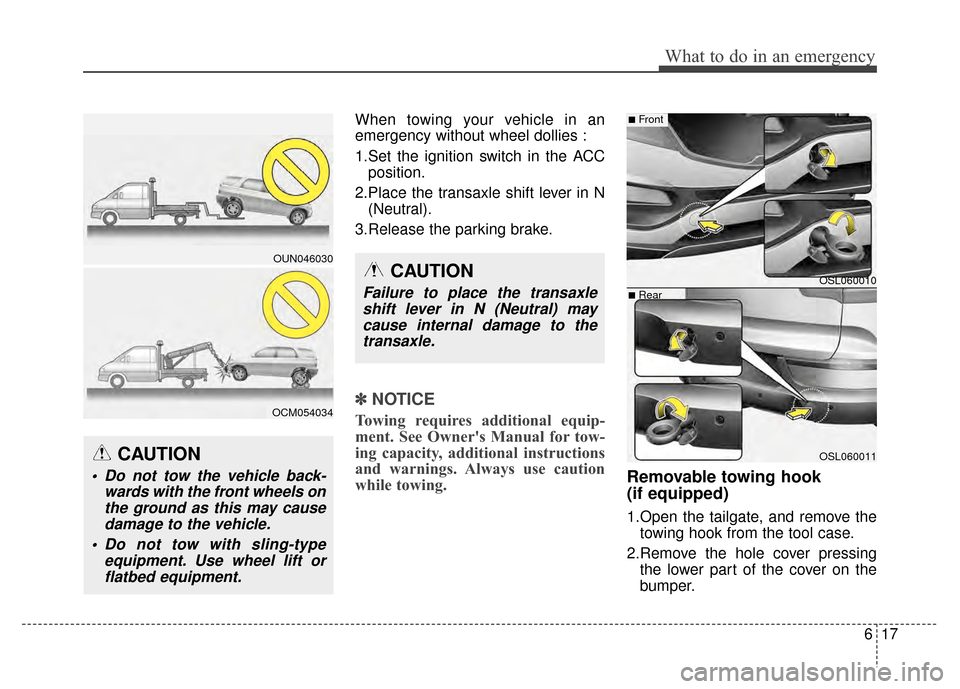
When towing your vehicle in an
emergency without wheel dollies :
1.Set the ignition switch in the ACCposition.
2.Place the transaxle shift lever in N (Neutral).
3.Release the parking brake.
✽ ✽ NOTICE
Towing requires additional equip-
ment. See Owner's Manual for tow-
ing capacity, additional instructions
and warnings. Always use caution
while towing.
Removable towing hook
(if equipped)
1.Open the tailgate, and remove the
towing hook from the tool case.
2.Remove the hole cover pressing the lower part of the cover on the
bumper.
CAUTION
Failure to place the transaxleshift lever in N (Neutral) maycause internal damage to thetransaxle.
CAUTION
Do not tow the vehicle back- wards with the front wheels onthe ground as this may causedamage to the vehicle.
Do not tow with sling-type equipment. Use wheel lift orflatbed equipment.
OUN046030
OCM054034
OSL060010
OSL060011
■Front
■Rear