2014 KIA Sportage Auto start
[x] Cancel search: Auto startPage 343 of 457
Driving your vehicle
66
5
E140407AUN-EA
Parking on hills
Generally, if you have a trailer
attached to your vehicle, you should
not park your vehicle on a hill. People
can be seriously or fatally injured,
and both your vehicle and the trailer
can be damaged if they unexpected-
ly roll downhill.
However, if you ever have to park
your trailer on a hill, here's how to do
it:
1.Pull the vehicle into the parking
space. Turn the steering wheel in
the direction of the curb (right if
headed downhill, left if headed up
hill). 2.If the vehicle has a manual
transaxle, place the car in neutral.
If the vehicle has an automatic
transaxle, place the car in P (Park).
3.Set the parking brake and shut off the vehicle.
4.Place chocks under the trailer wheels on the down hill side of the
wheels.
5.Start the vehicle, hold the brakes, shift to neutral, release the parking
brake and slowly release the
brakes until the trailer chocks
absorb the load.
6.Reapply the brakes, reapply the parking brake and shift the vehicle
to R (Reverse) for manual
transaxle or P (Park) for automatic
transaxle.
7. Shut off the vehicle and release the vehicle brakes but leave the
parking brake set.
CAUTION
When towing a trailer on steepgrades (in excess of 6%) payclose attention to the enginecoolant temperature gauge toensure the engine does notoverheat.
If the needle of the coolanttemperature gauge movesacross the dial towards “H”(HOT), pull over and stop assoon as it is safe to do so, andallow the engine to idle until itcools down. You may proceedonce the engine has cooledsufficiently.
You must decide driving speed depending on trailerweight and uphill grade toreduce the possibility ofengine and transaxle over-heating.
WARNING- Parking on a hill
Parking your vehicle on a hill
with a trailer attached could
cause serious injury or death,
should the trailer break loose or
brake stops working.
Page 344 of 457
567
Driving your vehicle
When you are ready to leave after
parking on a hill
1.With the manual transaxle inNeutral or automatic transaxle in P
(Park), apply your brakes and hold
the brake pedal down while you:
and
2.Slowly remove your foot from the brake pedal.
3.Drive slowly until the trailer is clear of the chocks.
4.Stop and have someone pick up and store the chocks.
E140500AUN
Maintenance when trailer tow-
ing
Your vehicle will need service more
often when you regularly pull a trail-
er. Important items to pay particular
attention to include engine oil, auto-
matic transaxle fluid, axle lubricant
and cooling system fluid. Brake con-
dition is another important item to
frequently check. Each item is cov-
ered in this manual, and the Index
will help you find them quickly. If
you’re trailering, it’s a good idea to
review these sections before you
start your trip.
Don’t forget to also maintain your
trailer and hitch. Follow the mainte-
nance schedule that accompanied
your trailer and check it periodically.
Preferably, conduct the check at the
start of each day’s driving. Most
importantly, all hitch nuts and bolts
should be tight.
CAUTION
Due to higher load during trailer usage, overheatingmight occur in hot days orduring uphill driving. If thecoolant gauge indicates over-heating, switch off the A/C andstop the vehicle in a safe areato cool down the engine.
When towing check transaxle fluid more frequently.
WARNING- Parkingbrake
It can be dangerous to get out
of your vehicle if the parking
brake is not firmly set.
If you have left the engine run-
ning, the vehicle can move sud-
denly. You or others could be
seriously or fatally injured.
Page 356 of 457
63
What to do in an emergency
2.When the vehicle is stopped, turnon your emergency hazard flash-
ers, set the parking brake and put
the transaxle in P (Park, automatic
transaxle) or reverse (manual
transaxle).
3.Have all passengers get out of the vehicle. Be sure they all get out on
the side of the car that is away from
traffic.
4.When changing a flat tire, follow the instruction provided later in this
section.
F020300AUN
If the engine stalls while driv-
ing
1.Reduce your speed gradually,keeping a straight line. Move cau-
tiously off the road to a safe place.
2.Turn on your emergency flashers.
3.Try to start the engine again. If your vehicle will not start, contact an
authorized Kia dealer or seek other
qualified assistance.
F030100AAM
If engine doesn't turn over or
turns over slowly
1.If your car has an automatictransaxle, be sure the shift lever is
in N (Neutral) or P (Park) and the
emergency brake is set.
2.Check the battery connections to be sure they are clean and tight.
3.Turn on the interior light. If the light dims or goes out when you operate
the starter, the battery is dis-
charged.
4.Check the starter connections to be sure they are securely tight-
ened.
5.Do not push or pull the vehicle to start it. See instructions for "Jump
starting".
F030200AHM
If engine turns over normally
but does not start
1.Check the fuel level.
2.With the ignition switch in theLOCK position, check all connec-
tors at the ignition coils and spark
plugs. Reconnect any that may be
disconnected or loose.
3.Check the fuel line in the engine compartment.
4.If the engine still does not start, call an authorized Kia dealer or seek
other qualified assistance.
IF THE ENGINE WILL NOT START
WARNING
If the engine will not start, do
not push or pull the vehicle to
start it. This could result in a
collision or cause other dam-
age. In addition, push or pull
starting may cause the catalytic
converter to overload and cre-
ate a fire hazard.
Page 357 of 457
What to do in an emergency
46
EMERGENCY STARTING
F040000AUN
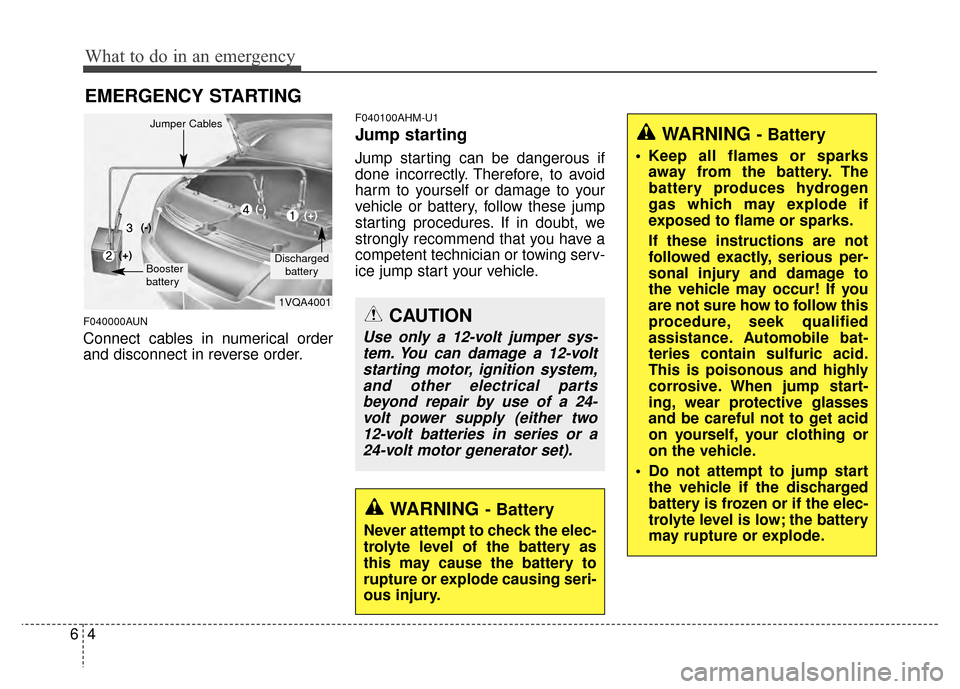
Connect cables in numerical order
and disconnect in reverse order.
F040100AHM-U1
Jump starting
Jump starting can be dangerous if
done incorrectly. Therefore, to avoid
harm to yourself or damage to your
vehicle or battery, follow these jump
starting procedures. If in doubt, we
strongly recommend that you have a
competent technician or towing serv-
ice jump start your vehicle.
CAUTION
Use only a 12-volt jumper sys-tem. You can damage a 12-voltstarting motor, ignition system,and other electrical partsbeyond repair by use of a 24-volt power supply (either two12-volt batteries in series or a24-volt motor generator set).
WARNING - Battery
• Keep all flames or sparks away from the battery. The
battery produces hydrogen
gas which may explode if
exposed to flame or sparks.
If these instructions are not
followed exactly, serious per-
sonal injury and damage to
the vehicle may occur! If you
are not sure how to follow this
procedure, seek qualified
assistance. Automobile bat-
teries contain sulfuric acid.
This is poisonous and highly
corrosive. When jump start-
ing, wear protective glasses
and be careful not to get acid
on yourself, your clothing or
on the vehicle.
Do not attempt to jump start the vehicle if the discharged
battery is frozen or if the elec-
trolyte level is low; the battery
may rupture or explode.
WARNING- Battery
Never attempt to check the elec-
trolyte level of the battery as
this may cause the battery to
rupture or explode causing seri-
ous injury.
1VQA4001
Discharged
battery
Jumper Cables
Booster
battery
(-)
(+)
(+)(-)
Page 358 of 457
65
What to do in an emergency
F040101ASA
Jump starting procedure
1.Make sure the booster battery is12-volt and that its negative termi-
nal is grounded.
2.If the booster battery is in another vehicle, do not allow the vehicles to
come in contact.
3.Turn off all unnecessary electrical loads.
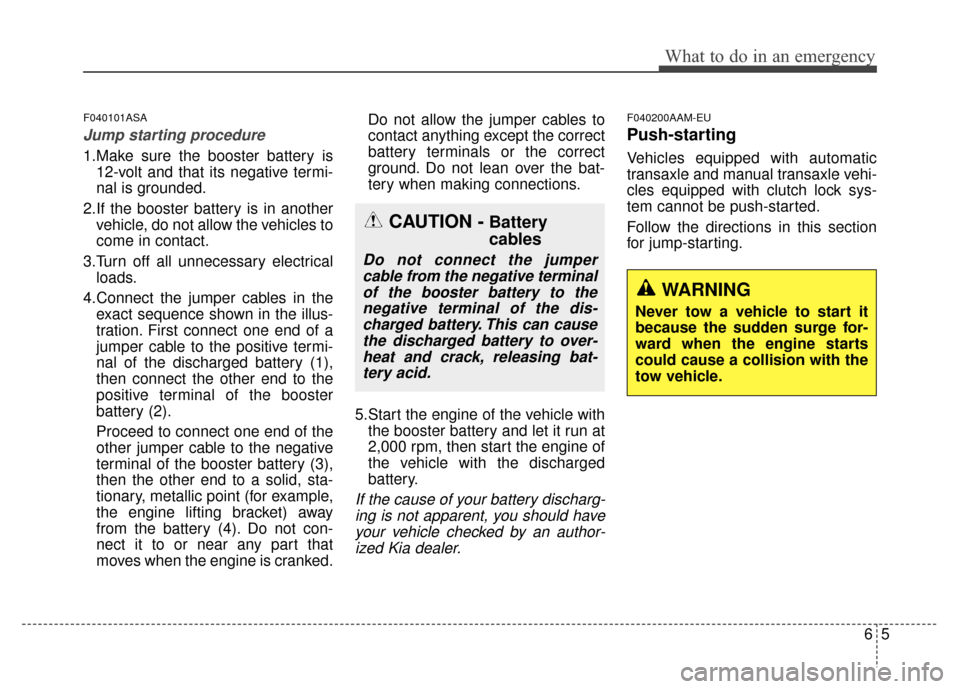
4.Connect the jumper cables in the exact sequence shown in the illus-
tration. First connect one end of a
jumper cable to the positive termi-
nal of the discharged battery (1),
then connect the other end to the
positive terminal of the booster
battery (2).
Proceed to connect one end of the
other jumper cable to the negative
terminal of the booster battery (3),
then the other end to a solid, sta-
tionary, metallic point (for example,
the engine lifting bracket) away
from the battery (4). Do not con-
nect it to or near any part that
moves when the engine is cranked. Do not allow the jumper cables to
contact anything except the correct
battery terminals or the correct
ground. Do not lean over the bat-
tery when making connections.
5.Start the engine of the vehicle with the booster battery and let it run at
2,000 rpm, then start the engine of
the vehicle with the discharged
battery.
If the cause of your battery discharg-ing is not apparent, you should haveyour vehicle checked by an author-ized Kia dealer.
F040200AAM-EU
Push-starting
Vehicles equipped with automatic
transaxle and manual transaxle vehi-
cles equipped with clutch lock sys-
tem cannot be push-started.
Follow the directions in this section
for jump-starting.
CAUTION -Battery
cables
Do not connect the jumpercable from the negative terminalof the booster battery to thenegative terminal of the dis-charged battery. This can causethe discharged battery to over-heat and crack, releasing bat-tery acid.
WARNING
Never tow a vehicle to start it
because the sudden surge for-
ward when the engine starts
could cause a collision with the
tow vehicle.
Page 361 of 457
What to do in an emergency
86
Removing and storing the
spare tire
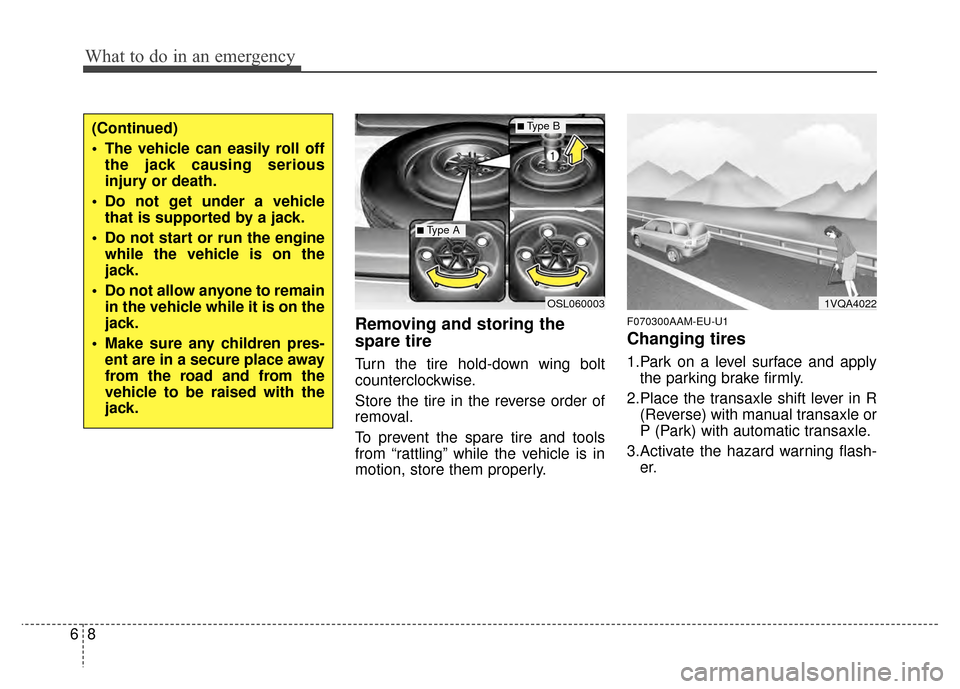
Turn the tire hold-down wing bolt
counterclockwise.
Store the tire in the reverse order of
removal.
To prevent the spare tire and tools
from “rattling” while the vehicle is in
motion, store them properly.
F070300AAM-EU-U1
Changing tires
1.Park on a level surface and applythe parking brake firmly.
2.Place the transaxle shift lever in R (Reverse) with manual transaxle or
P (Park) with automatic transaxle.
3.Activate the hazard warning flash- er.
(Continued)
The vehicle can easily roll offthe jack causing serious
injury or death.
Do not get under a vehicle that is supported by a jack.
Do not start or run the engine while the vehicle is on the
jack.
Do not allow anyone to remain in the vehicle while it is on the
jack.
Make sure any children pres- ent are in a secure place away
from the road and from the
vehicle to be raised with the
jack.
1VQA4022OSL060003
■Type A
■Type B
Page 428 of 457
755
Maintenance
Inner fuse panel
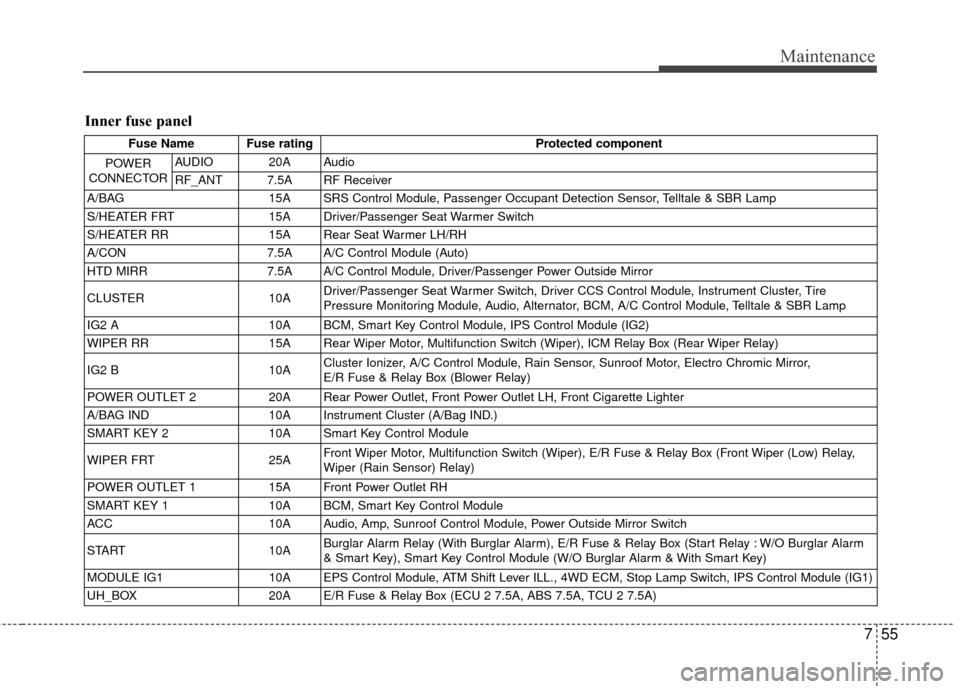
Fuse Name Fuse ratingProtected component
POWER
CONNECTOR
AUDIO 20A Audio
RF_ANT 7.5A RF Receiver
A/BAG 15A SRS Control Module, Passenger Occupant Detection Sensor, Telltale & SBR Lamp
S/HEATER FRT 15A Driver/Passenger Seat Warmer Switch
S/HEATER RR 15A Rear Seat Warmer LH/RH
A/CON 7.5A A/C Control Module (Auto)
HTD MIRR 7.5A A/C Control Module, Driver/Passenger Power Outside Mirror
CLUSTER 10A Driver/Passenger Seat Warmer Switch, Driver CCS Control Module, Instrument Cluster, Tire
Pressure Monitoring Module, Audio, Alternator, BCM, A/C Control Module, Telltale & SBR Lamp
IG2 A 10A BCM, Smart Key Control Module, IPS Control Module (IG2)
WIPER RR 15A Rear Wiper Motor, Multifunction Switch (Wiper), ICM Relay Box (Rear Wiper Relay)
IG2 B 10A Cluster Ionizer, A/C Control Module, Rain Sensor, Sunroof Motor, Electro Chromic Mirror,
E/R Fuse & Relay Box (Blower Relay)
POWER OUTLET 2 20A Rear Power Outlet, Front Power Outlet LH, Front Cigarette Lighter
A/BAG IND 10A Instrument Cluster (A/Bag IND.)
SMART KEY 2 10A Smart Key Control Module
WIPER FRT 25A Front Wiper Motor, Multifunction Switch (Wiper), E/R Fuse & Relay Box (Front Wiper (Low) Relay,
Wiper (Rain Sensor) Relay)
POWER OUTLET 1 15A Front Power Outlet RH
SMART KEY 1 10A BCM, Smart Key Control Module
ACC 10A Audio, Amp, Sunroof Control Module, Power Outside Mirror Switch
START 10A Burglar Alarm Relay (With Burglar Alarm), E/R Fuse & Relay Box (Start Relay : W/O Burglar Alarm
& Smart Key), Smart Key Control Module (W/O Burglar Alarm & With Smart Key)
MODULE IG1 10A EPS Control Module, ATM Shift Lever ILL., 4WD ECM, Stop Lamp Switch, IPS Control Module (IG1)
UH_BOX 20A E/R Fuse & Relay Box (ECU 2 7.5A, ABS 7.5A, TCU 2 7.5A)
Page 452 of 457
Index
2I
Air bag - advanced supplemental restraint system . . . . 3-48Air bag warning label. . . . . . . . . . . . . . . . . . . . . . . . 3-77
Air bag warning light . . . . . . . . . . . . . . . . . . . . . . . . 3-51
Curtain air bag . . . . . . . . . . . . . . . . . . . . . . . . . . . . . 3-68
Driver's and passenger's front air bag . . . . . . . . . . . 3-61
How does the air bag system operate. . . . . . . . . . . . 3-49
Occupant Detection System (ODS) . . . . . . . . . . . . . 3-55
Side impact air bag. . . . . . . . . . . . . . . . . . . . . . . . . . 3-66
SRS care . . . . . . . . . . . . . . . . . . . . . . . . . . . . . . . . . . 3-75\
SRS components and functions . . . . . . . . . . . . . . . . 3-52
Air cleaner . . . . . . . . . . . . . . . . . . . . . . . . . . . . . . . . . . 7-25\
Appearance care . . . . . . . . . . . . . . . . . . . . . . . . . . . . . . 7-59 Exterior care . . . . . . . . . . . . . . . . . . . . . . . . . . . . . . . 7-59
Interior care . . . . . . . . . . . . . . . . . . . . . . . . . . . . . . . 7-64
Audio system . . . . . . . . . . . . . . . . . . . . . . . . . . . . . . . 4-126 Antenna . . . . . . . . . . . . . . . . . . . . . . . . . . . . . . . . . 4-126
Aux, USB and iPod
®port . . . . . . . . . . . . . . . . . . . 4-128
Bluetooth®Wireless Technology . . . . . . . . . . . . . . 4-161
SIRIUS®Satellite Radio information . . . . . . . . . . 4-151
Steering wheel audio control . . . . . . . . . . . . . . . . . 4-127
Automatic climate control system . . . . . . . . . . . . . . . 4-103
Automatic transaxle . . . . . . . . . . . . . . . . . . . . . . . . . . . 5-16 Automatic transaxle operation . . . . . . . . . . . . . . . . . 5-16 Back-up warning system . . . . . . . . . . . . . . . . . . . . . . . 4-76
Back-up warning system . . . . . . . . . . . . . . . . . . . . . 4-78
Non-operational conditions of back-upwarning system . . . . . . . . . . . . . . . . . . . . . . . . . . . 4-77
Operation of the back-up warning system . . . . . . . . 4-76
Self-diagnosis . . . . . . . . . . . . . . . . . . . . . . . . . . . . . . 4-79
Battery. . . . . . . . . . . . . . . . . . . . . . . . . . . . . . . . . . . . \
. . 7-30
Before driving . . . . . . . . . . . . . . . . . . . . . . . . . . . . . . . . . 5-3
Brake system. . . . . . . . . . . . . . . . . . . . . . . . . . . . . . . . . 5-30 Anti-lock brake system (ABS) . . . . . . . . . . . . . . . . . 5-34
Downhill brake control (DBC). . . . . . . . . . . . . . . . . 5-42
Electronic stability control (ESC) . . . . . . . . . . . . . . 5-37
Hill-start assist control (HAC) . . . . . . . . . . . . . . . . . 5-42
Parking brake . . . . . . . . . . . . . . . . . . . . . . . . . . . . . . 5-32
Power brakes . . . . . . . . . . . . . . . . . . . . . . . . . . . . . 5-30
Vehicle stability management (VSM) . . . . . . . . . . . 5-40
Brake/clutch fluid . . . . . . . . . . . . . . . . . . . . . . . . . . . . . 7-22
Bulb wattage . . . . . . . . . . . . . . . . . . . . . . . . . . . . . . . . . . 8-2
Child restraint system . . . . . . . . . . . . . . . . . . . . . . . . . . 3-39 Using a child restraint system . . . . . . . . . . . . . . . . . 3-41
Climate control air filter . . . . . . . . . . . . . . . . . . . . . . . . 7-26
Cruise control system . . . . . . . . . . . . . . . . . . . . . . . . . . 5-46
AB
C