Page 125 of 457
433
Features of your vehicle
D100300AAM-EU
WARNING - Refueling
If pressurized fuel sprays out,it can cover your clothes or
skin and subject you to the
risk of fire and burns. Always
remove the fuel cap carefully
and slowly. If the cap is vent-
ing fuel or if you hear a hiss-
ing sound, wait until the con-
dition stops before complete-
ly removing the cap.
Do not "top off" after the noz- zle automatically shuts off
when refueling.
Tighten the cap until it clicks once. otherwise the Check
Engine light will illumi-
nate.
Always check that the fuel cap is installed securely to pre-
vent fuel spillage in the event
of an accident.
(Continued)
Do not get back into a vehicleonce you have begun refuel-
ing since you can generate
static electricity by touching,
rubbing or sliding against any
item or fabric (polyester, satin,
nylon, etc.) capable of produc-
ing static electricity. Static
electricity discharge can
ignite fuel vapors resulting in
rapid burning. If you must re-
enter the vehicle, you should
once again eliminate poten-
tially dangerous static elec-
tricity discharge by touching a
metal part of the vehicle, away
from the fuel filler neck, noz-
zle or other gasoline source.
(Continued)WARNING - Refuelingdangers
Automotive fuels are flammable
materials. When refueling,
please note the following guide-
lines carefully. Failure to follow
these guidelines may result in
severe personal injury, severe
burns or death by fire or explo-
sion.
Read and follow all warnings
posted at the gas station facil-
ity.
Before refueling, note the location of the Emergency
Gasoline Shut-Off, if available,
at the gas station facility.
Before touching the fuel noz- zle, you should eliminate
potentially dangerous static
electricity discharge by touch-
ing another metal part of the
vehicle, a safe distance away
from the fuel filler neck, noz-
zle, or other gas source.
(Continued)
Page 126 of 457
Features of your vehicle
34
4
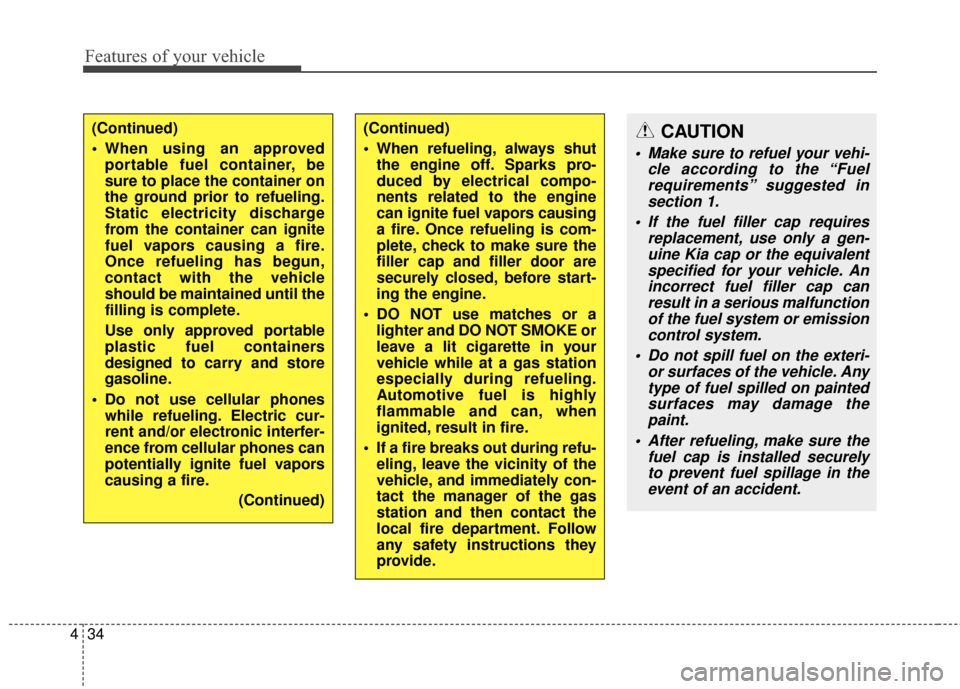
(Continued)
When using an approved
portable fuel container, be
sure to place the container on
the ground prior to refueling.
Static electricity discharge
from the container can ignite
fuel vapors causing a fire.
Once refueling has begun,
contact with the vehicle
should be maintained until the
filling is complete.
Use only approved portable
plastic fuel containers
designed to carry and store
gasoline.
Do not use cellular phones while refueling. Electric cur-
rent and/or electronic interfer-
ence from cellular phones can
potentially ignite fuel vapors
causing a fire.
(Continued)(Continued)
When refueling, always shutthe engine off. Sparks pro-
duced by electrical compo-
nents related to the engine
can ignite fuel vapors causing
a fire. Once refueling is com-
plete, check to make sure the
filler cap and filler door are
securely closed, before start-
ing the engine.
DO NOT use matches or a lighter and DO NOT SMOKE or
leave a lit cigarette in your
vehicle while at a gas station
especially during refueling.
Automotive fuel is highly
flammable and can, when
ignited, result in fire.
If a fire breaks out during refu- eling, leave the vicinity of the
vehicle, and immediately con-
tact the manager of the gas
station and then contact the
local fire department. Follow
any safety instructions they
provide.CAUTION
Make sure to refuel your vehi- cle according to the “Fuelrequirements” suggested insection 1.
If the fuel filler cap requires replacement, use only a gen-uine Kia cap or the equivalentspecified for your vehicle. Anincorrect fuel filler cap canresult in a serious malfunctionof the fuel system or emissioncontrol system.
Do not spill fuel on the exteri- or surfaces of the vehicle. Anytype of fuel spilled on paintedsurfaces may damage thepaint.
After refueling, make sure the fuel cap is installed securelyto prevent fuel spillage in theevent of an accident.
Page 146 of 457
Features of your vehicle
54
4
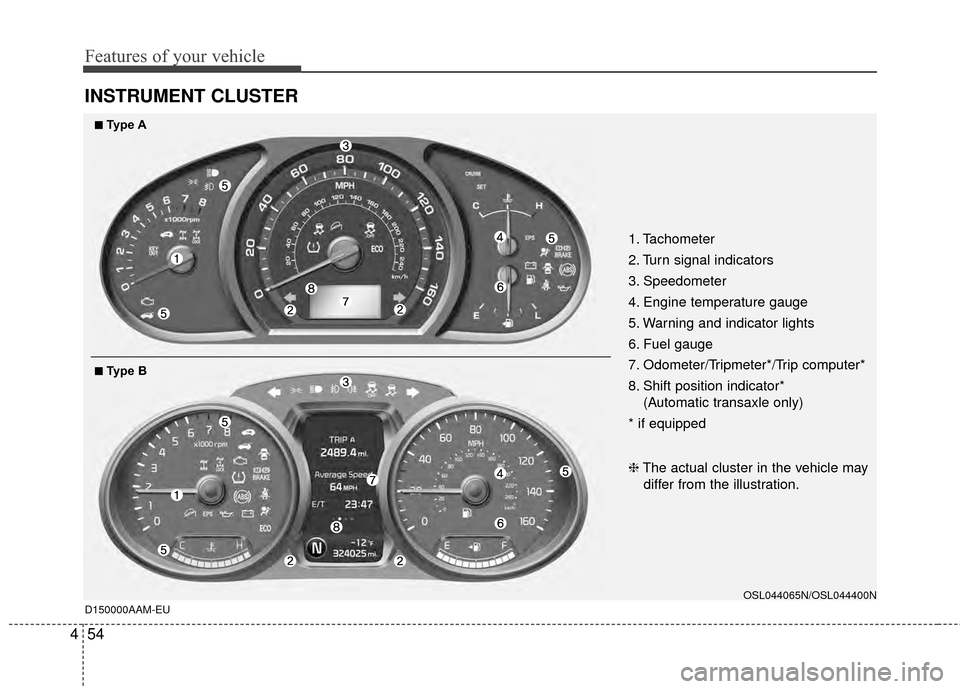
INSTRUMENT CLUSTER
D150000AAM-EU
1. Tachometer
2. Turn signal indicators
3. Speedometer
4. Engine temperature gauge
5. Warning and indicator lights
6. Fuel gauge
7. Odometer/Tripmeter*/Trip computer*
8. Shift position indicator*
(Automatic transaxle only)
* if equipped
OSL044065N/OSL044400N
❈ The actual cluster in the vehicle may
differ from the illustration.
■
■Type B
■
■Type A
Page 149 of 457
457
Features of your vehicle
D150204BHM-EE
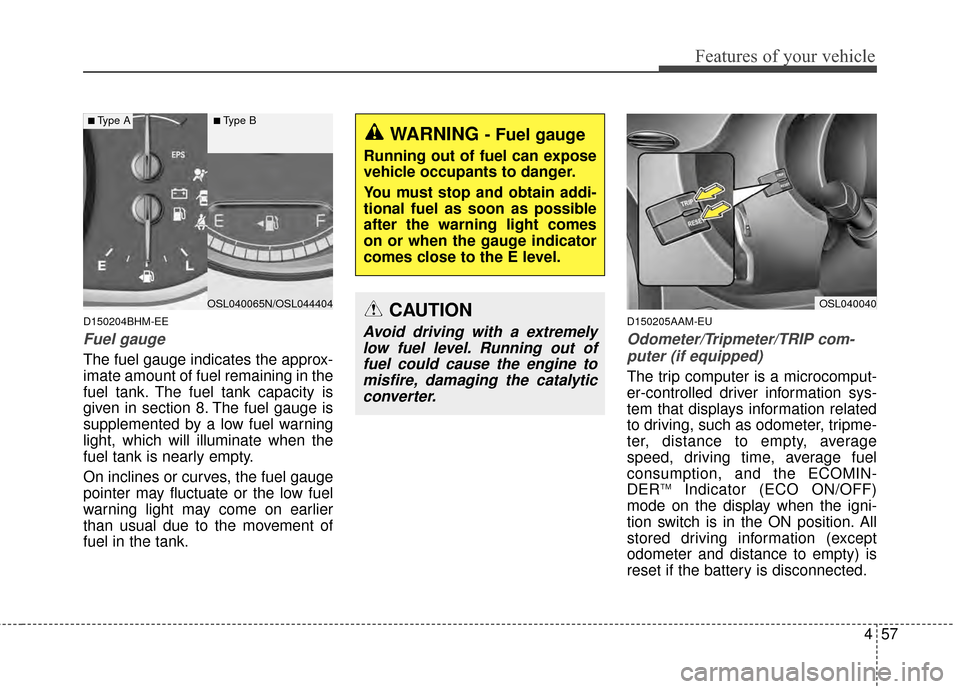
Fuel gauge
The fuel gauge indicates the approx-
imate amount of fuel remaining in the
fuel tank. The fuel tank capacity is
given in section 8. The fuel gauge is
supplemented by a low fuel warning
light, which will illuminate when the
fuel tank is nearly empty.
On inclines or curves, the fuel gauge
pointer may fluctuate or the low fuel
warning light may come on earlier
than usual due to the movement of
fuel in the tank.
D150205AAM-EU
Odometer/Tripmeter/TRIP com-puter (if equipped)
The trip computer is a microcomput-
er-controlled driver information sys-
tem that displays information related
to driving, such as odometer, tripme-
ter, distance to empty, average
speed, driving time, average fuel
consumption, and the ECOMIN-
DER
TMIndicator (ECO ON/OFF)
mode on the display when the igni-
tion switch is in the ON position. All
stored driving information (except
odometer and distance to empty) is
reset if the battery is disconnected.
WARNING - Fuel gauge
Running out of fuel can expose
vehicle occupants to danger.
You must stop and obtain addi-
tional fuel as soon as possible
after the warning light comes
on or when the gauge indicator
comes close to the E level.
CAUTION
Avoid driving with a extremely low fuel level. Running out offuel could cause the engine tomisfire, damaging the catalyticconverter.
OSL040040OSL040065N/OSL044404
■Type A■Type B
Page 150 of 457
Features of your vehicle
58
4
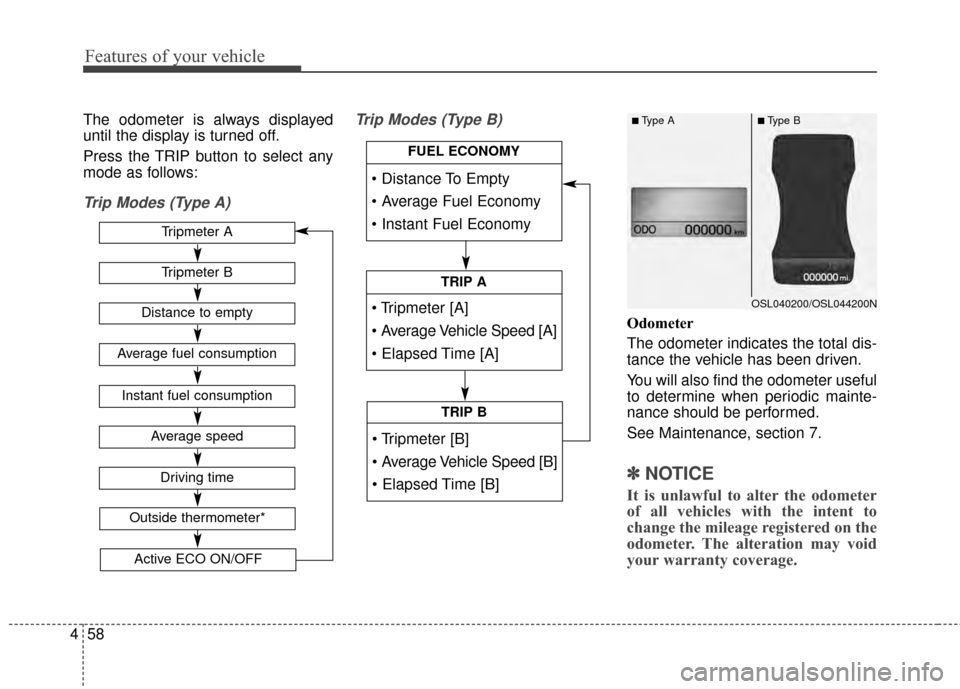
The odometer is always displayed
until the display is turned off.
Press the TRIP button to select any
mode as follows:
Trip Modes (Type A) Trip Modes (Type B)
Odometer
The odometer indicates the total dis-
tance the vehicle has been driven.
You will also find the odometer useful
to determine when periodic mainte-
nance should be performed.
See Maintenance, section 7.
✽ ✽
NOTICE
It is unlawful to alter the odometer
of all vehicles with the intent to
change the mileage registered on the
odometer. The alteration may void
your warranty coverage.
Tripmeter B
Average speed
Driving time
Tripmeter A
Distance to empty
Average fuel consumption
Instant fuel consumption
Outside thermometer*
OSL040200/OSL044200N
■Type A■Type B
Active ECO ON/OFF
FUEL ECONOMY
TRIP A
TRIP B
Page 151 of 457
459
Features of your vehicle
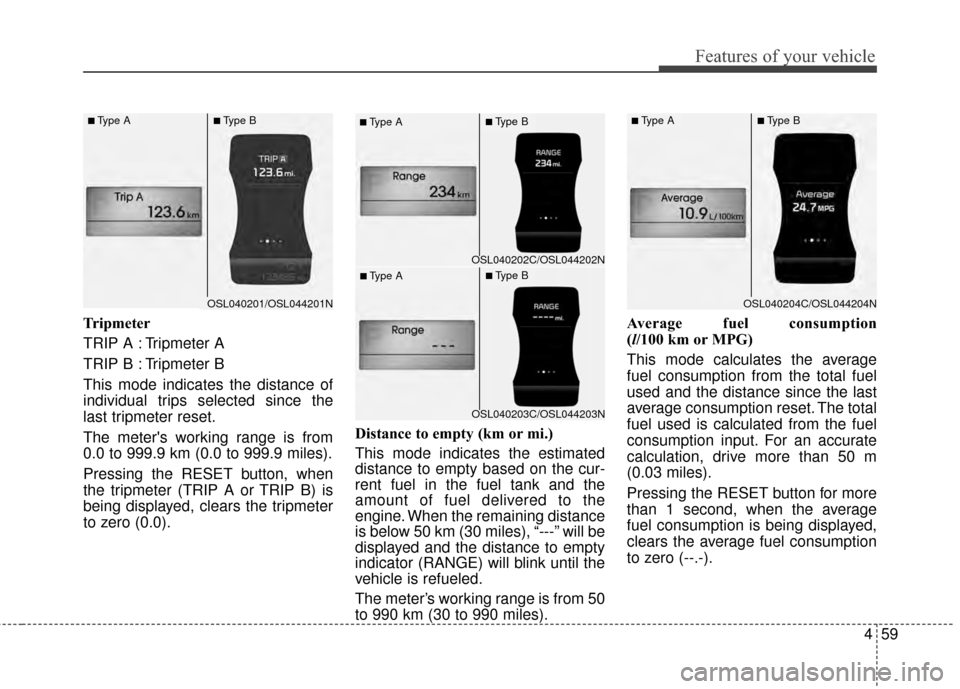
Tripmeter
TRIP A : Tripmeter A
TRIP B : Tripmeter B
This mode indicates the distance of
individual trips selected since the
last tripmeter reset.
The meter's working range is from
0.0 to 999.9 km (0.0 to 999.9 miles).
Pressing the RESET button, when
the tripmeter (TRIP A or TRIP B) is
being displayed, clears the tripmeter
to zero (0.0).Distance to empty (km or mi.)
This mode indicates the estimated
distance to empty based on the cur-
rent fuel in the fuel tank and the
amount of fuel delivered to the
engine. When the remaining distance
is below 50 km (30 miles), “---” will be
displayed and the distance to empty
indicator (RANGE) will blink until the
vehicle is refueled.
The meter’s working range is from 50
to 990 km (30 to 990 miles).Average fuel consumption
(l/100 km or MPG)
This mode calculates the average
fuel consumption from the total fuel
used and the distance since the last
average consumption reset. The total
fuel used is calculated from the fuel
consumption input. For an accurate
calculation, drive more than 50 m
(0.03 miles).
Pressing the RESET button for more
than 1 second, when the average
fuel consumption is being displayed,
clears the average fuel consumption
to zero (--.-).
OSL040204C/OSL044204N
■Type A■Type B
OSL040202C/OSL044202N
■Type A■Type B
OSL040203C/OSL044203N
■Type A■Type B
OSL040201/OSL044201N
■Type A■Type B
Page 152 of 457
Features of your vehicle
60
4
If the vehicle speed exceeds 1 km/h
(1.6 MPH) after refueled more than 6
l (1.6 gallons), the average fuel con-
sumption will be cleared to zero (--.-).
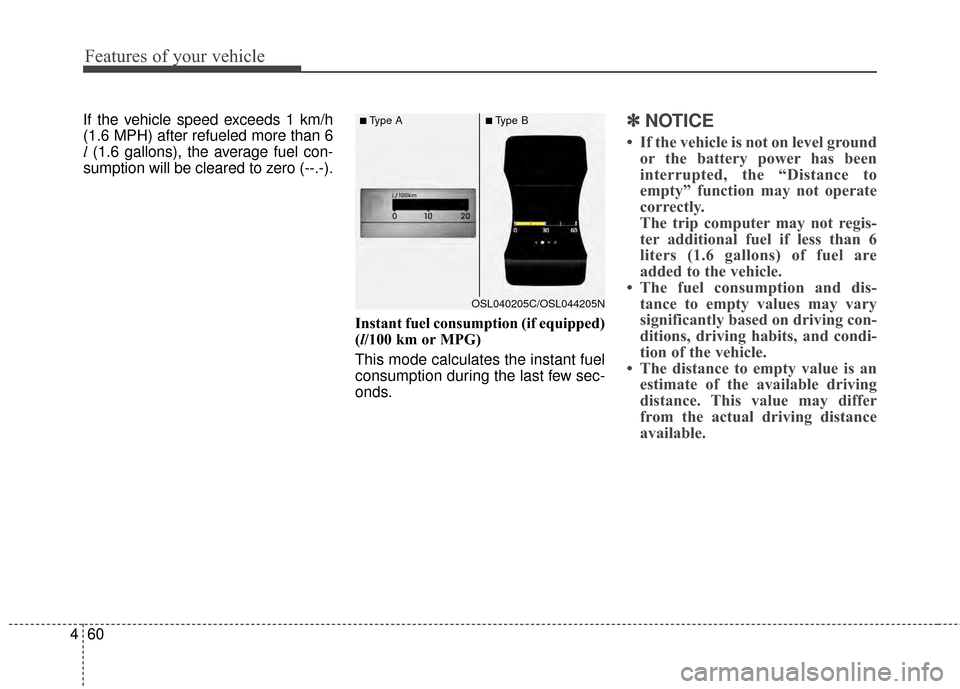
Instant fuel consumption (if equipped)
(l/100 km or MPG)
This mode calculates the instant fuel
consumption during the last few sec-
onds.✽ ✽NOTICE
• If the vehicle is not on level ground
or the battery power has been
interrupted, the “Distance to
empty” function may not operate
correctly.
The trip computer may not regis-
ter additional fuel if less than 6
liters (1.6 gallons) of fuel are
added to the vehicle.
• The fuel consumption and dis- tance to empty values may vary
significantly based on driving con-
ditions, driving habits, and condi-
tion of the vehicle.
• The distance to empty value is an estimate of the available driving
distance. This value may differ
from the actual driving distance
available.
OSL040205C/OSL044205N
■Type A■Type B
Page 154 of 457
Features of your vehicle
62
4
D150300AAM
Warnings and indicators
All warning lights are checked by
turning the ignition switch ON (do not
start the engine). Any light that does
not illuminate should be checked by
an authorized Kia dealer.
After starting the engine, check to
make sure that all warning lights are
off. If any warning lights are still on,
this indicates a situation that needs
attention. When releasing the park-
ing brake, the brake system warning
light should go off. The fuel warning
light will stay on if the fuel level is low.
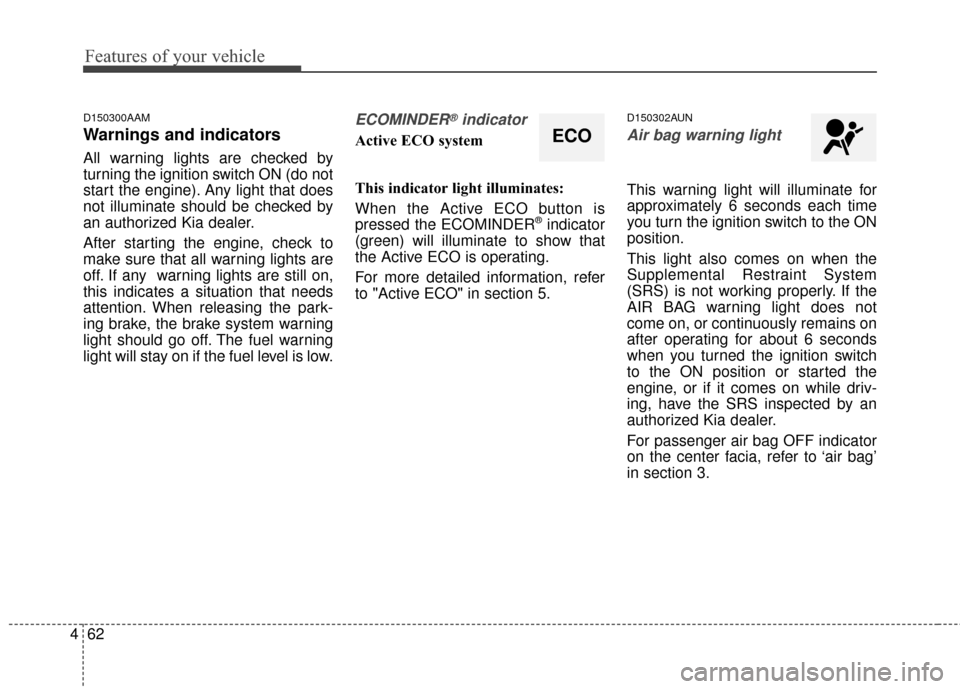
ECOMINDER®indicator
Active ECO system
This indicator light illuminates:
When the Active ECO button is
pressed the ECOMINDER
®indicator
(green) will illuminate to show that
the Active ECO is operating.
For more detailed information, refer
to "Active ECO" in section 5.
D150302AUN
Air bag warning light
This warning light will illuminate for
approximately 6 seconds each time
you turn the ignition switch to the ON
position.
This light also comes on when the
Supplemental Restraint System
(SRS) is not working properly. If the
AIR BAG warning light does not
come on, or continuously remains on
after operating for about 6 seconds
when you turned the ignition switch
to the ON position or started the
engine, or if it comes on while driv-
ing, have the SRS inspected by an
authorized Kia dealer.
For passenger air bag OFF indicator
on the center facia, refer to ‘air bag’
in section 3.
ECO