2014 KIA Sorento severe usage
[x] Cancel search: severe usagePage 75 of 508

361
Safety features of your vehicle
The indication of the system's pres-
ence are the letters "AIR BAG"
embossed on the air bag pad cover
on the steering wheel and the pas-
senger's side front panel pad above
the glove box.
The SRS consists of air bags
installed under the pad covers in the
center of the steering wheel and the
passenger's side front panel above
the glove box.
The purpose of the SRS is to provide
the vehicle's driver and/or the front
passenger with additional protection
than that offered by the seat belt sys-
tem alone in case of a frontal impact
of sufficient severity. The SRS uses
sensors to gather information about
the driver's and front passenger's
seat belt usage and impact severity.The seat belt buckle sensors deter-
mine if the driver and front passen-
ger's seat belts are fastened.These sensors provide the ability to
control the SRS deployment based on
whether or not the seat belts are fas-
tened, and how severe the impact is.
The advanced SRS offers the ability
to control the air bag inflation with
two levels. A first stage level is pro-
vided for moderate-severity impacts.
A second stage level is provided for
more severe impacts.
The passenger’s front air bag is
designed to help reduce the injury of
children sitting close to the instru-
ment panel in low speed collisions.
However, children are safer if they
are restrained in the rear seat.
According to the impact severity and
seat belt usage, the SRSCM (SRS
Control Module) controls the air bag
inflation. Failure to properly wear
seat belts can increase the risk or
severity of injury in an accident.
WARNING
If the occupant detection sys-
tem is not working properly, the
SRS air bag warning light on
the instrument panel will illumi-
nate because the SRS air bag
warning light is connected with
the occupant detection system.
If the SRS air bag warning light
does not illuminate when the
ignition switch is turned to the
ON position, remains illuminat-
ed after approximately 6 sec-
onds when the ignition switch
is turned to the ON position, or
if it illuminates while the vehicle
is being driven, have an author-
ized Kia dealer inspect the
advanced SRS air bag system
as soon as possible.
XM(FL) CAN(ENG) 3.QXP 1/23/2013 3:26 PM Page 61
Page 332 of 508

527
Driving your vehicle
✽
✽NOTICE• Do not drive in water if the level is
higher than the bottom of the vehi-
cle.
• Check your brake condition once you are out of mud or water. Press
the brake pedal several times as
you move slowly until you feel nor-
mal braking forces return.
• Shorten your scheduled mainte- nance interval if you drive in off-
road conditions such as sand, mud
or water (see “Maintenance under
severe usage conditions” in chap-
ter 7). Always wash your vehicle
thoroughly after off-road use,
especially cleaning the bottom of
the vehicle.
• Since the driving torque is always applied to the 4 wheels the per-
formance of the AWD vehicle is
greatly affected by the condition of
the tires. Be sure to equip the vehi-
cle with four tires of the same size
and type.
• A full time four wheel drive vehi- cle cannot be towed by an ordi-
nary tow truck. Make sure that
the vehicle is placed on a flat bed
truck for moving.
WARNING
- Drivingthrough
water
Drive slowly. If you are driving
too fast in water, the water can
get into the engine compart-
ment and wet the ignition sys-
tem, causing your vehicle to
suddenly stop. If this happens
and your vehicle is in a tilted
position, your vehicle may roll
over.
WARNING
- AWD driving
Avoid high cornering speed.
Do not make quick steering
wheel movements, such as
sharp lane changes or fast,
sharp turns.
The risk of rollover is greatly increased if you lose control
of your vehicle at high speed.
In a collision, an unbelted per- son is significantly more like-
ly to die compared to a person
wearing a seat belt.
Loss of control often occurs if two or more wheels drop off
the roadway and the driver
oversteers to re-enter the
roadway. In the event your
vehicle leaves the roadway, do
not steer sharply. Instead,
slow down before pulling
back into the travel lanes.
XM(FL) CAN(ENG) 5.QXP 1/23/2013 3:30 PM Page 27
Page 413 of 508
79
Maintenance
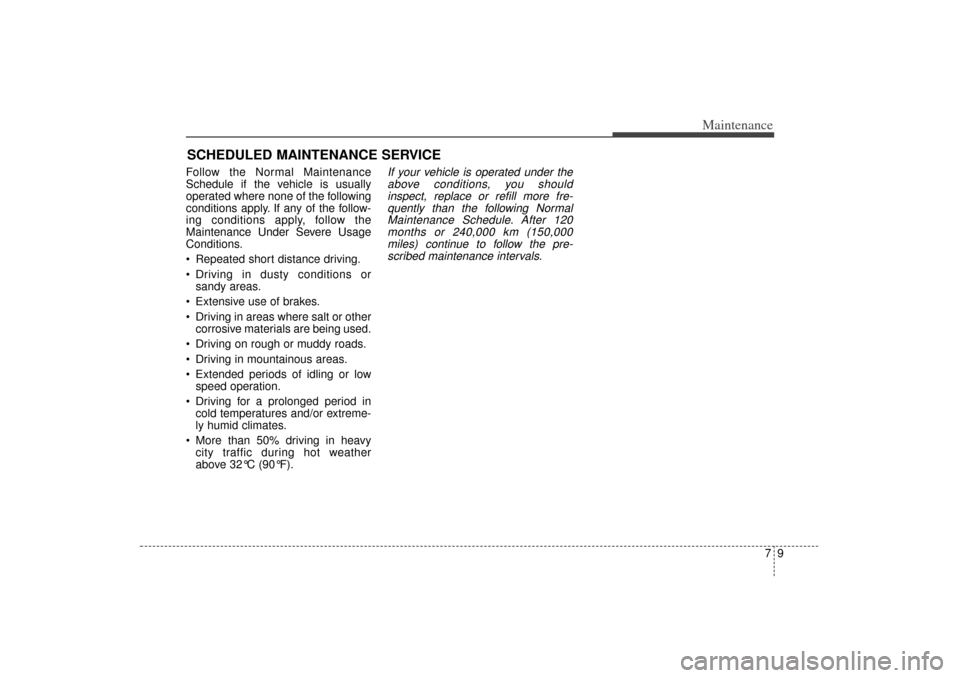
SCHEDULED MAINTENANCE SERVICEFollow the Normal Maintenance
Schedule if the vehicle is usually
operated where none of the following
conditions apply. If any of the follow-
ing conditions apply, follow the
Maintenance Under Severe Usage
Conditions.
Repeated short distance driving.
Driving in dusty conditions orsandy areas.
Extensive use of brakes.
Driving in areas where salt or other corrosive materials are being used.
Driving on rough or muddy roads.
Driving in mountainous areas.
Extended periods of idling or low speed operation.
Driving for a prolonged period in cold temperatures and/or extreme-
ly humid climates.
More than 50% driving in heavy city traffic during hot weather
above 32°C (90°F).
If your vehicle is operated under theabove conditions, you shouldinspect, replace or refill more fre-quently than the following NormalMaintenance Schedule. After 120months or 240,000 km (150,000miles) continue to follow the pre-scribed maintenance intervals.
XM(FL) CAN(ENG) 7.QXP 1/23/2013 3:35 PM Page 9
Page 429 of 508

725
Maintenance
MAINTENANCE UNDER SEVERE USAGE CONDITIONSThe following items must be serviced more frequently on cars normally used under severe driving conditions. Refer
to the chart below for the appropriate maintenance intervals.
R : Replace I : Inspect and, after inspection, clean, adjust, repair or replace if neces\
sary
MAINTENANCE ITEM
MAINTENANCEOPERATION
MAINTENANCE INTERVALS
DRIVING CONDI- TION
ENGINE OIL AND FILTER
R
EVERY 6,000 KM (3,750 MILES) OR 6 MONTHS
A, B, C, D, E, F, G,H, I, J, K
AIR CLEANER FILTER
R
MORE FREQUENTLY
C, E
SPARK PLUGS
R
MORE FREQUENTLY
A, B, H, I, K
AUTOMATIC TRANSAXLE FLUID
R
EVERY 96,000 KM (60,000 MILES)
A, C, E, F, G, I
MANUAL TRANSAXLE FLUID
R
EVERY 120,000 KM (80,000 MILES)
C, E, F, G, I, J
FRONT BRAKE DISC/PADS, CALIPERS
I
MORE FREQUENTLY
C, D, G, H
REAR BRAKE DISC/PADS
I
MORE FREQUENTLY
C, D, G, H
PARKING BRAKE
I
MORE FREQUENTLY
C, D, G, H
STEERING GEAR BOX, LINKAGE &
BOOTS/LOWER ARM BALL JOINT,
UPPER ARM BALL JOINT
I
MORE FREQUENTLY
C, D, E, F, G, H, I
XM(FL) CAN(ENG) 7.QXP 2/13/2013 9:55 AM Page 25
Page 433 of 508

729
Maintenance
Automatic transaxle fluid
(if equipped)Automatic transaxle fluid should not
be checked under normal usage
conditions.
But in severe conditions, the fluid
should be changed at an authorized
Kia dealer in accordance to the
scheduled maintenance at the begin-
ning of this section.Manual transaxle fluid
(if equipped)Inspect the manual transaxle fluid
according to the maintenance sched-
ule.✽ ✽NOTICEAutomatic transaxle fluid color is
basically red.
As the vehicle is driven, the auto-
matic transaxle fluid will begin to
look darker.
It is the normal condition and you
should not judge the need to replace
the fluid based upon the changed
color.
Brake hoses and linesVisually check for proper installation,
chafing, cracks, deterioration and
any leakage. Replace any deteriorat-
ed or damaged parts immediately.Brake/clutch (if equipped) fluidCheck the brake fluid level in the
brake fluid reservoir. The level should
be between “MIN” and “MAX” marks
on the side of the reservoir. Use only
hydraulic brake fluid conforming to
DOT 3 or DOT 4 specification.
CAUTION
The use of a non-specified fluid
could result in transaxle mal-function and failure.
Use only specified automatictransaxle fluid. (Refer to“Recommended lubricants andcapacities” in section 8.)
XM(FL) CAN(ENG) 7.QXP 1/23/2013 3:35 PM Page 29
Page 444 of 508

Maintenance40
7Replace the filter according to the
Maintenance Schedule.If the vehicle is operated in extreme-
ly dusty or sandy areas, replace theelement more often than the usualrecommended intervals. (Refer to“Maintenance under severe usageconditions” in this section.)
CAUTION
Do not drive with the air clean- er removed; this will result inexcessive engine wear.
When removing the air cleaner filter, be careful that dust ordirt does not enter the airintake, or damage may result.
Use a Kia genuine part. Use of non-genuine parts could dam-age the air flow sensor.
XM(FL) CAN(ENG) 7.QXP 1/23/2013 3:36 PM Page 40