2014 KIA Sorento Eco
[x] Cancel search: EcoPage 23 of 508

39
Safety features of your vehicle
Storing positions into memoryusing the buttons on the doorStoring driver’s seat positions
1. Shift the shift lever into P (for Automatic transaxle) while the
engine start/stop button is ON or
ignition switch ON.
2. Adjust the driver’s seat and out- side rearview mirror comfortable
for the driver.
3. Press SET button on the control panel. The system will beep once.
4. Press one of the memory buttons (1 or 2) within 5 seconds after
pressing the SET button. The sys-
tem will beep twice when memory
has been successfully stored. Recalling positions from memory
1. Shift the shift lever into P (for
Automatic transaxle) while the
engine start/stop button is ON or
ignition switch ON.
2. To recall the position in the memo- ry, press the desired memory but-
ton (1 or 2). The system will beep
once, then the driver’s seat will
automatically adjust to the stored
position.
Adjusting the control switch for the
driver’s seat while the system is
recalling the stored position will
cause the movement to stop and
move in the direction that the control
switch is moved.
WARNING
Use caution when recalling the
adjustment memory while sit-
ting in the vehicle. Push the seat
position control switch to the
desired position immediately if
the seat moves too far in any
direction.
WARNING
Never attempt to operate the
driver position memory system
while the vehicle is moving.
This could result in loss of con-
trol, and an accident causing
death, serious injury, or property
damage.
XM(FL) CAN(ENG) 3.QXP 1/23/2013 3:23 PM Page 9
Page 36 of 508

Safety features of your vehicle22
3HeadrestThe rear seat(s) is equipped with
headrests in all the seating positions
for the occupant's safety and com-
for t.
The headrest not only provides com-
fort for passengers, but also helps
protect the head and neck in the
event of a collision.
OHM038049N
**
* if equipped
WARNING -
Headrest
adjustment
For maximum effectiveness in case of an accident, the head-
rest should be adjusted so the
middle of the headrest is at the
same height as the center of
gravity of an occupant's head.
Generally, the center of gravi-
ty of most people's head is
similar with the height of the
top of their eyes.
Also adjust the headrest as
close to your head as possi-
ble. For this reason, the use of
a cushion that holds the body
away from the seatback is not
recommended.
(Continued)
(Continued)
Do not operate the vehiclewith the headrests removed.
Severe injury to an occupant
may occur in the event of an
accident. Headrests may pro-
vide protection against severe
neck injuries when properly
adjusted.
Do not adjust the headrest height while the vehicle is in
motion.
XM(FL) CAN(ENG) 3.QXP 1/23/2013 3:24 PM Page 22
Page 39 of 508
325
Safety features of your vehicle
SEAT BELTSSeat belt restraint system
WARNING
For maximum restraint sys-tem protection, the seat belts
must always be used whenev-
er the vehicle is moving.
Seat belts are most effective when seatbacks are in the
upright position.
Children age 12 and under must always be properly
restrained in the rear seat.
Never allow children to ride in
the front passenger seat. If a
child over 12 must be seated
in the front seat, he/she must
be properly belted and the
seat should be moved as far
back as possible.
(Continued)
(Continued)
Never wear the shoulder beltunder your arm or behind
your back. An improperly
positioned shoulder belt can
cause serious injuries in a
crash. The shoulder belt
should be positioned midway
over your shoulder across
your collarbone.
Avoid wearing twisted seat belts. A twisted belt can't do
its job well. In a collision, it
could even cut into you. Be
sure the belt webbing is
straight and not twisted.
Be careful not to damage the belt webbing or hardware. If
the belt webbing or hardware
is damaged, replace it.
WARNING
Seat belts are designed to bear
upon the bony structure of the
body, and should be worn low
across the front of the pelvis or
the pelvis, chest and shoulders,
as applicable; wearing the lap
section of the belt across the
abdominal area must be avoided.
Seat belts should be adjusted as
firmly as possible, consistent
with comfort, to provide the pro-
tection for which they have been
designed.
A slack belt will greatly reduce
the protection afforded to the
wearer.
Care should be taken to avoid
contamination of the webbing
with polishes, oils and chemicals,
and particularly battery acid.
Cleaning may safely be carried
out using mild soap and water.
The belt should be replaced if
webbing becomes frayed, con-
taminated or damaged.
(Continued)
XM(FL) CAN(ENG) 3.QXP 1/23/2013 3:24 PM Page 25
Page 41 of 508
327
Safety features of your vehicle
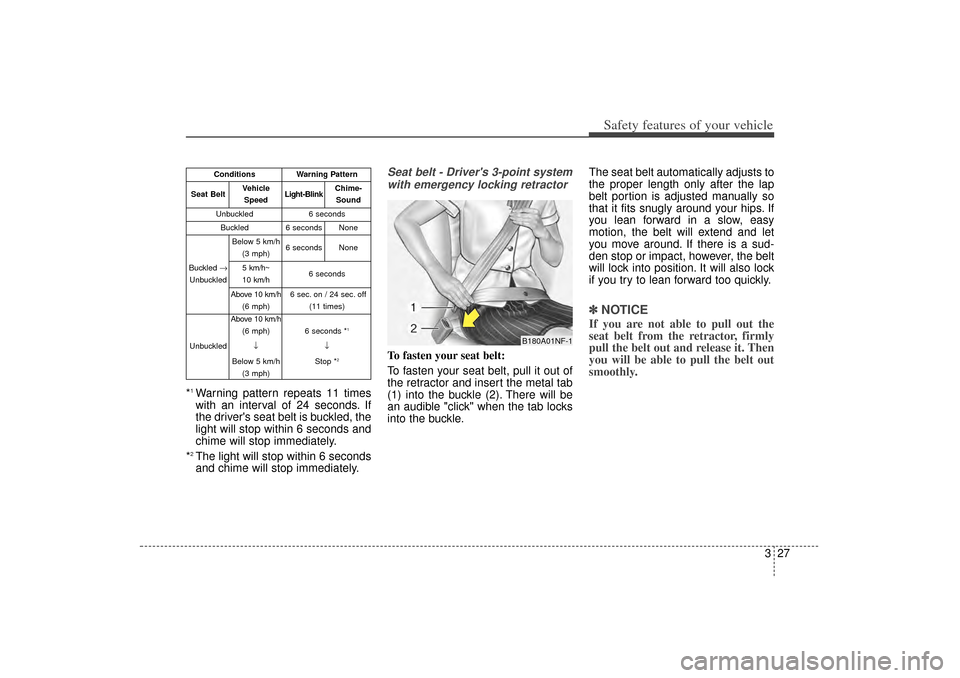
*1Warning pattern repeats 11 times
with an interval of 24 seconds. If
the driver's seat belt is buckled, the
light will stop within 6 seconds and
chime will stop immediately.
*2The light will stop within 6 seconds
and chime will stop immediately.
Seat belt - Driver's 3-point system with emergency locking retractorTo fasten your seat belt:
To fasten your seat belt, pull it out of
the retractor and insert the metal tab
(1) into the buckle (2). There will be
an audible "click" when the tab locks
into the buckle. The seat belt automatically adjusts to
the proper length only after the lap
belt portion is adjusted manually so
that it fits snugly around your hips. If
you lean forward in a slow, easy
motion, the belt will extend and let
you move around. If there is a sud-
den stop or impact, however, the belt
will lock into position. It will also lock
if you try to lean forward too quickly.
✽ ✽
NOTICEIf you are not able to pull out the
seat belt from the retractor, firmly
pull the belt out and release it. Then
you will be able to pull the belt out
smoothly.
B180A01NF-1
Conditions
Warning Pattern
Seat Belt
Vehicle
Speed
Light-Blink
Chime-Sound
Unbuckled
6 seconds
Buckled
6 seconds
None
Buckled →
Unbuckled
Below 5 km/h (3 mph)
6 seconds
None
5 km/h~
10 km/h
6 seconds
Above 10 km/h (6 mph)
6 sec. on / 24 sec. off (11 times)
Unbuckled
Above 10 km/h(6 mph)
↓
Below 5 km/h (3 mph)
6 seconds *
1
↓
Stop *
2
XM(FL) CAN(ENG) 3.QXP 1/23/2013 3:24 PM Page 27
Page 43 of 508
329
Safety features of your vehicle
Seat belts - Front passenger andrear seat 3-point system withcombination locking retractorTo fasten your seat belt:
Combination retractor type seat belts
are installed in the rear seat posi-
tions to help accommodate the
installation of child restraint systems.
Although a combination retractor is
also installed in the front passenger
seat position, it is strongly recom-
mended that children always be
seated in the rear seat. NEVER
place any infant restraint system in
the front seat of the vehicle.
This type of seat belt combines the
features of both an emergency lock-
ing retractor seat belt and an auto-
matic locking retractor seat belt. To
fasten your seat belt, pull it out of the
retractor and insert the metal tab into
the buckle. There will be an audible
"click" when the tab locks into the
buckle. When not securing a child
restraint, the seat belt operates in the
same way as the driver's seat belt
(Emergency Locking Retractor Type). It automatically adjusts to the proper
length only after the lap belt portion
of the seat belt is adjusted manually
so that it fits snugly around your hips.
When the seat belt is fully extended
from the retractor to allow the instal-
lation of a child restraint system, the
seat belt operation changes to allow
the belt to retract, but not to extend
(Automatic Locking Retractor Type).
Refer to “Using a child restraint sys-
tem” in this section.
✽ ✽
NOTICEAlthough the combination retractor
provides the same level of protection
for seated passengers in either emer-
gency or automatic locking modes,
have the seated passengers use the
emergency locking feature for
improved convenience. The auto-
matic locking function is intended to
facilitate child restraint installation.
To convert from the automatic lock-
ing feature to the emergency locking
operation mode, allow the unbuck-
led seat belt to fully retract.
CAUTION
Do NOT fold down the left por-
tion of the rear seat back whenthe rear center seat belt is buck-led. ALWAYS UNBUCKLE therear center seat belt before fold-ing down the left portion of therear seat back. If the rear centerseat belt is buckled when theleft portion of the rear seat backis folded down, distortion anddamage to the top portion of theseat back and seat belt garnishmay result, causing the seatback to lock into the foldeddown position.
XM(FL) CAN(ENG) 3.QXP 1/23/2013 3:25 PM Page 29
Page 47 of 508

333
Safety features of your vehicle
WARNING
To obtain maximum benefit
from a pre-tensioner seat belt:
1. The seat belt must be worncorrectly and adjusted to the
proper position. Please read
and follow all of the important
information and precautions
about your vehicle’s occupant
safety features – including
seat belts and air bags – that
are provided in this manual.
2. Be sure you and your passen- gers always wear seat belts
properly.
✽ ✽NOTICE• Both the driver's and front pas-
senger's seat belt pre-tensioner
system may be activated not only
in certain frontal collision but also
in certain side collision or rollover,
if the vehicle is equipped with a
side or curtain air bag.
• When the pre-tensioner seat belts are activated, a loud noise may be
heard and fine dust, which may
appear to be smoke, may be visible
in the passenger compartment.
These are normal operating condi-
tions and are not hazardous.
• Although it is harmless, the fine dust may cause skin irritation and
should not be breathed for pro-
longed periods. Wash all exposed
skin areas thoroughly after an
accident in which the pre-tension-
er seat belts were activated.
• Because the sensor that activates the SRS air bag is connected with
the pre-tensioner seat belt, the
SRS air bag warning light on
the instrument panel will illumi-
nate for approximately 6 seconds
after the ignition switch has been
turned to the ON position, and
then it should turn off.
CAUTION
If the pre-tensioner seat belt
system are not working proper-ly, this warning light will illumi-nate even if there is no malfunc-tion of the SRS air bag. If theSRS air bag warning light doesnot illuminate when the ignitionswitch is turned ON, or if itremains illuminated after illumi-nating for approximately 6 sec-onds, or if it illuminates whilethe vehicle is being driven, havean authorized Kia dealer inspectthe pre-tensioner seat belt andSRS air bag system as soon aspossible.
XM(FL) CAN(ENG) 3.QXP 1/23/2013 3:25 PM Page 33
Page 48 of 508
Safety features of your vehicle34
3
Seat belt precautions
WARNING
Pre-tensioners are designed
to operate only one time. After
activation, pre-tensioner seat
belts must be replaced. All
seat belts, of any type, should
always be replaced after they
have been worn during a colli-
sion.
The pre-tensioner seat belt assembly mechanisms become
hot during activation. Do not
touch the pre-tensioner seat
belt assemblies for several min-
utes after they have been acti-
vated.
Do not attempt to inspect or replace the pre-tensioner seat
belts yourself. This must be
done by an authorized Kia
dealer.
Do not strike the pre-tension- er seat belt assemblies.
Do not attempt to service or repair the pre-tensioner seat
belt system in any manner.
(Continued)
(Continued)
Improper handling of the pre-tensioner seat belt assem-
blies, and failure to heed the
warnings not to strike, modify,
inspect, replace, service or
repair the pre-tensioner seat
belt assemblies may lead to
improper operation or inad-
vertent activation and serious
injury.
Always wear the seat belts when driving or riding in a
motor vehicle.
If the vehicle or pre-tensioner seat belt must be discarded,
contact an authorized Kia
dealer.
WARNING
All occupants of the vehicle
must wear their seat belts at all
times. Seat belts and child
restraints reduce the risk of
serious or fatal injuries for all
occupants in the event of a col-
lision or sudden stop. Without a
seat belt, occupants could be
shifted too close to a deploying
air bag, strike the interior struc-
ture or be thrown from the vehi-
cle. Properly worn seat belts
greatly reduce these hazards.
Even with advanced air bags,
unbelted occupants can be
severely injured by a deploying
air bag.
Always follow the precautions
about seat belts, air bags and
occupant seating contained in
this manual.
XM(FL) CAN(ENG) 3.QXP 1/23/2013 3:25 PM Page 34
Page 50 of 508
Safety features of your vehicle36
3If the shoulder belt portion slightly
touches the child’s neck or face, try
placing the child closer to the center of
the vehicle. If the shoulder belt still
touches their face or neck they need to
be returned to a child restraint system.
Restraint of pregnant women Pregnant women should wear
lap/shoulder belt assemblies when-
ever possible according to specific
recommendations by their doctors.
The lap portion of the belt should be
worn AS SECURELY AND LOW AS
POSSIBLE.
Injured personA seat belt should be used when an
injured person is being transported.
When this is necessary, you should
consult a physician for recommenda-
tions.One person per beltTwo people (including children)
should never attempt to use a single
seat belt. This could increase the
severity of injuries in case of an acci-
dent.Do not lie downTo reduce the chance of injuries in
the event of an accident and to
achieve maximum effectiveness of
the restraint system, all passengers
should be sitting up and the front and
rear seats should be in an upright
position when the vehicle is moving.
A seat belt cannot provide proper
protection if the person is lying down
in the rear seat or if the front and rear
seats are in a reclined position.
WARNING
- Pregnant
women
Pregnant women must never
place the lap portion of the
safety belt over the area of the
abdomen where the fetus is
located or above the abdomen
where the belt could crush the
fetus during an impact.
WARNING
- Shoulder
belts on small children
Do not allow small children to ride in the vehicle without an
appropriate child restrain sys-
tem.
Never allow a shoulder belt to be in contact with a child’s
neck or face while the vehicle
is in motion.
If seat belts are not properly worn and adjusted on chil-
dren, there is a risk of death or
serious injury.
XM(FL) CAN(ENG) 3.QXP 1/23/2013 3:25 PM Page 36