2014 KIA Sorento eco
[x] Cancel search: ecoPage 323 of 508
Driving your vehicle18
5R (Reverse)
Use this position to drive the vehicle
backward. N (Neutral)
The wheels and transaxle are not
engaged. The vehicle will roll freely
even on the slightest incline unless
the parking brake or service brakes
are applied.
D (Drive)
This is the normal forward driving
position. The transaxle will automati-
cally shift through a 6-gear
sequence, providing the best fuel
economy and power.
For extra power when passing anoth-
er vehicle or climbing grades,
depress the accelerator fully, at
which time the transaxle will auto-
matically downshift to the next lower
gear.
✽ ✽
NOTICEAlways come to a complete stop
before shifting into D (Drive).
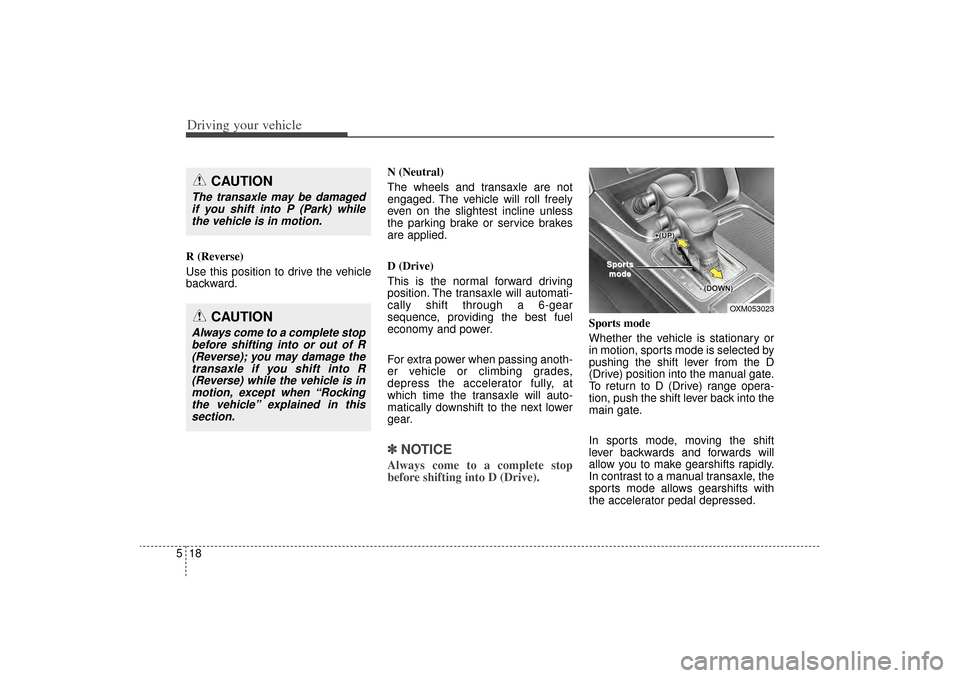
Sports mode
Whether the vehicle is stationary or
in motion, sports mode is selected by
pushing the shift lever from the D
(Drive) position into the manual gate.
To return to D (Drive) range opera-
tion, push the shift lever back into the
main gate.
In sports mode, moving the shift
lever backwards and forwards will
allow you to make gearshifts rapidly.
In contrast to a manual transaxle, the
sports mode allows gearshifts with
the accelerator pedal depressed.
CAUTION
The transaxle may be damaged
if you shift into P (Park) whilethe vehicle is in motion.
CAUTION
Always come to a complete stopbefore shifting into or out of R(Reverse); you may damage thetransaxle if you shift into R(Reverse) while the vehicle is inmotion, except when “Rockingthe vehicle” explained in thissection.
OXM053023
Spor
Spor
ts
ts
mode
mode
XM(FL) CAN(ENG) 5.QXP 1/23/2013 3:29 PM Page 18
Page 326 of 508
521
Driving your vehicle
Good driving practices Never move the gear shift leverfrom P (Park) to any other position
with the accelerator pedal
depressed.
Never move the gear shift lever into P (Park) when the vehicle is in
motion.
Be sure the vehicle is completely stopped before you attempt to shift
into R (Reverse) or D (Drive).
Never take the vehicle out of gear and coast down a hill. This may be
extremely hazardous. Always leave
the vehicle in gear when moving.
Do not "ride" the brakes. This can cause them to overheat and mal-
function. Instead, when you are
driving down a long hill, slow down
and shift to a lower gear. When you
do this, engine braking will help
slow down the vehicle.
Slow down before shifting to a lower gear. Otherwise, the lower
gear may not be engaged. Always use the parking brake. Do
not depend on placing the
transaxle in P (Park) to keep the
vehicle from moving.
Exercise extreme caution when driving on a slippery surface. Be
especially careful when braking,
accelerating or shifting gears. On a
slippery surface, an abrupt change
in vehicle speed can cause the
drive wheels to lose traction and
the vehicle to go out of control.
Optimum vehicle performance and economy is obtained by smoothly
depressing and releasing the
accelerator pedal.
WARNING
Always buckle-up! In a colli-sion, an unbelted occupant is
significantly more likely to be
seriously injured or killed than
a properly belted occupant.
Avoid high speeds when cor- nering or turning.
Do not make quick steering wheel movements, such as
sharp lane changes or fast,
sharp turns.
The risk of rollover is greatly increased if you lose control
of your vehicle at highway
speeds.
Loss of control often occurs if two or more wheels drop off
the roadway and the driver
oversteers to reenter the road-
way.
In the event your vehicle leaves the roadway, do not
steer sharply. Instead, slow
down before pulling back into
the travel lanes.
Never exceed posted speed limits.
XM(FL) CAN(ENG) 5.QXP 1/23/2013 3:29 PM Page 21
Page 327 of 508

Driving your vehicle22
5
Moving up a steep grade from a
standing startTo move up a steep grade from a
standing start, depress the brake
pedal, shift the shift lever to D
(Drive). Select the appropriate gear
depending on load weight and steep-
ness of the grade, and release the
parking brake. Depress the accelera-
tor gradually while releasing the
service brakes.
When accelerating from a stop on
a steep hill, the vehicle may have a
tendency to roll backwards.
Shifting the shift lever into 2
(Second Gear) will help prevent
the vehicle from rolling back-
wards.
WARNING
If your vehicle becomes stuck in
snow, mud, sand, etc., then you
may attempt to rock the vehicle
free by moving it forward and
backward. Do not attempt this
procedure if people or objects
are anywhere near the vehicle.
During the rocking operation
the vehicle may suddenly move
forward or backward as it
becomes unstuck, causing
injury or damage to nearby peo-
ple or objects.
XM(FL) CAN(ENG) 5.QXP 1/23/2013 3:29 PM Page 22
Page 331 of 508

Driving your vehicle26
5 You must consciously take the
effort to learn how to corner in an
AWD vehicle. Do not rely on your
experience in conventional 2WD
vehicles in choosing safe cornering
speed in AWD mode. For starters,
you must drive more slowly in
AWD.
Drive carefully off-road because your vehicle may be damaged by
rocks or roots of trees. Become
familiar with the off-road conditions
where you are going to drive
before you begin driving. Always hold the steering wheel
firmly when you are driving off-
road.
Make sure all passengers are wearing seat belts.
If you need to drive in the water, stop your vehicle, set your transfer
to the AWD LOCK mode and drive
at less than 8 km/h (5 mph).
WARNING
- Steeringwheel
Do not grab the inside of the
steering wheel when you are
driving off-road. You may hurt
your arm by a sudden steering
maneuver or from steering
wheel rebound due to impact
with objects on the ground. You
could lose control of the steer-
ing wheel.
WARNING
- Wind danger
If you are driving in heavy wind,
the vehicle's higher center of
gravity decreases your steering
control capacity and requires
you to drive more slowly.
OXM053026
WARNING
- 4WD
Reduce speed when you turn
corners. The center of gravity of
AWD vehicles is higher than
that of conventional 2WD vehi-
cles, making them more likely to
roll over when you turn corners
too fast.
XM(FL) CAN(ENG) 5.QXP 1/23/2013 3:29 PM Page 26
Page 333 of 508
Driving your vehicle28
5
Reducing the risk of a rolloverThis multi-purpose passenger vehi-
cle is defined as a Sports Utility
Vehicle (SUV). A SUV has higher
ground clearance and a narrower
track to make it more capable of per-
forming in a wide variety of off-road
applications. Specific design charac-
teristics give them a higher center of
gravity than ordinary vehicles. An
advantage of the higher ground
clearance is a better view of the
road, which allows you to anticipate
problems. A SUV is not designed for
cornering at the same speeds as
conventional passenger vehicles,
any more than low profile sports cars
are designed to perform satisfactori-
ly in off-road conditions. Due to this
risk, driver and passengers are
strongly recommended to buckle
their seat belts. In a rollover crash,
an unbelted person is more likely to
die than a person wearing a seat
belt. There are steps that a driver can
take to reduce the risk of a rollover.
Avoid sharp turns, excessive speed,
and or abrupt maneuvers, do not
load your roof rack with heavy cargo,
and never modify your vehicle in any
way.
CAUTION
- Mud or snow
If one of the front or rear wheels
begins to spin in mud, snow,etc. the vehicle can sometimesbe driven out by depressing theaccelerator pedal further; how-ever avoid running the enginecontinuously at high rpmbecause doing so could dam-age the AWD system.
WARNING
- Jacked vehicle
While the full-time AWD vehicle
is being raised on a jack, never
start the engine or cause the
tires to rotate.
There is the danger that rotating
tires touching the ground could
cause the vehicle to go off the
jack and to jump forward.
WARNING
- Rollover
As with other Sports Utility
Vehicle (SUV), failure to operate
this vehicle correctly may result
in loss of control, an accident or
vehicle rollover.
Utility vehicles have a signifi-
cantly higher rollover rate
than other types of vehicles.
Specific design characteris- tics (higher ground clearance,
narrower track, etc.) give this
vehicle a higher center of
gravity than ordinary vehicles.
A SUV is not designed for cor- nering at the same speeds as
conventional vehicles.
Avoid sharp turns or abrupt maneuvers.
In a rollover crash, an unbelt- ed person is significantly
more likely to die than a per-
son wearing a seat belt. Make
sure everyone in the vehicle is
properly buckled up.
XM(FL) CAN(ENG) 5.QXP 1/23/2013 3:30 PM Page 28
Page 334 of 508
529
Driving your vehicle
Full-time AWD vehicles must betested on a special four wheel
chassis dynamometer.✽ ✽ NOTICENever engage the parking brake
while performing these tests. A full-time AWD vehicle should not
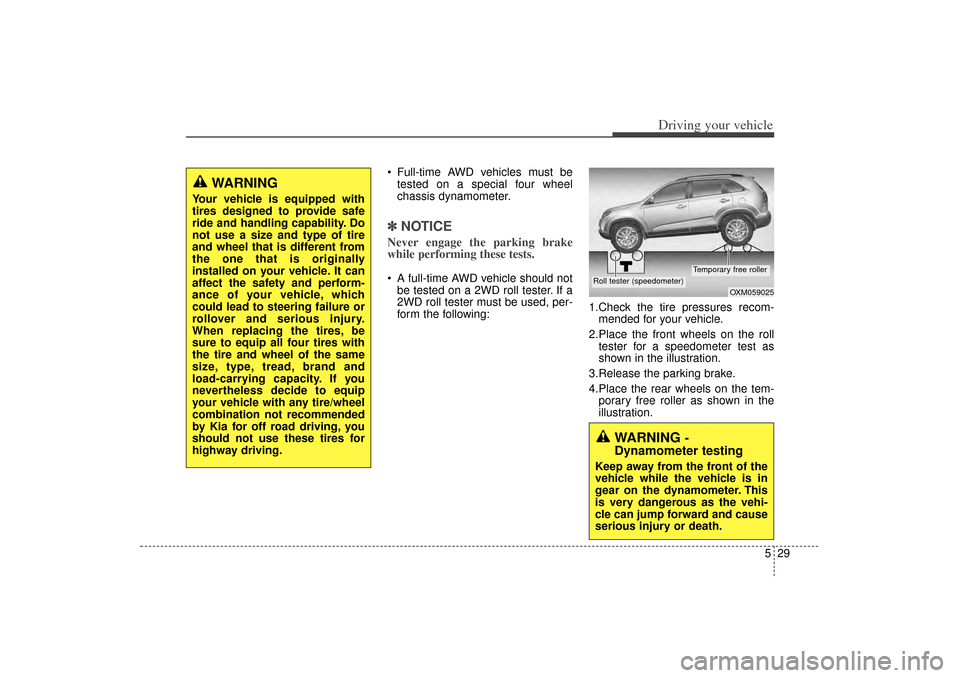
be tested on a 2WD roll tester. If a
2WD roll tester must be used, per-
form the following: 1.Check the tire pressures recom-
mended for your vehicle.
2.Place the front wheels on the roll tester for a speedometer test as
shown in the illustration.
3.Release the parking brake.
4.Place the rear wheels on the tem- porary free roller as shown in the
illustration.
WARNING
-
Dynamometer testing
Keep away from the front of the
vehicle while the vehicle is in
gear on the dynamometer. This
is very dangerous as the vehi-
cle can jump forward and cause
serious injury or death.
OXM059025
Roll tester (speedometer)
Temporary free roller
WARNING
Your vehicle is equipped with
tires designed to provide safe
ride and handling capability. Do
not use a size and type of tire
and wheel that is different from
the one that is originally
installed on your vehicle. It can
affect the safety and perform-
ance of your vehicle, which
could lead to steering failure or
rollover and serious injury.
When replacing the tires, be
sure to equip all four tires with
the tire and wheel of the same
size, type, tread, brand and
load-carrying capacity. If you
nevertheless decide to equip
your vehicle with any tire/wheel
combination not recommended
by Kia for off road driving, you
should not use these tires for
highway driving.
XM(FL) CAN(ENG) 5.QXP 1/23/2013 3:30 PM Page 29
Page 337 of 508
Driving your vehicle32
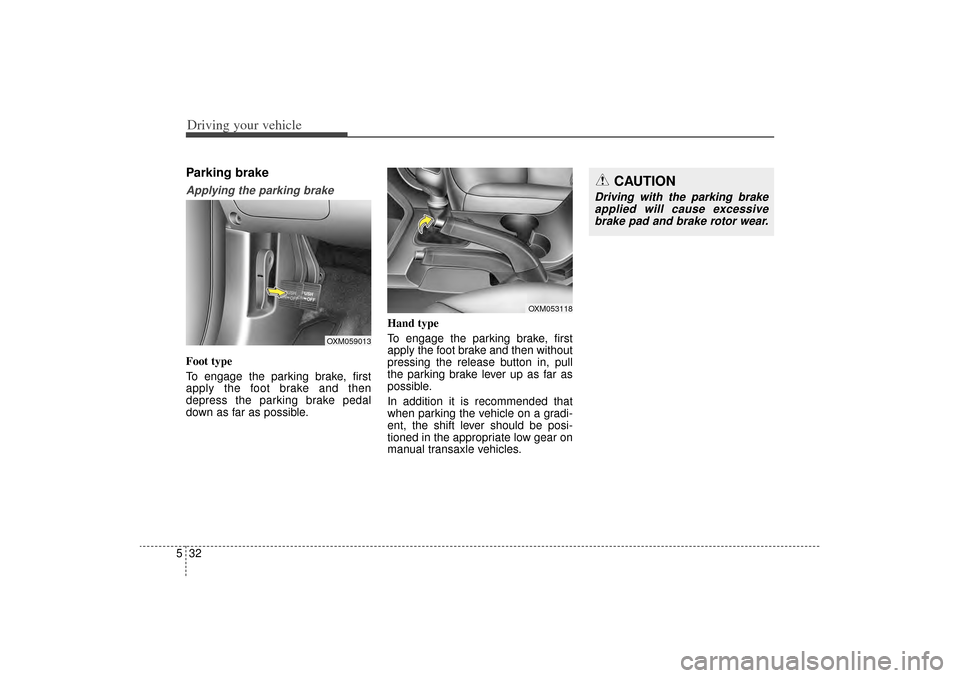
5Parking brake Applying the parking brakeFoot type
To engage the parking brake, first
apply the foot brake and then
depress the parking brake pedal
down as far as possible. Hand type
To engage the parking brake, first
apply the foot brake and then without
pressing the release button in, pull
the parking brake lever up as far as
possible.
In addition it is recommended that
when parking the vehicle on a gradi-
ent, the shift lever should be posi-
tioned in the appropriate low gear on
manual transaxle vehicles.
CAUTION
Driving with the parking brake
applied will cause excessivebrake pad and brake rotor wear.
OXM059013
OXM053118
XM(FL) CAN(ENG) 5.QXP 1/23/2013 3:30 PM Page 32
Page 338 of 508
533
Driving your vehicle
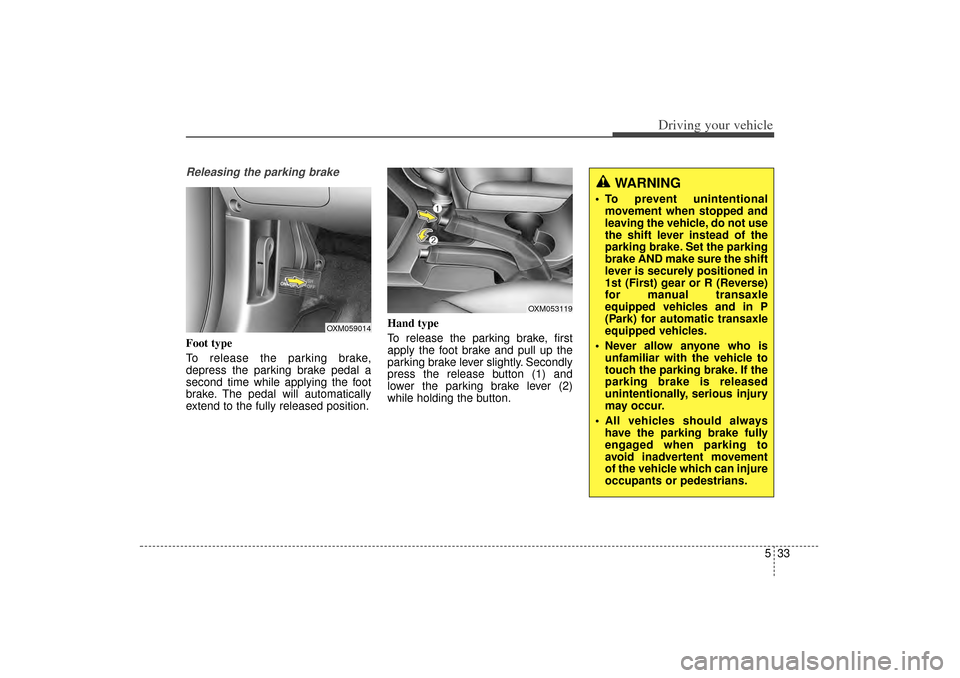
Releasing the parking brakeFoot type
To release the parking brake,
depress the parking brake pedal a
second time while applying the foot
brake. The pedal will automatically
extend to the fully released position.Hand type
To release the parking brake, first
apply the foot brake and pull up the
parking brake lever slightly. Secondly
press the release button (1) and
lower the parking brake lever (2)
while holding the button.
OXM059014
OXM053119
WARNING
To prevent unintentional
movement when stopped and
leaving the vehicle, do not use
the shift lever instead of the
parking brake. Set the parking
brake AND make sure the shift
lever is securely positioned in
1st (First) gear or R (Reverse)
for manual transaxle
equipped vehicles and in P
(Park) for automatic transaxle
equipped vehicles.
Never allow anyone who is unfamiliar with the vehicle to
touch the parking brake. If the
parking brake is released
unintentionally, serious injury
may occur.
All vehicles should always have the parking brake fully
engaged when parking to
avoid inadvertent movement
of the vehicle which can injure
occupants or pedestrians.
XM(FL) CAN(ENG) 5.QXP 1/23/2013 3:30 PM Page 33