Page 281 of 474
Driving your vehicle
45
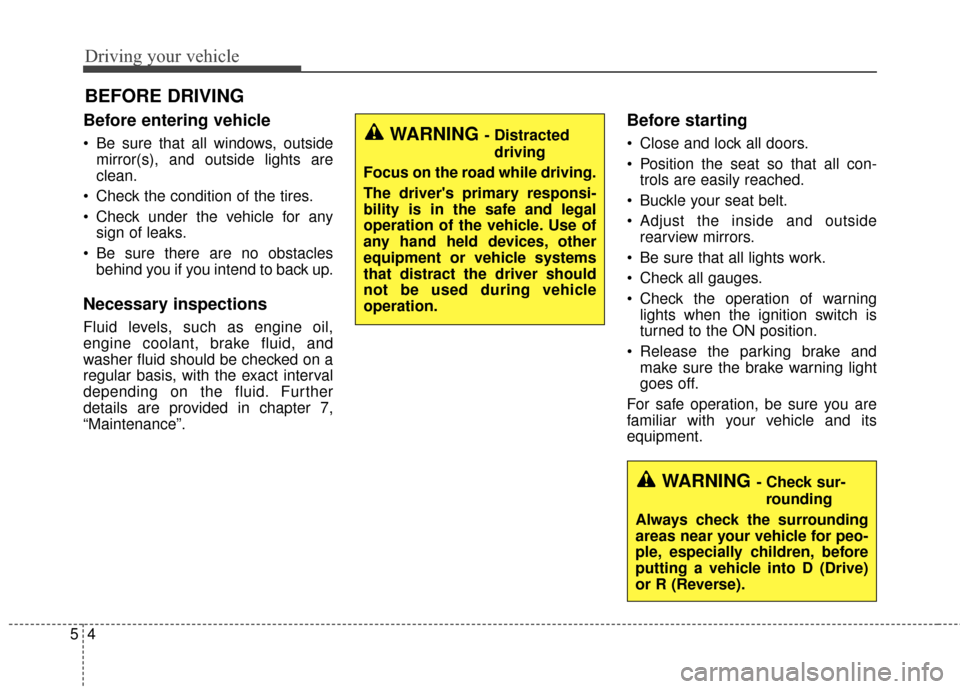
Before entering vehicle
• Be sure that all windows, outsidemirror(s), and outside lights are
clean.
Check the condition of the tires.
Check under the vehicle for any sign of leaks.
Be sure there are no obstacles behind you if you intend to back up.
Necessary inspections
Fluid levels, such as engine oil,
engine coolant, brake fluid, and
washer fluid should be checked on a
regular basis, with the exact interval
depending on the fluid. Further
details are provided in chapter 7,
“Maintenance”.
Before starting
Close and lock all doors.
Position the seat so that all con-trols are easily reached.
Buckle your seat belt.
Adjust the inside and outside rearview mirrors.
Be sure that all lights work.
Check all gauges.
Check the operation of warning lights when the ignition switch is
turned to the ON position.
Release the parking brake and make sure the brake warning light
goes off.
For safe operation, be sure you are
familiar with your vehicle and its
equipment.
BEFORE DRIVING
WARNING - Distracted driving
Focus on the road while driving.
The driver's primary responsi-
bility is in the safe and legal
operation of the vehicle. Use of
any hand held devices, other
equipment or vehicle systems
that distract the driver should
not be used during vehicle
operation.
WARNING - Check sur- rounding
Always check the surrounding
areas near your vehicle for peo-
ple, especially children, before
putting a vehicle into D (Drive)
or R (Reverse).
Page 326 of 474

549
Driving your vehicle
Driving off-road
Drive carefully off-road because your
vehicle may be damaged by rocks or
roots of trees. Become familiar with
the off-road conditions where you
are going to drive before you begin
driving.
Highway driving
Tires
Adjust the tire inflation pressures to
specification. Low tire inflation pres-
sures will result in overheating and
possible failure of the tires.
Avoid using worn or damaged tires
which may result in reduced traction
or tire failure.
Never exceed the maximum tire
inflation pressure shown on the tires.
Fuel, engine coolant and engineoil
High speed travel consumes more
fuel than urban motoring. Do not for-
get to check both the engine coolant
and engine oil.
Drive belt
A loose or damaged drive belt may
overheat the engine.
WARNING - Tire tread
Always check the tire tread
before driving your vehicle.
Worn-out tires can result in loss
of vehicle control. Worn-out
tires should be replaced as
soon as possible. For further
information and tread limits,
refer to "Tires and wheels" in
chapter 7.
Page 344 of 474

69
What to do in an emergency
IF THE ENGINE OVERHEATS
If your temperature gauge indicates
overheating, you will experience a
loss of power, or hear loud pinging or
knocking, the engine is probably too
hot. If this happens, you should:
1.Pull off the road and stop as soonas it is safe to do so.
2.Place the shift lever in P (automat- ic transaxle) and set the parking
brake. If the air conditioning is on,
turn it off.
3.If engine coolant is running out under the vehicle or steam is com-
ing out from underneath the hood,
stop the engine. Do not open the
hood until the coolant has stopped
running or the steaming has
stopped. If there is no visible loss
of engine coolant and no steam,
leave the engine running and
check to be sure the engine cool-
ing fan is operating. If the fan is not
running, turn the engine off. 4.Check to see if the water pump
drive belt is missing. If it is not
missing, check to see that it is
tight. If the drive belt seems to be
satisfactory, check for coolant leak-
ing from the radiator, hoses or
under the vehicle. (If the air condi-
tioning had been in use, it is nor-
mal for cold water to be draining
from it when you stop).
5.If the water pump drive belt is bro- ken or engine coolant leaks, stop
the engine immediately and call
the nearest authorized Kia dealer
for assistance. 6.If you cannot find the cause of the
overheating, wait until the engine
temperature has returned to nor-
mal. Then, if coolant has been lost,
carefully add coolant to the reser-
voir to bring the fluid level in the
reservoir up to the halfway mark.
7.Proceed with caution, keeping alert for further signs of overheat-
ing. If overheating happens again,
call an authorized Kia dealer for
assistance.
Serious loss of coolant indicates
there is a leak in the cooling system
and this should be checked as soon
as possible by an authorized Kia
dealer.
WARNING - Under the hood
While the engine is running,
keep hair, hands and clothing
away from moving parts such
as the fan and drive belts.
WARNING - Radiator cap
Do not remove the radiator cap
when the engine is hot. This can
allow coolant to be blown out of
the opening and cause serious
burns.
Page 370 of 474

77
Maintenance
At least monthly:
Check the coolant level in theengine coolant reservoir.
Check the operation of all exterior lights, including the stoplights, turn
signals and hazard warning flash-
ers.
Check the inflation pressures of all tires including the spare.
At least twice a year
(i.e., every Spring and Fall) :
Check the radiator, heater and air conditioning hoses for leaks or
damage.
Check the windshield washer spray and wiper operation. Clean
the wiper blades with clean cloth
dampened with washer fluid.
Check the headlight alignment.
Check the muffler, exhaust pipes, shields and clamps.
Check the lap/shoulder belts for wear and function.
Check for worn tires and loose wheel lug nuts.
At least once a year :
Clean the body and door drainholes.
Lubricate the door hinges and check the hood hinges.
Lubricate the door and hood locks and latches.
Lubricate the door rubber weather- strips.
Check the air conditioning system.
Check the power steering fluid level.
Inspect and lubricate automatic transaxle linkage and controls.
Clean the battery and terminals.
Check the brake fluid level.
Page 372 of 474

79
Maintenance
NORMAL MAINTENANCE SCHEDULE
The following maintenance services must be performed to ensure good emission control and performance. Keep
receipts for all vehicle emission services to protect your warranty. Where both mileage and time are shown, the fre-
quency of service is determined by whichever occurs first.
*1: If TOP TIER Detergent Gasoline is not available, one bottle of additive is recommended. Additives are available from yourauthorized Kia dealer along with information on how to use them. Do not mix other additives.
*
2: Fuel filter & Fuel tank air filter are considered to be maintenance free\
but periodic inspection is recommended for this mainte- nance schedule depends on fuel quality. If there are some important safety matters like fuel flow restriction, surging, loss of
power, hard starting problem etc, replace the fuel filter immediately regardless of maintenance schedule\
and consult an author-
ized Kia dealer for details.
*
3: The drive belt should be replaced when cracks occur or tension is reduced excessively.
*4: Inspect for excessive tappet noise and/or engine vibration and adjust if necessary.
Page 373 of 474

Maintenance
10
7
NORMAL MAINTENANCE SCHEDULE
The following maintenance services must be performed to ensure good emission control and performance. Keep receipts for all
vehicle emission services to protect your warranty. Where both mileage and time are shown, the frequency of service is deter-
mined by whichever occurs first.
24,000 km or 12 months
❑ Inspect air cleaner filter
❑Inspect HSG belt (24,000 km or 24 months)
❑ Inspect vacuum hose
❑Inspect air conditioning refrigerant
❑Inspect brake hoses and lines
❑Inspect drive shafts and boots
❑Inspect exhaust pipe and muffler
❑Inspect front brake disc/pads, calipers and rotors
❑Inspect rear brake disc/pads
❑Inspect parking brake
(Continued)
(Continued)
❑Inspect steering gear box, linkage & boots/lower arm ball
joint, upper arm ball joint
❑ Inspect suspension mounting bolts
❑Replace climate control air filter
(for evaporator and blower unit)
❑Replace engine oil and filter (24,000 km or 24 months)
❑ Add fuel additive *1 (Every 12,000 km or 12 months)
36,000 km or 18 months
❑ Inspect air cleaner filter
❑Inspect HSG belt (36,000 km or 36 months)
❑ Inspect vacuum hose
❑Replace engine oil and filter (36,000 km or 36 months)
❑Add fuel additive *1 (Every 12,000 km or 12 months)
12,000 km or 6 months
❑ Inspect air cleaner filter
❑Inspect HSG belt (12,000 km or 12 months)
❑ Inspect vacuum hose
❑Replace engine oil and filter (12,000 km or 12 months)
❑Add fuel additive *1 (Every 12,000 km or 12 months)
❈ Inspect : Inspect and if necessary, adjust, correct, clean or replace.
❈
Inspect : Inspect and if necessary, adjust, correct, clean or replace.
❈Inspect : Inspect and if necessary, adjust, correct, clean or replace.
Page 374 of 474
711
Maintenance
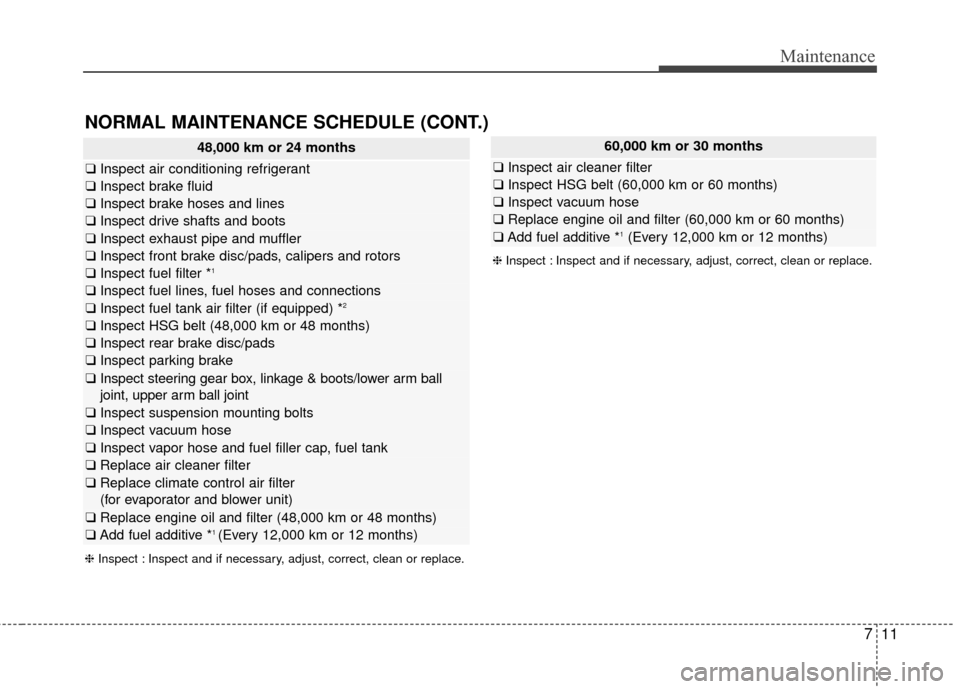
NORMAL MAINTENANCE SCHEDULE (CONT.)
60,000 km or 30 months
❑Inspect air cleaner filter
❑Inspect HSG belt (60,000 km or 60 months)
❑Inspect vacuum hose
❑Replace engine oil and filter (60,000 km or 60 months)
❑Add fuel additive *1(Every 12,000 km or 12 months)
48,000 km or 24 months
❑ Inspect air conditioning refrigerant
❑Inspect brake fluid
❑ Inspect brake hoses and lines
❑Inspect drive shafts and boots
❑Inspect exhaust pipe and muffler
❑Inspect front brake disc/pads, calipers and rotors
❑Inspect fuel filter *1
❑Inspect fuel lines, fuel hoses and connections
❑Inspect fuel tank air filter (if equipped) *2
❑Inspect HSG belt (48,000 km or 48 months)
❑ Inspect rear brake disc/pads
❑Inspect parking brake
❑Inspect steering gear box, linkage & boots/lower arm ball
joint, upper arm ball joint
❑Inspect suspension mounting bolts
❑ Inspect vacuum hose
❑Inspect vapor hose and fuel filler cap, fuel tank
❑Replace air cleaner filter
❑Replace climate control air filter
(for evaporator and blower unit)
❑Replace engine oil and filter (48,000 km or 48 months)
❑Add fuel additive *1 (Every 12,000 km or 12 months)
❈ Inspect : Inspect and if necessary, adjust, correct, clean or replace. ❈
Inspect : Inspect and if necessary, adjust, correct, clean or replace.
Page 375 of 474

Maintenance
12
7
72,000 km or 36 months
❑ Inspect air cleaner filter
❑Inspect air conditioning refrigerant
❑Inspect brake hoses and lines
❑Inspect drive shafts and boots
❑Inspect exhaust pipe and muffler
❑Inspect front brake disc/pads, calipers and rotors
❑Inspect HSG belt (72,000 km or 72 months)
❑ Inspect parking brake
❑Inspect rear brake disc/pads
❑Inspect steering gear box, linkage & boots/lower arm ball
joint, upper arm ball joint
❑ Inspect suspension mounting bolts
❑Inspect vacuum hose
❑Replace climate control air filter
(for evaporator and blower unit)
❑Replace engine oil and filter (72,000 km or 72 months)
❑Add fuel additive *1 (Every 12,000 km or 12 months)
NORMAL MAINTENANCE SCHEDULE (CONT.)
84,000 km or 42 months
❑ Inspect air cleaner filter
❑Inspect HSG belt (84,000 km or 84 months)
❑ Inspect vacuum hose
❑Replace engine oil and filter (84,000 km or 84 months)
❑Add fuel additive *1 (Every 12,000 km or 12 months)
❈ Inspect : Inspect and if necessary, adjust, correct, clean or replace. ❈
Inspect : Inspect and if necessary, adjust, correct, clean or replace.