2014 KIA MOHAVE trailer
[x] Cancel search: trailerPage 304 of 417

563
Driving your vehicle
Maintenance when trailer towing
Your vehicle will need service more often
when you regularly pull a trailer.
Important items to pay particular atten-tion to include engine oil, automatic
transmission fluid, mission lubricant and
cooling system fluid. Brake condition is
another important item to frequently
check. Each item is covered in this man-
ual, and the Index will help you find them
quickly. If you’re trailering, it’s a good idea
to review these sections before you start
your trip.
Don’t forget to also maintain your trailer
and hitch. Follow the maintenance
schedule that accompanied your trailer
and check it periodically. Preferably, con-
duct the check at the start of each day’s
driving. Most importantly, all hitch nutsand bolts should be tight.If you do decide to pull a trailer
Here are some important points if you
decide to pull a trailer:
Consider using a sway control. You can
ask a hitch dealer about sway control.
Do not do any towing with your car dur- ing its first 2,000 km (1,200 miles) in
order to allow the engine to properly
break in. Failure to heed this caution
may result in serious engine or trans-
mission damage.
When towing a trailer, be sure to con- sult an authorized Kia dealer for further
information on additional requirements
such as a towing kit, etc.
Always drive your vehicle at a moder- ate speed (less than 100 km/h / 60mph).
On a long uphill grade, do not exceed 70 km/h (45 mph) or the posted towing
speed limit, whichever is lower.CAUTION
Due to higher load during trailer
usage, overheating might occurin hot days or during uphill driv-ing. If the coolant gauge indicatesover-heating, switch off the A/C
and stop the vehicle in a safe area to cool down the engine.
When towing, check the transmis- sion fluid more frequently.
If your vehicle is not equipped with an air conditioner, youshould install a condenser fan to improve engine performancewhen towing a trailer.
Page 305 of 417
Driving your vehicle
64
5
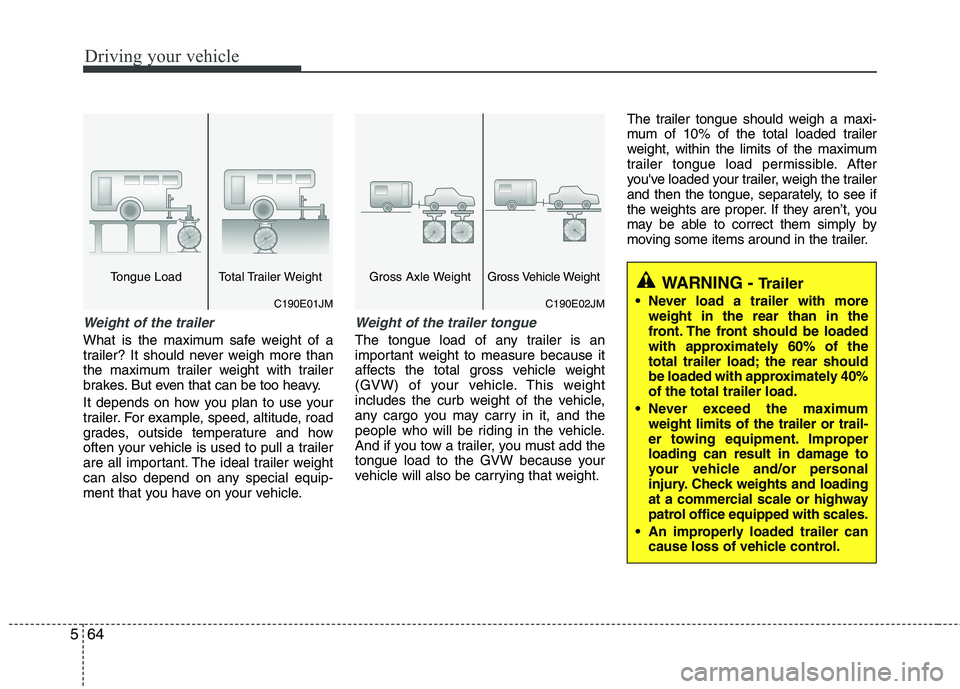
Weight of the trailer
What is the maximum safe weight of a
trailer? It should never weigh more than
the maximum trailer weight with trailer
brakes. But even that can be too heavy.
It depends on how you plan to use your
trailer. For example, speed, altitude, road
grades, outside temperature and how
often your vehicle is used to pull a trailer
are all important. The ideal trailer weight
can also depend on any special equip-
ment that you have on your vehicle.
Weight of the trailer tongue
The tongue load of any trailer is an
important weight to measure because it
affects the total gross vehicle weight
(GVW) of your vehicle. This weight
includes the curb weight of the vehicle,
any cargo you may carry in it, and the
people who will be riding in the vehicle.
And if you tow a trailer, you must add the
tongue load to the GVW because your
vehicle will also be carrying that weight. The trailer tongue should weigh a maxi-
mum of 10% of the total loaded trailer
weight, within the limits of the maximum
trailer tongue load permissible. After
you've loaded your trailer, weigh the trailer
and then the tongue, separately, to see if
the weights are proper. If they aren’t, you
may be able to correct them simply by
moving some items around in the trailer.
C190E01JM
Tongue Load Total Trailer Weight
C190E02JM
Gross Axle WeightGross Vehicle WeightWARNING -
Trailer
Never load a trailer with more weight in the rear than in the
front. The front should be loaded
with approximately 60% of the
total trailer load; the rear should
be loaded with approximately 40%of the total trailer load.
Never exceed the maximum weight limits of the trailer or trail-
er towing equipment. Improper
loading can result in damage to
your vehicle and/or personal
injury. Check weights and loading
at a commercial scale or highway
patrol office equipped with scales.
An improperly loaded trailer can cause loss of vehicle control.
Page 306 of 417

565
Driving your vehicle
Service connector for towing
brake controller (if equipped)
1 : Trailer brake (blue)
2 : Battery(+) (black)
3 : Stop light (red)
4 : Ground(-) (white)A service connector is equipped in your
vehicle for the towing brake controller as
shown. Link the connector to the towing
brake controller with the sub wire har-
ness stored in the glove box. The detailed
explanation of the sub wire harness cir-
cuit is shown in the picture. Be sure to
position the towing brake controller
where it does not interfere with the driver
from operating the pedal.
We recommend that the sub wire har-
ness be stored in the glove box when it is
not in use.
Trailer light connector (if equipped)
Your vehicle is equipped with a wire har-
ness stored in the rear end underbody.
Use it to connect and operate the trailer
lights. However, the trailer lights must
comply with federal, state/provincial and
local regulations. See your local recre-
ational vehicle dealer or rental agency for
the correct type of wiring and relays for
your trailer. Check for correct operation of
the turn signals, tail, back-up and stop
lights each time you hitch up. Direct splic-
ing may damage your vehicle's electrical
system and cause a malfunction of your
lights.
OHM068032N
Page 307 of 417
Driving your vehicle
66
5
E160000AUN
This section will guide you in the proper
loading of your vehicle and/or trailer, to
keep your loaded vehicle weight within its
design rating capability, with or without a
trailer. Properly loading your vehicle will
provide maximum return of the vehicle
design performance. Before loading your
vehicle, familiarize yourself with the fol-
lowing terms for determining your vehi-
cle's weight ratings, with or without a
trailer, from the vehicle's specifications
and the certification label:
E160100AUN Base curb weight
This is the weight of the vehicle including a full tank of fuel and all standard equip-
ment. It does not include passengers,
cargo, or optional equipment.
E160200AUN
Vehicle curb weight
This is the weight of your new vehicle
when you picked it up from your dealer
plus any aftermarket equipment.
E160300AUN
Cargo weight
This figure includes all weight added to
the Base Curb Weight, including cargoand optional equipment. E160400AUN
GAW (Gross axle weight)
This is the total weight placed on each
axle (front and rear) - including vehicle
curb weight and all payload.
E160500AUN
GAWR (Gross axle weight rating)
This is the maximum allowable weight
that can be carried by a single axle (front
or rear). These numbers are shown on
the certification label.
The total load on each axle must never
exceed its GAWR.
E160600AUN
GVW (Gross vehicle weight)
This is the Base Curb Weight plus actual
Cargo Weight plus passengers.
E160700AUN
GVWR (Gross vehicle weight rating)
This is the maximum allowable weight of
the fully loaded vehicle (including all
options, equipment, passengers and
cargo). The GVWR is shown on the cer-
tification label located on the driver’s (or
front passenger’s) door sill.
E160800AHM Overloading
VEHICLE WEIGHT
WARNING -
Vehicle weight
The gross axle weight rating
(GAWR) and the gross vehicle
weight rating (GVWR) for your vehi-
cle are on the certification label
attached to the driver's (or front
passenger’s) door. Exceedingthese ratings can cause an acci-
dent or damage the vehicle. You can
calculate the weight of your load byweighing the items (and people)
before putting them in the vehicle.
Be careful not to overload your
vehicle.
Page 322 of 417
615
What to do in an emergency
Do not take this vehicle through anautomatic car wash while the com- pact spare tire is installed.
Do not use tire chains on the com- pact spare tire. Because of the
smaller size, a tire chain will not fit
properly. This could damage the
vehicle and result in loss of thechain.
Do not use the compact spare tire on any other vehicle because thistire has been designed especially
for your vehicle.
The compact spare tire’s tread life is shorter than a regular tire.
Inspect your compact spare tire
regularly and replace worn com-
pact spare tires with the same sizeand design, mounted on the samewheel. The compact spare tire should not
be used on any other wheels, nor
should standard tires, snow tires,
wheel covers or trim rings be used
with the compact spare wheel. Ifsuch use is attempted, damage tothese items or other car compo-
nents may occur.
Do not use more than one compact spare tire at a time.
Do not tow a trailer while the com- pact spare tire is installed.
Page 341 of 417

Maintenance
14
7
Severe driving conditions
A : Repeatedly driving short distance of less than 8 km (5 miles)
in normal temperature or less than 16 km (10 miles) in freez-
ing temperature.
B : Extensive engine idling or low speed driving for long dis-
tances.
C : Driving on rough, dusty, muddy, unpaved, graveled or salt- spread roads.
D : Driving in areas using salt or other corrosive materials or in very cold weather E : Driving in sandy areas
F : More than 50 % driving in heavy city traffic during hot
weather above 32°C (90°F)
G : Driving on uphill, downhill, or mountain roads.
H : Towing a trailer or using a camper on roof rack.I:
Driving for patrol car, taxi, commercial car or vehicle towing
J : Driving over 170 km/h (106 mile/h)
K : Frequently driving in stop and go condition
Disc brakes and pads, calipers and rotors I C, D, E, G, H
Parking brake I C, D, G, H
Driveshaft and boots I C, D, E, F, H
Climate control air filter (if equipped) R C, E
Automatic transmission For Europe REvery 90,000 km (56,250 miles)
A, C, E, F, G, I
fluid Except Europe Every 100,000 km (60,000 miles)
MAINTENANCE ITEM Maintenance
operation Maintenance intervals
Driving condition
Inspect more frequently
depending on the condition
Inspect more frequently
depending on the condition
Inspect more frequently
depending on the condition
Replace more frequently
depending on the condition
Page 417 of 417

Index
10
I
Tire sidewall labeling ···············································7-41
Tire traction ······························································7-40
Wheel alignment and tire balance ····························7-38
Wheel replacement ···················································7-40
Towing ···········································································6-16 Emergency towing ····················································6-17
Tie-down hook (for flatbed towing) ·························6-19
Trailer towing ····························································5-58
Trailer towing··································································5-58
Transmission Automatic transmission ············································5-12
Tripmeter ········································································4-52
Trip computer ································································4-52
Turn signal light bulb replacement ································7-55
Vehicle break-in process ··················································1-5
Vehicle certification label ················································8-7
Vehicle identification number (VIN) ·······························8-7
Vehicle weight ·······························································5-66 Base curb weight ······················································5-66
Cargo weight ····························································5-66
GAW (Gross axle weight) ········································5-66
GAWR (Gross axle weight rating) ···························5-66
GVW (Gross vehicle weight) ···································5-66
GVWR (Gross vehicle weight rating) ·····················5-66 Washer fluid ···································································7-24
Waste tray, see ashtray ·················································4-116
Warnings and indicators ················································4-55
Weight ············································································5-66
Base curb weight ······················································5-66
Cargo weight ····························································5-66
GAW (Gross axle weight) ········································5-66
GAWR (Gross axle weight rating) ···························5-66
GVW (Gross vehicle weight) ···································5-66
GVWR (Gross vehicle weight rating) ·····················5-66
Wheel alignment and tire balance ·································7-38
Wheel replacement ························································7-40
Windows ········································································4-20 Auto down window ··················································4-21
Auto up/down window ·············································4-22
Power window lock button ·······································4-23
Windshield defrosting and defogging ··························4-110 Defogging logic ······················································4-112
Winter driving ································································5-54 Snow tires ·································································5-54
Tire chains ································································5-55
Wiper blades ··································································7-29
Wipers and washers ·······················································4-77
V
W