2014 KIA MOHAVE brake
[x] Cancel search: brakePage 11 of 417

15
Introduction
Biodiesel (for New Zealand)
Commercially supplied Diesel blends of no more than 7% biodiesel, commonly
known as "B7 Diesel" may be used in
your vehicle if Biodiesel meets EN 14214
or equivalent specifications. (EN stands
for "European Norm"). The use of biofu-
els exceeding 7%, made from rapeseed
methyl ester (RME), vegetable oil methyl
ester (VME) etc. or mixing diesel exceed-ing 7% with biodiesel will cause
increased wear or damage to the engine
and fuel system. Repair or replacement
of worn or damaged components due to
the use of non approved fuels will not be
covered by the manufactures warranty.A090000AEN
As with other vehicles of this type, failure
to operate this vehicle correctly mayresult in loss of control, an accident or
vehicle rollover.
Specific design characteristics (higher
ground clearance, track, etc.) give this
vehicle a higher center of gravity than
other types of vehicles. In other words
they are not designed for cornering at the
same speeds as conventional 2-wheel
drive vehicles. Avoid sharp turns or
abrupt maneuvers. Again, failure to oper-
ate this vehicle correctly may result in
loss of control, an accident or vehicle
rollover.
Be sure to read the “Reducing
the risk of a rollover” driving guide-
lines, in section 5 of this manual. A030000AUN
No special break-in period is needed. By
following a few simple precautions for the
first 1,000 km (600 miles) you may add to
the performance, economy and life of
your vehicle.
Do not race the engine.
While driving, keep your engine speed
(rpm, or revolutions per minute)
between 2,000 rpm and 4,000 rpm.
Do not maintain a single speed for long
periods of time, either fast or slow.
Varying engine speed is needed to
properly break-in the engine.
Avoid hard stops, except in emergen- cies, to allow the brakes to seat prop-
erly.
Don't let the engine idle longer than 3 minutes at one time.
Don't tow a trailer during the first 2,000
km (1,200 miles) of operation.
CAUTION
Never use any fuel, whether
diesel, B7 biodiesel or otherwise,
that fails to meet the latest petro-leum industry specification.
Never use any fuel additives or treatments that are not recom-mended or approved by the vehi-
cle manufacturer.
VEHICLE HANDLING
INSTRUCTIONS VEHICLE BREAK-IN PROCESS
Page 12 of 417
Introduction
6
1
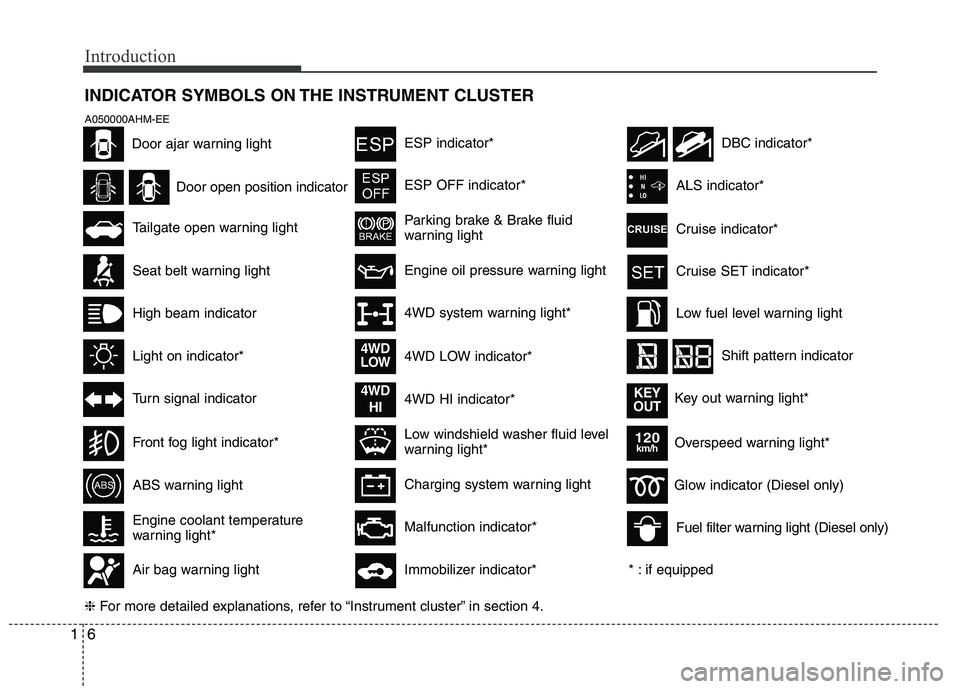
INDICATOR SYMBOLS ON THE INSTRUMENT CLUSTER
Seat belt warning light
Door open position indicator
Tailgate open warning light
High beam indicator
Light on indicator*
Turn signal indicator
Front fog light indicator*
ABS warning light
Parking brake & Brake fluid
warning light
Engine oil pressure warning light
4WD system warning light*
4WD LOW indicator* 4WD HI indicator*
Malfunction indicator*
Air bag warning light
Cruise SET indicator*
ALS indicator*
Immobilizer indicator*
Low fuel level warning light
Shift pattern indicator
DBC indicator*
❈ For more detailed explanations, refer to “Instrument cluster” in section 4.
Charging system warning light
Low windshield washer fluid level
warning light*
Engine coolant temperature
warning light*
A050000AHM-EE
Door ajar warning light
Overspeed warning light*
120km/h
Key out warning light*KEY
OUT
4WD
LOW
4WD
HI
* : if equipped
Glow indicator (Diesel only)
Fuel filter warning light (Diesel only)
ESP OFF indicator*
ESP indicator*
Cruise indicator*
Page 14 of 417

Your vehicle at a glance
2
2
INTERIOR OVERVIEW
1. Door lock/unlock button ....................4-15
2. Outside rearview mirror folding
button*...............................................4-46
3. Outside rearview mirror control switch ................................................4-45
4. Central door lock switch....................4-15
5. Power window lock button ................4-23
6. Power window switches ....................4-20
7. Air vent ..............................................4-90
8. Instrument panel illumination control knob* or Head lamp leveling device*.................................................4-49, 4-75
9. ESP OFF button* .............................5-33
10. DBC button* ....................................5-37
11. Power adjustable pedal control switch* or Heated steering wheel button*................................................4-36,4-38
12. ALS control switch* .........................5-41
13. 4WD transfer shift knob* .................5-19
14. Steering wheel tilt control* ..............4-38
15. Heated steering wheel button* .......4-38
16. Steering wheel ................................4-37
17. Driver position memory system button* ................................4-33
18. Fuel filler lid release lever ...............4-26
19. Hood release lever ..........................4-24
20. Brake pedal .....................................5-28
21. Accelerator pedal ..............................5-8
22. Fuse box .........................................7-46
23. Seat...................................................3-2
* : if equipped OHM013001L
B010000CHM-EE
■Type A
■ Type B
Page 15 of 417

23
Your vehicle at a glance
INSTRUMENT PANEL OVERVIEW
1. Instrument cluster.............................4-47
2. Steering wheel audio controls* ......4-125
3. Light control / Turn signals ...............4-71
4. Horn .................................................4-39
5. Auto cruise controls* ........................5-44
6. Wiper/Washer switch ........................4-77
7. Driver’s front air bag .........................3-48
8. Ignition switch* orENGINE START/STOP button* ...5-4, 5-6
9. Hazard warning flasher ......................6-2
10. Audio* ...........................................4-131
11. Digital clock ..................................4-119
12. Climate control system* .................4-86
13. Power outlet* ................................4-118
14. Cigar lighter and ashtray ..............4-116
15. Shift lever .......................................5-12
16. AUX, USB and iPod port*.............4-128
17. Seat warmer switch* ........................3-9
18. Climate control seat button* ...........3-10
19. Rear parking assist system OFF switch* ....................................4-67
20. Rear fog light switch* .....................4-75
21. Parking brake pedal .......................5-29
22. Brake pedal ....................................5-28
23. Accelerator pedal .............................5-8
24. Passenger’s front air bag* ..............3-48
25. Glove box .....................................4-113
* : if equipped OHM018002L
B020000CHM-EE
Page 16 of 417

Your vehicle at a glance
4
2
ENGINE COMPARTMENT
B030000AHM-EE
1. Engine coolant reservoir .................7-20
2. Engine oil filler cap..........................7-18
3. Brake fluid reservoir ........................7-22
4. Air cleaner .......................................7-26
5. Fuse box .........................................7-45
6. Negative battery terminal ................7-32
7. Positive battery terminal .................7-32
8. Radiator cap....................................7-21
9. Engine oil dipstick ...........................7-18
10. Power steering fluid reservoir .......7-23
11. Windshield washer fluid reservoir .7-24 OHM018005N/OHM018004N
* The actual engine room in the vehicle may differ from the illustration.
■
■
Gasoline Engine (3.8L)
■■Gasoline Engine (4.6L)
Page 17 of 417

25
Your vehicle at a glance
OHM013003
1. Engine coolant reservoir ..................7-20
2. Engine oil filler cap ..........................7-18
3. Fuel filter ..........................................7-25
4. Brake fluid reservoir.........................7-22
5. Air cleaner .......................................7-26
6. Fuse box ..........................................7-45
7. Negative battery terminal ................7-32
8. Positive battery terminal ..................7-32
9. Radiator cap ....................................7-21
10. Engine oil dipstick ..........................7-18
11. Power steering fluid reservoir ........7-23
12. Windshield washer fluid reservoir ..7-24
■■Diesel Engine (3.0L)
* The actual engine room in the vehicle may differ from the illustration.
Page 37 of 417

Safety features of your vehicle
20
3
CAUTION - Rear seat belts
When returning the rear (2nd and/or
3rd row) seatbacks to the upright
position, remember to return the rearshoulder belts to their proper posi-tion. Routing the seat belt webbing through the rear seat belt guides will
help keep the belts from beingtrapped behind or under the seats.
WARNING - Cargo loading
Make sure the engine is off, the automatic transmission is in P
(Park) and the parking brake is
securely applied whenever loading
or unloading cargo. Failure to take
these steps may allow the vehicle
to move if the shift lever is inadver-
tently moved to another position.
WARNING - Cargo
Cargo should always be secured to
prevent it from being thrown about
the vehicle in a collision and caus-
ing injury to the vehicle occupants.Do not place objects in the rear
(2nd and/or 3rd row) seats, since
they cannot be properly secured
and may hit the front seat occu-pants in a collision.
Page 74 of 417

357
Safety features of your vehicle
Just before impact, drivers often brakeheavily. Such heavy braking lowers the
front portion of the vehicle causing it to
“ride” under a vehicle with a higher
ground clearance. Air bags may not
inflate in this "under-ride" situation
because deceleration forces that are
detected by sensors may be signifi-
cantly reduced by such “under-ride”
collisions. Front air bags may not inflate in
rollover accidents because front air
bag deployment would not provideadditional occupant protection.
✽✽ NOTICE - Except Middle East and China
However, if equipped with side impact
and curtain air bags, the air bags may
inflate in a rollover, when it is detected
by the rollover sensor.
✽
✽ NOTICE - For Middle East and China
However, side and/or curtain air bags
may inflate when the vehicle is rolled
over by a side impact collision, if the
vehicle is equipped with side impact air
bags and curtain air bags.
Air bags may not inflate if the vehicle collides with objects such as utility
poles or trees, where the point of
impact is concentrated to one area and
the full force of the impact is not deliv-
ered to the sensors.
1VQA20901VQA20911VQA2092