Page 306 of 417

565
Driving your vehicle
Service connector for towing
brake controller (if equipped)
1 : Trailer brake (blue)
2 : Battery(+) (black)
3 : Stop light (red)
4 : Ground(-) (white)A service connector is equipped in your
vehicle for the towing brake controller as
shown. Link the connector to the towing
brake controller with the sub wire har-
ness stored in the glove box. The detailed
explanation of the sub wire harness cir-
cuit is shown in the picture. Be sure to
position the towing brake controller
where it does not interfere with the driver
from operating the pedal.
We recommend that the sub wire har-
ness be stored in the glove box when it is
not in use.
Trailer light connector (if equipped)
Your vehicle is equipped with a wire har-
ness stored in the rear end underbody.
Use it to connect and operate the trailer
lights. However, the trailer lights must
comply with federal, state/provincial and
local regulations. See your local recre-
ational vehicle dealer or rental agency for
the correct type of wiring and relays for
your trailer. Check for correct operation of
the turn signals, tail, back-up and stop
lights each time you hitch up. Direct splic-
ing may damage your vehicle's electrical
system and cause a malfunction of your
lights.
OHM068032N
Page 309 of 417

What to do in an emergency
2
6
ROAD WARNING
F010100ASA
Hazard warning flasher
The hazard warning flasher serves as a
warning to other drivers to exercise
extreme caution when approaching,
overtaking, or passing your vehicle. It should be used whenever emergency
repairs are being made or when the vehi-cle is stopped near the edge of a road-
way.
Depress the flasher switch with the igni-
tion switch in any position. The flasher
switch is located in the center console
switch panel. All turn signal lights will
flash simultaneously.
• The hazard warning flasher operates
whether your vehicle is running or not.
The turn signals do not work when the hazard flasher is on. F020100AUN-EU
If the engine stalls at a crossroad
or crossing If the engine stalls at a crossroad or
crossing, set the shift lever in the N
(Neutral) position and then push the vehi-
cle to a safe place. F020200AHM
If you have a flat tire while driving
If a tire goes flat while you are driving:
1. Take your foot off the accelerator pedal
and let the vehicle slow down while
driving straight ahead. Do not apply the
brakes immediately or attempt to pull
off the road as this may cause a loss of
control. When the vehicle has slowed
to such a speed that it is safe to do so,
brake carefully and pull off the road.
Drive off the road as far as possible
and park on a firm level ground. If you
are on a divided highway, do not park
in the median area between the two
traffic lanes.
2. When the vehicle is stopped, turn on your emergency hazard flashers, set
the parking brake and put the trans-
mission in P (Park).
IN CASE OF AN EMERGENCY WHILE DRIVING
OHM068001L
Page 310 of 417

63
What to do in an emergency
3. Have all passengers get out of thevehicle. Be sure they all get out on the
side of the vehicle that is away from the
traffic.
4. When changing a flat tire, follow the instruction provided later in this sec-tion.
F020300APB If the engine stalls while driving
1. Reduce your speed gradually, keeping a straight line. Move cautiously off the
road to a safe place.
2. Turn on your emergency flashers.
3. Try to start the engine again. If your vehicle will not start, contact an
authorized Kia dealer or seek other
qualified assistance. F030100AHM
If the engine doesn't turn over or
turns over slowly
1. If your vehicle has an automatic trans-
mission, be sure the gear shift lever is
in N (Neutral) or P (Park) and the
parking brake is set.
2. Check the battery connections to be sure they are clean and tight.
3. Turn on the interior light. If the light dims or goes out when you operate the
starter, the battery is discharged.
4. Check the starter connections to be sure they are securely tightened.
5. Do not push or pull the vehicle to start it. See instructions for "Jump starting". F030200AHM
If the engine turns over normally
but does not start
1. Check the fuel level.
2. With the ignition switch in the LOCK
position, check all connectors at the
ignition coils and spark plugs.
Reconnect any that may be discon-
nected or loose.
3. Check the fuel line in the engine com- partment.
4. If the engine still does not start, call an authorized Kia dealer or seek other
qualified assistance.
IF THE ENGINE WILL NOT START
WARNING
If the engine does not start, do not
push or pull the vehicle to start it.This could result in a collision or
cause other damage. In addition,
push or pull starting may cause the
catalytic converter to overload and
create a fire.
Page 318 of 417

611
What to do in an emergency
7. Place the jack at the front or rearjacking position closest to the tire
you are changing. Place the jackat the designated locations under
the frame. The jacking positions
are plates welded to the frame
with two tabs and a raised dot to
index with the jack. 8. Insert the jack handle into the jack
and turn it clockwise, raising the
vehicle until the tire just clears the
ground. This measurement is
approximately 30 mm (1.2 in).
Before removing the wheel lug
nuts, make sure the vehicle is sta-
ble and that there is no chance for
movement or slippage. 9. Loosen the wheel nuts and
remove them with your fingers.Slide the wheel off the studs and
lay it flat so it cannot roll away. To
put the wheel on the hub, pick up
the spare tire, line up the holeswith the studs and slide the wheel
onto them. If this is difficult, tip thewheel slightly and get the top holein the wheel lined up with the top
stud. Then jiggle the wheel back
and forth until the wheel can be
slid over the other studs.
WARNING - Jack location
To reduce the possibility of
injury, be sure to use only the
jack provided with the vehicle
and in the correct jack position;
never use any other part of the
vehicle for jack support.
OCM049013NOCM054012
Page 328 of 417
7
Engine compartment / 7-2
Maintenance services / 7-4
Owner maintenance / 7-6
Scheduled maintenance service / 7-8
Explanation of scheduled maintenance items / 7-15
Engine oil / 7-18
Engine coolant / 7-19
Brake fluid / 7-22
Power steering fluid / 7-23
Washer fluid / 7-24
Parking brake / 7-24
Fuel filter / 7-25
Air cleaner / 7-26
Climate control air filter / 7-27
Wiper blades / 7-29
Battery / 7-32
Tires and wheels / 7-35
Fuses / 7-45
Light bulbs / 7-55
Appearance care / 7-62
Emission control system / 7-68
Maintenance
Page 334 of 417
77
Maintenance
G030102AHM
While operating your vehicle:
Note any changes in the sound of theexhaust or any smell of exhaust fumes
in the vehicle.
Check for vibrations in the steering wheel. Notice any increased steering
effort or looseness in the steering
wheel, or change in its straight-aheadposition.
Notice if your vehicle constantly turns slightly or “pulls” to one side when trav-
eling on smooth, level road.
When stopping, listen and check for unusual sounds, pulling to one side,
increased brake pedal travel or “hard-
to-push” brake pedal.
If any slipping or changes in the oper- ation of your transmission occurs,
check the transmission fluid level.
Check the automatic transmission P (Park) function.
Check the parking brake.
Check for fluid leaks under your vehicle (water dripping from the air condition-
ing system during or after use is nor-mal). G030103AHM
At least monthly:
Check the coolant level in the engine
coolant reservoir.
Check the operation of all exterior lights, including the stoplights, turn sig-
nals and hazard warning flashers.
Check the inflation pressures of all tires including the spare.
G030104AHM
At least twice a year (i.e., every Spring and Fall):
Check the radiator, heater and air con- ditioning hoses for leaks or damage.
Check the windshield washer spray and wiper operation. Clean the wiper
blades with clean cloth dampened with
washer fluid.
Check the headlight alignment.
Check the muffler, exhaust pipes, shields and clamps.
Check the lap/shoulder belts for wear and function.
Check for worn tires and loose wheel lug nuts. G030105AHM
At least once a year:
Clean the body and door drain holes.
Lubricate the door hinges and checks,
and hood hinges.
Lubricate the door and hood locks and latches.
Lubricate the door rubber weather- strips.
Check the air conditioning system.
Check the power steering fluid level.
Inspect and lubricate the automatic transmission linkage and controls.
Clean the battery and terminals.
Check the brake fluid level.
Page 352 of 417
725
Maintenance
FUEL FILTER (FOR DIESEL)
G150100AHM
Draining water from the fuel filter
The fuel filter for diesel engine plays an
important role of separating water from
fuel and accumulating the water in itsbottom.
If water accumulates in the fuel filter, the
warning light comes on when the ignition
switch is in the ON position. Place a water trap under the fuel filter.
Loosen the drain plug and drain water.
After water is drained, securely tighten
the drain plug.
After starting the engine, check to make certain the fuel filter warning
light is off.
G150200AUN
Fuel filter cartridge replacement
✽✽NOTICE
When replacing the fuel filter cartridge,
use Kia genuine parts.
OHM078008CAUTION
If the water accumulated in the fuel filter is not drained at proper times,damages to the major parts such as
the fuel system can be caused bywater permeation in the fuel filter.
Page 358 of 417
731
Maintenance
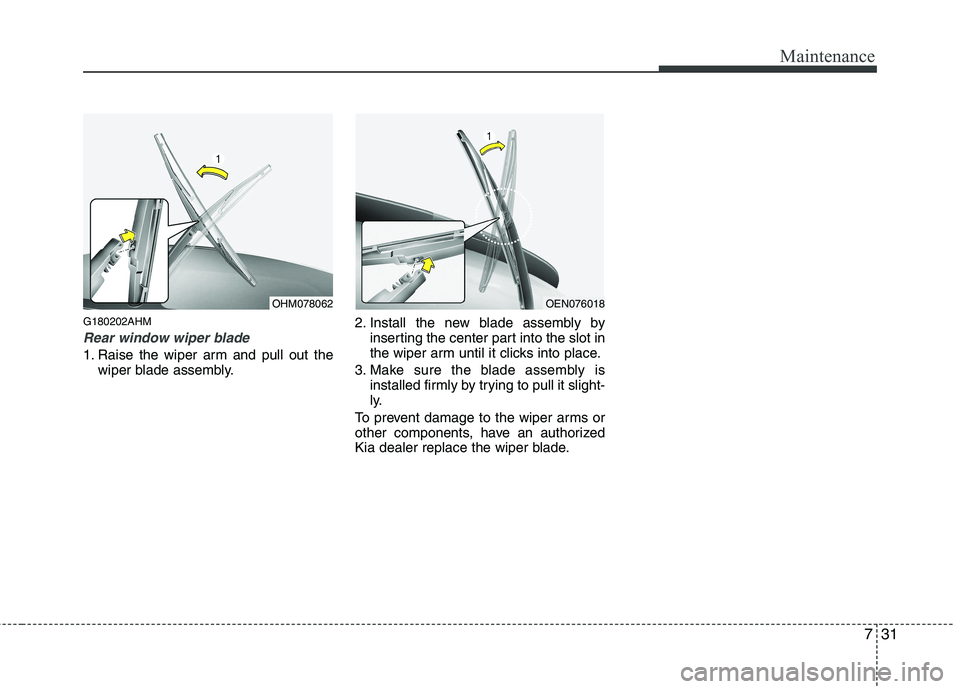
G180202AHM
Rear window wiper blade
1. Raise the wiper arm and pull out thewiper blade assembly. 2. Install the new blade assembly by
inserting the center part into the slot in
the wiper arm until it clicks into place.
3. Make sure the blade assembly is installed firmly by trying to pull it slight-
ly.
To prevent damage to the wiper arms or
other components, have an authorized
Kia dealer replace the wiper blade.
OHM078062OEN076018