2014 KIA CEED towing
[x] Cancel search: towingPage 1025 of 1206
Driving your vehicle
76
5
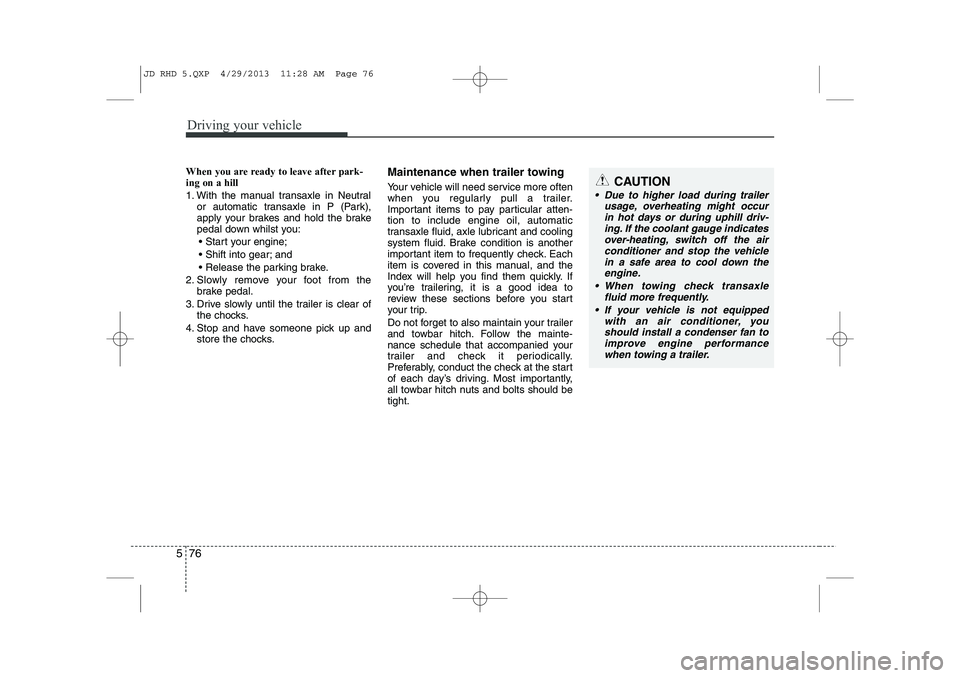
When you are ready to leave after park- ing on a hill
1. With the manual transaxle in Neutral
or automatic transaxle in P (Park),
apply your brakes and hold the brake
pedal down whilst you:
Start your engine;
Shift into gear; and
Release the parking brake.
2. Slowly remove your foot from the brake pedal.
3. Drive slowly until the trailer is clear of the chocks.
4. Stop and have someone pick up and store the chocks. Maintenance when trailer towing
Your vehicle will need service more often
when you regularly pull a trailer.
Important items to pay particular atten-tion to include engine oil, automatic
transaxle fluid, axle lubricant and cooling
system fluid. Brake condition is another
important item to frequently check. Each
item is covered in this manual, and the
Index will help you find them quickly. If
you’re trailering, it is a good idea to
review these sections before you start
your trip.
Do not forget to also maintain your trailer
and towbar hitch. Follow the mainte-
nance schedule that accompanied your
trailer and check it periodically.
Preferably, conduct the check at the start
of each day’s driving. Most importantly,
all towbar hitch nuts and bolts should betight.CAUTION
Due to higher load during trailer
usage, overheating might occur
in hot days or during uphill driv-ing. If the coolant gauge indicatesover-heating, switch off the air conditioner and stop the vehicle
in a safe area to cool down the engine.
When towing check transaxle fluid more frequently.
If your vehicle is not equipped with an air conditioner, youshould install a condenser fan to improve engine performance
when towing a trailer.
JD RHD 5.QXP 4/29/2013 11:28 AM Page 76
Page 1026 of 1206
577
Driving your vehicle
If you do decide to pull a trailer
Here are some important points if you decide to pull a trailer:
Consider using a sway control. You can ask a towbar hitch dealer about sway control.
Do not do any towing with your car during its first 2,000 km (1,200 miles) in order to allow the engine to properly break in. Failure
to heed this caution may result in serious engine or transaxle damage.
When towing a trailer, we recommend that you consult an authorised Kia dealer on additional requirements such as a towing kit, etc.
Always drive your vehicle at a moderate speed (less than 100 km/h (60 mph)).
On a long uphill grade, do not exceed 70 km/h (45 mph) or the posted towing speed limit, whichever is lower.
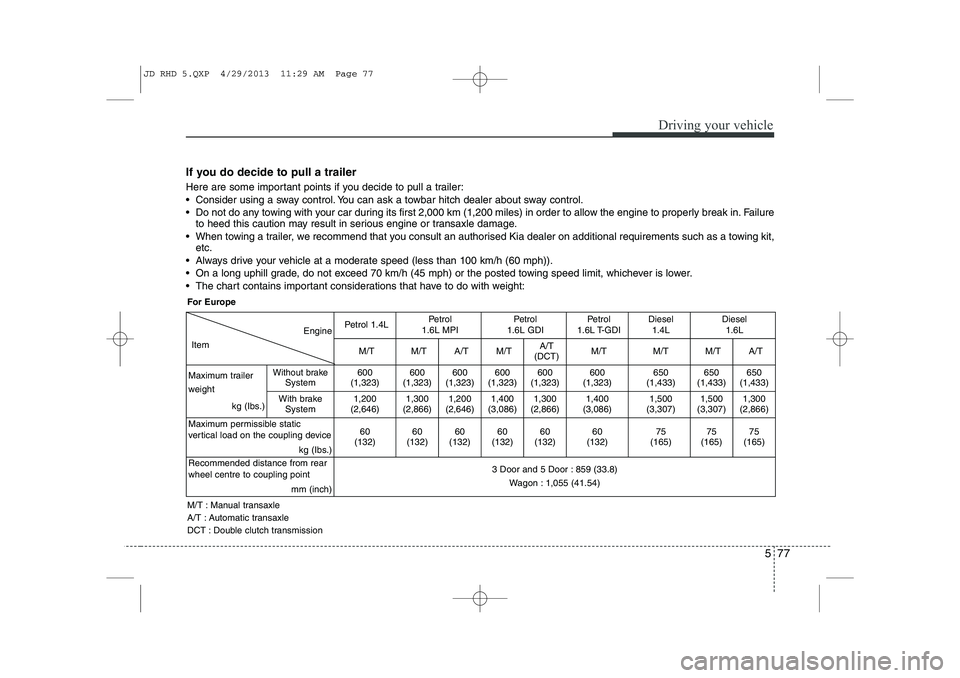
The chart contains important considerations that have to do with weight:
For Europe
M/T : Manual transaxle
A/T : Automatic transaxle
DCT : Double clutch transmission Engine
Item
Petrol 1.4LPetrol
1.6L MPI Petrol
1.6L GDIPetrol
1.6L T-GDIDiesel 1.4L Diesel
1.6L
M/TM/TA/T M/T A/T
(DCT)M/TM/T M/T A/T
Maximum trailer
weight kg (Ibs.)
Without brakeSystem600
(1,323)600
(1,323)600
(1,323) 600
(1,323) 600
(1,323)600
(1,323)650
(1,433) 650
(1,433) 650
(1,433)
With brake System
1,200
(2,646)1,300
(2,866)1,200
(2,646) 1,400
(3,086) 1,300
(2,866)1,400
(3,086)1,500
(3,307) 1,500
(3,307) 1,300
(2,866)
Maximum permissible static
vertical load on the coupling device kg (Ibs.)
60
(132)60
(132)60
(132) 60
(132) 60
(132)60
(132)75
(165) 75
(165) 75
(165)
Recommended distance from rear wheel centre to coupling point mm (inch)
3 Door and 5 Door : 859 (33.8)Wagon : 1,055 (41.54)
JD RHD 5.QXP 4/29/2013 11:29 AM Page 77
Page 1028 of 1206
579
Driving your vehicle
✽✽NOTICE
With increasing altitude the engine per-
formance decreases. From 1.000 m
above sea level and for every 1.000 m
thereafter 10% of vehicle/trailer weight
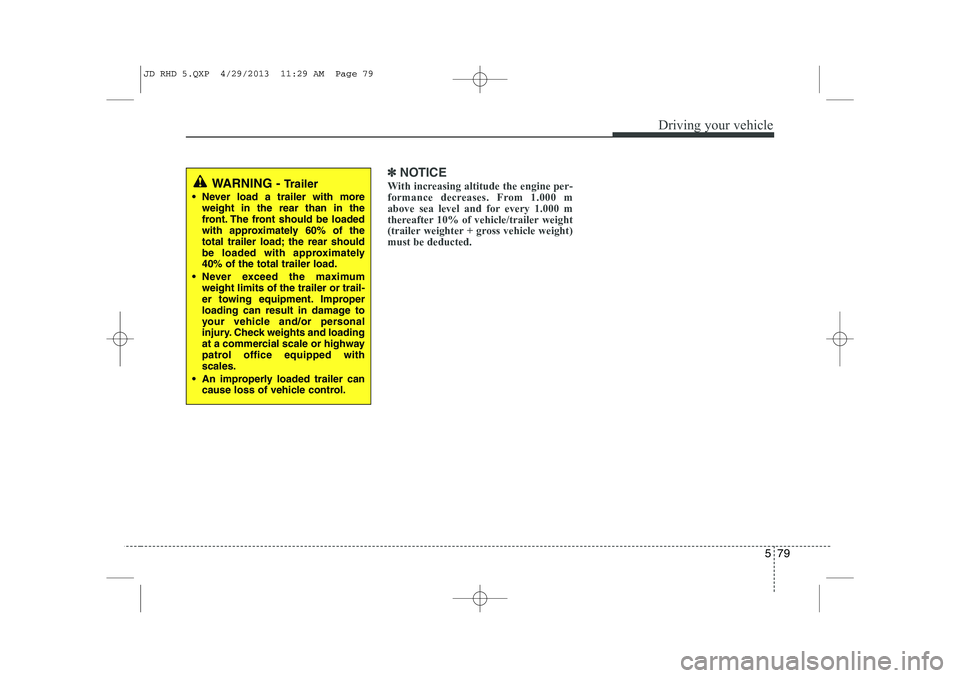
(trailer weighter + gross vehicle weight)must be deducted.WARNING - Trailer
Never load a trailer with more weight in the rear than in the
front. The front should be loaded
with approximately 60% of the
total trailer load; the rear should
be loaded with approximately40% of the total trailer load.
Never exceed the maximum weight limits of the trailer or trail-
er towing equipment. Improper
loading can result in damage to
your vehicle and/or personal
injury. Check weights and loading
at a commercial scale or highway
patrol office equipped withscales.
An improperly loaded trailer can cause loss of vehicle control.
JD RHD 5.QXP 4/29/2013 11:29 AM Page 79
Page 1034 of 1206
65
What to do in an emergency
EMERGENCY STARTING
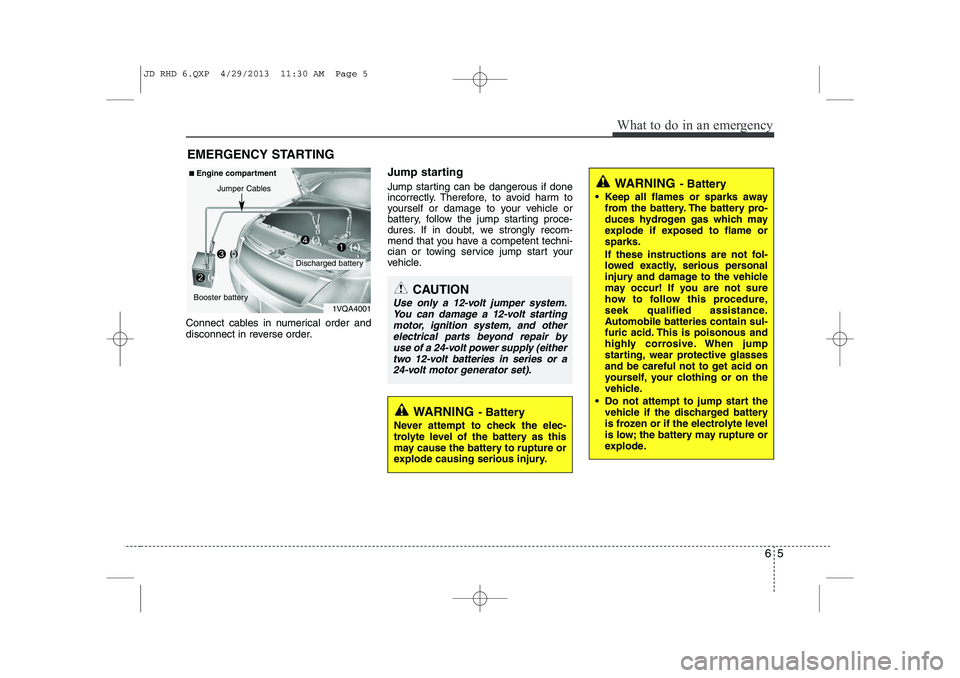
Connect cables in numerical order and
disconnect in reverse order. Jump starting
Jump starting can be dangerous if done
incorrectly. Therefore, to avoid harm to
yourself or damage to your vehicle or
battery, follow the jump starting proce-
dures. If in doubt, we strongly recom-
mend that you have a competent techni-
cian or towing service jump start your
vehicle.
CAUTION
Use only a 12-volt jumper system.
You can damage a 12-volt starting motor, ignition system, and otherelectrical parts beyond repair by
use of a 24-volt power supply (eithertwo 12-volt batteries in series or a 24-volt motor generator set).
WARNING - Battery
• Keep all flames or sparks away from the battery. The battery pro-
duces hydrogen gas which may
explode if exposed to flame orsparks.
If these instructions are not fol-
lowed exactly, serious personal
injury and damage to the vehicle
may occur! If you are not sure
how to follow this procedure,
seek qualified assistance.
Automobile batteries contain sul-
furic acid. This is poisonous and
highly corrosive. When jump
starting, wear protective glasses
and be careful not to get acid on
yourself, your clothing or on the
vehicle.
Do not attempt to jump start the vehicle if the discharged battery
is frozen or if the electrolyte level
is low; the battery may rupture or
explode.
WARNING - Battery
Never attempt to check the elec-
trolyte level of the battery as this
may cause the battery to rupture or
explode causing serious injury.
1VQA4001
Discharged battery
Jumper Cables
■
Engine compartment
Booster battery(-)
(+)
(+)(-)
JD RHD 6.QXP 4/29/2013 11:30 AM Page 5
Page 1050 of 1206
621
What to do in an emergency
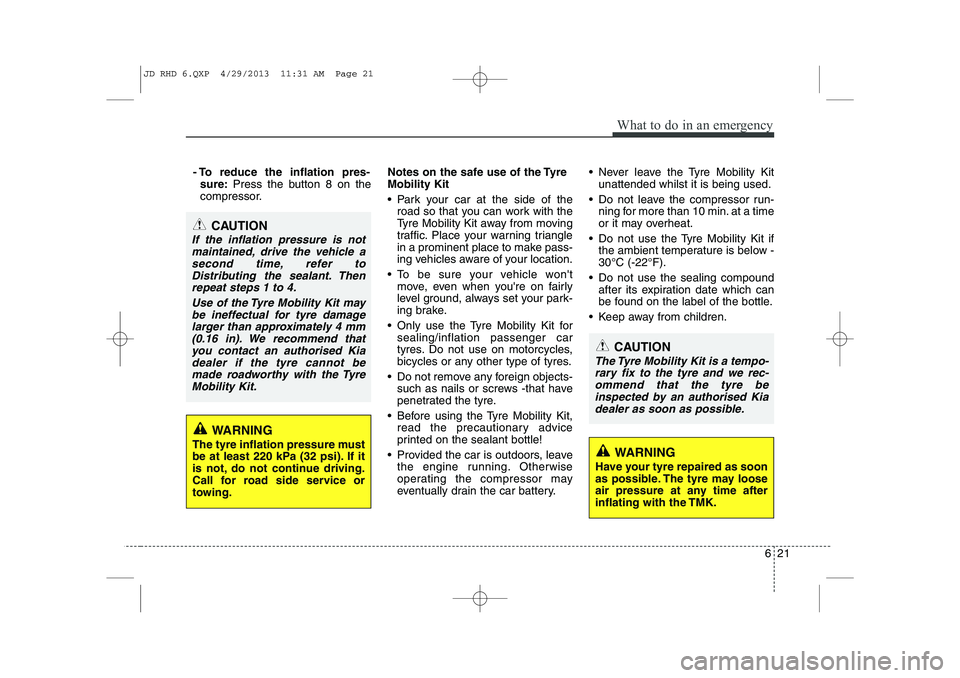
- To reduce the inflation pres-sure: Press the button 8 on the
compressor. Notes on the safe use of the Tyre Mobility Kit
Park your car at the side of the
road so that you can work with the
Tyre Mobility Kit away from moving
traffic. Place your warning triangle
in a prominent place to make pass-
ing vehicles aware of your location.
To be sure your vehicle won't move, even when you're on fairly
level ground, always set your park-
ing brake.
Only use the Tyre Mobility Kit for sealing/inflation passenger car
tyres. Do not use on motorcycles,
bicycles or any other type of tyres.
Do not remove any foreign objects- such as nails or screws -that have
penetrated the tyre.
Before using the Tyre Mobility Kit, read the precautionary advice
printed on the sealant bottle!
Provided the car is outdoors, leave the engine running. Otherwise
operating the compressor may
eventually drain the car battery. Never leave the Tyre Mobility Kit
unattended whilst it is being used.
Do not leave the compressor run- ning for more than 10 min. at a time
or it may overheat.
Do not use the Tyre Mobility Kit if the ambient temperature is below -30°C (-22°F).
Do not use the sealing compound after its expiration date which can
be found on the label of the bottle.
Keep away from children.
WARNING
The tyre inflation pressure must
be at least 220 kPa (32 psi). If it
is not, do not continue driving.
Call for road side service or
towing.
CAUTION
If the inflation pressure is not maintained, drive the vehicle asecond time, refer to Distributing the sealant. Thenrepeat steps 1 to 4.
Use of the Tyre Mobility Kit maybe ineffectual for tyre damagelarger than approximately 4 mm (0.16 in). We recommend thatyou contact an authorised Kiadealer if the tyre cannot be made roadworthy with the TyreMobility Kit.
WARNING
Have your tyre repaired as soon
as possible. The tyre may loose
air pressure at any time after
inflating with the TMK.
CAUTION
The Tyre Mobility Kit is a tempo- rary fix to the tyre and we rec-ommend that the tyre beinspected by an authorised Kia dealer as soon as possible.
JD RHD 6.QXP 4/29/2013 11:31 AM Page 21
Page 1057 of 1206
What to do in an emergency
28
6
TOWING
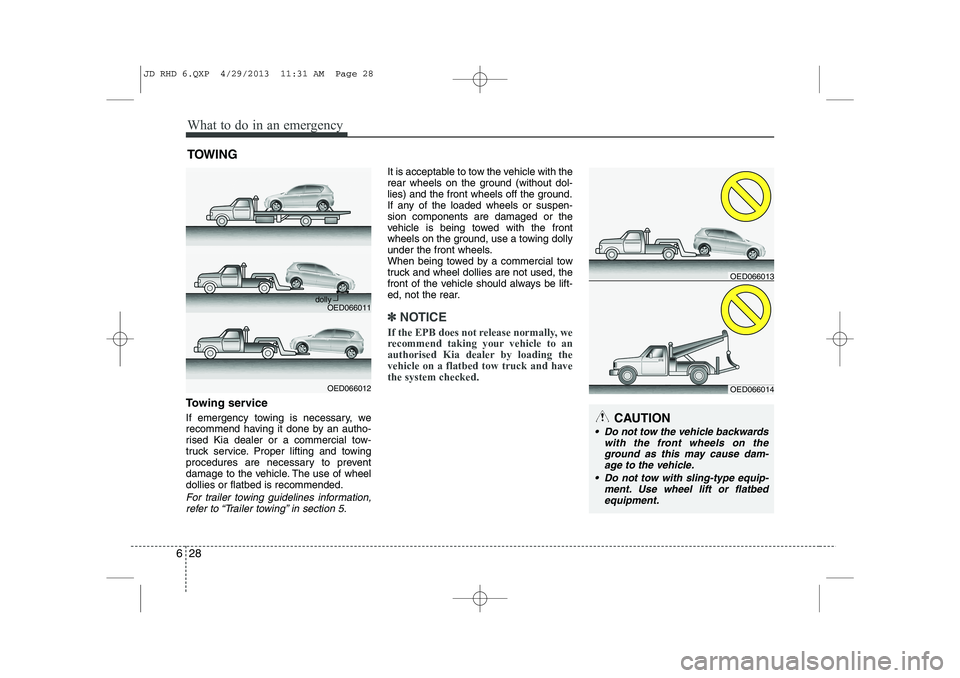
Towing service
If emergency towing is necessary, we
recommend having it done by an autho-
rised Kia dealer or a commercial tow-
truck service. Proper lifting and towing
procedures are necessary to prevent
damage to the vehicle. The use of wheeldollies or flatbed is recommended.
For trailer towing guidelines information, refer to “Trailer towing” in section 5.
It is acceptable to tow the vehicle with the
rear wheels on the ground (without dol-
lies) and the front wheels off the ground.
If any of the loaded wheels or suspen-sion components are damaged or the
vehicle is being towed with the front
wheels on the ground, use a towing dolly
under the front wheels.
When being towed by a commercial tow
truck and wheel dollies are not used, the
front of the vehicle should always be lift-
ed, not the rear.
✽✽ NOTICE
If the EPB does not release normally, we
recommend taking your vehicle to an
authorised Kia dealer by loading thevehicle on a flatbed tow truck and havethe system checked.
CAUTION
Do not tow the vehicle backwards with the front wheels on the
ground as this may cause dam-age to the vehicle.
Do not tow with sling-type equip- ment. Use wheel lift or flatbedequipment.
OED066011
OED066012
dolly
OED066014
OED066013
JD RHD 6.QXP 4/29/2013 11:31 AM Page 28
Page 1058 of 1206
629
What to do in an emergency
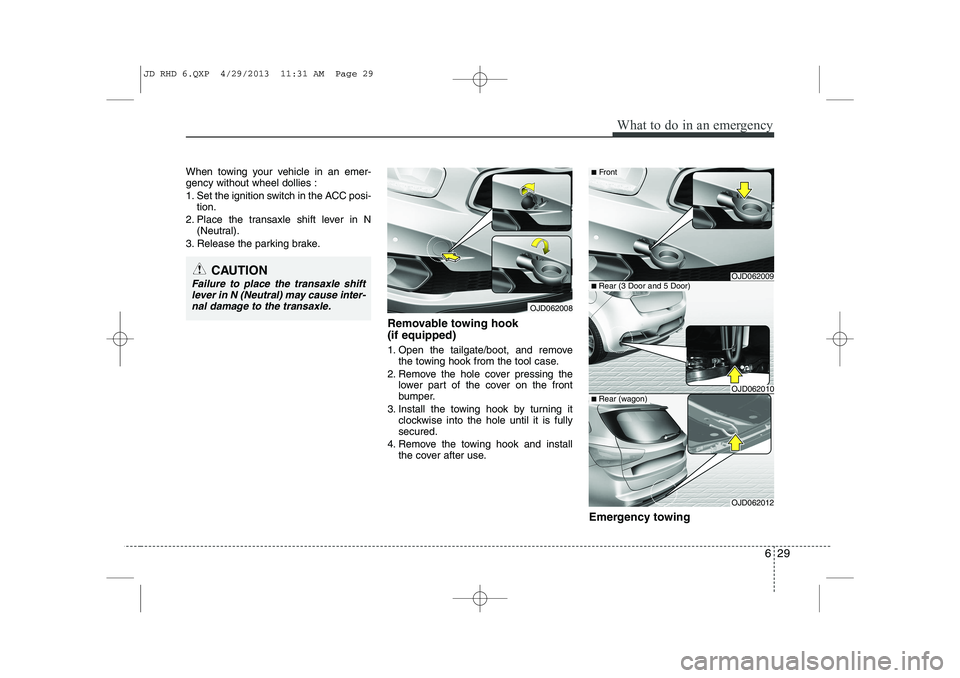
When towing your vehicle in an emer- gency without wheel dollies :
1. Set the ignition switch in the ACC posi-tion.
2. Place the transaxle shift lever in N (Neutral).
3. Release the parking brake.
Removable towing hook (if equipped)
1. Open the tailgate/boot, and removethe towing hook from the tool case.
2. Remove the hole cover pressing the lower part of the cover on the front
bumper.
3. Install the towing hook by turning it clockwise into the hole until it is fullysecured.
4. Remove the towing hook and install the cover after use.
Emergency towing
CAUTION
Failure to place the transaxle shiftlever in N (Neutral) may cause inter-
nal damage to the transaxle.
OJD062008
■ Rear (3 Door and 5 Door)
OJD062012
■Rear (wagon)
■ Front
OJD062009
OJD062010
JD RHD 6.QXP 4/29/2013 11:31 AM Page 29
Page 1059 of 1206
What to do in an emergency
30
6
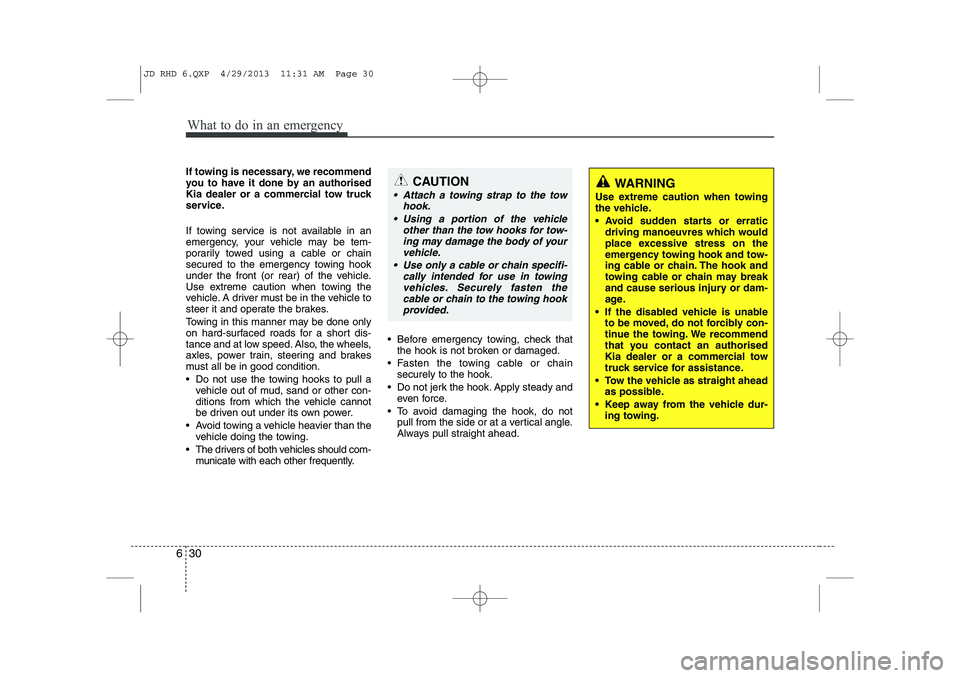
If towing is necessary, we recommend
you to have it done by an authorised
Kia dealer or a commercial tow truck
service.
If towing service is not available in an
emergency, your vehicle may be tem-
porarily towed using a cable or chain
secured to the emergency towing hook
under the front (or rear) of the vehicle.
Use extreme caution when towing the
vehicle. A driver must be in the vehicle to
steer it and operate the brakes.
Towing in this manner may be done only
on hard-surfaced roads for a short dis-
tance and at low speed. Also, the wheels,
axles, power train, steering and brakes
must all be in good condition.
Do not use the towing hooks to pull a
vehicle out of mud, sand or other con-
ditions from which the vehicle cannot
be driven out under its own power.
Avoid towing a vehicle heavier than the vehicle doing the towing.
The drivers of both vehicles should com- municate with each other frequently. Before emergency towing, check that
the hook is not broken or damaged.
Fasten the towing cable or chain securely to the hook.
Do not jerk the hook. Apply steady and even force.
To avoid damaging the hook, do not pull from the side or at a vertical angle.
Always pull straight ahead.CAUTION
Attach a towing strap to the tow
hook.
Using a portion of the vehicle other than the tow hooks for tow-ing may damage the body of yourvehicle.
Use only a cable or chain specifi- cally intended for use in towingvehicles. Securely fasten thecable or chain to the towing hookprovided.WARNING
Use extreme caution when towing
the vehicle.
Avoid sudden starts or erratic driving manoeuvres which would
place excessive stress on the
emergency towing hook and tow-
ing cable or chain. The hook and
towing cable or chain may break
and cause serious injury or dam-
age.
If the disabled vehicle is unable to be moved, do not forcibly con-
tinue the towing. We recommend
that you contact an authorised
Kia dealer or a commercial tow
truck service for assistance.
Tow the vehicle as straight ahead as possible.
Keep away from the vehicle dur- ing towing.
JD RHD 6.QXP 4/29/2013 11:31 AM Page 30