2014 KIA CEED towing
[x] Cancel search: towingPage 491 of 1206

733
Maintenance
SEVERE DRIVING CONDITIONS
A : Repeated short distance driving
B : Extensive idling
C : Driving in dusty, rough roads
D : Driving in areas using salt or other corrosive materials or in very cold weather
E : Driving in sandy areas
F : More than 50 % driving in heavy city traffic during hot weather above 32°C (90°F) G : Driving in mountainous areas.
H : Towing a trailer or using a camper on roof rack
I : Driving for patrol car, taxi, commercial car or vehicle tow-
ing
J : Driving over 170 km/h (106 mile/h)
K : Frequently driving in stop-and-go conditions
L : Driving in very cold weather
Maintenance itemMaintenance operationMaintenance intervalsDriving condition
Steering gear rack, linkage and bootsIInspect more frequently
depending on the conditionC, D, E, F, G
Front suspension ball jointsIInspect more frequently
depending on the conditionC, D, E, F, G
Disc brakes and pads, calipers and rotorsIInspect more frequently
depending on the conditionC, D, E, G, H
Parking brake (Hand type)IInspect more frequently
depending on the conditionC, D, G, H
Driveshaft and bootsIInspect more frequently
depending on the conditionC, D, E, F, G, H, I, J
Climate control air filterRReplace more frequently
depending on the conditionC, E, G
JD eng 7.QXP 5/6/2013 9:48 AM Page 33
Page 602 of 1206

Index
12
I
Tilt and telescopic steering . . . . . . . . . . . . . . . . . . . 4-38
Storage compartment . . . . . . . . . . . . . . . . . . . . . . . . 4-152 Center console storage . . . . . . . . . . . . . . . . . . . . . . 4-152
Cool box . . . . . . . . . . . . . . . . . . . . . . . . . . . . . . . . . . 4-153
Glove box . . . . . . . . . . . . . . . . . . . . . . . . . . . . . . . . . 4-153
Luggage side tray . . . . . . . . . . . . . . . . . . . . . . . . . 4-155
Luggage tray . . . . . . . . . . . . . . . . . . . . . . . . . . . . . . 4-154
Sliding armrest . . . . . . . . . . . . . . . . . . . . . . . . . . . . 4-152
Sunglass holder . . . . . . . . . . . . . . . . . . . . . . . . . . . . 4-154
Sunroof, see panorama sunroof. . . . . . . . . . . . . . . . . 4-33
Sunvisor . . . . . . . . . . . . . . . . . . . . . . . . . . . . . . . . . . . 4-158
Tachometer (Normal vision) . . . . . . . . . . . . . . . . . . . 4-47
Tachometer (Super vision) . . . . . . . . . . . . . . . . . . . . . 4-61
Tailgate . . . . . . . . . . . . . . . . . . . . . . . . . . . . . . . . . . . . . 4-22
Tether anchor system . . . . . . . . . . . . . . . . . . . . . . . . . 3-36
Theft-alarm system . . . . . . . . . . . . . . . . . . . . . . . . . . . 4-14
Tilt and telescopic steering. . . . . . . . . . . . . . . . . . . . . 4-38
Tire chains . . . . . . . . . . . . . . . . . . . . . . . . . . . . . . . . . . 5-68
Tire pressure monitoring system (TPMS) . . . . . . . . 6-23
Tire rotation . . . . . . . . . . . . . . . . . . . . . . . . . . . . . . . . 7-58
Tire specification and pressure label . . . . . . . . . . . . 8-12
Tires and wheels . . . . . . . . . . . . . . . . . . . . . . . . . 7-55, 8-7
Checking tire inflation pressure . . . . . . . . . . . . . . . 7-57 Compact spare tire replacement . . . . . . . . . . . . . . . 7-60
Low aspect ratio tire . . . . . . . . . . . . . . . . . . . . . . . . 7-65
Recommended cold tire inflation pressures . . . . . . 7-55
Tire care. . . . . . . . . . . . . . . . . . . . . . . . . . . . . . . . . . . 7-55
Tire maintenance . . . . . . . . . . . . . . . . . . . . . . . . . . . 7-61
Tire replacement . . . . . . . . . . . . . . . . . . . . . . . . . . . . 7-59
Tire rotation . . . . . . . . . . . . . . . . . . . . . . . . . . . . . . . 7-58
Tire sidewall labeling . . . . . . . . . . . . . . . . . . . . . . . . 7-61
Tire traction . . . . . . . . . . . . . . . . . . . . . . . . . . . . . . . 7-61
Wheel alignment and tire balance . . . . . . . . . . . . . 7-59
Wheel replacement . . . . . . . . . . . . . . . . . . . . . . . . . . 7-60
Towing . . . . . . . . . . . . . . . . . . . . . . . . . . . . . . . . . . . . . 6-28
Trailer towing . . . . . . . . . . . . . . . . . . . . . . . . . . . . . . . 5-71
Transaxle Automatic transaxle . . . . . . . . . . . . . . . . . . . . . . . . . 5-23
Double clutch transmission . . . . . . . . . . . . . . . . . . . 5-23
Manual transaxle . . . . . . . . . . . . . . . . . . . . . . . . . . . 5-20
Trip computer (Normal vision) . . . . . . . . . . . . . . . . . 4-51 Service mode . . . . . . . . . . . . . . . . . . . . . . . . . . . . . . . 4-54
User Settings . . . . . . . . . . . . . . . . . . . . . . . . . . . . . . . 4-56
Trip computer (Super vision) . . . . . . . . . . . . . . . . . . 4-66 Driving information mode . . . . . . . . . . . . . . . . . . . . 4-67
Lane Departure Warning System Mode . . . . . . . . 4-69
Service mode . . . . . . . . . . . . . . . . . . . . . . . . . . . . . . . 4-69
User Settings . . . . . . . . . . . . . . . . . . . . . . . . . . . . . . . 4-71
Turn signals . . . . . . . . . . . . . . . . . . . . . . . . . . . . . . . . 4-115
T
JD eng Index.QXP 5/6/2013 10:37 AM Page 12
Page 613 of 1206

Your vehicle at a glance
2
2
EXTERIOR OVERVIEW (FRONT)
1. Front removable towing hook .................6-29
2. Front windscreen wiper ........................4-119
3. Outside rearview mirror ..........................4-44
4. Door lock ................................................4-17
5. Head lamp ...................................4-111, 7-89
6. Front fog lamp.......................................4-116
7. Bonnet ...................................................4-28
8. Tyre and wheel .......................................7-55
OJD012001R
❈ The actual shape may differ from the illustration.
JD RHD 2.QXP 4/30/2013 6:27 PM Page 2
Page 614 of 1206

23
Your vehicle at a glance
EXTERIOR OVERVIEW (REAR)
1. Roof antenna ........................................4-172
2. Rear window defroster..........................4-127
3. Rear wiper ............................................4-122
4. Rear parking assist system ....................4-92
5. Child-protector rear door lock .................4-21
6. Fuel filler .................................................4-30
7. Rear towing hook....................................6-29
8. Rear combination lamp ........................7-102
9. Tailgate handle switch ...........................4-22
10. High mounted stop lamp ....................7-107
11. Rearview camera................................4-110OJD012002
❈ The actual shape may differ from the illustration.
JD RHD 2.QXP 4/30/2013 6:27 PM Page 3
Page 778 of 1206

Features of your vehicle
94
4
Non-operational conditions of rear parking assist system
The rear parking assist system may
not operate properly when:
1. Moisture is frozen to the sensor. (It will
operate normally when the moisture has been cleared.)
2. The sensor is covered with foreign matter, such as snow or water, or the
sensor cover is blocked. (It will operate
normally when the material is removed
or the sensor is no longer blocked.)
3. Driving on uneven road surfaces (unpaved roads, gravel, bumps, gradi-ent).
4. Objects generating excessive noise (vehicle horns, loud motorcycle
engines, or truck air brakes) are within
range of the sensor.
5. Heavy rain or water spray exists.
6. Wireless transmitters or mobile phones are within range of the sensor.
7. Trailer towing. The detecting range may decrease when:
1. The sensor is stained with foreign mat-
ter such as snow or water. (The sens-
ing range will return to normal when
removed.)
2. Outside air temperature is extremely hot or cold.
The following objects may not be rec-
ognized by the sensor:
1. Sharp or slim objects such as ropes, chains or small poles.
2. Objects which tend to absorb the sen- sor frequency such as clothes, spongy
material or snow.
3. Undetectable objects smaller than 1 m (40 in.) and narrower than 14 cm (6 in.)
in diameter. Rear parking assist system pre- cautions
The rear parking assist system may
not sound sequentially depending on the speed and shapes of the objectsdetected.
The rear parking assist system may malfunction if the vehicle bumperheight or sensor installation has been
modified or damaged. Any non-factory
installed equipment or accessories
may also interfere with the sensor per-
formance.
The sensor may not recognize objects less than 30 cm (11.8 in.) from the sen-
sor, or it may sense an incorrect dis-
tance. Use caution.
When the sensor is frozen or stained with snow, dirt, or water, the sensor
may be inoperative until the stains are
removed using a soft cloth.
Do not push, scratch or strike the sen- sor. Sensor damage could occur.
JD RHD 4a(~171).QXP 4/29/2013 12:00 PM Page 94
Page 1020 of 1206
571
Driving your vehicle
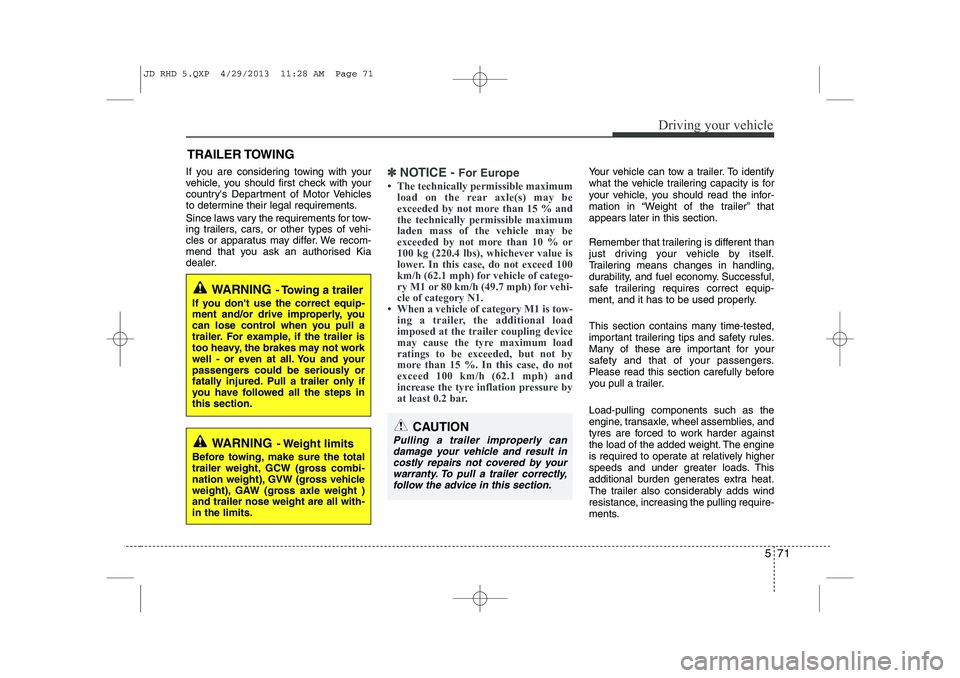
If you are considering towing with your
vehicle, you should first check with your
country's Department of Motor Vehicles
to determine their legal requirements.
Since laws vary the requirements for tow-
ing trailers, cars, or other types of vehi-
cles or apparatus may differ. We recom-
mend that you ask an authorised Kia
dealer.✽✽NOTICE - For Europe
Page 1022 of 1206
573
Driving your vehicle
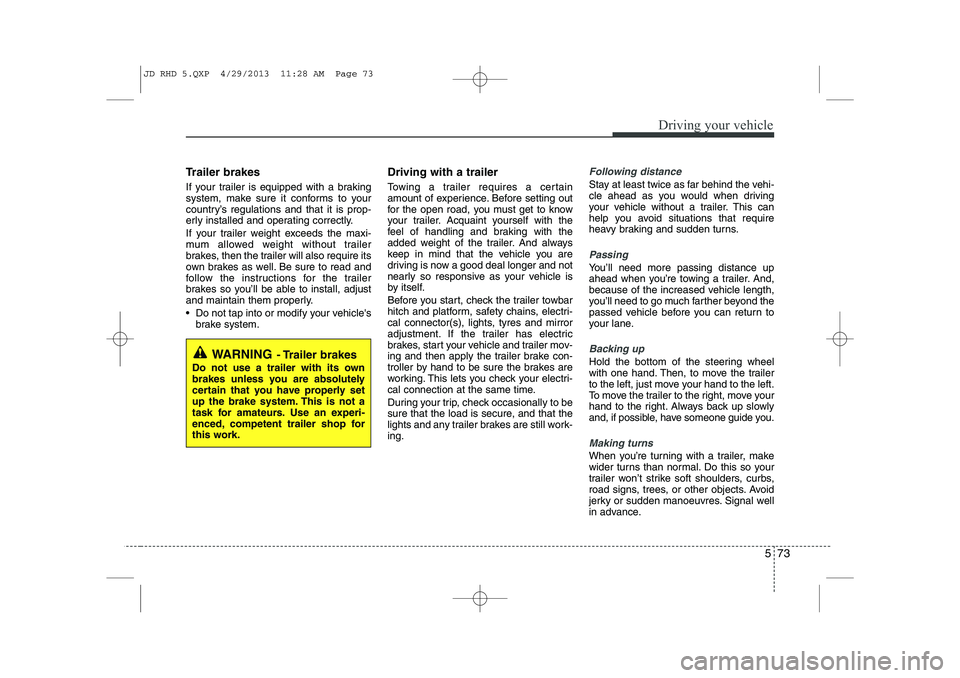
Trailer brakes
If your trailer is equipped with a braking
system, make sure it conforms to your
country’s regulations and that it is prop-
erly installed and operating correctly.
If your trailer weight exceeds the maxi-
mum allowed weight without trailer
brakes, then the trailer will also require its
own brakes as well. Be sure to read and
follow the instructions for the trailer
brakes so you’ll be able to install, adjust
and maintain them properly.
Do not tap into or modify your vehicle'sbrake system. Driving with a trailer
Towing a trailer requires a certain
amount of experience. Before setting out
for the open road, you must get to know
your trailer. Acquaint yourself with the
feel of handling and braking with the
added weight of the trailer. And always
keep in mind that the vehicle you are
driving is now a good deal longer and not
nearly so responsive as your vehicle is
by itself.
Before you start, check the trailer towbar
hitch and platform, safety chains, electri-
cal connector(s), lights, tyres and mirror
adjustment. If the trailer has electric
brakes, start your vehicle and trailer mov-
ing and then apply the trailer brake con-
troller by hand to be sure the brakes are
working. This lets you check your electri-
cal connection at the same time.
During your trip, check occasionally to be
sure that the load is secure, and that the
lights and any trailer brakes are still work-ing.Following distance
Stay at least twice as far behind the vehi-
cle ahead as you would when driving
your vehicle without a trailer. This can
help you avoid situations that require
heavy braking and sudden turns.
Passing
You’ll need more passing distance up
ahead when you’re towing a trailer. And,
because of the increased vehicle length,
you’ll need to go much farther beyond the
passed vehicle before you can return to
your lane.
Backing up
Hold the bottom of the steering wheel
with one hand. Then, to move the trailer
to the left, just move your hand to the left.
To move the trailer to the right, move your
hand to the right. Always back up slowly
and, if possible, have someone guide you.
Making turns
When you’re turning with a trailer, make
wider turns than normal. Do this so your
trailer won’t strike soft shoulders, curbs,
road signs, trees, or other objects. Avoid
jerky or sudden manoeuvres. Signal well
in advance.
WARNING
- Trailer brakes
Do not use a trailer with its own
brakes unless you are absolutely
certain that you have properly set
up the brake system. This is not a
task for amateurs. Use an experi-
enced, competent trailer shop for
this work.
JD RHD 5.QXP 4/29/2013 11:28 AM Page 73
Page 1023 of 1206
Driving your vehicle
74
5
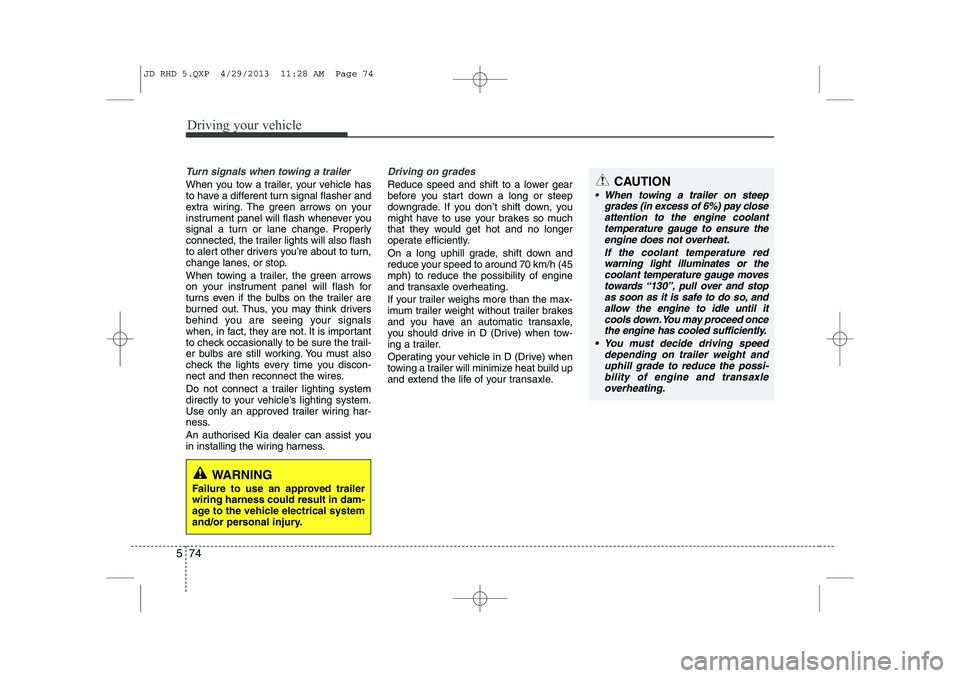
Turn signals when towing a trailer
When you tow a trailer, your vehicle has
to have a different turn signal flasher and
extra wiring. The green arrows on your
instrument panel will flash whenever you
signal a turn or lane change. Properly
connected, the trailer lights will also flash
to alert other drivers you’re about to turn,
change lanes, or stop.
When towing a trailer, the green arrows
on your instrument panel will flash for
turns even if the bulbs on the trailer are
burned out. Thus, you may think drivers
behind you are seeing your signals
when, in fact, they are not. It is important
to check occasionally to be sure the trail-
er bulbs are still working. You must also
check the lights every time you discon-
nect and then reconnect the wires.
Do not connect a trailer lighting system
directly to your vehicle’s lighting system.
Use only an approved trailer wiring har-
ness.
An authorised Kia dealer can assist you
in installing the wiring harness.
Driving on grades
Reduce speed and shift to a lower gear
before you start down a long or steep
downgrade. If you don’t shift down, you
might have to use your brakes so much
that they would get hot and no longer
operate efficiently.
On a long uphill grade, shift down and
reduce your speed to around 70 km/h (45mph) to reduce the possibility of engine
and transaxle overheating.
If your trailer weighs more than the max-
imum trailer weight without trailer brakes
and you have an automatic transaxle,
you should drive in D (Drive) when tow-
ing a trailer.
Operating your vehicle in D (Drive) when
towing a trailer will minimize heat build up
and extend the life of your transaxle.
WARNING
Failure to use an approved trailer wiring harness could result in dam-
age to the vehicle electrical system
and/or personal injury.
CAUTION
When towing a trailer on steep grades (in excess of 6%) pay close
attention to the engine coolant temperature gauge to ensure theengine does not overheat.
If the coolant temperature redwarning light illuminates or the coolant temperature gauge movestowards “130”, pull over and stop as soon as it is safe to do so, and
allow the engine to idle until it cools down. You may proceed oncethe engine has cooled sufficiently.
You must decide driving speed depending on trailer weight anduphill grade to reduce the possi- bility of engine and transaxleoverheating.
JD RHD 5.QXP 4/29/2013 11:28 AM Page 74