2014 JEEP RENEGADE warning
[x] Cancel search: warningPage 80 of 212

As soon as a speed threshold of 8
km/h is maintained for more than 10
continuous seconds (or 50
discontinuous seconds), with driver
side seat belt or the passenger side
seat belt (with occupant seated)
unfastened, an acoustic signal is
activated simultaneously with warning
light
flashing for about 105 seconds.
When this cycle of warnings is activated
it will stay on for its entire length
(regardless of the vehicle speed) or until
the seat belts are fastened again.
When the reverse is engaged, during
the cycle of warnings, the acoustic
signal is deactivated and the
warning
light turns on constantly. The cycle of
warnings will be reactivated as soon as
speed exceeds 8 km/h again.
Operation of rear seat belt
icons
The icons are shown on the display (fig.
67 versions with multifunction display
or fig. 68 versions with reconfigurable
multifunction display) after a few
seconds have elapsed since when the
ignition device is turned to MAR.
The icons turn off at least 30 seconds
after the doors have been closed or
after a change in the seat belt fastening
status.
The icons shown on the display
indicate:
❒A: rear left seat belt;
❒B: rear central seat belt;
❒C: rear right seat belt.
NOTE On versions equipped with
multifunction display, if a seat belt is
unfastened, icon
lights up.The icons are displayed according to
the corresponding seat belts in the rear
seats, and stay on for about 30
seconds from the last seat belt status
change:
❒if the seat belt is fastenedthe
corresponding icon will be green;
❒if the seat belt is unfastenedthe
corresponding icon will be red.
0 204060
140120 100 80
km/h
MPH
66J0A0330C
12 0120
04/07/2014
1230 KM
CHE F
KM/H
68J0A0245C
67J0A0240C
78
SAFETY
Page 81 of 212

If the rear seat belt is unfastened, an
acoustic warning (3 "beeps") will be
activated along with the relevant icon
lighting up in the display.
Furthermore the icons will light up again
for 90 seconds each time one of the
rear doors is closed.
The icon will turn green after the
corresponding seat has been fastened.
The rear seat icons will go out,
regardless of the state of the belt (red
icon or green icon), approximately
30 seconds after the last signal.
IMPORTANT
As far as the rear seats are concerned,
the SBR system will only indicate
whether the seat belts are unfastened
(red icon) or fastened (green icon),
not the presence of any passengers.
The warning lights/icons are all off if all
seat belts (front and rear) are fastened
when the ignition device is at MAR.
For the rear seats, the icons will
activate after a few seconds after the
ignition device has been turned to
MAR, regardless of the status of the
seat belts (even if the seat belts are all
fastened).
All the warning lights/icons will come on
when at least one belt changes from
fastened to unfastened status or vice
versa.
PRETENSIONERS
79) 80) 81) 82)33)
The vehicle is equipped with front seat
belt pretensioners, which draw back
the seat belts by several centimetres in
the event of a strong frontal impact.
This guarantees the perfect adherence
of the seat belts to the occupant's
bodies before the retention action
begins.
It is evident that the pretensioners have
been activated when the belt withdraws
toward the retractor.
This vehicle is also equipped with a
second pretensioner (fitted in the kick
plate area). Its activation is signalled by
the shortening of the metal cable.
A slight discharge of smoke may be
produced during the activation of the
pretensioner which is not harmful and
does not indicate any fire hazard.
The pretensioner does not require any
maintenance or lubrication: any
changes to its original conditions will
invalidate its efficiency.
If, due to unusual natural events (floods,
sea storms, etc.), the device has been
affected by water and/or mud, contact
a Jeep Dealership to have it replaced.IMPORTANT To obtain the highest
degree of protection from the action of
the pretensioner, wear the seat belt
tight to the torso and pelvis.
LOAD LIMITERS
To increase safety in the event of an
accident, the front seat belt retractors
contain a load limiter which controls the
force acting on the chest and
shoulders during the belt restraining
action in the event of a head-on
collision.
GENERAL
INSTRUCTIONS FOR
USING THE SEAT BELTS
Respect and ensure that all the other
occupants of the vehicle comply with
the local laws in force regarding the use
of seat belts. Always fasten the seat
belts before setting off.
Seat belts must also be worn by
pregnant women: the risk of injury in
the event of an accident is reduced for
them and the unborn child if they are
wearing a seat belt.
79
Page 83 of 212

WARNING
79)The pretensioner may be used only
once. Contact a Jeep Dealership to have it
replaced after it has been deployed.
80)Removing or otherwise tampering with
seat belt and pretensioner components
is strictly prohibited. Any operations on
these components must be performed by
qualified and authorised technicians.
Always contact a Jeep Dealership.
81)For maximum safety, keep the back of
your seat upright, lean back into it and
make sure the seat belt fits closely across
your torso and pelvis. Always fasten the
seat belts for both the front and rear seats!
Travelling without wearing seat belts will
increase the risk of serious injury and even
death in the event of an accident.
82)If the belt has been subjected to high
levels of stress, for example after an
accident, it should be changed completely
together with the attachments, attachment
fixing screws and the pretensioner. In
fact, even if the belt has no visible defects,
it may have lost its resilience.
WARNING
33)Operations which lead to impacts,
vibrations or localised heating (over 100°C
for a maximum of six hours) in the area
around the pretensioner may damage or
deploy it. Contact a Jeep Dealership
should intervention be necessary on these
components.
CHILD PROTECTION
SYSTEMS
CARRYING CHILDREN
SAFELY
83) 84) 85) 86)
For optimal protection in the event of an
impact, all occupants must be seated
and wearing adequate restraint
systems, including newborn and other
children! This prescription is
compulsory in all EC countries
according to EC Directive 2003/20/EC.
Children below the height of 1.50
metres and until 12 years, must be
protected with suitable restraint
systems and be seated on the rear
seats.
Statistics on accidents indicate that the
rear seats give a better performance
when protecting children safety.
Compared with an adult, a child's head
is larger and heavier in proportion to
their body and the child's muscular and
bone structures are not fully developed.
Therefore, correct restraint systems
other than adult seat belts are
necessary to reduce as much as
possible the risk of injuries in the event
of an accident, braking or sudden
manoeuvre.Children must be seated safely and
comfortably. Depending on the
characteristics of the child restraint
systems used, you are advised to keep
children in rearward facing child
restraint systems for as long as
possible (at least until 3–4 years old),
since this is the most protected position
in the event of an impact.
The choice of the most suitable child
restraint device depends on the weight
and size of the child. There are various
types of child restraint systems, which
can be secured to the vehicle by means
of the seat belts or with the ISOFIX/i-
Size anchorages.
It is recommended to always choose
the restraint system most suitable
for the child; for this reason always refer
to the Owner Handbook provided with
the child restraint system, to be sure
that it is of the right type for the children
it is intended for.
In Europe the characteristics of child
restraint systems are ruled by the
regulation ECE-R44, dividing them into
five weight groups:
Group Weight range
Group0 upto10kg
Group 0+ up to 13 kg
Group 1 9–18 kg
81
Group 2 15–25 kg
Group 3 22-36 kg
Page 92 of 212

Weight group Child restraint system Type of child restraint system Child restraint system installation
Group 2: from 15 kg
to 36 kgFair Junior Fix
Type-approval number: E4
04443721It can only be fitted facing forwards,
using the three-point seat belt and the
ISOFIX anchorages of the vehicle, if
present.
IMPORTANT Jeep recommends fitting the child restraint system according to the instructions, which must be included.
Main recommendations to carry
children safely
❒Install the child restraint systems on
the rear seat, which is the most
protected position in the event of an
impact.
❒Keep children in rearward facing child
restraint systems for as long as
possible, until 3–4 years old if possible.
❒If the passenger's front airbag is
deactivated always check the
dedicated warning light on the panel
located on the dashboard to make sure
that it has actually been deactivated.❒Carefully follow the child restraint
manufacturer's instruction supplied with
the child restraint system. Keep the
instructions in the vehicle along with the
other documents and this handbook.
Do not use second-hand child restraint
systems without instructions.
❒Only one child is to be strapped into
each restraint system; never carry
two children using one child restraint
system.
❒Always check that the seat belts do
not rest on the child’s neck.
❒Always check that the seat belt is
well fastened by pulling on it.
❒While travelling, do not let the child sit
incorrectly or unfasten the belts.
❒Never allow a child to put the belt's
diagonal section under an arm or
behind their back.❒Never carry children on your lap,
even newborns. No-one could restrain
them in the event of an accident.
❒In the event of an accident, replace
the child restraint system with a new
one.
WARNING
83)SEVERE DANGER When a front
passenger airbag is fitted, do not install
rearward facing child restraint systems on
the front passenger seat. Deployment of
the airbag in an accident could cause fatal
injuries to the baby regardless of the
severity of the collision. It is advisable to
always carry children in a child restraint
system on the rear seat, which is the most
protected position in the event of an
impact.
90
SAFETY
Page 96 of 212
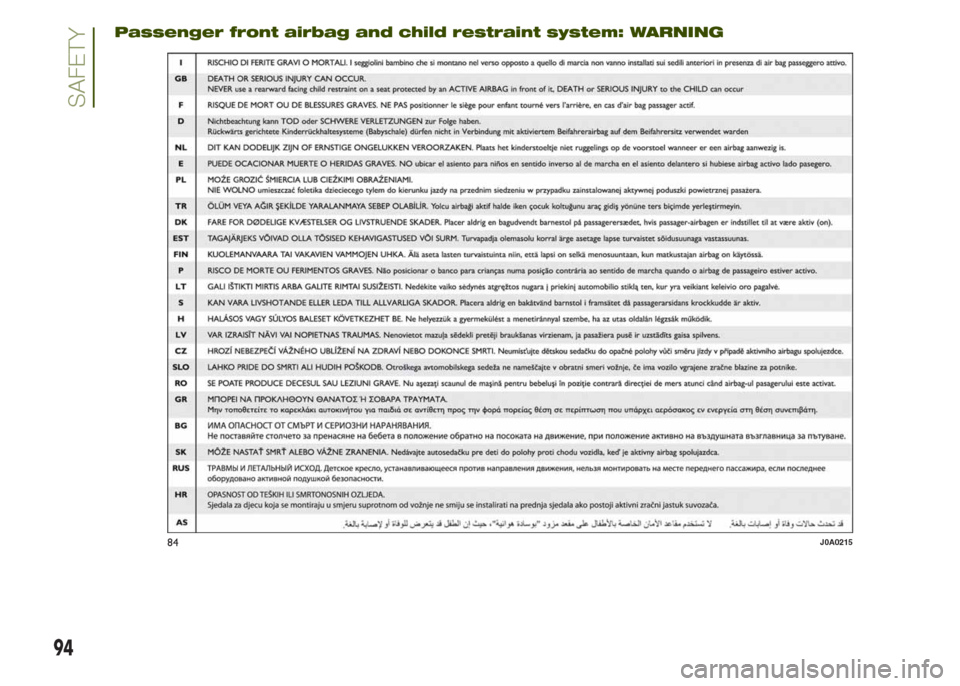
Passenger front airbag and child restraint system: WARNING
84J0A0215
94
SAFETY
Page 98 of 212

WARNING
94)Do not apply stickers or other objects
on the steering wheel, on the dashboard in
the passenger side airbag area, on side
upholstery on the roof or on the seats.
Never put objects (e.g. mobile phones) on
the passenger's side dashboard since
they could interfere with correct inflation of
the airbag and also cause serious injury
to the passengers.
95)Always drive keeping your hands on
the steering wheel rim so that the airbag
can inflate freely if necessary. Do not drive
with your body bent forward. Keep your
back straight against the backrest.
96)When an active passenger airbag is
fitted, DO NOT install rearward facing child
restraint systems on the front passenger
seat. Deployment of the airbag in an
accident could cause fatal injuries to the
child regardless of the severity of the
impact. Therefore, always deactivate the
passenger side airbag when a rearward
facing child restraint system is installed on
the front passenger seat. The front
passenger seat must also be positioned
back as far as possible in order to prevent
the child restraint system from coming
into contact with the dashboard.
Immediately reactivate the passenger
airbag as soon as the child restraint system
has been removed.
97)Do not hook rigid objects to the coat
hooks and to the support handles.100)If the
warning light does not
switch on when the ignition device is
moved to MAR or if it stays on when
driving, there might be a fault in the
restraint systems; in this case, the airbags
or pretensioners may not deploy in the
event of an accident or, in a lower number
of cases, they could deploy erroneously.
Before proceeding, contact a Jeep
Dealership immediately to have the system
checked.
101)On some versions, if the
OFFLED
(located on the dashboard panel) is faulty,
warning light
lights up in the instrument
panel.
102)If a side bag is present, do not cover
the front seat backrests with extra covers.
103)Do not travel carrying objects in
your lap, in front of your chest or between
your lips (pipe, pencils, etc.). They could
cause severe injury if the airbag is
deployed.
104)If the has been subject to theft,
attempted theft, vandalism, or flooding,
have the airbag system inspected at a
Jeep Dealership.105)If the ignition device is at MAR, even if
the engine is switched off, airbags may
be deployed when the vehicle is stationary
and hit by another vehicle. Therefore,
even if the vehicle is stationary, when an
active front passenger airbag is fitted, DO
NOT install rearward facing child restraint
systems on the front passenger seat.
Deployment of the airbag following an
impact could cause fatal injuries to the
child. Therefore, always deactivate the
passenger side airbag when a rearward
facing child restraint system is installed on
the front passenger seat. The front
passenger seat must also be positioned
back as far as possible in order to prevent
the child restraint system from coming
into contact with the dashboard.
Immediately reactivate the passenger
airbag as soon as the child restraint system
has been removed. Finally, remember that
if the ignition device is at STOP, no safety
device (airbags or pretensioners) will
activate following an impact; therefore if
these devices do not activate this cannot
be considered as signal of the system
malfunction.
106)If the airbag failure warning light is
faulty this will be signalled by an airbag
failure icon lighting up in the instrument
panel display with a dedicated message.
The pyrotechnic charges are not disabled.
Before proceeding, contact a Jeep
Dealership immediately to have the system
checked.
107)The front airbag deployment threshold
is higher than that of the pretensioners.
When the impact is between the two
deployment thresholds, it is normal that
pretensioners only are engaged.
96
SAFETY
98)Do not rest your head, arms or elbows
on the door, windows or the area in which
the window bag is located to avoid
possible injury during inflation.
99)
elbows out of the windowNever lean head, arms and
Page 100 of 212

STARTING AND DRIVING
Let’s get to the "heart" of the vehicle:
seeing how you can exploit all of its
potential to the full.
We’ll look at how to drive it safely in any
situation, so that it can be a welcome
companion, with our comfort and
our wallets in mind.STARTING THE ENGINE ................. 99
ELECTRIC PARKING BRAKE (EPB).100
MANUAL GEARBOX .......................103
AUTOMATIC TRANSMISSION.........103
STOP/START SYSTEM ...................106
SPEED LIMITER ..............................107
ELECTRONIC CRUISE CONTROL ..108
FOUR WHEEL DRIVE - JEEP
ACTIVE DRIVE (4WD) AND JEEP
ACTIVE DRIVE LOW (4WD LOW) ....109
SELEC-TERRAIN ............................111
PARKSENSE SYSTEM ....................112
LANESENSE SYSTEM (LANE
CROSSING WARNING) ...................114
REAR CAMERA (PARKVIEW®
REAR BACKUP CAMERA) ..............115
TOWING TRAILERS ........................117
REFUELLING THE VEHICLE ...........120
98
STARTING AND DRIVING
Page 101 of 212

STARTING THE
ENGINE
Before starting the engine, adjust the
seat, the interior rear view mirrors,
the door mirrors and fasten the seat
belt correctly.
Never press the accelerator pedal for
starting the engine.
If necessary, messages indicating the
starting procedure can be shown on
the display.
109) 110) 111)34) 35) 36) 37)
PROCEDURE FOR
VERSIONS WITH MANUAL
GEARBOX
Proceed as follows:
❒engage the electric parking brake
and place the gear lever in neutral;
❒bring the ignition device to MAR. On
Diesel versions, waning light
lights
up in the instrument panel: wait for the
warning light to switch off;
❒fully depress the clutch pedal without
touching the accelerator;
❒turn the ignition device to AVV and
release it as soon as the engine starts;❒if the engine does not start within 10
seconds, bring the ignition device
back to STOP and wait for 10-15
seconds before repeating the starting
procedure.
PROCEDURE FOR
VERSIONS WITH
AUTOMATIC
TRANSMISSION
Proceed as follows:
❒engage the electric parking brake
and place the gear lever to P (Park) or
N (Neutral);
❒fully depress the brake pedal without
touching the accelerator;
❒place the ignition device to AVV;
❒if the engine does not start, bring the
ignition device back to STOP and
wait for 10-15 seconds before
repeating the starting procedure.
IMPORTANT If, with the ignition device
at MAR, the
symbol on the
instrument panel stays on together with
warning light
, turn the ignition
device to STOP and then back to MAR.
If the warning light (or the symbol on
the display) remains on, try with the
other keys provided with the vehicle.
Contact a Jeep Dealership if the engine
still does not start.
STOPPING THE ENGINE
Proceed as follows:
❒park the car in a position that is not
dangerous for oncoming traffic; engage
a gear (versions with manual gearbox)
or position the gear lever to P (Parking)
(versions with automatic transmission);
❒turn the ignition device to STOP
with the engine idling.
Cars equipped with electronic key
(Keyless Enter-N-Go):at a car speed
over 8 km/h (5 mph) it is possible to
switch the engine off, also with
automatic transmission lever in a
position other than P (Parking). To
switch off the engine in this situation,
hold down the ignition device button for
a while or press it 3 times in a row
within a few seconds. In this case the
engine will stop and the ignition device
will switch to MAR.
WARNING
109)It is dangerous to run the engine in
enclosed areas. The engine takes in
oxygen and releases carbon dioxide,
carbon monoxide and other toxic gases.
110)The brake servo is not active until the
engine is started, so you would need to
apply much more force than usual to the
brake pedal.
99