Page 113 of 615
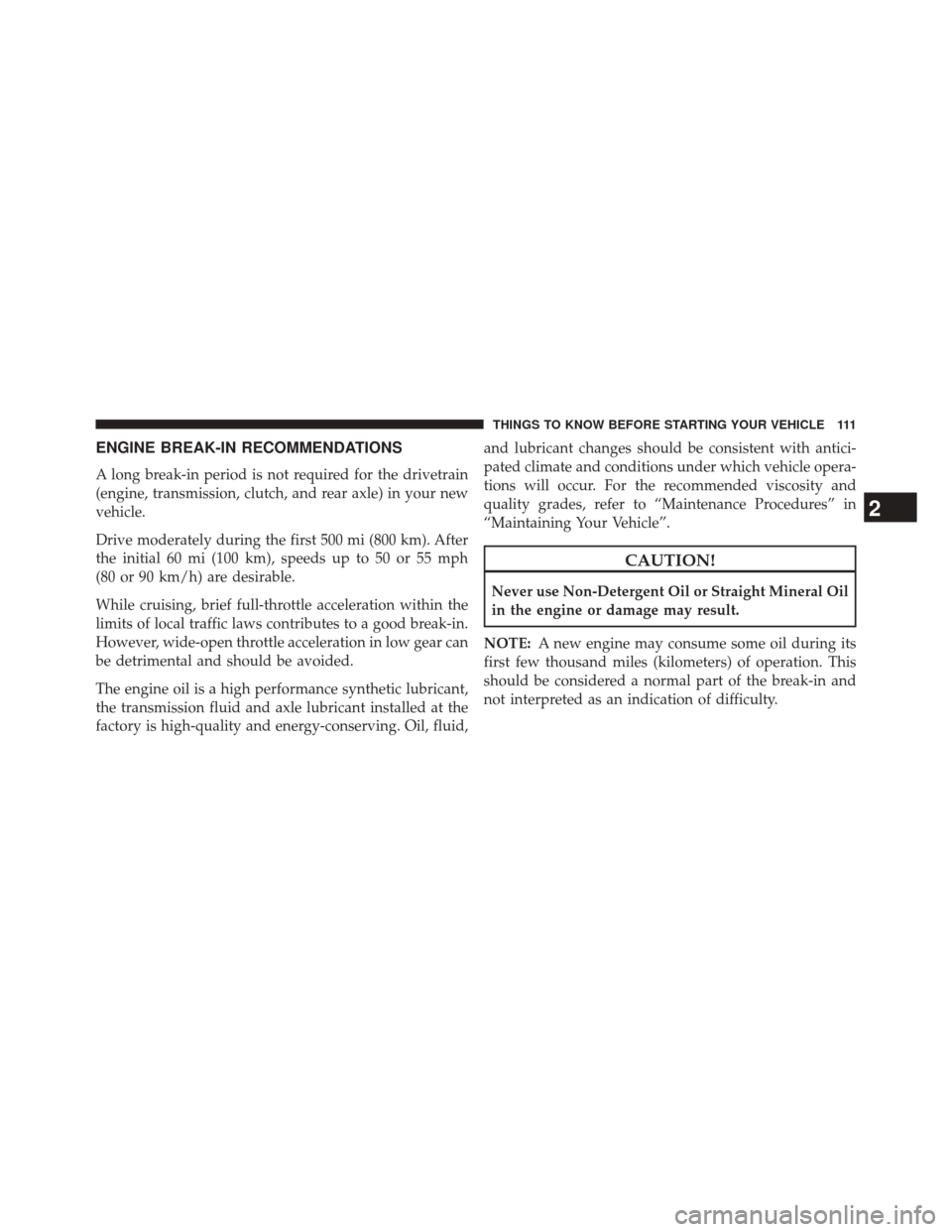
ENGINE BREAK-IN RECOMMENDATIONS
A long break-in period is not required for the drivetrain
(engine, transmission, clutch, and rear axle) in your new
vehicle.
Drive moderately during the first 500 mi (800 km). After
the initial 60 mi (100 km), speeds up to 50 or 55 mph
(80 or 90 km/h) are desirable.
While cruising, brief full-throttle acceleration within the
limits of local traffic laws contributes to a good break-in.
However, wide-open throttle acceleration in low gear can
be detrimental and should be avoided.
The engine oil is a high performance synthetic lubricant,
the transmission fluid and axle lubricant installed at the
factory is high-quality and energy-conserving. Oil, fluid,and lubricant changes should be consistent with antici-
pated climate and conditions under which vehicle opera-
tions will occur. For the recommended viscosity and
quality grades, refer to “Maintenance Procedures” in
“Maintaining Your Vehicle”.
CAUTION!
Never use Non-Detergent Oil or Straight Mineral Oil
in the engine or damage may result.
NOTE: A new engine may consume some oil during its
first few thousand miles (kilometers) of operation. This
should be considered a normal part of the break-in and
not interpreted as an indication of difficulty.
2
THINGS TO KNOW BEFORE STARTING YOUR VEHICLE 111
Page 416 of 615

CAUTION!(Continued)
•Driving through standing water may cause damage
to your vehicle’s drivetrain components. Always
inspect your vehicle’s fluids (i.e., engine oil, trans-
mission, axle, etc.) for signs of contamination (i.e.,
fluid that is milky or foamy in appearance) after
driving through standing water. Do not continue to
operate the vehicle if any fluid appears contami-
nated, as this may result in further damage. Such
damage is not covered by the New Vehicle Limited
Warranty.
• Getting water inside your vehicle’s engine can
cause it to lock up and stall out, and cause serious
internal damage to the engine. Such damage is not
covered by the New Vehicle Limited Warranty.
POWER STEERING
The standard power steering system will give you good
vehicle response and increased ease of maneuverability
in tight spaces. The system will provide mechanical
steering capability if power assist is lost.
If for some reason the power assist is interrupted, it will
still be possible to steer your vehicle. Under these condi-
tions, you will observe a substantial increase in steering
effort, especially at very low vehicle speeds and during
parking maneuvers.
NOTE:
• Increased noise levels at the end of the steering wheel
travel are considered normal and do not indicate that
there is a problem with the power steering system.
• Upon initial start-up in cold weather, the power steer-
ing pump may make noise for a short amount of time.
414 STARTING AND OPERATING
Page 471 of 615

Curb Weight
The curb weight of a vehicle is defined as the total weight
of the vehicle with all fluids, including vehicle fuel, at full
capacity conditions, and with no occupants or cargo loaded
into the vehicle. The front and rear curb weight values are
determined by weighing your vehicle on a commercial
scale before any occupants or cargo are added.
Loading
The actual total weight and the weight of the front and
rear of your vehicle at the ground can best be determined
by weighing it when it is loaded and ready for operation.
The entire vehicle should first be weighed on a commer-
cial scale to insure that the GVWR has not been exceeded.
The weight on the front and rear of the vehicle should
then be determined separately to be sure that the load is
properly distributed over the front and rear axle. Weigh-
ing the vehicle may show that the GAWR of either thefront or rear axles has been exceeded but the total load is
within the specified GVWR. If so, weight must be shifted
from front to rear or rear to front as appropriate until the
specified weight limitations are met. Store the heavier
items down low and be sure that the weight is distributed
equally. Stow all loose items securely before driving.
Improper weight distributions can have an adverse effect
on the way your vehicle steers and handles and the way
the brakes operate.
CAUTION!
Do not load your vehicle any heavier than the GVWR
or the maximum front and rear GAWR. If you do,
parts on your vehicle can break, or it can change the
way your vehicle handles. This could cause you to
lose control. Also overloading can shorten the life of
your vehicle.
5
STARTING AND OPERATING 469
Page 511 of 615
MAINTAINING YOUR VEHICLE
CONTENTS
�ENGINE COMPARTMENT — 6.4L ..........511
� ONBOARD DIAGNOSTIC SYSTEM (OBD II) . . .512
� EMISSIONS INSPECTION AND
MAINTENANCE PROGRAMS .............512
� REPLACEMENT PARTS ..................514
� DEALER SERVICE ..................... .514
� MAINTENANCE PROCEDURES ...........515
▫ Engine Oil ......................... .516
▫ Engine Oil Filter ..................... .519
▫ Engine Air Cleaner Filter ................519 ▫
Maintenance-Free Battery ...............520
▫ Air Conditioner Maintenance .............521
▫ Body Lubrication .....................524
▫ Windshield Wiper Blades ...............524
▫ Adding Washer Fluid ..................526
▫ Exhaust System ..................... .527
▫ Cooling System ..................... .530
▫ Brake System ....................... .536
▫ Front/Rear Axle Fluid ..................538
▫ Transfer Case ....................... .539
7
Page 540 of 615

WARNING!(Continued)
•Do not allow petroleum based fluid to contaminate
the brake fluid. Brake seal components could be
damaged, causing partial or complete brake failure.
This could result in a collision.
Front/Rear Axle Fluid
For normal service, periodic fluid level checks are not
required. When the vehicle is serviced for other reasons the
exterior surfaces of the axle assembly should be inspected.
If gear oil leakage is suspected inspect the fluid level. Refer
to “Fluids, Lubricants, and Genuine Parts” in “Maintaining
Your Vehicle” for further information.
Front Axle Fluid Level Check
The front axle oil level needs to be no lower than 1/8 in
(3 mm) below the bottom of the fill hole. The front axle fill and drain plugs should be tightened to
22 to 29 ft lbs (30 to 40 N·m).
CAUTION!
Do not overtighten the plugs as it could damage them
and cause them to leak.
Rear Axle Fluid Level Check
The rear axle oil level needs to be no lower than 1/8 in
(3 mm) below the bottom of the fill hole.
The rear axle fill and drain plugs should be tightened to
22 to 29 ft lbs (30 to 40 N·m) on axles with aluminum
housings. The rear axle fill and drain plugs should be
tightened to 22 to 52 ft lbs (30 to 70 N·m) on axles with
cast iron housings.
538 MAINTAINING YOUR VEHICLE
Page 567 of 615
Chassis
ComponentFluid, Lubricant or Genuine Part
Automatic Transmission Use only MOPAR® ZF 8&9 Speed ATF™ Automatic Transmission Fluid, or equivalent. Failure to use the correct fluid may affect the function or perfor-
mance of your transmission.
Transfer Case We recommend you use MOPAR® ATF+4® Automatic Transmission Fluid.
Front Axle We recommend you use MOPAR® GL-5 Synthetic Axle Lubricant SAE 75W-85.
Rear Axle We recommend you use MOPAR® GL-5 Synthetic Axle Lubricant SAE 75W-85
with friction modifier additive.
Brake Master Cylinder We recommend you use MOPAR® DOT 3 Brake Fluid, SAE J1703. If DOT 3, SAE
J1703 brake fluid is not available, then DOT 4 is acceptable.
Power Steering Reservoir We recommend you use MOPAR® Power Steering Fluid +4, MOPAR® ATF+4® Automatic Transmission Fluid.
7
MAINTAINING YOUR VEHICLE 565
Page 573 of 615

18,000 Miles (30,000 km) or
18 Months Maintenance
Service Schedule
❏Change the engine oil and engine oil
filter.
❏ Rotate the tires, rotate at the first
sign of irregular wear.
Odometer Reading Date
Repair Order #Dealer Code
Signature, Authorized Service Center
24,000 Miles (40,000 km) or 24 Months Maintenance Service
Schedule
❏Change the engine oil and engine oil filter.
❏ Rotate the tires, rotate at the first sign of irregular wear.
❏ If using your vehicle for any of the following: Dusty or off-road conditions. Inspect
the engine air cleaner filter; replace if necessary.
❏ Inspect the brake linings, replace if necessary.
❏ Inspect the CV joints.
❏ Inspect exhaust system.
❏ Inspect the front suspension, tie rod ends and boot seals for cracks or leaks and all
parts for damage, wear, improper looseness or end play; replace if necessary.
❏ Inspect the front and rear axle fluid, change if using your vehicle for police, taxi,
fleet, sustained high speed driving, off-road or frequent trailer towing.
Odometer Reading Date
Repair Order #Dealer Code
Signature, Authorized Service Center
8
M
A I
N T
E
N
A
N
C E
S
C
H E
D
U L
E
SMAINTENANCE SCHEDULES 571
Page 575 of 615
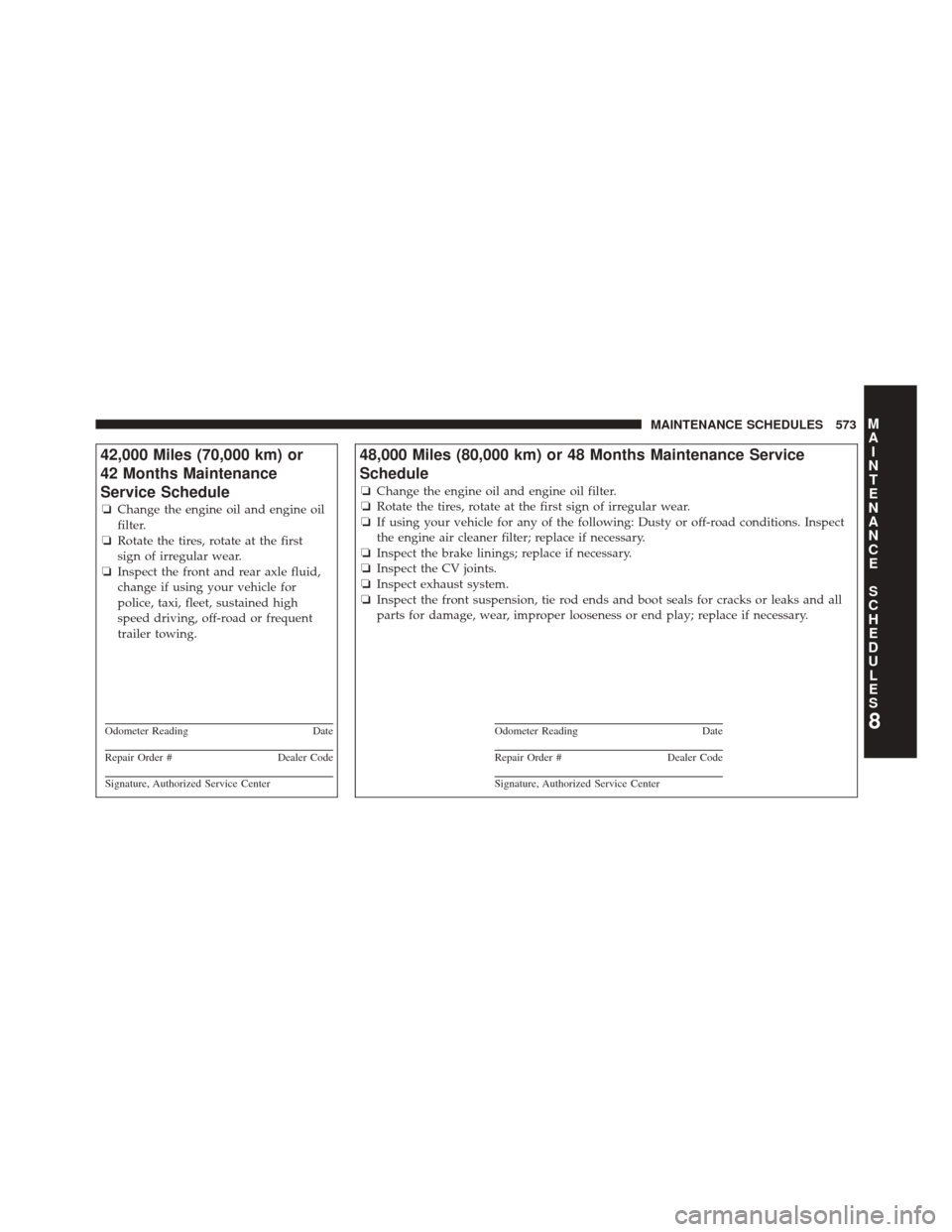
42,000 Miles (70,000 km) or
42 Months Maintenance
Service Schedule
❏Change the engine oil and engine oil
filter.
❏ Rotate the tires, rotate at the first
sign of irregular wear.
❏ Inspect the front and rear axle fluid,
change if using your vehicle for
police, taxi, fleet, sustained high
speed driving, off-road or frequent
trailer towing.
Odometer Reading Date
Repair Order #Dealer Code
Signature, Authorized Service Center
48,000 Miles (80,000 km) or 48 Months Maintenance Service
Schedule
❏Change the engine oil and engine oil filter.
❏ Rotate the tires, rotate at the first sign of irregular wear.
❏ If using your vehicle for any of the following: Dusty or off-road conditions. Inspect
the engine air cleaner filter; replace if necessary.
❏ Inspect the brake linings; replace if necessary.
❏ Inspect the CV joints.
❏ Inspect exhaust system.
❏ Inspect the front suspension, tie rod ends and boot seals for cracks or leaks and all
parts for damage, wear, improper looseness or end play; replace if necessary.
Odometer Reading Date
Repair Order #Dealer Code
Signature, Authorized Service Center
8
M
A I
N T
E
N
A
N
C E
S
C
H E
D
U L
E
SMAINTENANCE SCHEDULES 573

