Page 552 of 690

8. After the NEUTRAL (N) button has been released, thepower transfer unit will shift to the position indicated
by the selector switch.
NOTE: When shifting the power transfer unit out of
NEUTRAL (N), turning the engine OFF may be required
to avoid gear clash.
9. Shift the transmission into PARK.
10. Release the brake pedal.
11. Disconnect vehicle from the tow vehicle.
12. Start the engine.
13. Press and hold the brake pedal.
14. Release the parking brake.
15. Shift the transmission into DRIVE, release the brake pedal, and check that the vehicle operates normally. NOTE:
•
Steps 1 through 5 are requirements that must be met
prior to pressing the NEUTRAL (N) button, and must
continue to be met until the shift has been completed.
If any of these requirements are not met prior to
pressing the NEUTRAL (N) button or are no longer
met during the shift, the NEUTRAL (N) indicator light
will flash continuously until all requirements are met
or until the NEUTRAL (N) button is released.
• The ignition switch must be in the ON/RUN position
for a shift to take place and for the position indicator
lights to be operable. If the ignition switch is not in the
ON/RUN position, the shift will not take place and no
position indicator lights will be on or flashing.
• A flashing NEUTRAL (N) position indicator light
indicates that shift requirements have not been met.
550 STARTING AND OPERATING
Page 629 of 690

Your leather upholstery can be best preserved by regular
cleaning with a damp soft cloth. Small particles of dirt
can act as an abrasive and damage the leather upholstery
and should be removed promptly with a damp cloth.
Stubborn soils can be removed easily with a soft cloth
and MOPAR® Total Clean or equivalent. Care should be
taken to avoid soaking leather upholstery with any
liquid. Please do not use polishes, oils, cleaning fluids,
solvents, detergents, or ammonia-based cleaners to clean
leather upholstery. Application of a leather conditioner is
not required to maintain the original condition.
WARNING!
Do not use volatile solvents for cleaning purposes.
Many are potentially flammable, and if used in
closed areas they may cause respiratory harm.
Cleaning Headlights
Your vehicle is equipped with plastic headlights and fog
lights that are lighter and less susceptible to stone break-
age than glass headlights.
Plastic is not as scratch resistant as glass and therefore
different lens cleaning procedures must be followed.
To minimize the possibility of scratching the lenses and
reducing light output, avoid wiping with a dry cloth. To
remove road dirt, wash with a mild soap solution fol-
lowed by rinsing.
Do not use abrasive cleaning components, solvents, steel
wool or other aggressive material to clean the lenses.
Glass Surfaces
All glass surfaces should be cleaned on a regular basis
with MOPAR® Glass Cleaner, or any commercial
household-type glass cleaner. Never use an abrasive type
7
MAINTAINING YOUR VEHICLE 627
Page 638 of 690
CavityBlade Fuse Cartridge Fuse Description
F66 10 Amp Red —
In Car Temperature Sensor / Humidity
Sensor / Driver Assist System Module
(DASM) / Park Assist (PAM)
F67— —Not Used
F68 — —Not Used
F69 10 Amp Red —Power Transfer Unit Switch (TSBM) / Active
Grill Shutter (AGS) - If Equipped
F70 — —Not Used
F71 20 Amp Yellow —Windshield De-Icer - If Equipped
F72 5 Amp Tan —Intelligent Battery Sensor (IBS) If Equipped
With Stop/Start Engine Option
F72 20 Amp Yellow —Trailer Tow RT Stop / Turn Lights -
If Equipped
F73 —30 Amp Pink Rear Defroster / Defogger
636 MAINTAINING YOUR VEHICLE
Page 640 of 690
CavityBlade Fuse Cartridge Fuse Description
F83 —30 Amp Pink Headlamp Washer Pump - If Equipped
F84 —40 Amp Green Brake System Module (BSM) - Pump Motor
If Equipped With Diesel Engine
F84 —20 Amp Blue Trailer Tow Backup Lights - If Equipped With
Gasoline Engine
F85 — —Not Used
F86 — —Not Used
F87 — —Not Used
F88 15 Amp Blue —Collision Mitigation Module (CMM) /
Electrochromatic Mirror / Smart Camera
Module - If Equipped
F89 10 Amp Red —Headlamp Leveling - If Equipped
F90 — —Not Used
638 MAINTAINING YOUR VEHICLE
Page 646 of 690

NOTE:On vehicles equipped with HID headlamps,
when the headlamps are turned on, there is a blue hue to
the lights. This diminishes and becomes more white after
approximately 10 seconds, as the system charges.
WARNING!
A transient high voltage occurs at the bulb sockets of
HID headlamps when the headlamp switch is turned
ON. It may cause serious electrical shock or electro-
cution if not serviced properly. See your authorized
dealer for service.
Bi-Halogen Headlamps
1. Unlock upper access door in wheel liner.
2. Reach behind the headlamp housing to access the headlamp bulb cap. 3. Firmly grasp the cap and rotate it counterclockwise to
unlock it.
4. Firmly grasp the bulb and connector assembly and rotate counterclockwise to remove from the housing.
5. Disconnect the bulb from the electrical connector and then connect the replacement bulb.
CAUTION!
Do not touch the new bulb with your fingers. Oil
contamination will severely shorten bulb life. If the
bulb comes in contact with any oily surface, clean the
bulb with rubbing alcohol.
6. Install the bulb and connector assembly into the headlamp housing and rotate clockwise to lock it in
place.
644 MAINTAINING YOUR VEHICLE
Page 655 of 690

Once A Month Or Before A Long Trip:
•Check engine oil level.
• Check windshield washer fluid level.
•
Check tire pressure and look for unusual wear or
damage. Rotate tires at the first sign of irregular wear,
even if it occurs before the oil indicator system turns on.
• Check the fluid levels of the coolant reservoir and
brake master cylinder, fill as needed.
• Check function of all interior and exterior lights.
Required Maintenance Intervals.
Refer to the maintenance schedules on the following
page for the required maintenance intervals.
At Every Oil Change Interval As Indicated By Oil Change Indicator System:
•Change oil and filter
• Rotate the tires. Rotate at the first sign of irregu-
lar wear, even if it occurs before the oil indicator
system turns on.
• Inspect battery and clean and tighten terminals as
required
• Inspect brake pads, shoes, rotors, drums, hoses
and park brake
• Inspect engine cooling system protection and
hoses
• Inspect exhaust system
• Inspect engine air cleaner if using in dusty or
off-road conditions
8
M
A I
N T
E
N
A
N
C E
S
C
H E
D
U L
E
SMAINTENANCE SCHEDULES 653
Page 671 of 690

Automatic Headlights..................... .167
Automatic High Beams .....................168
Automatic Temperature Control (ATC) ..........403
Automatic Transaxle ...................... .424
Automatic Transmission ....................426
Adding Fluid ......................... .622
Fluid and Filter Changes ..................622
Fluid Change ......................... .622
Fluid Level Check ...................... .621
Fluid Type ........................... .621
Special Additives ...................... .621
Auto Unlock, Doors ........................36
Auto Up Power Windows ....................45
Auxiliary Electrical Outlet (Power Outlet) ........300
Auxiliary Power Outlet .....................300
Axle Fluid ............................. .650
Axle Lubrication (Axle Fluid) .................650Battery
................................ .604
Keyless Transmitter Replacement (RKE) ........26
Belts, Seat ...............................55
Blind Spot Monitoring ..................... .138
Body Mechanism Lubrication .................607
B-Pillar Location ......................... .488
Brake Assist System ...................... .462
Brake Control System, Electronic ..............459
Brake Fluid ............................ .650
Brakes ................................ .458
Brake System ........................... .458
Anti-Lock (ABS) ....................... .459
Fluid Check .......................... .619
Master Cylinder ....................... .619
Warning Light ........................ .327
Brake/Transmission Interlock .................426
Brightness, Interior Lights ...................174
Bulb Replacement ........................ .642
Bulbs, Light .............................
11910
INDEX 669
Page 673 of 690
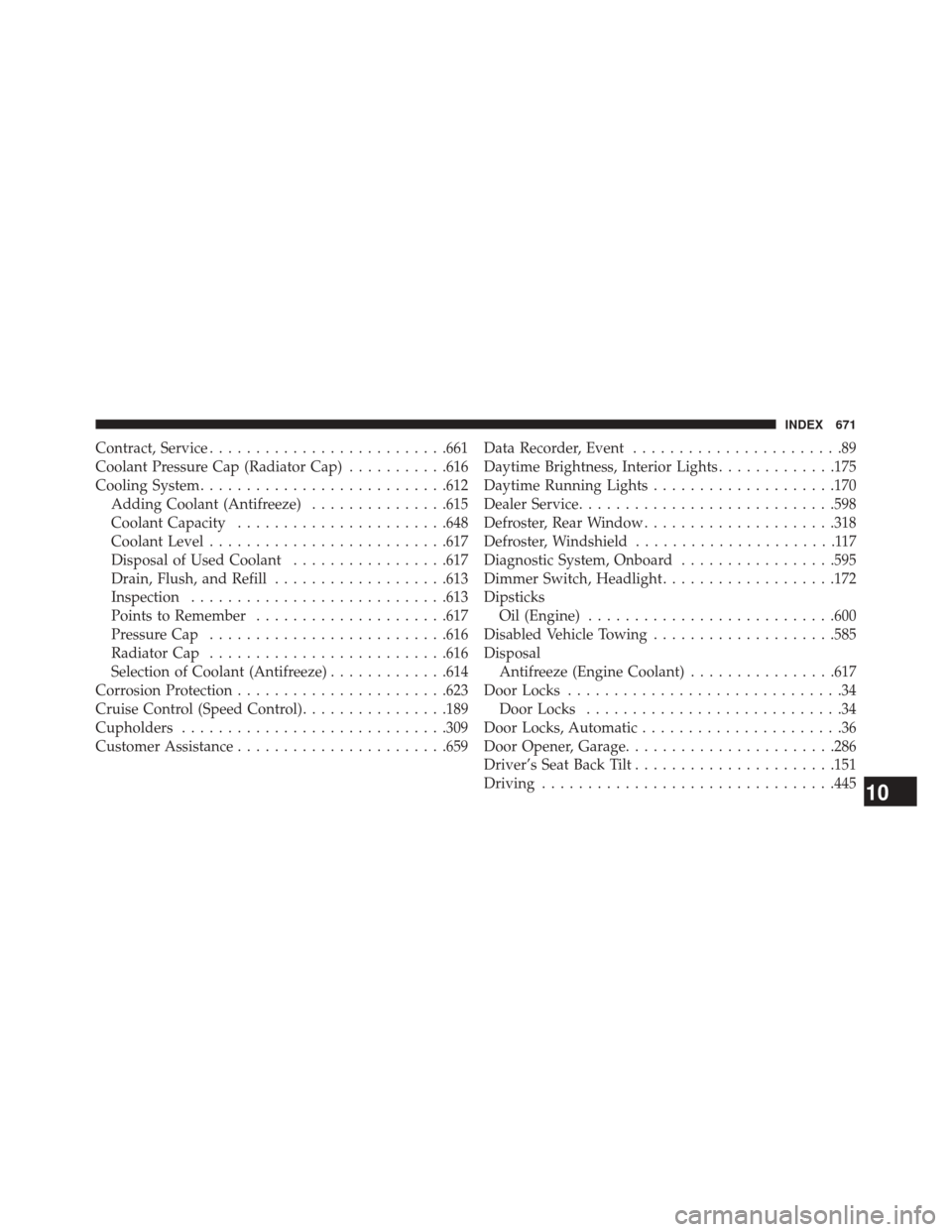
Contract, Service......................... .661
Coolant Pressure Cap (Radiator Cap) ...........616
Cooling System .......................... .612
Adding Coolant (Antifreeze) ...............615
Coolant Capacity ...................... .648
Coolant Level ......................... .617
Disposal of Used Coolant .................617
Drain, Flush, and Refill ...................613
Inspection ........................... .613
Points to Remember .....................617
Pressure Cap ......................... .616
Radiator Cap ......................... .616
Selection of Coolant (Antifreeze) .............614
Corrosion Protection ...................... .623
Cruise Control (Speed Control) ................189
Cupholders ............................ .309
Customer Assistance ...................... .659Data Recorder, Event
.......................89
Daytime Brightness, Interior Lights .............175
Daytime Running Lights ....................170
Dealer Service ........................... .598
Defroster, Rear Window .....................318
Defroster, Windshield ......................117
Diagnostic System, Onboard .................595
Dimmer Switch, Headlight ...................172
Dipsticks Oil (Engine) .......................... .600
Disabled Vehicle Towing ....................585
Disposal Antifreeze (Engine Coolant) ................617
Door Locks ..............................34
Door Locks ............................34
Door Locks, Automatic ......................36
Door Opener, Garage ...................... .286
Driver’s Seat Back Tilt ..................... .151
Driving ............................... .445
10
INDEX 671

