Page 534 of 690

WARNING!
It is important that you do not exceed the maximum
front or rear GAWR. A dangerous driving condition
can result if either rating is exceeded. You could lose
control of the vehicle and have a collision.
Tongue Weight (TW)
The tongue weight is the downward force exerted on the
hitch ball by the trailer. In most cases it should not be less
than 10% of the trailer load. You must consider this as
part of the load on your vehicle.
Frontal Area
The frontal area is the maximum height multiplied by the
maximum width of the front of a trailer.
Trailer Sway Control — Mechanical
The trailer sway control is a telescoping link that can be
installed between the hitch receiver and the trailer tongue
that typically provides adjustable friction associated with
the telescoping motion to dampen any unwanted trailer
swaying motions while traveling.
Weight-Carrying Hitch
A weight-carrying hitch supports the trailer tongue
weight, just as if it were luggage located at a hitch ball or
some other connecting point of the vehicle. These kinds
of hitches are the most popular on the market today and
they are commonly used to tow small and medium sized
trailers.
532 STARTING AND OPERATING
Page 535 of 690

Weight-Distributing Hitch
A weight-distributing system works by applying lever-
age through spring (load) bars. They are typically used
for heavier loads to distribute trailer tongue weight to the
tow vehicle’s front axle and the trailer axle(s). When used
in accordance with the manufacturer’s directions, it pro-
vides for a more level ride, offering more consistent
steering and brake control thereby enhancing towing
safety. The addition of a friction/hydraulic sway control
also dampens sway caused by traffic and crosswinds and
contributes positively to tow vehicle and trailer stability.
Trailer sway control and a weight distributing (load
equalizing) hitch are recommended for heavier Tongue
Weights (TW) and may be required depending on vehicle
and trailer configuration/loading to comply with Gross
Axle Weight Rating (GAWR) requirements.
WARNING!
•An improperly adjusted Weight Distributing Hitch
system may reduce handling, stability, braking
performance, and could result in a collision.
•
Weight Distributing Systems may not be compatible
with Surge Brake Couplers. Consult with your hitch
and trailer manufacturer or a reputable Recreational
Vehicle dealer for additional information.
5
STARTING AND OPERATING 533
Page 536 of 690
Trailer Hitch Classification
The following chart provides the industry standard for
the maximum trailer weight a given trailer hitch class can
tow and should be used to assist you in selecting the
correct trailer hitch for your intended towing condition.
Trailer Hitch Classification DefinitionsClass Max. Trailer Hitch Industry Standards
Class I - Light Duty 2,000 lbs (907 kg)
Class II - Medium Duty 3,500 lbs (1 587 kg) Class III - Heavy Duty 5,000 lbs (2 268 kg)
Trailer Hitch Classification Definitions Class Max. Trailer Hitch Industry Standards
Class IV -
Extra Heavy Duty 10,000 lbs (4 540 kg)
Refer to the “Trailer Towing Weights (Maximum
Trailer Weight Ratings)” chart for the Maximum
Gross Trailer Weight (GTW) towable for your given
drivetrain.
All trailer hitches should be professionally installed
on your vehicle.
534 STARTING AND OPERATING
Page 537 of 690
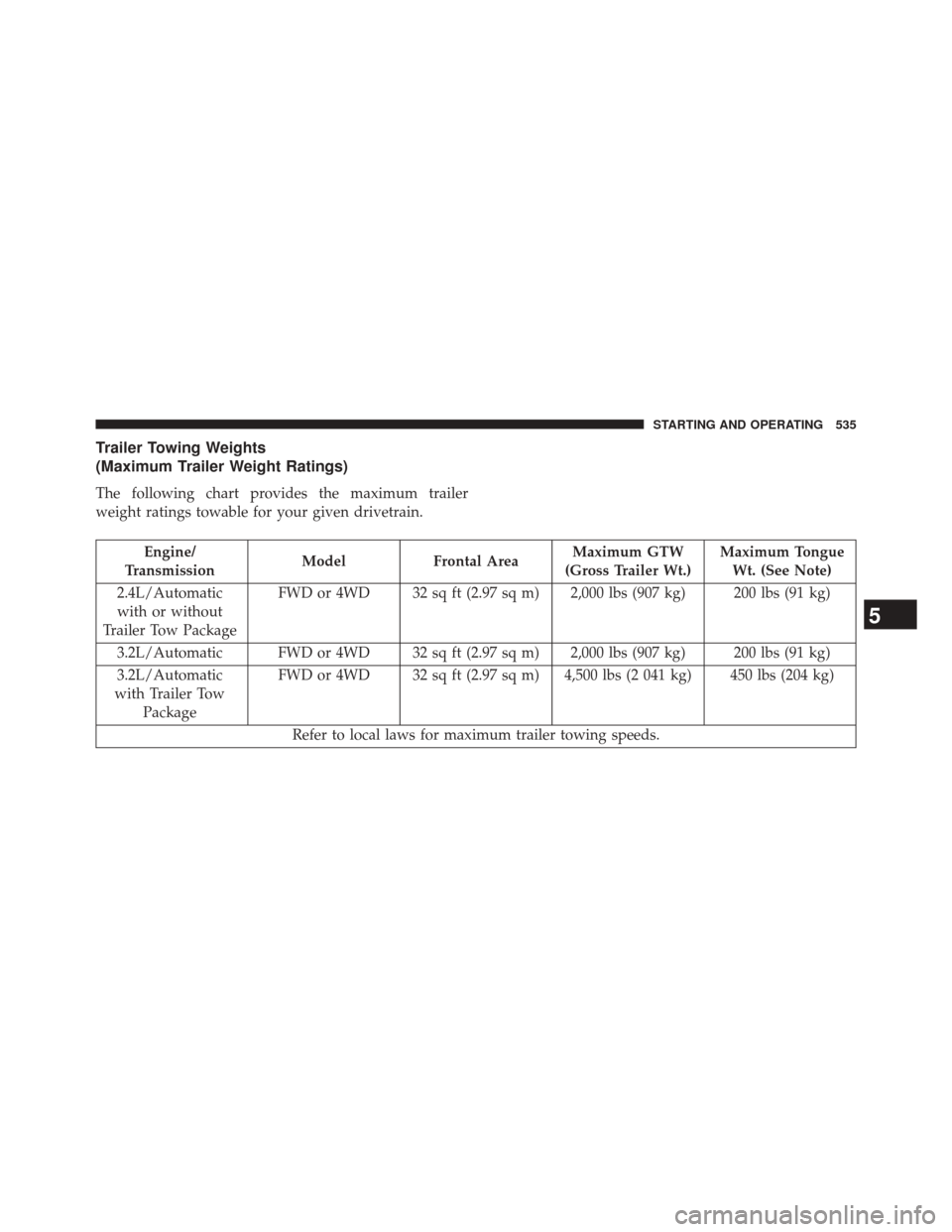
Trailer Towing Weights
(Maximum Trailer Weight Ratings)
The following chart provides the maximum trailer
weight ratings towable for your given drivetrain.
Engine/
Transmission Model
Frontal Area Maximum GTW
(Gross Trailer Wt.) Maximum Tongue
Wt. (See Note)
2.4L/Automatic with or without
Trailer Tow Package FWD or 4WD 32 sq ft (2.97 sq m) 2,000 lbs (907 kg) 200 lbs (91 kg)
3.2L/Automatic FWD or 4WD 32 sq ft (2.97 sq m) 2,000 lbs (907 kg) 200 lbs (91 kg)
3.2L/Automatic
with Trailer Tow Package FWD or 4WD 32 sq ft (2.97 sq m) 4,500 lbs (2 041 kg) 450 lbs (204 kg)
Refer to local laws for maximum trailer towing speeds.
5
STARTING AND OPERATING 535
Page 538 of 690
NOTE:The trailer tongue weight must be considered as
part of the combined weight of occupants and cargo (ie.
the GVWR), and the GVWR should never exceed the
weight referenced on the Tire and Loading Information
placard. Refer to “Tire Safety Information” in “Starting
and Operating” for further information.
Trailer And Tongue Weight
Always load a trailer with 60% to 65% of the weight in
the front of the trailer. This places 10% to 15% of the
Gross Trailer Weight (GTW) on the tow hitch of your
vehicle. Loads balanced over the wheels or heavier in the
rear can cause the trailer to sway severelyside to side
which will cause loss of control of the vehicle and trailer.
Failure to load trailers heavier in front is the cause of
many trailer collisions. Never exceed the maximum tongue weight stamped on
your bumper or trailer hitch.
536 STARTING AND OPERATING
Page 539 of 690

Consider the following items when computing the
weight on the rear axle of the vehicle:
•The tongue weight of the trailer.
• The weight of any other type of cargo or equipment
put in or on your vehicle.
• The weight of the driver and all passengers.
NOTE: Remember that everything put into or on the
trailer adds to the load on your vehicle. Also, additional
factory-installed options or dealer-installed options must
be considered as part of the total load on your vehicle.
Refer to the “Tire and Loading Information” placard for
the maximum combined weight of occupants and cargo
for your vehicle.Towing Requirements
To promote proper break-in of your new vehicle drive-
train components, the following guidelines are recom-
mended:
WARNING!
Improper towing can lead to a collision. Follow these
guidelines to make your trailer towing as safe as
possible:
• Make certain that the load is secured in the trailer
and that it will not shift during travel. When
trailering cargo that is not fully secured, dynamic
load shifts can occur that may be difficult for the
driver to control. You could lose control of your
vehicle and have a collision.
(Continued)
5
STARTING AND OPERATING 537
Page 540 of 690

WARNING!(Continued)
•When hauling cargo, or towing a trailer, do not
overload your vehicle or trailer. Overloading can
cause a loss of control, poor performance, or dam-
age to brakes, axle, engine, transmission, steering,
suspension, chassis structure, or tires.
• Safety chains must always be used between your
vehicle and trailer. Always connect the chains to
the frame or hook retainers of the vehicle hitch.
Cross the chains under the trailer tongue and allow
enough slack for turning corners.
• Vehicles with trailers should not be parked on a
grade. When parking, apply the parking brake on
the tow vehicle. Put the tow vehicle transmission in
PARK. Always, block or �chock�the trailer wheels.
• GCWR must not be exceeded.
(Continued)
WARNING! (Continued)
•Total weight must be distributed between the tow
vehicle and the trailer such that the following four
ratings are not exceeded:
1. GVWR
2. GTW
3. GAWR
4. Tongue weight rating for the trailer hitch uti-
lized.
CAUTION!
• Do not tow a trailer at all during the first 500 miles
(805 km) the new vehicle is driven. The engine, axle
or other parts could be damaged.
(Continued)
538 STARTING AND OPERATING
Page 676 of 690

Filler Cap (Gas Cap).....................525
Gasoline ............................. .519
Gauge .............................. .332
Materials Added ....................... .523
Methanol ............................ .521
Octane Rating ......................... .519
Requirements ......................... .519
Specifications ......................... .649
Tank Capacity ......................... .648
Fuses ................................. .629
Garage Door Opener (HomeLink®) ............286
Gas Cap (Fuel Filler Cap) ...................525
Gasoline, Clean Air ....................... .521
Gasoline (Fuel) .......................... .519
Gasoline, Reformulated .....................521
Gauges Coolant Temperature .....................332
Fuel ................................ .332Speedometer
......................... .330
Tachometer ........................... .326
Gear Ranges ............................ .428
Gear Select Lever Override ..................585
General Information ...................... .212
Glass Cleaning .......................... .627
Gross Axle Weight Rating ...................531
Gross Vehicle Weight Rating ..................530
GVWR ................................ .528
Hazard Warning Flasher ....................553
Headlights Automatic ........................... .167
Bulb Replacement ...................... .644
Cleaning ............................ .627
Delay ............................... .167
High Beam/Low Beam Select Switch .........172
Lights On Reminder .....................170
On With Wipers ....................... .167
674 INDEX