2014 Hyundai Sonata engine
[x] Cancel search: enginePage 4 of 665
F4
FOREWORD
Thank you for choosing HYUNDAI. We are pleased to welcome you to the growing number of discriminating people who
drive HYUNDAI. The advanced engineering and high-quality construction of each HYUNDAI we build is something of
which we're very proud.
Yo u r O w n e r ' s M a n u a l w i l l i n t r o d u c e y o u t o t h e f e a t u r e s a n d o p e r a t i o n o f y o u r n e w H Y U N D A I . I t i s s u g g e s t e d t h a t y o u r e a d
it carefully because the information it contains can contribute greatly to the satisfaction you receive from your new car.
The manufacturer also recommends that service and maintenance on your vehicle be performed by an authorized
HYUNDAI dealer.
HYUNDAI MOTOR COMPANY
Note :Because future owners will also need the information included in this manual, if you sell this HYUNDAI, please
leave the manual in the vehicle for their use. Thank you.
Copyright 2014 HYUNDAI Motor Company. All rights reserved. No part of this publication may be reproduced, stored
in any retrieval system or transmitted in any form or by any means without the prior written permission of HYUNDAI
Motor Company.
Severe engine and transaxle damage may result from the use of poor quality fuels and lubricants that do
not meet HYUNDAI specifications. You must always use high quality fuels and lubricants that meet the
specifications listed on Page 8-6 in the Vehicle Specifications section of the Owner's Manual.
CAUTION
Page 6 of 665

F6
Introduction
NOTICE indicates a situation
which, if not avoided, could result
in vehicle damage.
Gasoline engine
Unleaded
For Europe
For the optimal vehicle perfor mance,
we recommend you use unleaded
gasoline which has an octane rating of
RON (Research Octane Number) 95 /
AKI (Anti Knock Index) 91 or higher.
Yo u m a y u s e u n l e a d e d g a s o l i n e w i t h
an octane rating of RON 91-94 / AKI
87-90 but it may result in slight per-
for mance reduction of the vehicle. (Do
not use methanol blended fuels)
Except Europe
Yo u r n e w v e h i c l e i s d e s i g n e d t o u s e
only unleaded fuel having an Octane
Rating of RON (Research Octane
Number) 91 / AKI (Anti-Knock Index)
87 or higher. (Do not use methanol
blended fuels)
Yo u r n e w v e h i c l e i s d e s i g n e d t o
obtain maximum performance with
UNLEADED FUEL, as well as mini-
mize exhaust emissions and spark
plug fouling.
NOTICE
•Do not "top off" after the noz-
zle automatically shuts off
when refueling.
•Always check that the fuel cap
is installed securely to pre-
vent fuel spillage in the event
of an accident.
WARNING
NEVER USE LEADED FUEL. The
use of leaded fuel is detrimental
to the catalytic converter and
will damage the engine control
system’s oxygen sensor and
affect emission control.
Never add any fuel system
cleaning agents to the fuel tank
other than what has been speci-
fied (We recommend that you
consult an authorized HYUNDAI
dealer for details.)
CAUTION
CAUTION indicates a hazardous
situation which, if not avoided,
could result in minor or moder-
ate injury.
CAUTION
FUEL REQUIREMENTS
Page 7 of 665
F7
Introduction
Leaded (if equipped)
For some countries, your vehicle is
designed to use leaded gasoline.
When you are going to use leaded
gasoline, we recommend that you
ask an authorized HYUNDAI dealer.
Octane rating of leaded gasoline is
same with unleaded one.
Gasoline containing alcohol and
methanol
Gasohol, a mixture of gasoline and
ethanol (also known as grain alco-
hol), and gasoline or gasohol con-
taining methanol (also known as
wood alcohol) are being marketed
along with or instead of leaded or
unleaded gasoline.
Do not use gasohol containing more
than 10% ethanol, and do not use
gasoline or gasohol containing any
methanol. Either of these fuels may
cause drivability problems and dam-
age to the fuel system, engine control
system and emission control system.
Discontinue using gasohol of any
kind if drivability problems occur.
Ve h i c l e d a m a g e o r d r i v e a b i l i t y p r o b -
lems may not be covered by the
manufacturer’s warranty if they result
from the use of:
1. Gasohol containing more than
10% ethanol.
2. Gasoline or gasohol containing
methanol.
3. Leaded fuel or leaded gasohol.
Other fuels
Using fuels such as;
-Silicone (Si) contained fuel,
-MMT (Manganese, Mn) contained
fuel,
-Ferrocene (Fe) contained fuel, and
-Other metalic additives contained
fuels,
may cause vehicle and engine dam-
age. Also, the Malfunction Indicator
Lamp (MIL) may illuminate or cause
plugging, misfiring, poor accelera-
tion, engine stalling, catalyst melting,
abnormal corrosion, life cycle reduc-
tion, etc.
Never use gasohol which con-
tains methanol. Discontinue
use of any gasohol product
which impairs drivability.
CAUTION
Page 8 of 665
F8
Introduction
Use of MTBE
HYUNDAI recommends avoiding
fuels containing MTBE (Methyl
Tertiary Butyl Ether) over 15.0% vol.
(Oxygen Content 2.7% weight) in
your vehicle.
Fuel containing MTBE over 15.0%
vol. (Oxygen Content 2.7% weight)
may reduce vehicle performance and
produce vapor lock or hard starting.
Do not use methanol
Fuels containing methanol (wood
alcohol) should not be used in your
vehicle.This type of fuel can reduce
vehicle performance and damage
components of the fuel system, engine
control system and emission control
system.
Fuel Additives
HYUNDAI recommends that you use
unleaded gasoline which has an
octane rating of RON (Research
Octane Number) 95 / AKI (Anti Knock
Index) 91 or higher (for Europe) or
Octane Rating of RON (Research
Octane Number) 91 / AKI (Anti-Knock
Index) 87 or higher (except Europe).
For customers who do not use good
quality gasolines including fuel addi-
tives regularly, and have problems
starting or the engine does not run
smoothly, one bottle of additives added
to the fuel tank at every 15,000km (for
Europe)/ 5,000km (except Europe).
Additives are available from your
authorized HYUNDAI dealer along
with information on how to use them.
Do not mix other additives.
Yo u r N e w Ve h i c l e L i m i t e d
Warranty may not cover dam-
age to the fuel system and any
performance problems that are
caused by the use of fuels con-
taining methanol or fuels con-
taining MTBE (Methyl Tertiary
Butyl Ether) over 15.0% vol.
(Oxygen Content 2.7% weight.)
CAUTION
Page 9 of 665
F9
Introduction
Operation in foreign countries
If you are going to drive your vehicle
in another country, be sure to:
•Observe all regulations regarding
registration and insurance.
•Determine that acceptable fuel is
available.
No special break-in period is needed.
By following a few simple precautions
for the first 1,000 km (600 miles) you
may add to the performance, econo-
my and life of your vehicle.
•Do not race the engine.
•While driving, keep your engine
speed (rpm, or revolutions per
minute) between 2,000 rpm and
4,000 rpm.
•Do not maintain a single speed for
long periods of time, either fast or
slow. Varying engine speed is need-
ed to properly break-in the engine.
•Avoid hard stops, except in emer-
gencies, to allow the brakes to seat
properly.
•Don't tow a trailer during the first
2,000 km (1,200 miles) of operation.
VEHICLE BREAK-IN
PROCESS
Page 12 of 665
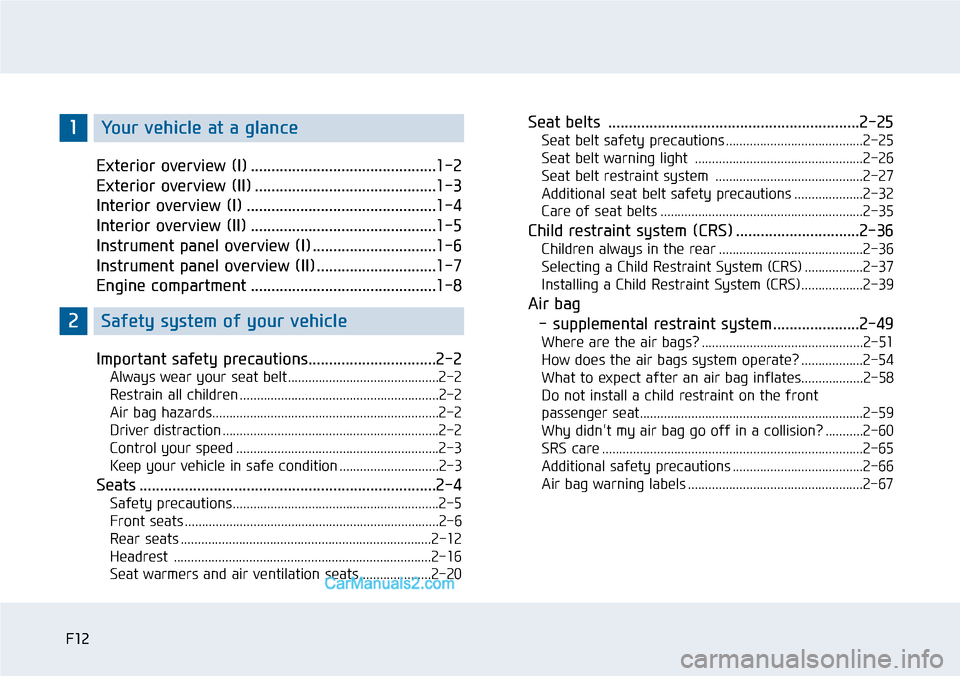
F12F12
Exterior overview (I) .............................................1-2
Exterior overview (II) ............................................1-3
Interior overview (I) ..............................................1-4
Interior overview (II) .............................................1-5
Instrument panel overview (I) ..............................1-6
Instrument panel overview (II) .............................1-7
Engine compartment .............................................1-8
Important safety precautions...............................2-2
Always wear your seat belt............................................2-2
Restrain all children ..........................................................2-2
Air bag hazards..................................................................2-2
Driver distraction ...............................................................2-2
Control your speed ...........................................................2-3
Keep your vehicle in safe condition .............................2-3
Seats ........................................................................2-4
Safety precautions............................................................2-5
Front seats ..........................................................................2-6
Rear seats .........................................................................2-12
Headrest ...........................................................................2-16
Seat warmers and air ventilation seats.....................2-20
Seat belts .............................................................2-25
Seat belt safety precautions ........................................2-25
Seat belt warning light .................................................2-26
Seat belt restraint system ...........................................2-27
Additional seat belt safety precautions ....................2-32
Care of seat belts ...........................................................2-35
Child restraint system (CRS) ..............................2-36
Children always in the rear ..........................................2-36
Selecting a Child Restraint System (CRS) .................2-37
Installing a Child Restraint System (CRS)..................2-39
Air bag
- supplemental restraint system.....................2-49
Where are the air bags? ...............................................2-51
How does the air bags system operate? ..................2-54
What to expect after an air bag inflates..................2-58
Do not install a child restraint on the front
passenger seat.................................................................2-59
Why didn't my air bag go off in a collision? ...........2-60
SRS care ............................................................................2-65
Additional safety precautions ......................................2-66
Air bag warning labels ...................................................2-67
1Your vehicle at a glance
2Safety system of your vehicle
Page 17 of 665
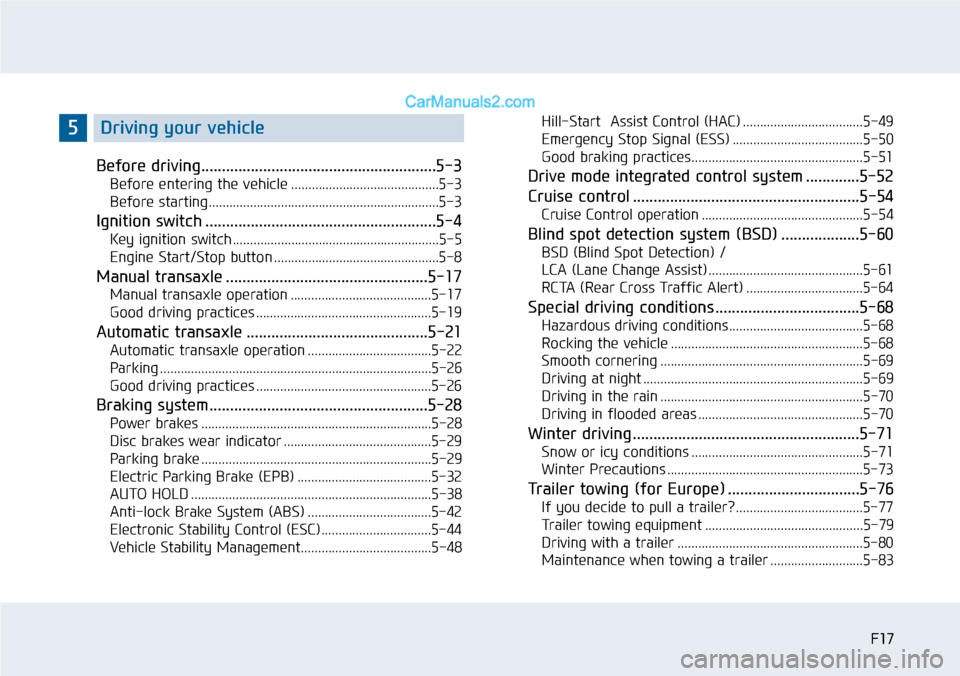
F17F17
Before driving.........................................................5-3
Before entering the vehicle ...........................................5-3
Before starting...................................................................5-3
Ignition switch ........................................................5-4
Key ignition switch ............................................................5-5
Engine Start/Stop button ................................................5-8
Manual transaxle .................................................5-17
Manual transaxle operation .........................................5-17
Good driving practices ...................................................5-19
Automatic transaxle ............................................5-21
Automatic transaxle operation ....................................5-22
Parking ...............................................................................5-26
Good driving practices ...................................................5-26
Braking system.....................................................5-28
Power brakes ...................................................................5-28
Disc brakes wear indicator ...........................................5-29
Parking brake ...................................................................5-29
Electric Parking Brake (EPB) .......................................5-32
AUTO HOLD ......................................................................5-38
Anti-lock Brake System (ABS) ....................................5-42
Electronic Stability Control (ESC)................................5-44
Vehicle Stability Management......................................5-48
Hill-Start Assist Control (HAC) ...................................5-49
Emergency Stop Signal (ESS) ......................................5-50
Good braking practices..................................................5-51
Drive mode integrated control system .............5-52
Cruise control .......................................................5-54
Cruise Control operation ...............................................5-54
Blind spot detection system (BSD) ...................5-60
BSD (Blind Spot Detection) /
LCA (Lane Change Assist) .............................................5-61
RCTA (Rear Cross Traffic Alert) ..................................5-64
Special driving conditions ...................................5-68
Hazardous driving conditions.......................................5-68
Rocking the vehicle ........................................................5-68
Smooth cornering ...........................................................5-69
Driving at night ................................................................5-69
Driving in the rain ...........................................................5-70
Driving in flooded areas ................................................5-70
Winter driving .......................................................5-71
Snow or icy conditions ..................................................5-71
Winter Precautions .........................................................5-73
Tr a i l e r t o w i n g ( fo r E u r o p e ) . . . . . . . . . . . . . . . . . . . . . . . . . . . . . . . . 5 - 7 6
If you decide to pull a trailer? .....................................5-77
Tr a i l e r t o w i n g e q u i p m e n t . . . . . . . . . . . . . . . . . . . . . . . . . . . . . . . . . . . . . . . . . . . . . . 5 - 7 9
Driving with a trailer ......................................................5-80
Maintenance when towing a trailer ...........................5-83
5Driving your vehicle
Page 18 of 665
F18
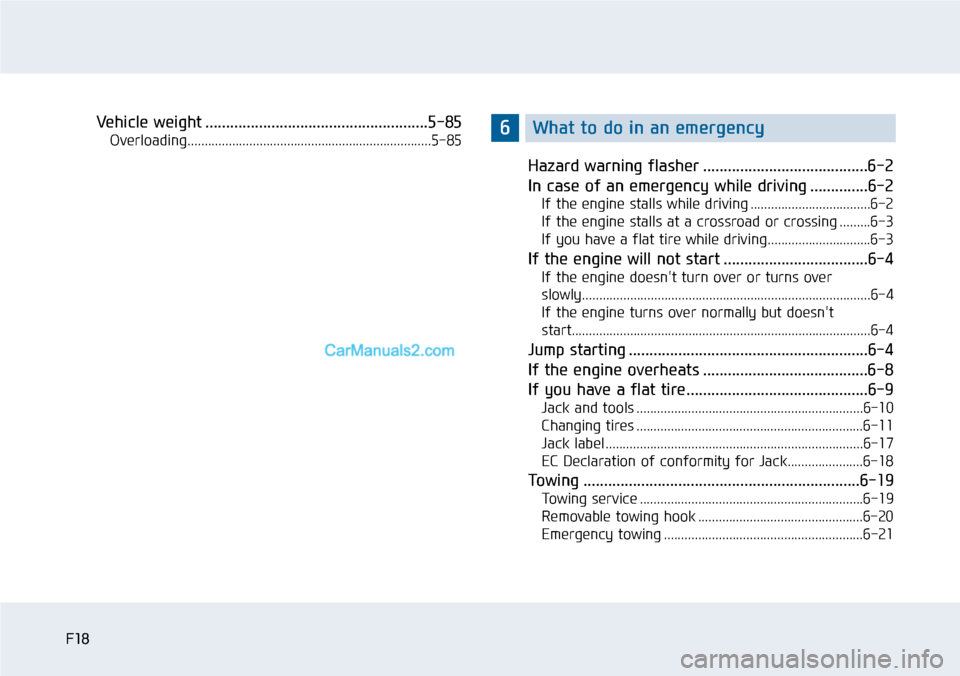
Vehicle weight ......................................................5-85
Overloading.......................................................................5-85
Hazard warning flasher ........................................6-2
In case of an emergency while driving ..............6-2
If the engine stalls while driving ...................................6-2
If the engine stalls at a crossroad or crossing .........6-3
If you have a flat tire while driving..............................6-3
If the engine will not start ...................................6-4
If the engine doesn't turn over or turns over
slowly....................................................................................6-4
If the engine turns over normally but doesn't
start.......................................................................................6-4
Jump starting ..........................................................6-4
If the engine overheats ........................................6-8
If you have a flat tire............................................6-9
Jack and tools ..................................................................6-10
Changing tires ..................................................................6-11
Jack label ...........................................................................6-17
EC Declaration of conformity for Jack......................6-18
To w i n g . . . . . . . . . . . . . . . . . . . . . . . . . . . . . . . . . . . . . . . . . . . . . . . . . . . . . . . . . . . . . . . . . . . 6 - 1 9
Towing service .................................................................6-19
Removable towing hook ................................................6-20
Emergency towing ..........................................................6-21
F18
6What to do in an emergency