Page 44 of 665
2-15
Safety system of your vehicle
2
Carrying long/narrow cargo
(if equipped)
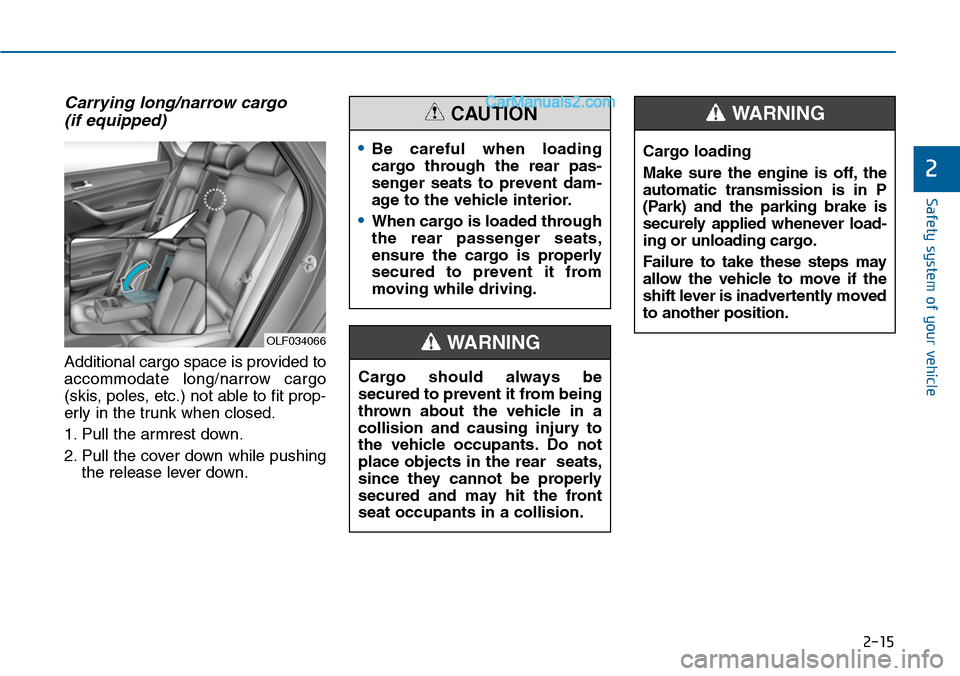
Additional cargo space is provided to
accommodate long/narrow cargo
(skis, poles, etc.) not able to fit prop-
erly in the trunk when closed.
1. Pull the armrest down.
2. Pull the cover down while pushing
the release lever down.
Cargo should always be
secured to prevent it from being
thrown about the vehicle in a
collision and causing injury to
the vehicle occupants. Do not
place objects in the rear seats,
since they cannot be properly
secured and may hit the front
seat occupants in a collision.
WARNING
Cargo loading
Make sure the engine is off, the
automatic transmission is in P
(Park) and the parking brake is
securely applied whenever load-
ing or unloading cargo.
Failure to take these steps may
allow the vehicle to move if the
shift lever is inadvertently moved
to another position.
WARNING
•Be careful when loading
cargo through the rear pas-
senger seats to prevent dam-
age to the vehicle interior.
•When cargo is loaded through
the rear passenger seats,
ensure the cargo is properly
secured to prevent it from
moving while driving.
CAUTION
OLF034066
Page 50 of 665
2-21
Safety system of your vehicle
2
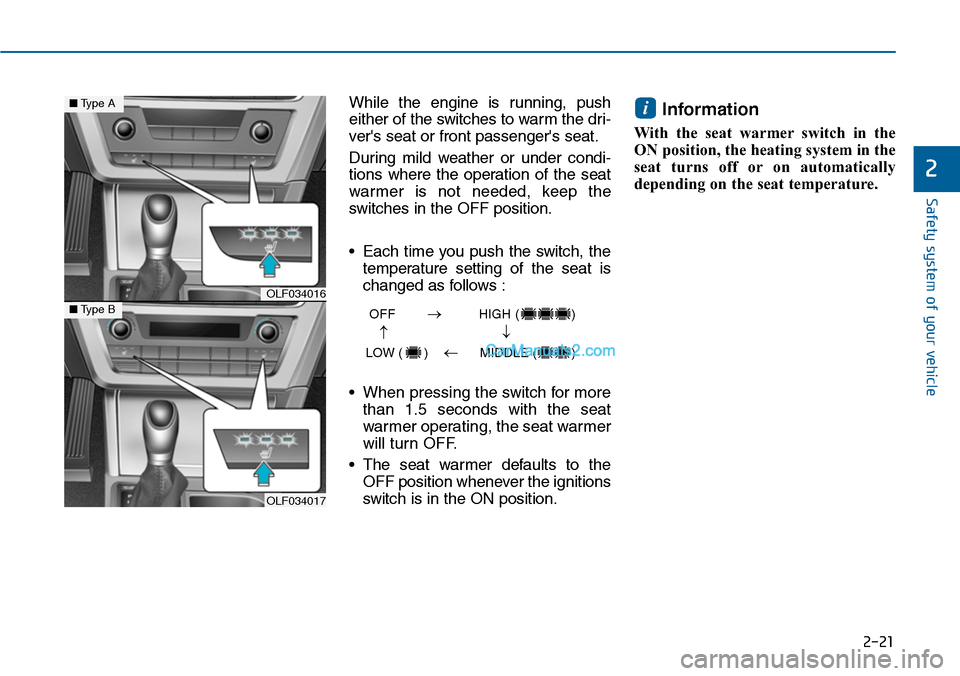
While the engine is running, push
either of the switches to warm the dri-
ver's seat or front passenger's seat.
During mild weather or under condi-
tions where the operation of the seat
warmer is not needed, keep the
switches in the OFF position.
•Each time you push the switch, the
temperature setting of the seat is
changed as follows :
•When pressing the switch for more
than 1.5 seconds with the seat
warmer operating, the seat warmer
will turn OFF.
•The seat warmer defaults to the
OFF position whenever the ignitions
switch is in the ON position.
Information
With the seat warmer switch in the
ON position, the heating system in the
seat turns off or on automatically
depending on the seat temperature.
i
OLF034016
OLF034017
■Type A
■Type BOFF HIGH ( )
LOW ( ) MIDDLE ( )
→→
→
→
Page 51 of 665
2-22
Safety system of your vehicle
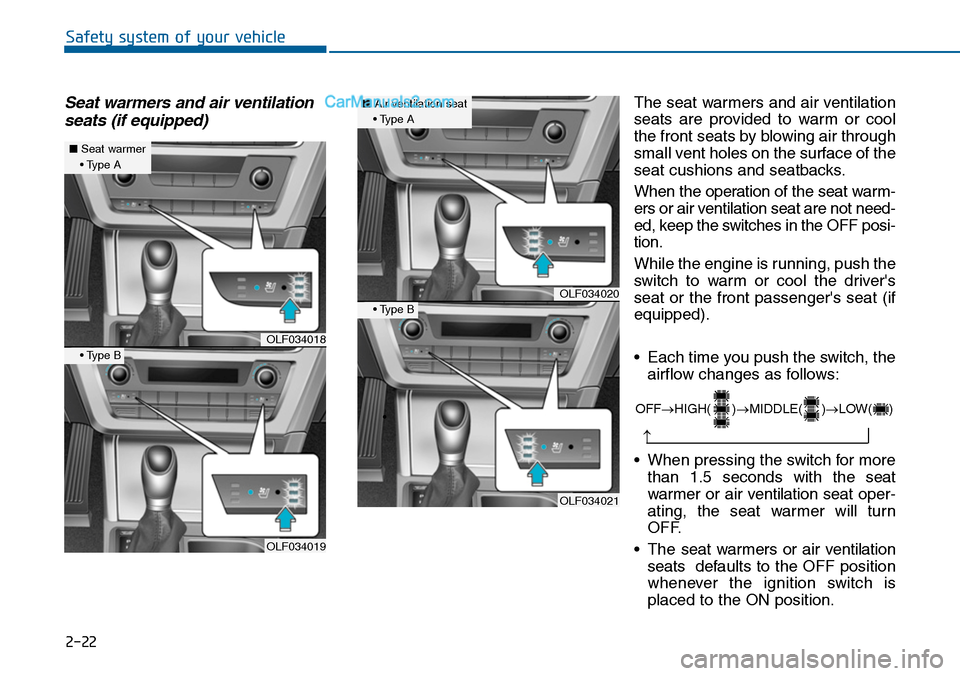
Seat warmers and air ventilation
seats (if equipped)
The seat warmers and air ventilation
seats are provided to warm or cool
the front seats by blowing air through
small vent holes on the surface of the
seat cushions and seatbacks.
When the operation of the seat warm-
ers or air ventilation seat are not need-
ed, keep the switches in the OFF posi-
tion.
While the engine is running, push the
switch to war m or cool the driver's
seat or the front passenger's seat (if
equipped).
•Each time you push the switch, the
airflow changes as follows:
•When pressing the switch for more
than 1.5 seconds with the seat
warmer or air ventilation seat oper-
ating, the seat warmer will turn
OFF.
•The seat warmers or air ventilation
seats defaults to the OFF position
whenever the ignition switch is
placed to the ON position.
OFF→HIGH( )→MIDDLE( )→LOW( )
→
OLF034018
OLF034019
■Seat warmer• Type A
• Type B
OLF034020
OLF034021
■Air ventilation seat• Type A
•
• Type B
Page 53 of 665
2-24
Safety system of your vehicle
Rear seat warmers (if equipped)
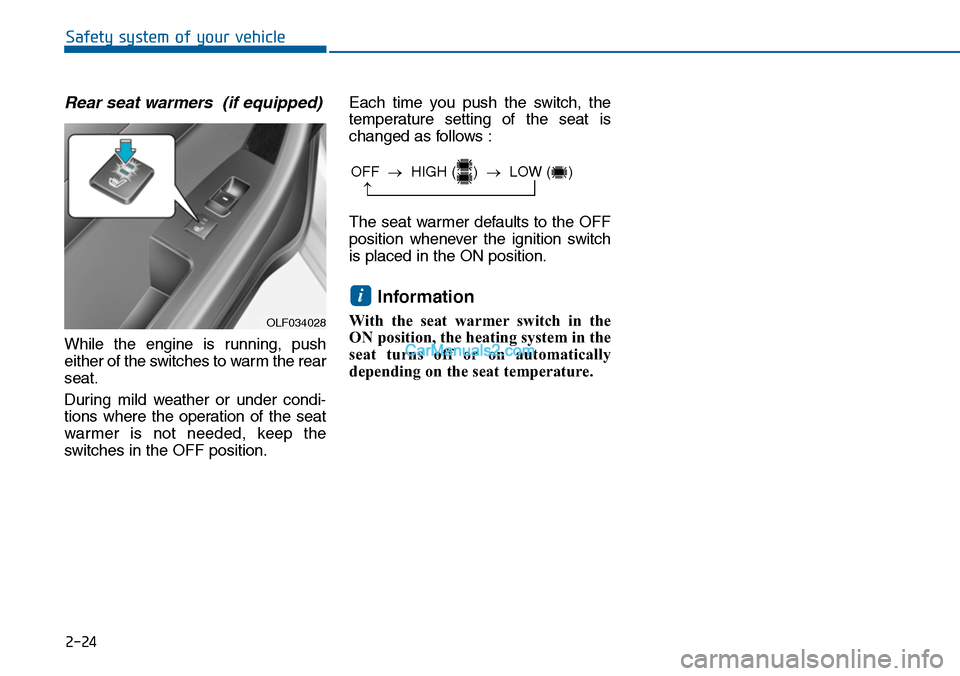
While the engine is running, push
either of the switches to warm the rear
seat.
During mild weather or under condi-
tions where the operation of the seat
warmer is not needed, keep the
switches in the OFF position.
Each time you push the switch, the
temperature setting of the seat is
changed as follows :
The seat warmer defaults to the OFF
position whenever the ignition switch
is placed in the ON position.
Information
With the seat warmer switch in the
ON position, the heating system in the
seat turns off or on automatically
depending on the seat temperature.
i
OFF →HIGH ( ) →LOW ( )
→
OLF034028
Page 79 of 665
2-50
Safety system of your vehicle
Ve h i c l e s a r e e q u i p p e d w i t h a
Supplemental Air Bag System for the
driver’s seat and front passenger’s
seats.
The front air bags are designed to
supplement the three-point seat
belts. For these air bags to provide
protection, the seat belts must be
worn at all times when driving.
Yo u c a n b e s e v e r e l y i n j u r e d o r k i l l e d
in an accident if you are not wearing
a seat belt. Air bags are designed to
supplement seat belts, but do not
replace them. Also, air bags are not
designed to deploy in every collision.
In some accidents, the seat belts are
the only restraint protecting you.
AIR BAG SAFETY PRECAUTIONS
ALWAYS use seat belts and child restraints - every trip, every time,
everyone! Even with air bags, you can be seriously injured or killed in
a collision if you are improperly belted or not wearing your seat belt
when the air bag inflates.
NEVER place a child in any child restraint or booster seat in the front
passenger seat. An inflating air bag could forcefully strike the infant
or child causing serious or fatal injuries.
ABC - Always Buckle Children under age 13 in the back seat. It is the
safest place for children of any age to ride. If a child age 13 or older
must be seated in the front seat, he or she must be properly belted
and the seat should be moved as far back as possible.
All occupants should sit upright with the seatback in an upright posi-
tion, centered on the seat cushion with their seat belt on, legs com-
fortably extended and their feet on the floor until the vehicle is parked
and the engine is turned off. If an occupant is out of position during
an accident, the rapidly deploying air bag may forcefully contact the
occupant causing serious or fatal injuries.
Yo u a n d y o u r p a s s e n g e r s s h o u l d n e v e r s i t o r l e a n u n n e c e s s a r i l y
close to the air bags or lean against the door or center console.
Move your seat as far back as possible from front air bags, while still
maintaining control of the vehicle.
WARNING
Page 84 of 665
2-55
Safety system of your vehicle
2
During a frontal collision, sensors will
detect the vehicle’s deceleration. If the
rate of deceleration is high enough,
the control unit will inflate the front air
bags, at the time and with the force
needed.
The front air bags help protect the
driver and front passenger by
responding to frontal impacts in
which seat belts alone cannot provide
adequate restraint. When needed,
the side air bags help provide protec-
tion in the event of a side impact.
•Air bags are activated (able to
inflate if necessary) only when the
ignition switch is in the ON position.
•Air bags inflate in the event of cer-
tain frontal or side collisions to help
protect the occupants from serious
physical injury.
•There is no single speed at which
the air bags will inflate. Generally,
air bags are designed to inflate
based upon the severity of a colli-
sion and its direction. These two
factors deter mine whether the sen-
sors produce an electronic deploy-
ment/inflation signal.
.• Air bag deployment depends on a
number of factors including vehicle
speed, angles of impact and the
density and stiffness of the vehicles
or objects which your vehicle
impacts during a collision. The
determining factors are not limited
to those mentioned above.
•The front air bags will completely
inflate and deflate in an instant. It is
virtually impossible for you to see
the air bags inflate during an acci-
dent. It is much more likely that you
will simply see the deflated air bags
hanging out of their storage com-
partments after the collision.
(Continued)
•The light stays on after illumi-
nating for approximately six
seconds.
•The light comes on while the
vehicle is in motion.
•The light blinks when the
engine is running.
We recommend that an author-
ized HYUNDAI dealer inspect the
SRS as soon as possible if any
of these conditions occur.
Page 100 of 665
3-4
Convenient features of your vehicle
Remote key
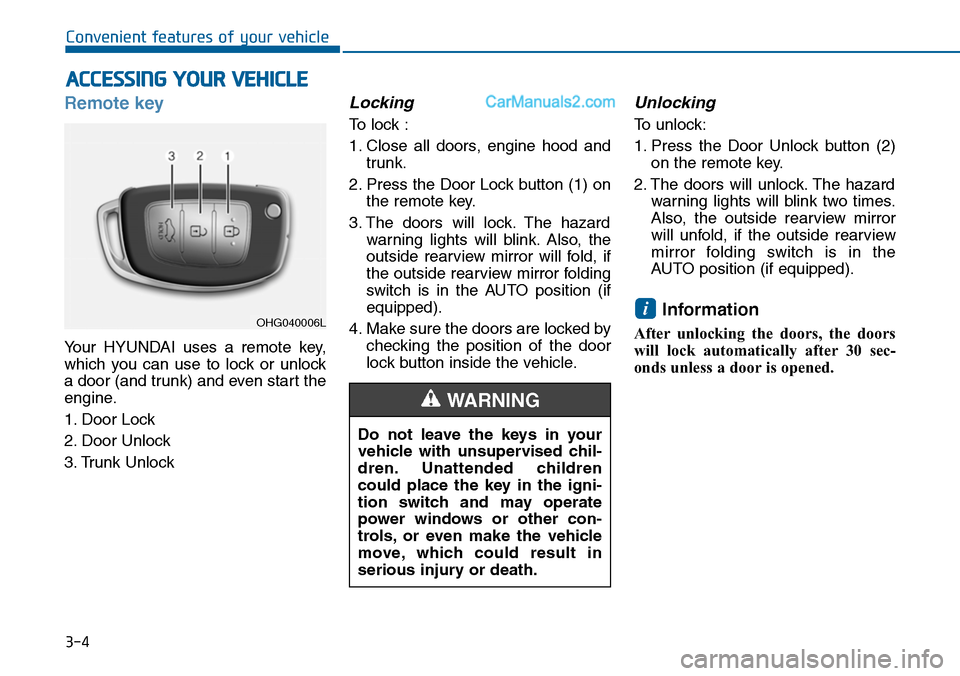
Yo u r H Y U N D A I u s e s a r e m o t e k e y,
which you can use to lock or unlock
a door (and trunk) and even start the
engine.
1. Door Lock
2. Door Unlock
3. Trunk Unlock
Locking
To lock :
1. Close all doors, engine hood and
trunk.
2. Press the Door Lock button (1) on
the remote key.
3. The doors will lock. The hazard
warning lights will blink. Also, the
outside rearview mirror will fold, if
the outside rearview mirror folding
switch is in the AUTO position (if
equipped).
4. Make sure the doors are locked by
checking the position of the door
lock button inside the vehicle.
Unlocking
To unlock:
1. Press the Door Unlock button (2)
on the remote key.
2. The doors will unlock. The hazard
warning lights will blink two times.
Also, the outside rearview mirror
will unfold, if the outside rearview
mirror folding switch is in the
AUTO position (if equipped).
Information
After unlocking the doors, the doors
will lock automatically after 30 sec-
onds unless a door is opened.
i
ACCESSING YOUR VEHICLE
Do not leave the keys in your
vehicle with unsupervised chil-
dren. Unattended children
could place the key in the igni-
tion switch and may operate
power windows or other con-
trols, or even make the vehicle
move, which could result in
serious injury or death.
WARNING
OHG040006L
Page 104 of 665
3-8
Smart key
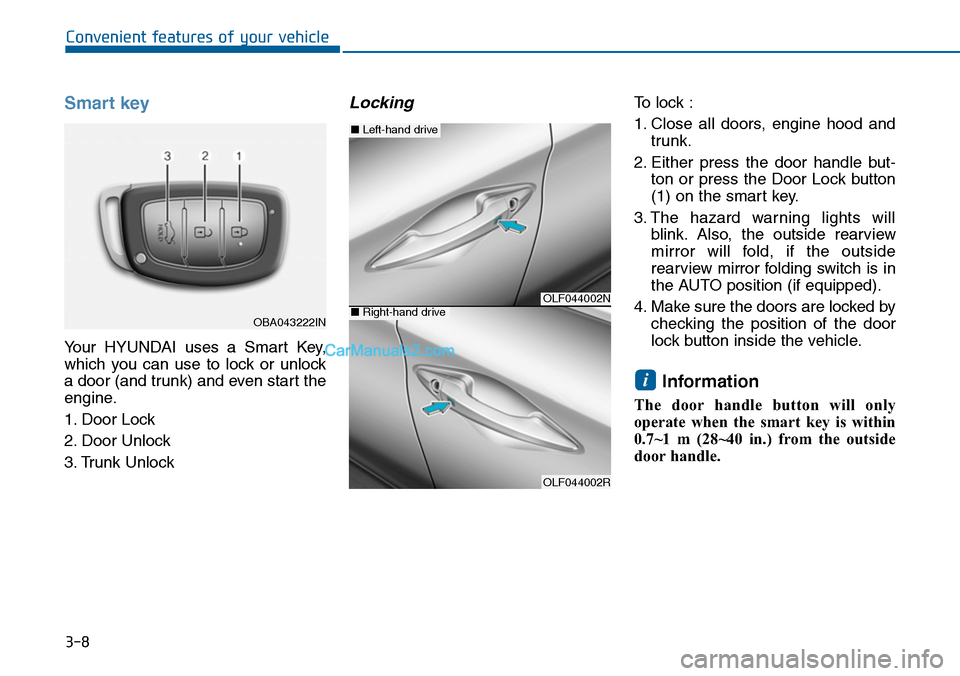
Yo u r H Y U N D A I u s e s a S m a r t K e y,
which you can use to lock or unlock
a door (and trunk) and even start the
engine.
1. Door Lock
2. Door Unlock
3. Trunk Unlock
Locking To lock :
1. Close all doors, engine hood and
trunk.
2. Either press the door handle but-
ton or press the Door Lock button
(1) on the smart key.
3. The hazard warning lights will
blink. Also, the outside rearview
mirror will fold, if the outside
rearview mirror folding switch is in
the AUTO position (if equipped).
4. Make sure the doors are locked by
checking the position of the door
lock button inside the vehicle.
Information
The door handle button will only
operate when the smart key is within
0.7~1 m (28~40 in.) from the outside
door handle.
i
Convenient features of your vehicle
OBA043222IN
OLF044002N
OLF044002R
■Left-hand drive
■Right-hand drive