2014 Hyundai Sonata light
[x] Cancel search: lightPage 28 of 665

1-7
Yo u r v e h i c l e a t a g l a n c e
INSTRUMENT PANEL OVERVIEW (II)
11. Light control/Turn signals ..................3-98
2. Steering wheel audio controls*/Bluetooth®wireless technology hands-free controls* ............................4-4
3. Instrument cluster ..............................3-57
4. Horn ..................................................3-28
5. Driver's front air bag ..........................2-47
6. Wiper/Washer ..................................3-111
7. Cruise controls* ................................5-54
8. Engine Start/Stop button/Key ignition switch ..............................5-6
9. Automatic transaxle ..........................5-21
10. Rear curtain* ................................3-161
11. Drive mode integrated control system ............................................5-52
12. Rear parking assist system*..........3-116
13. Parking assist system....................3-119
14. EPB (Electric Parking Brake)* ........5-32
15. AUTO HOLD ....................................5-38
16. Audio system/Navigation system ......4-5
17. Digital Clock ..................................3-158
18. Climate control system ........3-124/3-134
19. Power outlet ..................................3-156
20. AUX, USB and iPod®port ................4-2
21. Cigarette lighter ............................3-158
22. Passenger's front air bag ................2-47
23. Glove box ......................................3-152
* : if equippedOLF014004RThe actual shape may differ from the illustration.
■Type A
■Type B
■Right-hand drive
Page 30 of 665
Safety system of your vehicle
2
Important safety precautions...............................2-2
Always wear your seat belt............................................2-2
Restrain all children ..........................................................2-2
Air bag hazards..................................................................2-2
Driver distraction ...............................................................2-2
Control your speed ...........................................................2-3
Keep your vehicle in safe condition .............................2-3
Seats ........................................................................2-4
Safety precautions............................................................2-5
Front seats ..........................................................................2-6
Rear seats .........................................................................2-12
Headrest ...........................................................................2-16
Seat warmers and air ventilation seats.....................2-20
Seat belts .............................................................2-25
Seat belt safety precautions ........................................2-25
Seat belt warning light .................................................2-26
Seat belt restraint system ...........................................2-27
Additional seat belt safety precautions ....................2-32
Care of seat belts ...........................................................2-35
Child restraint system (CRS) ..............................2-36
Children always in the rear ..........................................2-36
Selecting a Child Restraint System (CRS) .................2-37
Installing a Child Restraint System (CRS)..................2-39
Air bag
- supplemental restraint system.....................2-49
Where are the air bags? ...............................................2-51
How does the air bags system operate? ..................2-54
What to expect after an air bag inflates..................2-58
Do not install a child restraint on the front
passenger seat.................................................................2-59
Why didn't my air bag go off in a collision? ...........2-60
SRS care ............................................................................2-65
Additional safety precautions ......................................2-66
Air bag warning labels ...................................................2-67
This chapter provides you with important information about how to protect yourself and your passengers.
It explains how to properly use your seats and seat belts, and how your air bags work.
Additionally, this chapter explains how to properly restrain infants and children in your vehicle.
Page 36 of 665
2-7
Safety system of your vehicle
Manual adjustment
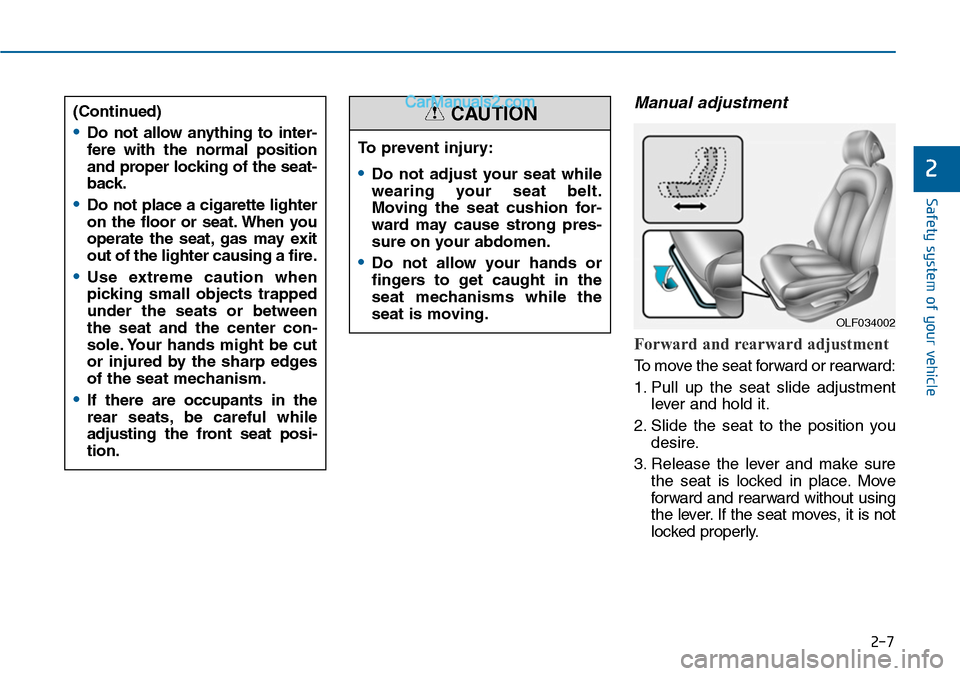
Forward and rearward adjustment
To m o v e t h e s e a t f o r w a r d o r r e a r w a r d :
1. Pull up the seat slide adjustment
lever and hold it.
2. Slide the seat to the position you
desire.
3. Release the lever and make sure
the seat is locked in place. Move
forward and rearward without using
the lever. If the seat moves, it is not
locked properly.
2
To prevent injury:
•Do not adjust your seat while
wearing your seat belt.
Moving the seat cushion for-
ward may cause strong pres-
sure on your abdomen.
•Do not allow your hands or
fingers to get caught in the
seat mechanisms while the
seat is moving.
CAUTION(Continued)
•Do not allow anything to inter-
fere with the normal position
and proper locking of the seat-
back.
•Do not place a cigarette lighter
on the floor or seat. When you
operate the seat, gas may exit
out of the lighter causing a fire.
•Use extreme caution when
picking small objects trapped
under the seats or between
the seat and the center con-
sole. Your hands might be cut
or injured by the sharp edges
of the seat mechanism.
•If there are occupants in the
rear seats, be careful while
adjusting the front seat posi-
tion.
OLF034002
Page 37 of 665
2-8
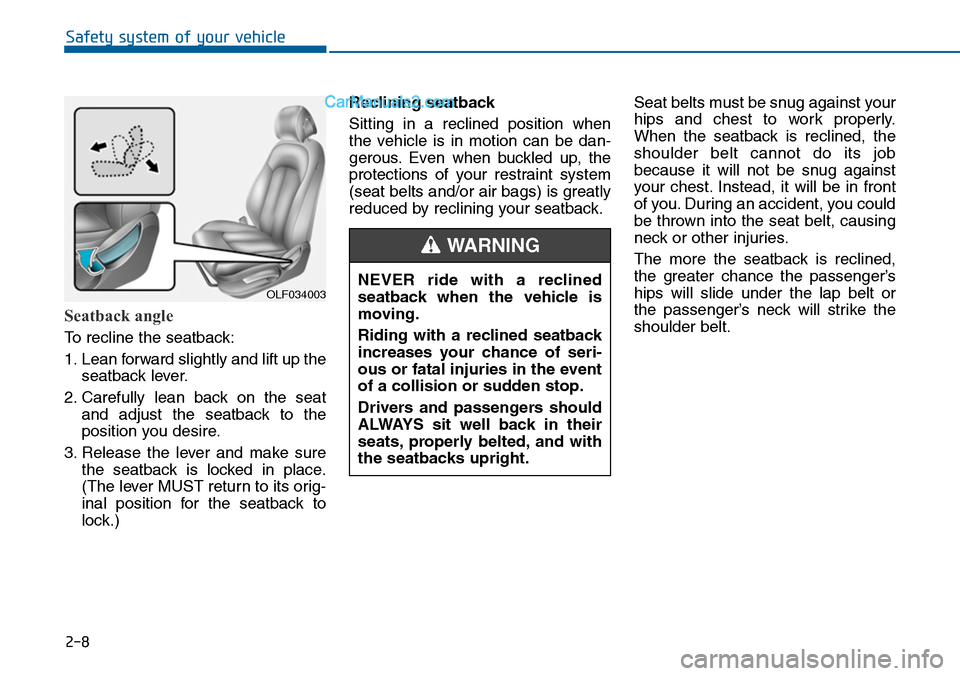
Seatback angle
To recline the seatback:
1. Lean forward slightly and lift up the
seatback lever.
2. Carefully lean back on the seat
and adjust the seatback to the
position you desire.
3. Release the lever and make sure
the seatback is locked in place.
(The lever MUST return to its orig-
inal position for the seatback to
lock.)
Reclining seatback
Sitting in a reclined position when
the vehicle is in motion can be dan-
gerous. Even when buckled up, the
protections of your restraint system
(seat belts and/or air bags) is greatly
reduced by reclining your seatback.
Seat belts must be snug against your
hips and chest to work properly.
When the seatback is reclined, the
shoulder belt cannot do its job
because it will not be snug against
your chest. Instead, it will be in front
of you. During an accident, you could
be thrown into the seat belt, causing
neck or other injuries.
The more the seatback is reclined,
the greater chance the passenger’s
hips will slide under the lap belt or
the passenger’s neck will strike the
shoulder belt.
Safety system of your vehicle
OLF034003NEVER ride with a reclined
seatback when the vehicle is
moving.
Riding with a reclined seatback
increases your chance of seri-
ous or fatal injuries in the event
of a collision or sudden stop.
Drivers and passengers should
ALWAYS sit well back in their
seats, properly belted, and with
the seatbacks upright.
WARNING
Page 40 of 665
2-11
Safety system of your vehicle
2
Seat belts must be snug against your
hips and chest to work properly.
When the seatback is reclined, the
shoulder belt cannot do its job
because it will not be snug against
your chest. Instead, it will be in front
of you. During an accident, you could
be thrown into the seat belt, causing
neck or other injuries.
The more the seatback is reclined,
the greater chance the passenger’s
hips will slide under the lap belt or
the passenger’s neck will strike the
shoulder belt.Seat cushion height
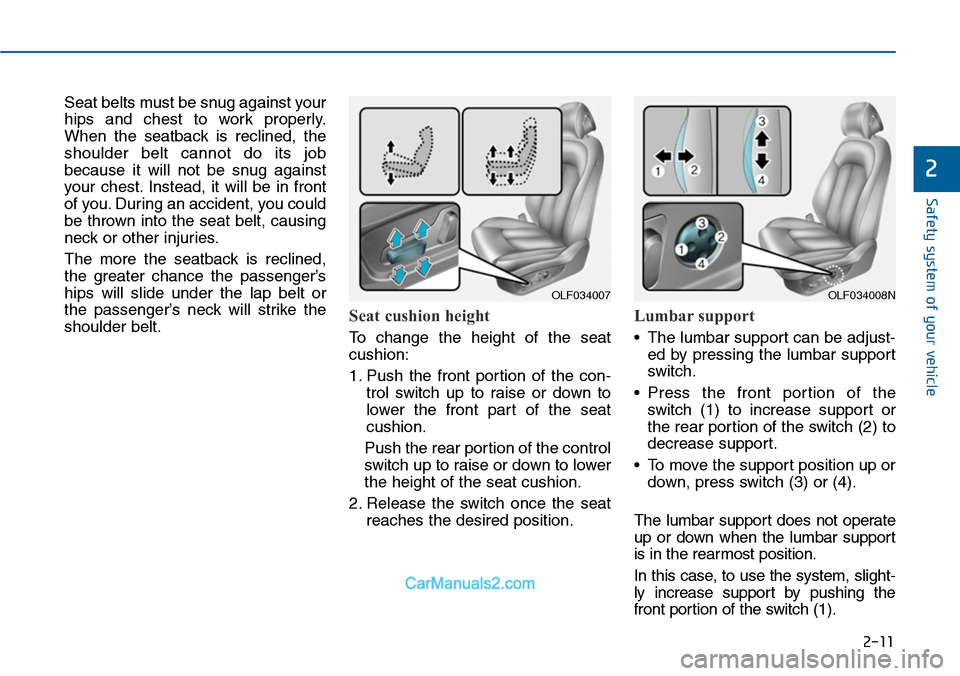
To change the height of the seat
cushion:
1. Push the front portion of the con-
trol switch up to raise or down to
lower the front part of the seat
cushion.
Push the rear portion of the control
switch up to raise or down to lower
the height of the seat cushion.
2. Release the switch once the seat
reaches the desired position.
Lumbar support
•The lumbar support can be adjust-
ed by pressing the lumbar support
switch.
•Press the front portion of the
switch (1) to increase suppor t or
the rear portion of the switch (2) to
decrease support.
•To move the support position up or
down, press switch (3) or (4).
The lumbar support does not operate
up or down when the lumbar support
is in the rearmost position.
In this case, to use the system, slight-
ly increase support by pushing the
front portion of the switch (1).
OLF034007OLF034008N
Page 55 of 665
2-26
Safety system of your vehicle
Seat belt warning light
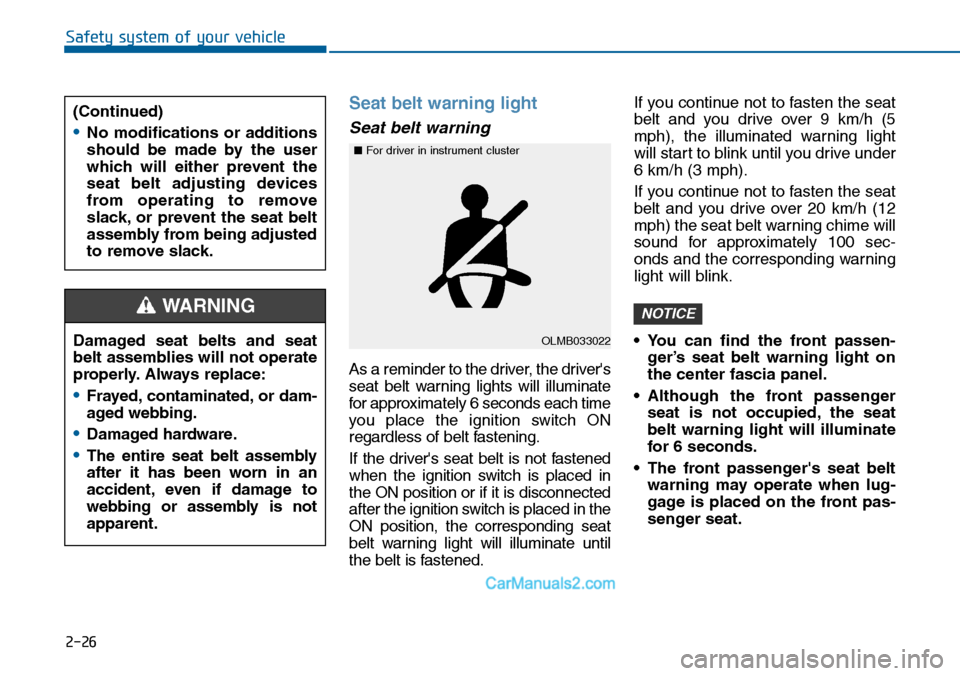
Seat belt warning
As a reminder to the driver, the driver's
seat belt warning lights will illuminate
for approximately 6 seconds each time
you place the ignition switch ON
regardless of belt fastening.
If the driver's seat belt is not fastened
when the ignition switch is placed in
the ON position or if it is disconnected
after the ignition switch is placed in the
ON position, the corresponding seat
belt warning light will illuminate until
the belt is fastened.
If you continue not to fasten the seat
belt and you drive over 9 km/h (5
mph), the illuminated warning light
will start to blink until you drive under
6 km/h (3 mph).
If you continue not to fasten the seat
belt and you drive over 20 km/h (12
mph) the seat belt warning chime will
sound for approximately 100 sec-
onds and the corresponding warning
light will blink.
•You can find the front passen-
ger’s seat belt warning light on
the center fascia panel.
•Although the front passenger
seat is not occupied, the seat
belt warning light will illuminate
for 6 seconds.
•The front passenger's seat belt
warning may operate when lug-
gage is placed on the front pas-
senger seat.
NOTICE
Damaged seat belts and seat
belt assemblies will not operate
properly. Always replace:
•Frayed, contaminated, or dam-
aged webbing.
•Damaged hardware.
•The entire seat belt assembly
after it has been worn in an
accident, even if damage to
webbing or assembly is not
apparent.
WARNING
(Continued)
•No modifications or additions
should be made by the user
which will either prevent the
seat belt adjusting devices
from operating to remove
slack, or prevent the seat belt
assembly from being adjusted
to remove slack.
OLMB033022
■For driver in instrument cluster
Page 60 of 665

2-31
Safety system of your vehicle
2
The Pre-Tensioner Seat Belt System
consists mainly of the following com-
ponents. Their locations are shown in
the illustration above:
(1) SRS air bag warning light
(2) Retractor pre-tensioner
(3) SRS control module
The sensor that activates the SRS
air bag is connected with the
pre–tensioner seat belts. The SRS
air bag warning light on the instru-
ment panel will illuminate for
approximately 6 seconds after the
ignition switch is placed to the ON
position, and then it should turn off.
If the pre-tensioner is not working
properly, the warning light will illu-
minate even if the SRS air bag is
not malfunctioning. If the warning
light does not illuminate, stays illu-
minated or illuminates when the
vehicle is being driven, we recom-
mend the pre-tensioner seat belts
and/or SRS air bags be inspected
by an authorized HYUNDAI dealer
as soon as possible.
NOTICE(Continued)
•Do not hit the seat belt assem-
blies.
Do not touch the pre-tensioner
seat belt assemblies for several
minutes after they have been
activated. When the pre-ten-
sioner seat belt mechanism
deploys during a collision, the
pre-tensioner can become hot
and can burn you.
WARNING
Body work on the front area of
the vehicle may damage the
pre-tensioner seat belt system.
Therefore, we recommend that
the system be serviced by an
authorized HYUNDAI dealer.
CAUTION
OLMB033040/Q
Page 62 of 665
2-33
Safety system of your vehicle
2
Small children are best protected
from injury in an accident when prop-
erly restrained in the rear seat by a
child restraint system that meets the
requirements of the Safety Standards
of your country. Before buying any
child restraint system, make sure that
it has a label certifying that it meets
Safety Standard of your country. The
restraint must be appropriate for your
child's height and weight. Check the
label on the child restraint for this
information. Refer to “Child Restraint
Systems” in this chapter.
Larger children
Children under age 13 and who are
too large for a booster seat must
always occupy the rear seat and use
the available lap/shoulder belts. A
seat belt should lie across the upper
thighs and be snug across the shoul-
der and chest to restrain the child
safely. Check belt fit periodically. A
child's squirming could put the belt
out of position. Children are afforded
the most safety in the event of an
accident when they are restrained by
a proper restraint system and/or seat
belts in the rear seat.
If a larger child over age 13 must be
seated in the front seat, the child
must be securely restrained by the
available lap/shoulder belt and the
seat should be placed in the rear-
most position.
If the shoulder belt portion slightly
touches the child’s neck or face, try
placing the child closer to the center
of the vehicle. If the shoulder belt still
touches their face or neck, they need
to be returned to an appropriate
booster seat in the rear seat.
ALWAYS properly restrain infants
and small children in a child
restraint appropriate for the
child’s height and weight.
To r e d u c e t h e r i s k o f s e r i o u s
injury or death to a child and
other passengers, NEVER hold a
child in your lap or arms when
the vehicle is moving. The violent
forces created during an acci-
dent will tear the child from your
arms and throw the child against
the interior of the vehicle.
WARNING