2014 HYUNDAI IX35 warning
[x] Cancel search: warningPage 974 of 1534
7 109
Maintenance
Bright-metal maintenance
To remove road tar and insects, use atar remover, not a scraper or other
sharp object.
To protect the surfaces of bright-metal parts from corrosion, apply a coating of
wax or chrome preservative and rub to
a high luster.
During winter weather or in coastal areas, cover the bright metal parts with
a heavier coating of wax or preserva-
tive. If necessary, coat the parts with
non-corrosive petroleum jelly or other
protective compound.
Underbody maintenance
Corrosive materials used for ice and
snow removal and dust control may col-
lect on the underbody. If these materials
are not removed, accelerated rusting can
occur on underbody parts such as the
fuel lines, frame, floor pan and exhaust
system, even though they have been
treated with rust protection.
Thoroughly flush the vehicle underbody
and wheel openings with lukewarm or
cold water once a month, after off-road
driving and at the end of each winter. Payspecial attention to these areas because
it is difficult to see all the mud and dirt. It
will do more harm than good to wet down
the road grime without removing it. The
lower edges of doors, rocker panels, and
frame members have drain holes that
should not be allowed to clog with dirt;
trapped water in these areas can cause
rusting.WARNING
After washing the vehicle, test the
brakes while driving slowly to see if
they have been affected by water. If
braking performance is impaired,
dry the brakes by applying them
lightly while maintaining a slow for-
ward speed.
EL(FL) Eng 7.QXP 10/7/2013 9:33 AM Page 109
Page 979 of 1534
Maintenance
114
7
3. Exhaust emission control
system
The Exhaust Emission Control System is
a highly effective system which controls
exhaust emissions while maintaining
good vehicle performance.
Vehicle modifications
This vehicle should not be modified. Modification of your vehicle could
affect its performance, safety or dura-
bility and may even violate governmen-
tal safety and emissions regulations.
In addition, damage or performance
problems resulting from any modifica-
tion may not be covered under warran-
ty.
If you use unauthorized electronic devices, it may cause the vehicle to
operate abnormally, wire damage, bat-
tery discharge and fire. For your safety,
do not use unauthorized electronic
devices.
Engine exhaust gas precautions
(carbon monoxide)
Carbon monoxide can be present with other exhaust fumes. Therefore, if you
smell exhaust fumes of any kind inside
your vehicle, have it inspected and
repaired immediately. If you ever sus-
pect exhaust fumes are coming into
your vehicle, drive it only with all the
windows fully open. Have your vehicle
checked and repaired immediately. Do not operate the engine in confined
or closed areas (such as garages) any
more than what is necessary to move
the vehicle in or out of the area.
When the vehicle is stopped in an open area for more than a short time
with the engine running, adjust the
ventilation system (as needed) to draw
outside air into the vehicle.
Never sit in a parked or stopped vehi- cle for any extended time with the
engine running.
When the engine stalls or fails to start, excessive attempts to restart the
engine may cause damage to theemission control system.
WARNING - Exhaust
Engine exhaust gases contain car-
bon monoxide (CO). Though color-
less and odorless, it is dangerousand could be lethal if inhaled.
Follow the instructions following to
avoid CO poisoning.
EL(FL) Eng 7.QXP 10/7/2013 9:33 AM Page 114
Page 980 of 1534

7 115
Maintenance
Operating precautions for catalyticconverters (if equipped)Your vehicle is equipped with a catalytic
converter emission control device.
Therefore, the following precautions
must be observed:
Use only UNLEADED FUEL for gaso- line engine.
Do not operate the vehicle when there are signs of engine malfunction, such
as misfire or a noticeable loss of per-
formance.
Do not misuse or abuse the engine. Examples of misuse are coasting withthe ignition off and descending steep
grades in gear with the ignition off.
Do not operate the engine at high idle speed for extended periods (5 minutesor more).
Do not modify or tamper with any part of the engine or emission control sys-
tem. We recommend that the system
be inspected by an authorized
HYUNDAI dealer.
Avoid driving with a extremely low fuel level. Running out of fuel cause the
engine to misfire, damaging the cat-
alytic converter.
Failure to observe these precautionscould result in damage to the catalytic
converter and to your vehicle.
Additionally, such actions could void your
warranties.Diesel Particulate Filter (if equipped)
The Diesel Particulate Filter (DPF) sys-
tem removes the soot emitted from the
vehicle.
Unlike a disposable air filter, the DPF
system automatically burns (oxidizes)
and removes the accumulated soot
according to the driving condition. In
other words, the active burning by engine
control system and high exhaust gas
temperature caused by normal/high driv-
ing condition burns and removes the
accumulated soot.
However, if the vehicle continues to be
driven at low speed for long time, the
accumulated soot may not be automati-
cally removed because of low exhaust
gas temperature. In this particular case,the amount of soot is out of detection
limit, the soot oxidation process by
engine control system may not happen
and the malfunction indicator light may
blink. When the malfunction indicator light
blinks, it may stop blinking by driving the
vehicle at more than 60km/h (37 mph) orat more than second gear with 1500 ~
2000 engine rpm for a certain time (for
about 25 minutes).
WARNING - Fire
A hot exhaust system can ignite flammable items under your vehi-
cle. Do not park, idle, or drive the
vehicle over or near flammable
objects, such as dry grass, paper,
leaves, etc.
The exhaust system and catalytic system are very hot while the
engine is running or immediately
after the engine is turned off.
Keep away from the exhaust sys-
tem and catalytic, you may get
burned.
Also, do not remove the heat sink
around the exhaust system, do
not seal the bottom of the vehicle
or do not coat the vehicle for cor-
rosion control. It may present a
fire risk under certain conditions.
EL(FL) Eng 7.QXP 10/7/2013 9:33 AM Page 115
Page 994 of 1534

Introduction
2
1
This Owners Manual is designed to help
vehicle users derive the greatest possi-
ble amount of enjoyment and satisfaction
from driving the HYUNDAI vehicle. It isstrongly recommended that the entire
manual is read in order that all of the fea-
tures, safety systems and maintenancerequirements are understood.
To minimise the RISK of death or injury,
the "WARNING" and "CAUTION" state-
ments must be read and understood
before operating the vehicle.
Illustrations are used throughout the
manual to complement written descrip-
tions intended to best explain how to
enjoy using the vehicle.
Reading this manual will assist the vehi-
cle user to learn about and understand
the features, important safety informa-
tion, and driving recommendations.
The general layout of the manual is pro-
vided in the Table of Contents. The index
has an alphabetical listing of all the infor-
mation contained in the manual. The
manual has eight sections plus an index.
Each section begins with a brief list ofcontents to easily identify at a glance if
that section contains the informationbeing sought. "WARNING", "CAUTION", and "NOTICE"
information is provided to enhance the
personal safety of the vehicle user. This
information must be carefully read and
followed.
✽✽
NOTICE
A NOTICE indicates interesting or help-
ful information is being provided.
Petrol engine
Unleaded
For the optimal vehicle performance, we
recommend you to use unleaded petrol
with an octane rating of RON (Research
Octane Number) 95 /AKI (Anti Knock
Index) 91 or higher.
You may use unleaded petrol with an
octane rating of RON 91~94/AKI 87~90
but it may result in slight performance
reduction of the vehicle.
HOW TO USE THIS MANUAL FUEL REQUIREMENTS
WARNING
A WARNING indicates a situation in
which harm, serious bodily injury ordeath could result if the warning isignored.
CAUTION
A CAUTION indicates a situation in which damage to your vehicle couldresult if the caution is ignored.
CAUTION
NEVER USE LEADED FUEL. Theuse of leaded fuel is detrimental to the catalytic converter and will
damage the engine control sys- tem’s oxygen sensor and affectemission control.
Never add any fuel system cleaningagents to the fuel tank other than
what has been specified. (We rec- ommend that you consult a HYUNDAI authorised repairer fordetails.)
EL(FL) UK 1.QXP 8/5/2013 6:21 PM Page 2
Page 995 of 1534

13
Introduction
Petrol containing alcohol andmethanol
Gasohol, a mixture of petrol and ethanol
(also known as grain alcohol), and petrolor gasohol containing methanol (also
known as wood alcohol) are being mar-
keted along with or instead of leaded orunleaded petrol. Do not use gasohol containing more than 10% ethanol, and do not use petrol or
gasohol containing any methanol. Either
of these fuels may cause drivability prob-lems and damage to the fuel system.
Discontinue using gasohol of any kind if
drivability problems occur.
Vehicle damage or driveability problems
may not be covered by the manufactur-
er’s warranty if they result from the useof:
1. Gasohol containing more than 10% ethanol.
2. Petrol or gasohol containing methanol.
3. Leaded fuel or leaded gasohol.
Use of MTBE
HYUNDAI recommends avoiding fuels
containing MTBE (Methyl Tertiary Butyl
Ether) over 15.0% vol. (Oxygen Content
2.7% weight) in your vehicle.
Fuel containing MTBE over 15.0% vol.
(Oxygen Content 2.7% weight) may
reduce vehicle performance and produce
vapour lock or hard starting.
Do not use methanol
Fuels containing methanol (wood alco-
hol) should not be used in your vehicle.
This type of fuel can reduce vehicle per-
formance and damage components ofthe fuel system.
WARNING
Do not "top off" after the nozzle automatically shuts off when refuelling.
Always check that the fuel cap is installed securely to prevent fuel
spillage in the event of an acci-dent.
CAUTION
Never use gasohol which contains
methanol. Discontinue use of any gasohol product which impairs dri-
vability.
CAUTION
Your New Vehicle Limited Warranty may not cover damage to the fuel
system and any performance prob- lems that are caused by the use offuels containing methanol or fuels
containing MTBE (Methyl TertiaryButyl Ether) over 15.0% vol. (Oxygen Content 2.7% weight.)
EL(FL) UK 1.QXP 8/5/2013 6:21 PM Page 3
Page 998 of 1534
Introduction
6
1
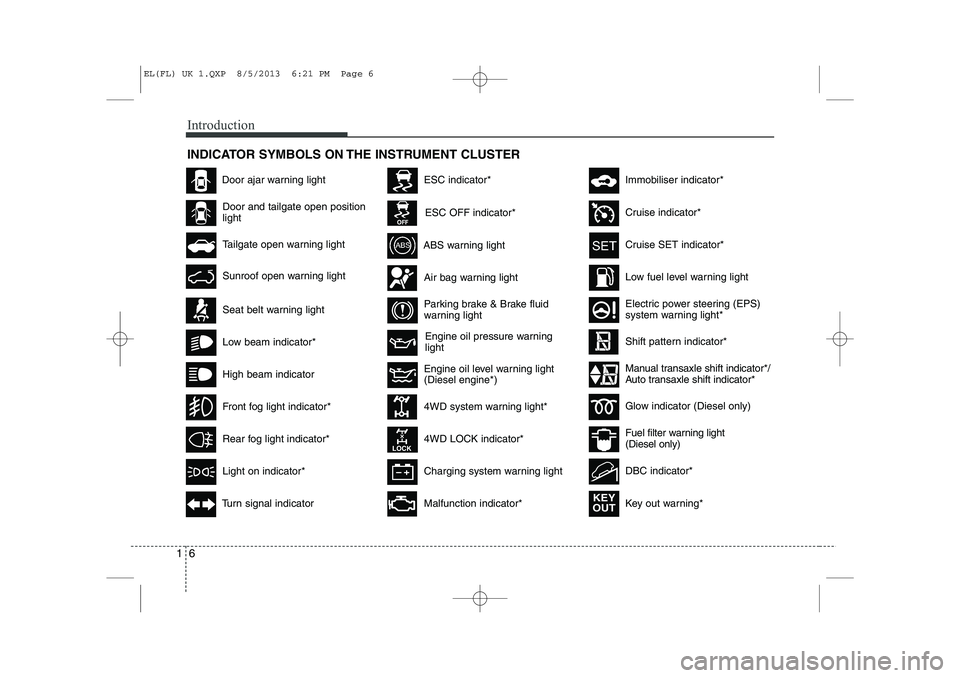
INDICATOR SYMBOLS ON THE INSTRUMENT CLUSTER
Engine oil pressure warning light
Seat belt warning light
Door and tailgate open position light
High beam indicator
Light on indicator*
Turn signal indicator
ABS warning light
Parking brake & Brake fluid
warning light
4WD system warning light* 4WD LOCK indicator*
Malfunction indicator*
Air bag warning light
Cruise SET indicator*
Low fuel level warning light
Charging system warning light
Door ajar warning light
Glow indicator (Diesel only)
Fuel filter warning light (Diesel only)
Cruise indicator*
ESC indicator*
ESC OFF indicator*
Immobiliser indicator*
Shift pattern indicator*
Front fog light indicator*
Rear fog light indicator*
Low beam indicator*
Electric power steering (EPS)
system warning light*
Key out warning*
KEY
OUT
DBC indicator*
Tailgate open warning light
Sunroof open warning light
Engine oil level warning light (Diesel engine*)Manual transaxle shift indicator*/
Auto transaxle shift indicator*
EL(FL) UK 1.QXP 8/5/2013 6:21 PM Page 6
Page 999 of 1534
17
Introduction
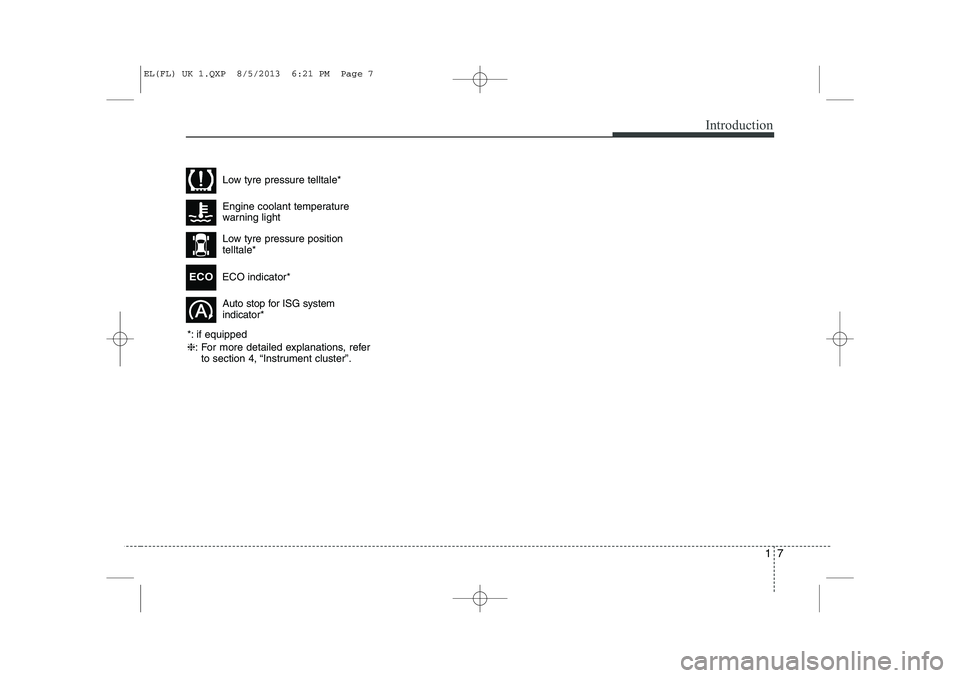
Low tyre pressure position telltale*
ECO indicator*ECO
*: if equipped ❈: For more detailed explanations, refer
to section 4, “Instrument cluster”. Engine coolant temperature
warning light
Auto stop for ISG system indicator*
Low tyre pressure telltale*
EL(FL) UK 1.QXP 8/5/2013 6:21 PM Page 7
Page 1002 of 1534
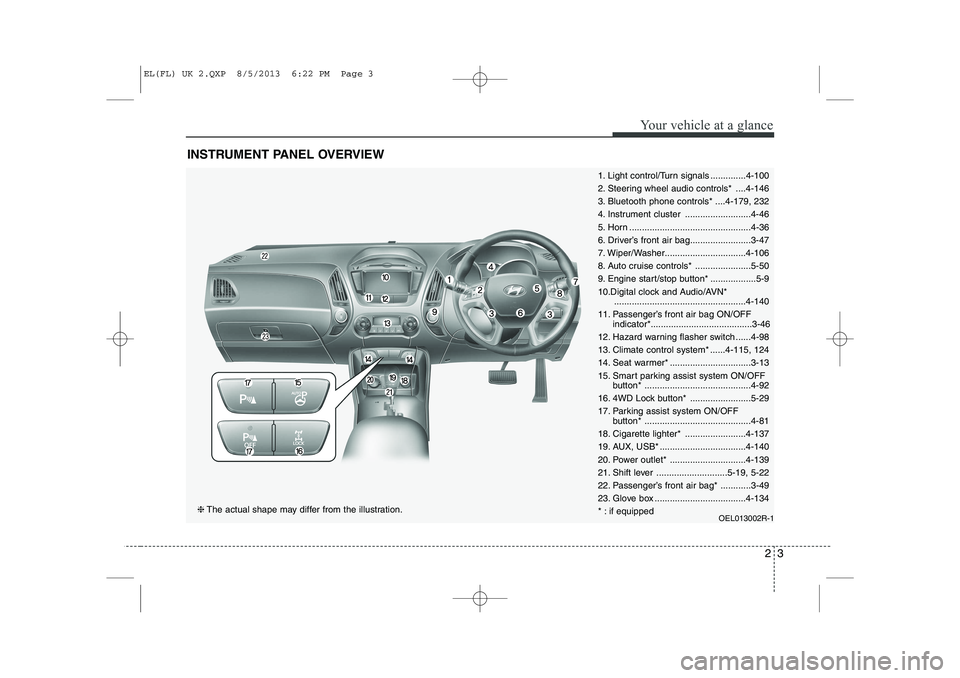
23
Your vehicle at a glance
INSTRUMENT PANEL OVERVIEW
1. Light control/Turn signals ..............4-100
2. Steering wheel audio controls* ....4-146
3. Bluetooth phone controls* ....4-179, 232
4. Instrument cluster ..........................4-46
5. Horn ................................................4-36
6. Driver’s front air bag........................3-47
7. Wiper/Washer................................4-106
8. Auto cruise controls* ......................5-50
9. Engine start/stop button* ..................5-9
10.Digital clock and Audio/AVN*....................................................4-140
11. Passenger’s front air bag ON/OFF indicator*........................................3-46
12. Hazard warning flasher switch ......4-98
13. Climate control system* ......4-115, 124
14. Seat warmer* ................................3-13
15. Smart parking assist system ON/OFF button* ..........................................4-92
16. 4WD Lock button* ........................5-29
17. Parking assist system ON/OFF button* ..........................................4-81
18. Cigarette lighter* ........................4-137
19. AUX, USB* ..................................4-140
20. Power outlet* ..............................4-139
21. Shift lever ............................5-19, 5-22
22. Passenger’s front air bag* ............3-49
23. Glove box ....................................4-134
* : if equipped OEL013002R-1
❈The actual shape may differ from the illustration.
EL(FL) UK 2.QXP 8/5/2013 6:22 PM Page 3