Page 281 of 1534

65
What to do in an emergency
EMERGENCY STARTING
Connect cables in numerical order and
disconnect in reverse order. Jump starting
Jump starting can be dangerous if done
incorrectly. Therefore, to avoid harm to
yourself or damage to your vehicle or
battery, follow the jump starting proce-
dures. If in doubt, we strongly recom-
mend that you have a competent techni-
cian or towing service jump start your
vehicle.
CAUTION
Use only a 12-volt jumper system.
You can damage a 12-volt startingmotor, ignition system, and other electrical parts beyond repair by
use of a 24-volt power supply (either two 12-volt batteries in series or a24-volt motor generator set).
WARNING - Battery
• Keep all flames or sparks away from the battery. The battery pro-
duces hydrogen gas which may
explode if exposed to flame orsparks.
If these instructions are not fol-
lowed exactly, serious personal
injury and damage to the vehicle
may occur! If you are not sure
how to follow this procedure,
seek qualified assistance.
Automobile batteries contain sul-
furic acid. This is poisonous and
highly corrosive. When jump
starting, wear protective glasses
and be careful not to get acid on
yourself, your clothing or on the
vehicle.
Do not attempt to jump start the vehicle if the discharged battery
is frozen or if the electrolyte level
is low; the battery may rupture or
explode.
WARNING - Battery
Never attempt to check the elec-
trolyte level of the battery as this
may cause the battery to rupture or
explode causing serious injury.
1VQA4001
Discharged battery
Jumper Cables
Booster battery(-)
(+)
(+)(-)
EL(FL) Aust 6.QXP 7/26/2013 2:11 PM Page 5
Page 282 of 1534
What to do in an emergency
6
6
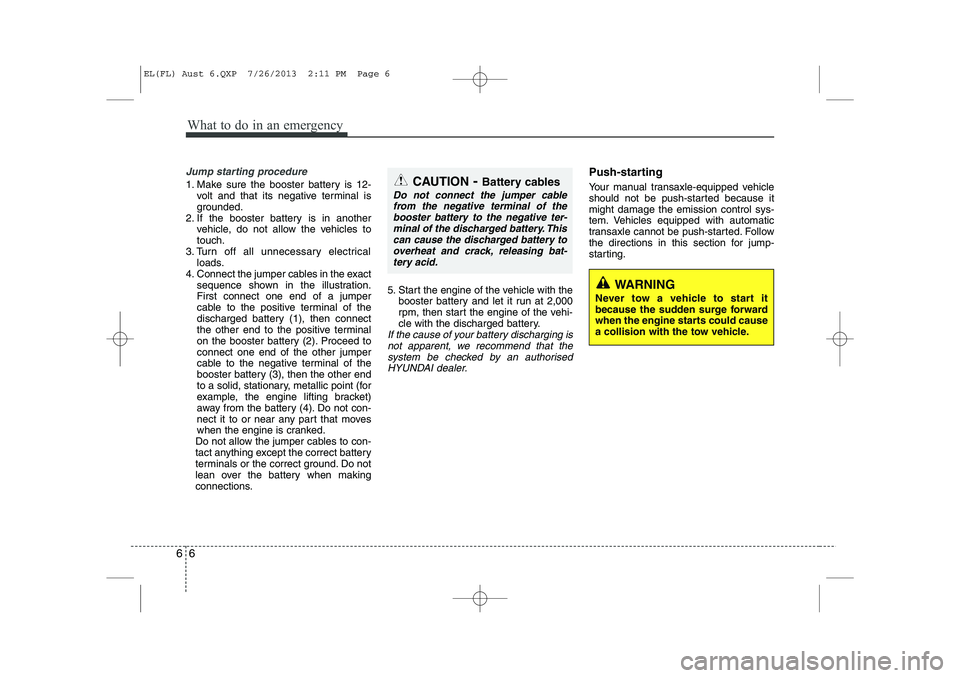
Jump starting procedure
1. Make sure the booster battery is 12-
volt and that its negative terminal is
grounded.
2. If the booster battery is in another vehicle, do not allow the vehicles totouch.
3. Turn off all unnecessary electrical loads.
4. Connect the jumper cables in the exact sequence shown in the illustration.First connect one end of a jumper
cable to the positive terminal of the
discharged battery (1), then connect
the other end to the positive terminal
on the booster battery (2). Proceed toconnect one end of the other jumper
cable to the negative terminal of the
booster battery (3), then the other end
to a solid, stationary, metallic point (for
example, the engine lifting bracket)
away from the battery (4). Do not con-
nect it to or near any part that moves
when the engine is cranked.
Do not allow the jumper cables to con-
tact anything except the correct battery
terminals or the correct ground. Do not
lean over the battery when making
connections. 5. Start the engine of the vehicle with the
booster battery and let it run at 2,000
rpm, then start the engine of the vehi-
cle with the discharged battery.
If the cause of your battery discharging is
not apparent, we recommend that thesystem be checked by an authorised
HYUNDAI dealer.
Push-starting
Your manual transaxle-equipped vehicle
should not be push-started because itmight damage the emission control sys-
tem. Vehicles equipped with automatic
transaxle cannot be push-started. Follow
the directions in this section for jump-
starting.
WARNING
Never tow a vehicle to start it
because the sudden surge forward
when the engine starts could cause
a collision with the tow vehicle.
CAUTION - Battery cables
Do not connect the jumper cable
from the negative terminal of the
booster battery to the negative ter-minal of the discharged battery. Thiscan cause the discharged battery to overheat and crack, releasing bat-
tery acid.
EL(FL) Aust 6.QXP 7/26/2013 2:11 PM Page 6
Page 297 of 1534
73
Maintenance
ENGINE COMPARTMENT
OEL073300R
1. Engine coolant reservoir
2. Engine oil filler cap
3. Brake/clutch* fluid reservoir
4. Air cleaner
5. Fuse box
6. Negative battery terminal
7. Positive battery terminal
8. Radiator cap
9. Engine oil dipstick
10. Windscreen washer fluid reservoir
* : if equipped
■■Petrol Engine (2.0L) - GDI
❈ The actual engine room in the vehicle may differ from the illustration.
EL(FL) Aust 7.QXP 7/26/2013 2:22 PM Page 3
Page 298 of 1534
Maintenance
4
7
OEL079002R
1. Engine coolant reservoir
2. Fuse box
3. Fuel filter
4. Engine oil dipstick
5. Engine oil filler cap
6. Brake/clutch* fluid reservoir
7. Air cleaner
8. Negative battery terminal
9. Positive battery terminal
10. Radiator cap
11. Windscreen washer fluid reservoir
* : if equipped
■■
Diesel Engine (2.0L)
* The actual engine room in the vehicle may differ from the illustration.
EL(FL) Aust 7.QXP 7/26/2013 2:22 PM Page 4
Page 302 of 1534

Maintenance
8
7
At least monthly:
Check coolant level in the engine
coolant reservoir.
Check the operation of all exterior lights, including the stoplights, turn sig-
nals and hazard warning flashers.
Check the inflation pressures of all tyres including the spare.
At least twice a year
(i.e., every Spring and Fall) :
Check radiator, heater and air condi- tioning hoses for leaks or damage.
Check windscreen washer spray and wiper operation. Clean wiper blades
with clean cloth dampened with wash-er fluid.
Check headlight alignment.
Check muffler, exhaust pipes, shields and clamps.
Check the lap/shoulder belts for wear and function.
Check for worn tyres and loose wheel lug nuts.
At least once a year :
Clean body and door drain holes.
Lubricate door hinges and checks, andbonnet hinges.
Lubricate door and bonnet locks and latches.
Lubricate door rubber weatherstrips.
Check the air conditioning system.
Check the power steering fluid level.
Inspect and lubricate automatic transaxle linkage and controls.
Clean battery and terminals.
Check the brake (and clutch) fluid level.
EL(FL) Aust 7.QXP 7/26/2013 2:22 PM Page 8
Page 305 of 1534

711
Maintenance
NORMAL MAINTENANCE SCHEDULE (CONT.)
30,000 km or 24 months
❑ Inspect air cleaner filter
❑ Inspect air conditioner refrigerant/compressor (if equipped)
❑ Inspect battery condition
❑ Inspect brake lines, hoses and connections
❑ Inspect disc brakes and pads
❑ Inspect drive belt (Petrol) * 3
❑
Inspect drive shafts and boots
❑ Inspect exhaust system
❑ Inspect front suspension ball joints
❑ Inspect fuel filter (Petrol) * 4
❑
Inspect fuel filter cartridge (Diesel) * 5
❑
Inspect fuel lines, fuel hoses and connections (Diesel)
❑ Inspect fuel tank air filter (Petrol)
❑ Inspect parking brake
❑ Inspect propeller shaft (4WD)
❑ Inspect steering gear rack, linkage and boots
(Continued)
15,000 km or 12 months
❑ Inspect air cleaner filter
❑ Inspect air conditioner refrigerant/compressor (if equipped)
❑ Inspect battery condition
❑ Inspect brake/clutch(if equipped) fluid
❑ Inspect brake lines, hoses and connections
❑ Inspect disc brakes and pads
❑ Inspect front suspension ball joints
❑ Inspect steering gear rack, linkage and boots
❑ Inspect tyre (pressure & tread wear)
❑ Replace climate control air filter (if equipped)
❑ Replace engine oil and filter * 1
*2
❑ Add fuel additives * 9
❈
Inspect : Inspect and if necessary, adjust, correct, clean or
replace.
EL(FL) Aust 7.QXP 7/26/2013 2:22 PM Page 11
Page 306 of 1534
Maintenance
12
7
NORMAL MAINTENANCE SCHEDULE (CONT.)
(Continued)
❑ Inspect tyre (pressure & tread wear)
❑ Replace brake/clutch(if equipped) fluid
❑ Replace climate control air filter (if equipped)
❑ Replace engine oil and filter * 1
*2
❑ Add fuel additives * 9
45,000 km or 36 months
❑
Inspect air conditioner refrigerant/compressor (if equipped)
❑ Inspect battery condition
❑ Inspect brake/clutch(if equipped) fluid
❑ Inspect brake lines, hoses and connections
❑ Inspect disc brakes and pads
❑ Inspect front suspension ball joints
❑ Inspect steering gear rack, linkage and boots
❑ Inspect tyre (pressure & tread wear)
❑ Replace air cleaner filter
❑ Replace climate control air filter (if equipped)
❑ Replace engine oil and filter * 1
*2
❑ Add fuel additives * 9
❈
Inspect : Inspect and if necessary, adjust, correct, clean or
replace.
❈Inspect : Inspect and if necessary, adjust, correct, clean or
replace.
EL(FL) Aust 7.QXP 7/26/2013 2:22 PM Page 12
Page 307 of 1534
713
Maintenance
NORMAL MAINTENANCE SCHEDULE (CONT.)
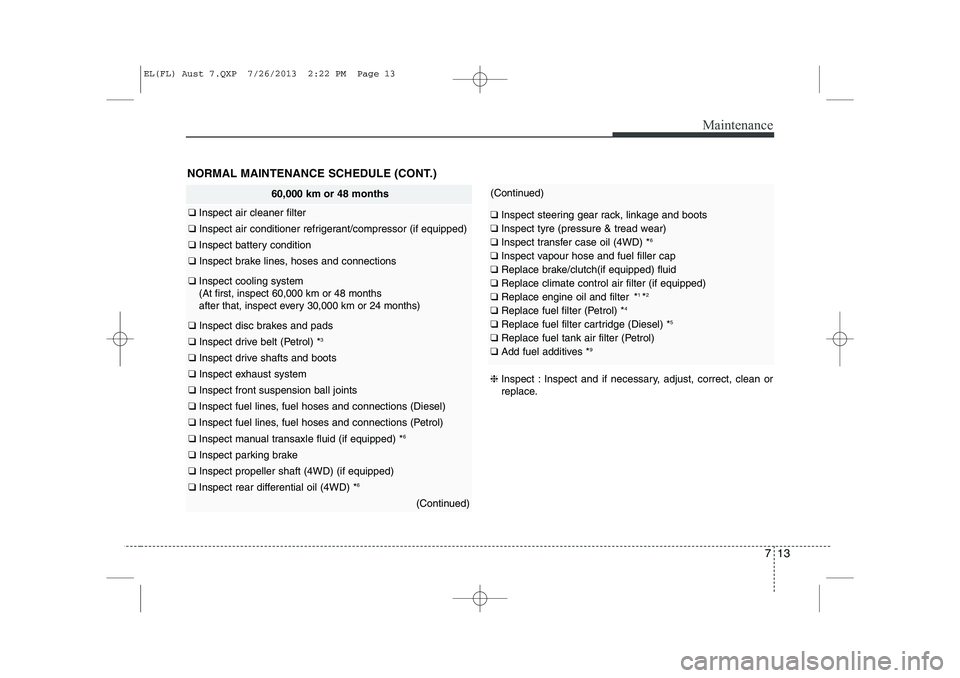
60,000 km or 48 months
❑ Inspect air cleaner filter
❑ Inspect air conditioner refrigerant/compressor (if equipped)
❑ Inspect battery condition
❑ Inspect brake lines, hoses and connections
❑ Inspect cooling system
(At first, inspect 60,000 km or 48 months
after that, inspect every 30,000 km or 24 months)
❑ Inspect disc brakes and pads
❑ Inspect drive belt (Petrol) * 3
❑
Inspect drive shafts and boots
❑ Inspect exhaust system
❑ Inspect front suspension ball joints
❑ Inspect fuel lines, fuel hoses and connections (Diesel)
❑ Inspect fuel lines, fuel hoses and connections (Petrol)
❑ Inspect manual transaxle fluid (if equipped) * 6
❑
Inspect parking brake
❑ Inspect propeller shaft (4WD) (if equipped)
❑ Inspect rear differential oil (4WD) * 6
(Continued)
(Continued)
❑
Inspect steering gear rack, linkage and boots
❑ Inspect tyre (pressure & tread wear)
❑ Inspect transfer case oil (4WD) * 6
❑ Inspect vapour hose and fuel filler cap
❑ Replace brake/clutch(if equipped) fluid
❑ Replace climate control air filter (if equipped)
❑ Replace engine oil and filter * 1
*2
❑ Replace fuel filter (Petrol) * 4
❑ Replace fuel filter cartridge (Diesel) * 5
❑ Replace fuel tank air filter (Petrol)
❑ Add fuel additives * 9
❈ Inspect : Inspect and if necessary, adjust, correct, clean or
replace.
EL(FL) Aust 7.QXP 7/26/2013 2:22 PM Page 13