Page 1517 of 1534
773
Maintenance
Aluminum or chrome wheel mainte-nance
The aluminum or chrome wheels are
coated with a clear protective finish.
Do not use any abrasive cleaner, pol- ishing compound, solvent, or wire
brushes on aluminum or chrome
wheels. They may scratch or damagethe finish.
Clean the wheel when it has cooled.
Use only a mild soap or neutral deter- gent, and rinse thoroughly with water.
Also, be sure to clean the wheels after
driving on salted roads. This helps pre-
vent corrosion.
Avoid washing the wheels with high- speed car wash brushes.
Do not use any alkaline or acid deter- gent. It may damage and corrode the
aluminum or chrome wheels coated
with a clear protective finish.
Corrosion protection
Protecting your vehicle from corrosion
By using the most advanced design and
construction practices to combat corro-
sion, we produces cars of the highest
quality. However, this is only part of the
job. To achieve the long-term corrosion
resistance your vehicle can deliver, the
owner's cooperation and assistance isalso required.
Common causes of corrosion The most common causes of corrosion
on your car are:
Road salt, dirt and moisture that isallowed to accumulate underneath the
car.
Removal of paint or protective coatings by stones, gravel, abrasion or minor
scrapes and dents which leave unpro-
tected metal exposed to corrosion.
High-corrosion areas
If you live in an area where your car is
regularly exposed to corrosive materials,
corrosion protection is particularly impor-
tant. Some of the common causes of
accelerated corrosion are road salts,
dust control chemicals, ocean air and
industrial pollution. Moisture breeds corrosion Moisture creates the conditions in which
corrosion is most likely to occur. For
example, corrosion is accelerated by
high humidity, particularly when tempera-
tures are just above freezing. In such
conditions, the corrosive material is kept
in contact with the car surfaces by mois-
ture that is slow to evaporate.
Mud is particularly corrosive because it is
slow to dry and holds moisture in contact
with the vehicle. Although the mud
appears to be dry, it can still retain themoisture and promote corrosion.
High temperatures can also accelerate
corrosion of parts that are not properly
ventilated so the moisture can be dis-
persed. For all these reasons, it is par-
ticularly important to keep your car clean
and free of mud or accumulations of
other materials. This applies not only to
the visible surfaces but particularly to the
underside of the car.
To help prevent corrosion
You can help prevent corrosion from get-
ting started by observing the following:
EL(FL) UK 7.QXP 8/5/2013 7:05 PM Page 73
Page 1522 of 1534
Maintenance
78
7
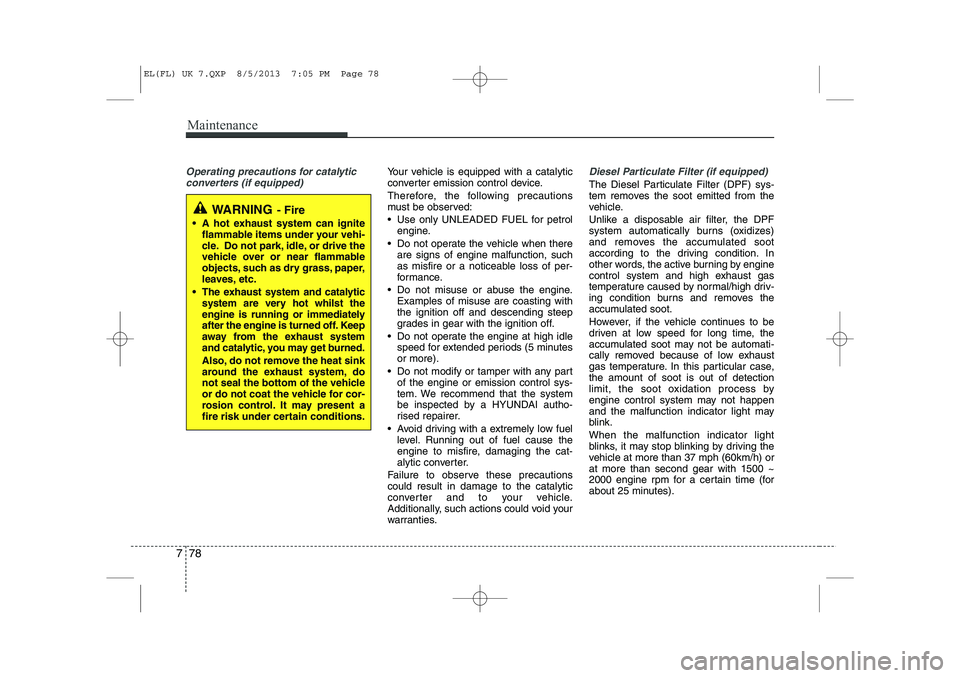
Operating precautions for catalytic
converters (if equipped)Your vehicle is equipped with a catalytic
converter emission control device.
Therefore, the following precautions
must be observed:
Use only UNLEADED FUEL for petrol engine.
Do not operate the vehicle when there are signs of engine malfunction, such
as misfire or a noticeable loss of per-
formance.
Do not misuse or abuse the engine. Examples of misuse are coasting withthe ignition off and descending steep
grades in gear with the ignition off.
Do not operate the engine at high idle speed for extended periods (5 minutesor more).
Do not modify or tamper with any part of the engine or emission control sys-
tem. We recommend that the system
be inspected by a HYUNDAI autho-
rised repairer.
Avoid driving with a extremely low fuel level. Running out of fuel cause the
engine to misfire, damaging the cat-
alytic converter.
Failure to observe these precautionscould result in damage to the catalytic
converter and to your vehicle.
Additionally, such actions could void your
warranties.Diesel Particulate Filter (if equipped)
The Diesel Particulate Filter (DPF) sys-
tem removes the soot emitted from the
vehicle.
Unlike a disposable air filter, the DPF
system automatically burns (oxidizes)
and removes the accumulated soot
according to the driving condition. In
other words, the active burning by engine
control system and high exhaust gas
temperature caused by normal/high driv-
ing condition burns and removes the
accumulated soot.
However, if the vehicle continues to be
driven at low speed for long time, the
accumulated soot may not be automati-
cally removed because of low exhaust
gas temperature. In this particular case,the amount of soot is out of detection
limit, the soot oxidation process by
engine control system may not happen
and the malfunction indicator light may
blink. When the malfunction indicator light
blinks, it may stop blinking by driving the
vehicle at more than 37 mph (60km/h) orat more than second gear with 1500 ~
2000 engine rpm for a certain time (for
about 25 minutes).
WARNING - Fire
A hot exhaust system can ignite flammable items under your vehi-
cle. Do not park, idle, or drive the
vehicle over or near flammable
objects, such as dry grass, paper,
leaves, etc.
The exhaust system and catalytic system are very hot whilst the
engine is running or immediately
after the engine is turned off. Keep
away from the exhaust system
and catalytic, you may get burned.
Also, do not remove the heat sink
around the exhaust system, do
not seal the bottom of the vehicle
or do not coat the vehicle for cor-
rosion control. It may present a
fire risk under certain conditions.
EL(FL) UK 7.QXP 8/5/2013 7:05 PM Page 78
Page 1524 of 1534
Specifications & Consumer information
Dimensions . . . . . . . . . . . . . . . . . . . . . . . . . . . . . . . . 8-2
Engine . . . . . . . . . . . . . . . . . . . . . . . . . . . . . . . . . . . . 8-2
Air conditioning system . . . . . . . . . . . . . . . . . . . . . . 8-2
Bulb wattage . . . . . . . . . . . . . . . . . . . . . . . . . . . . . . . 8-3
Tyres and wheels . . . . . . . . . . . . . . . . . . . . . . . . . . . 8-4
Load and speed capacity tyres . . . . . . . . . . . . . . . . 8-4
Gross vehicle weight. . . . . . . . . . . . . . . . . . . . . . . . . 8-5
Luggage volume . . . . . . . . . . . . . . . . . . . . . . . . . . . . 8-5
Recommended lubricants and capacities . . . . . . . 8-6
Page 1525 of 1534
Specifications & Consumer information
2
8
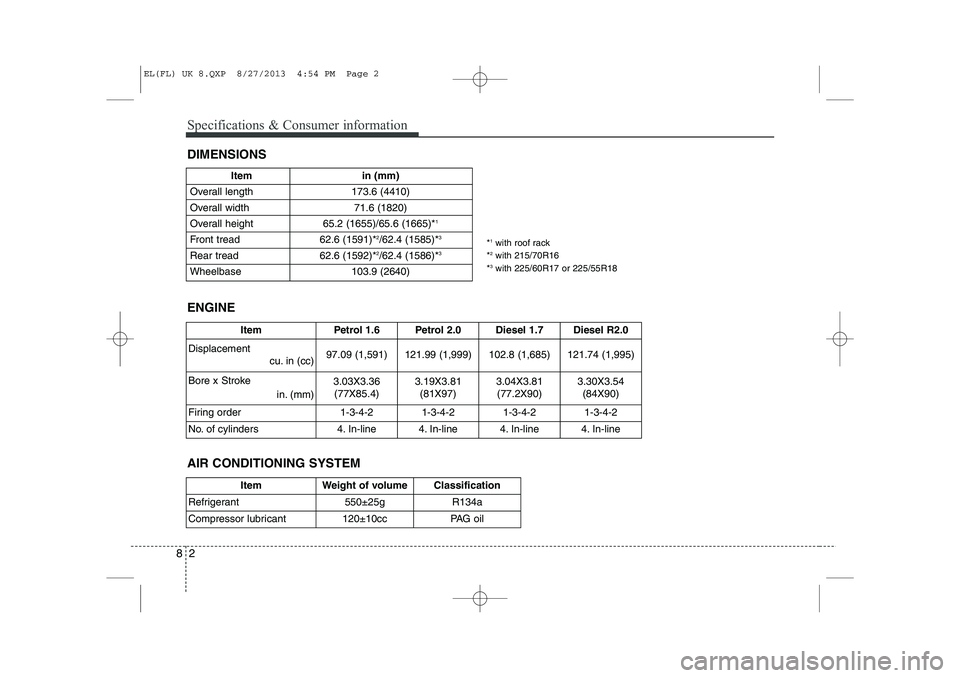
DIMENSIONS
Item in (mm)
Overall length 173.6 (4410)
Overall width 71.6 (1820)
Overall height 65.2 (1655)/65.6 (1665)* 1
Front tread 62.6 (1591)* 2
/62.4 (1585)* 3
Rear tread 62.6 (1592)* 2
/62.4 (1586)* 3
Wheelbase 103.9 (2640)
* 1
with roof rack
* 2
with 215/70R16
* 3
with 225/60R17 or 225/55R18
ENGINE Item
Petrol 1.6 Petrol 2.0Diesel 1.7Diesel R2.0
Displacement cu. in (cc)
97.09 (1,591) 121.99 (1,999)102.8 (1,685)121.74 (1,995)
Bore x Stroke in. (mm)
3.03X3.36(77X85.4) 3.19X3.81
(81X97)3.04X3.81(77.2X90)3.30X3.54 (84X90)
Firing order
1-3-4-2 1-3-4-21-3-4-21-3-4-2
No. of cylinders
4. In-line 4. In-line4. In-line4. In-line
ItemWeight of volume Classification
Refrigerant
550±25g R134a
Compressor lubricant
120±10cc PAG oil
AIR CONDITIONING SYSTEM
EL(FL) UK 8.QXP 8/27/2013 4:54 PM Page 2
Page 1534 of 1534
811
Specifications & Consumer information
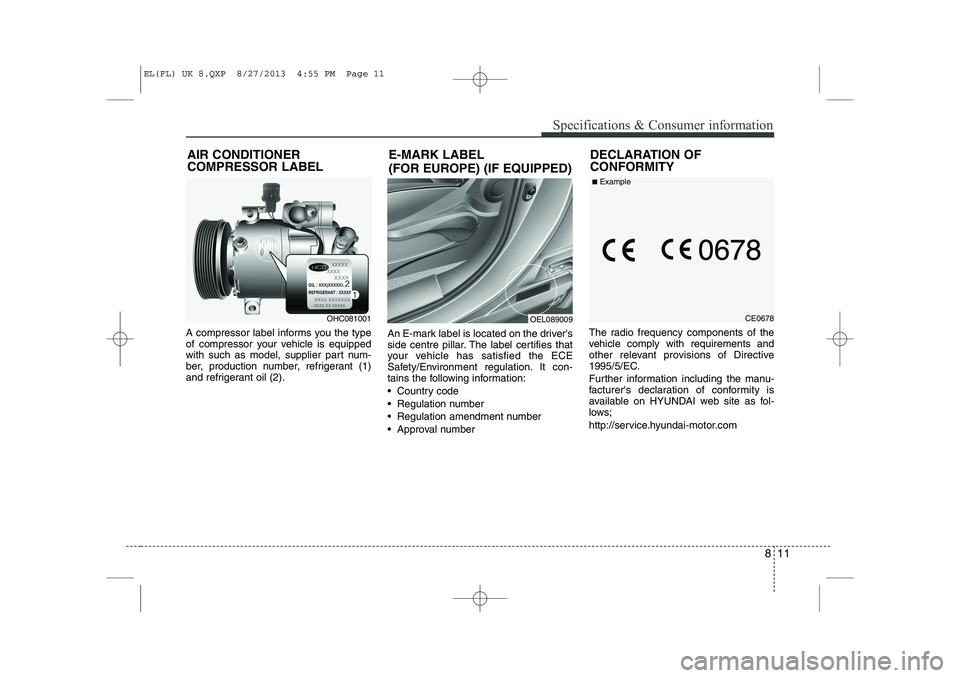
A compressor label informs you the type
of compressor your vehicle is equipped
with such as model, supplier part num-
ber, production number, refrigerant (1)
and refrigerant oil (2).An E-mark label is located on the driver's
side centre pillar. The label certifies that
your vehicle has satisfied the ECE
Safety/Environment regulation. It con-
tains the following information:
Country code
Regulation number
Regulation amendment number
Approval numberThe radio frequency components of the
vehicle comply with requirements and
other relevant provisions of Directive
1995/5/EC.
Further information including the manu-
facturer's declaration of conformity is
available on HYUNDAI web site as fol-
lows;
http://service.hyundai-motor.com
OEL089009
AIR CONDITIONER COMPRESSOR LABELOHC081001
E-MARK LABEL
(FOR EUROPE) (IF EQUIPPED)
DECLARATION OF CONFORMITYCE0678
■
Example
EL(FL) UK 8.QXP 8/27/2013 4:55 PM Page 11