2014 HYUNDAI IX35 ESP
[x] Cancel search: ESPPage 1422 of 1534
What to do in an emergency
14
6
Always check the TPMS malfunction telltale after replacing one or more
tyres or wheels on your vehicle toensure that the replacement or alter-
nate tyres and wheels allow the
TPMS to continue to function proper-
ly.
✽✽
NOTICE
If the TPMS, Low Tyre Pressure and Position indicators do not illuminate
for 3 seconds when the ignitionswitch is turned to the ON position
or engine is running, or if they
remain illuminated after coming on
for approximately 3 seconds, we rec-ommend that the system be checked
by a HYUNDAI authorised repairer.
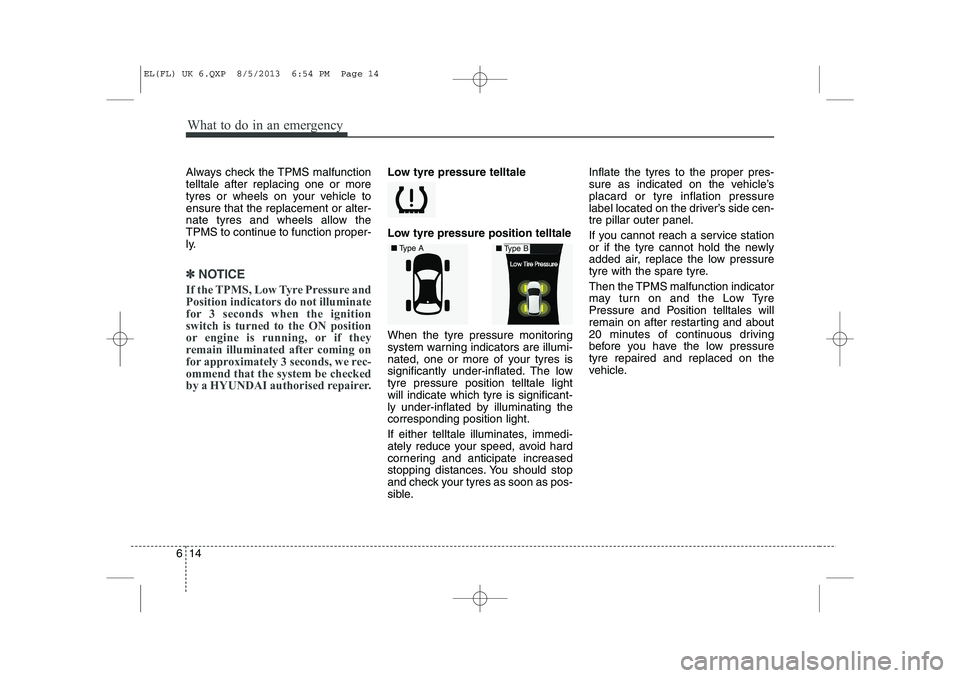
Low tyre pressure telltale
Low tyre pressure position telltale
When the tyre pressure monitoring
system warning indicators are illumi-
nated, one or more of your tyres is
significantly under-inflated. The lowtyre pressure position telltale lightwill indicate which tyre is significant-
ly under-inflated by illuminating thecorresponding position light.
If either telltale illuminates, immedi-
ately reduce your speed, avoid hard
cornering and anticipate increased
stopping distances. You should stop
and check your tyres as soon as pos-
sible. Inflate the tyres to the proper pres-
sure as indicated on the vehicle’splacard or tyre inflation pressure
label located on the driver’s side cen-tre pillar outer panel.
If you cannot reach a service station
or if the tyre cannot hold the newly
added air, replace the low pressure
tyre with the spare tyre.
Then the TPMS malfunction indicator
may turn on and the Low Tyre
Pressure and Position telltales will
remain on after restarting and about
20 minutes of continuous driving
before you have the low pressuretyre repaired and replaced on the
vehicle.
■
Type A■Type B
EL(FL) UK 6.QXP 8/5/2013 6:54 PM Page 14
Page 1424 of 1534
What to do in an emergency
16
6
Changing a tyre with TPMS
If you have a flat tyre, the Low Tyre
Pressure and Position telltales will
come on. We recommend that the
system be checked by a HYUNDAI
authorised repairer. Each wheel is equipped with a tyre pressure sensor mounted inside the
tyre behind the valve stem. You must
use TPMS specific wheels. It is rec-
ommended that you have your tyres
serviced by a HYUNDAI authorised
repairer. Even if you replace the low pressure
tyre with the spare tyre, the Low Tyre
Pressure and Position telltales will
remain on until the low pressure tyre
is repaired and placed on the vehi-
cle.
After you replace the low pressure
tyre with the spare tyre, the TPMS
malfunction indicator may illuminate
after a few minutes because theTPMS sensor is not mounted on thespare wheel.
Once the low pressure tyre is rein- flated to the recommended pressure
and installed on the vehicle or the
new TPMS sensor mounted on the
wheel, the TPMS malfunction indica-
tor and the low tyre pressure and
position telltales will extinguish within
a few minutes of driving.
If the indicator is not extinguished
after a few minutes of driving, werecommend that the system be
checked by a HYUNDAI authorised
repairer.
CAUTION
We recommend that you use the
sealant approved by HYUNDAI.The sealant on the tyre pressure sensor and wheel shall be elim-inated when you replace thetyre with a new one.
CAUTION
The TPMS malfunction indica- tor may be illuminated if thevehicle is moving around elec-tric power supply cables orradios transmitter such as at police stations, governmentand public offices, broadcast-ing stations, military installa- tions, airports, or transmittingtowers, etc. This can interferewith normal operation of the Tyre Pressure MonitoringSystem (TPMS).
The TPMS malfunction indica- tor may be illuminated if snowchains are used or some sep- arate electronic devices suchas notebook computers,mobile charger, remote starter or navigation etc., are used inthe vehicle. This can interferewith normal operation of the Tyre Pressure MonitoringSystem (TPMS).
EL(FL) UK 6.QXP 8/5/2013 6:54 PM Page 16
Page 1434 of 1534
What to do in an emergency
26
6
It is possible that some tyres, espe- cially with larger punctures or dam-
age to the sidewall, cannot be sealed
completely.
Air pressure loss in the tyre may
adversely affect tyre performance.
For this reason, you should avoid
abrupt steering or other driving
manoeuvres, especially if the vehicle
is heavily loaded or if a trailer is in
use.
The TyreMobilityKit is not designed
or intended as a permanent tyre
repair method and is to be used for
one tyre only. This instruction shows
you step by step how to temporarily
seal the puncture simply and reliably.
Read the section "Notes on the safe
use of the TyreMobilityKit". Notes on the safe use of the
TyreMobilityKit
Park your car at the side of the
road so that you can work with the
TyreMobilityKit away from moving
traffic.
To be sure your vehicle won't move, even when you're on fairly
level ground, always set your park-
ing brake.
Only use the TyreMobilityKit for sealing/inflation passenger car
tyres. Only punctured areas locat-ed within the tread region of thetyre can be sealed using the tyremobility kit.
Do not use on motorcycles, bicy- cles or any other type of tyres.
When the tyre and wheel are dam- aged, do not use Tyre Mobility Kit
for your safety.
Use of the Tyre Mobility Kit may not be effective for tyre damage larger
than approximately 0.24 in (6 mm). If the tyre cannot be made road-
worthy with the Tyre Mobility Kit,
we recommend that you contact a
HYUNDAI authorised repairer. Do not use the Tyre Mobility Kit if a
tyre is severely damaged by driving
run flat or with insufficient air pres-
sure.
Do not remove any foreign objects- such as nails or screws that have
penetrated the tyre.
Provided the car is outdoors, leave the engine running. Otherwise
operating the compressor may
eventually drain the car battery.
Never leave the TyreMobilityKit unattended whilst it is being used.
Do not leave the compressor run- ning for more than 10 min. at a time
or it may overheat.
Do not use the TyreMobilityKit if the ambient temperature is below -30°C (-22°F).
WARNING
Do not use the TMK if a tyre is
severely damaged by drivingrun flat or with insufficient air
pressure.
Only punctured areas located within the tread region of thetyre can be sealed using theTMK.
EL(FL) UK 6.QXP 8/5/2013 6:54 PM Page 26
Page 1451 of 1534
77
Maintenance
MAINTENANCE SERVICES
You should exercise the utmost care to
prevent damage to your vehicle and
injury to yourself whenever performing
any maintenance or inspection proce-
dures.
Inadequate, incomplete or insufficient
servicing may result in operational prob-
lems with your vehicle that could lead to
vehicle damage, an accident, or person-
al injury. Owner’s responsibility
✽✽
NOTICE
Maintenance Service and Record
Retention are the owner's responsibility.
We recommend in general that you have
your vehicle serviced by a HYUNDAI
authorised repairer. You should retain
documents that show proper mainte-
nance has been performed on your vehi-cle in accordance with the scheduled
maintenance service charts shown on
the following pages. You need this infor-
mation to establish your compliance with
the servicing and maintenance require-
ments of your vehicle warranties.
Detailed warranty information is provided
in your Service Passport. Repairs andadjustments required as a result of
improper maintenance or a lack of
required maintenance are not covered
when your vehicle is covered by warran-
ty. Owner maintenance precautions
Improper or incomplete service may
result in problems. This section gives
instructions only for the maintenance
items that are easy to perform.✽✽
NOTICE
Improper owner maintenance during the warranty period may affect warran-
ty coverage. For details, read the sepa-
rate Service Passport provided with the
vehicle. If you're unsure about any serv-
icing or maintenance procedure, we rec-ommend that the system be serviced by
a HYUNDAI authorised repairer.
EL(FL) UK 7.QXP 8/5/2013 7:01 PM Page 7
Page 1452 of 1534
Maintenance
8
7
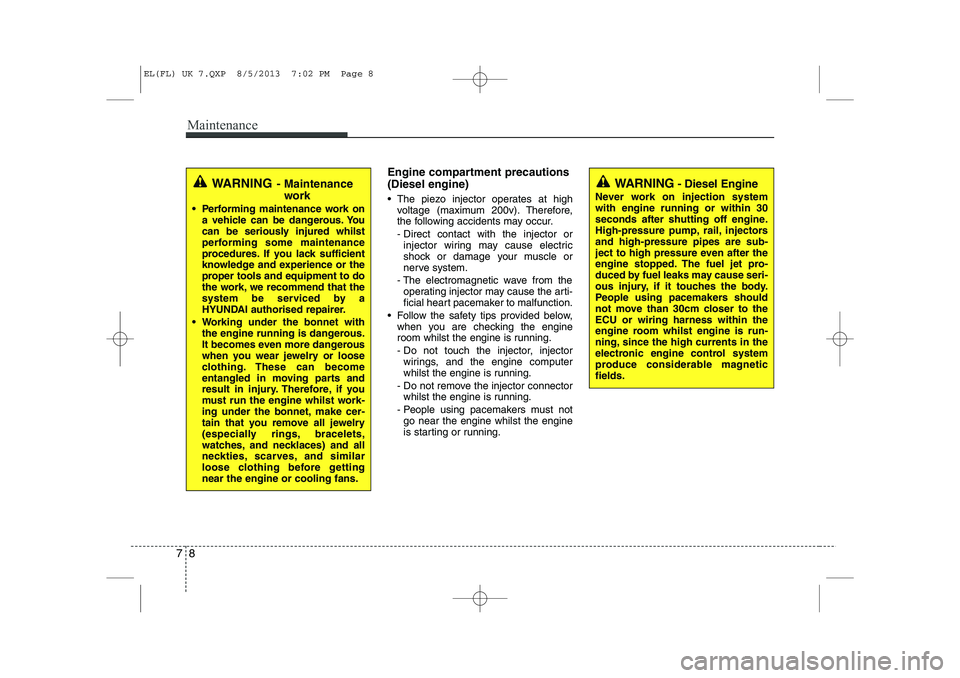
Engine compartment precautions (Diesel engine)
• The piezo injector operates at high
voltage (maximum 200v). Therefore,
the following accidents may occur.
- Direct contact with the injector or
injector wiring may cause electric
shock or damage your muscle or
nerve system.
- The electromagnetic wave from the operating injector may cause the arti-
ficial heart pacemaker to malfunction.
Follow the safety tips provided below, when you are checking the engine
room whilst the engine is running.
- Do not touch the injector, injector
wirings, and the engine computer
whilst the engine is running.
- Do not remove the injector connector whilst the engine is running.
- People using pacemakers must not go near the engine whilst the engine
is starting or running.
WARNING - Maintenance
work
Performing maintenance work on a vehicle can be dangerous. You
can be seriously injured whilst
performing some maintenance
procedures. If you lack sufficient
knowledge and experience or the
proper tools and equipment to do
the work, we recommend that the
system be serviced by a
HYUNDAI authorised repairer.
Working under the bonnet with the engine running is dangerous.
It becomes even more dangerous
when you wear jewelry or loose
clothing. These can become
entangled in moving parts and
result in injury. Therefore, if you
must run the engine whilst work-
ing under the bonnet, make cer-
tain that you remove all jewelry
(especially rings, bracelets,
watches, and necklaces) and all
neckties, scarves, and similar
loose clothing before gettingnear the engine or cooling fans.WARNING - Diesel Engine
Never work on injection system with engine running or within 30
seconds after shutting off engine.
High-pressure pump, rail, injectorsand high-pressure pipes are sub-
ject to high pressure even after the
engine stopped. The fuel jet pro-
duced by fuel leaks may cause seri-
ous injury, if it touches the body.
People using pacemakers should
not move than 30cm closer to theECU or wiring harness within the
engine room whilst engine is run-
ning, since the high currents in the
electronic engine control system
produce considerable magneticfields.
EL(FL) UK 7.QXP 8/5/2013 7:02 PM Page 8
Page 1459 of 1534
715
Maintenance
ENGINE OIL
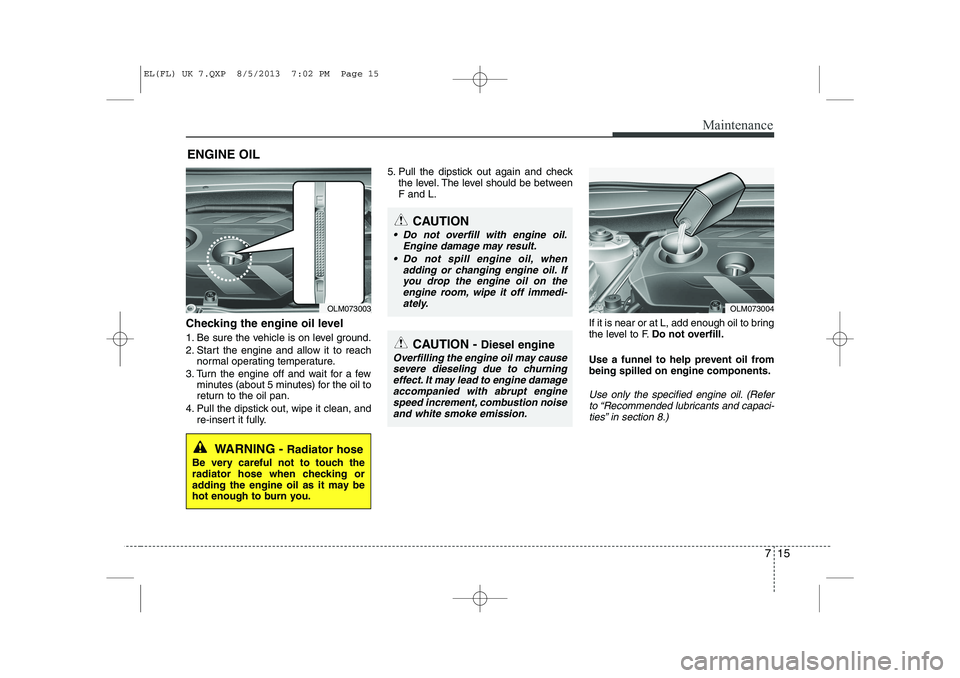
Checking the engine oil level
1. Be sure the vehicle is on level ground.
2. Start the engine and allow it to reach normal operating temperature.
3. Turn the engine off and wait for a few minutes (about 5 minutes) for the oil to
return to the oil pan.
4. Pull the dipstick out, wipe it clean, and re-insert it fully. 5. Pull the dipstick out again and check
the level. The level should be between F and L.
If it is near or at L, add enough oil to bring
the level to F.Do not overfill.
Use a funnel to help prevent oil frombeing spilled on engine components.
Use only the specified engine oil. (Refer to “Recommended lubricants and capaci-ties” in section 8.)
WARNING - Radiator hose
Be very careful not to touch the
radiator hose when checking or
adding the engine oil as it may be
hot enough to burn you.
CAUTION - Diesel engine
Overfilling the engine oil may cause
severe dieseling due to churning
effect. It may lead to engine damage accompanied with abrupt enginespeed increment, combustion noise and white smoke emission.
CAUTION
Do not overfill with engine oil. Engine damage may result.
Do not spill engine oil, when adding or changing engine oil. Ifyou drop the engine oil on the engine room, wipe it off immedi-
ately.
OLM073003OLM073004
EL(FL) UK 7.QXP 8/5/2013 7:02 PM Page 15
Page 1482 of 1534
Maintenance
38
7
Compact spare tyre replacement
(if equipped)
A compact spare tyre has a shorter
tread life than a regular size tyre.
Replace it when you can see the
tread wear indicator bars on the tyre.The replacement compact spare tyre
should be the same size and design
tyre as the one provided with your
new vehicle and should be mountedon the same compact spare tyre
wheel. The compact spare tyre is notdesigned to be mounted on a regular
size wheel, and the compact spare
tyre wheel is not designed for mount-
ing a regular size tyre. Wheel replacement
When replacing the metal wheels for
any reason, make sure the new
wheels are equivalent to the original
factory units in diameter, rim widthand offset.
(Continued)
The use of any other tyre size
or type may seriously affect
ride, handling, ground clear-
ance, stopping distance, body
to tyre clearance, snow tyre
clearance, and speedometer
reliability.
It is best to replace all four tyres at the same time. If that
is not possible, or necessary,
then replace the two front or
two rear tyres as a pair.Replacing just one tyre can
seriously affect your vehicle’shandling.
The ABS works by comparing the speed of the wheels. Tyre
size can affect wheel speed.
When replacing tyres, all 4
tyres must use the same size
originally supplied with the
vehicle. Using tyres of a dif-
ferent size can cause the ABS
(Anti-lock Brake System) and
ESP (Electronic Stability
Program) (if equipped) to
work irregularly.
WARNING
A wheel that is not the correct
size may adversely affect wheel
and bearing life, braking and
stopping abilities, handling
characteristics, ground clear-
ance, body-to-tyre clearance,
snow chain clearance,speedometer and odometer cal-
ibration, headlight aim and
bumper height.
EL(FL) UK 7.QXP 8/5/2013 7:03 PM Page 38
Page 1484 of 1534
Maintenance
40
7
S 112 mph (180 km/h)
T 118 mph (190 km/h)
H 130 mph (210 km/h)
V 149 mph (240 km/h) Z Above 149 mph (240 km/h)
Maximum Speed
Speed
Rating
Symbol
102 - Load Index, a numerical code
associated with the maximum
load the tyre can carry.
H - Speed Rating Symbol. See the speed rating chart in this section
for additional information.
Wheel size designation
Wheels are also marked with impor-
tant information that you need if you
ever have to replace one. The follow-
ing explains what the letters and
numbers in the wheel size designa-tion mean.
Example wheel size designation: 7.0JX18
7.0 - Rim width in inches. J - Rim contour designation.
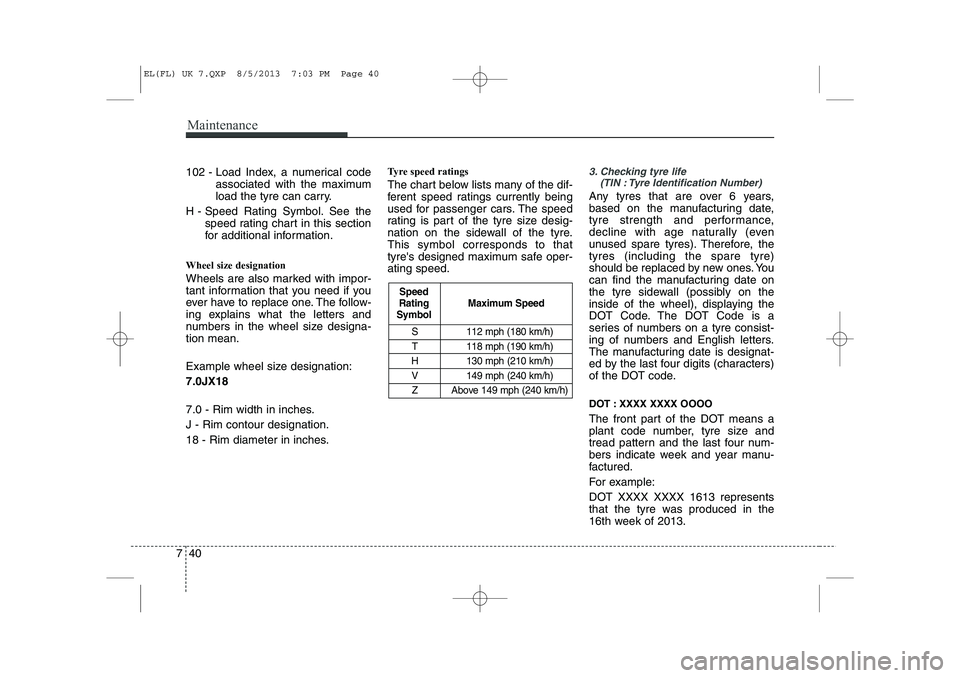
18 - Rim diameter in inches. Tyre speed ratings
The chart below lists many of the dif-
ferent speed ratings currently being
used for passenger cars. The speed
rating is part of the tyre size desig-
nation on the sidewall of the tyre.This symbol corresponds to that
tyre's designed maximum safe oper-ating speed.3. Checking tyre life
(TIN : Tyre Identification Number)
Any tyres that are over 6 years,
based on the manufacturing date,
tyre strength and performance,
decline with age naturally (even
unused spare tyres). Therefore, thetyres (including the spare tyre)
should be replaced by new ones. You
can find the manufacturing date on
the tyre sidewall (possibly on the
inside of the wheel), displaying the
DOT Code. The DOT Code is a
series of numbers on a tyre consist-
ing of numbers and English letters.
The manufacturing date is designat-
ed by the last four digits (characters)
of the DOT code.
DOT : XXXX XXXX OOOO
The front part of the DOT means a
plant code number, tyre size and
tread pattern and the last four num-
bers indicate week and year manu-
factured.
For example:
DOT XXXX XXXX 1613 represents
that the tyre was produced in the
16th week of 2013.
EL(FL) UK 7.QXP 8/5/2013 7:03 PM Page 40