Page 882 of 1534
717
Maintenance
Severe driving conditions
A : Repeatedly driving short distance of less than 8 km (5miles) in normal temperature or less than 16 km (10 miles)
in freezing temperature
B : Extensive engine idling or low speed driving for long dis- tances
C : Driving on rough, dusty, muddy, unpaved, graveled or salt- spread roads
D : Driving in areas using salt or other corrosive materials or in very cold weather
E : Driving in sandy areas F : Driving in heavy traffic area over 90°F (32°C)
G : Driving on uphill, downhill, or mountain road
H : Towing a Trailer, or using a camper, or roof rack
I : Driving as a patrol car, taxi, other commercial use or vehicle
towing
J : Driving over 140 km/h (87 mile/h)
K : Driving over 170 km/h (106 mile/h)
L : Frequently driving in stop-and-go conditions
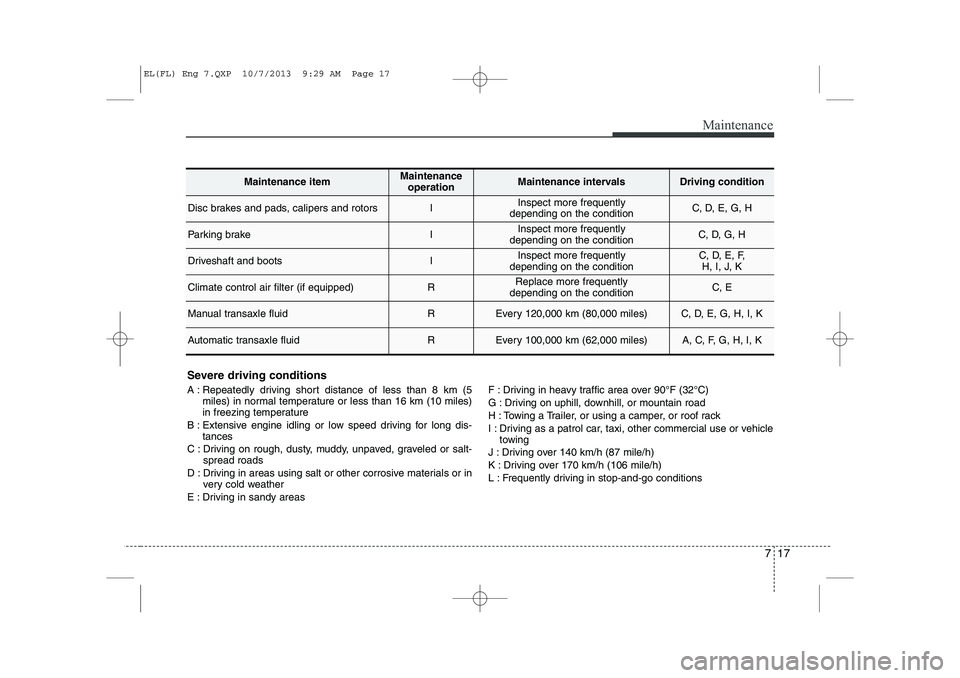
Maintenance itemMaintenance operationMaintenance intervalsDriving condition
Disc brakes and pads, calipers and rotorsIInspect more frequently
depending on the conditionC, D, E, G, H
Parking brakeIInspect more frequently
depending on the conditionC, D, G, H
Driveshaft and bootsIInspect more frequently
depending on the conditionC, D, E, F, H, I, J, K
Climate control air filter (if equipped)RReplace more frequently
depending on the conditionC, E
Manual transaxle fluid REvery 120,000 km (80,000 miles)C, D, E, G, H, I, K
Automatic transaxle fluidREvery 100,000 km (62,000 miles)A, C, F, G, H, I, K
EL(FL) Eng 7.QXP 10/7/2013 9:29 AM Page 17
Page 893 of 1534
Maintenance
28
7
SEVERE DRIVING CONDITIONS
A : Repeated short distance driving
B : Extensive idling
C : Driving in dusty, rough roads
D : Driving in areas using salt or other corrosive
materials or in very cold weather
E : Driving in sandy areas
F : More than 50 % driving in heavy city traffic during hot weather above 32 °C (90 °F) G : Driving in mountainous areas.
H : Towing a trailer or using a camper on roof rack
I : Driving for patrol car, taxi, commercial car or vehicle towing
J : Driving in very cold weather
K : Driving over 170 km/h (106 mile/h)
L : Frequently driving in stop-and-go conditions
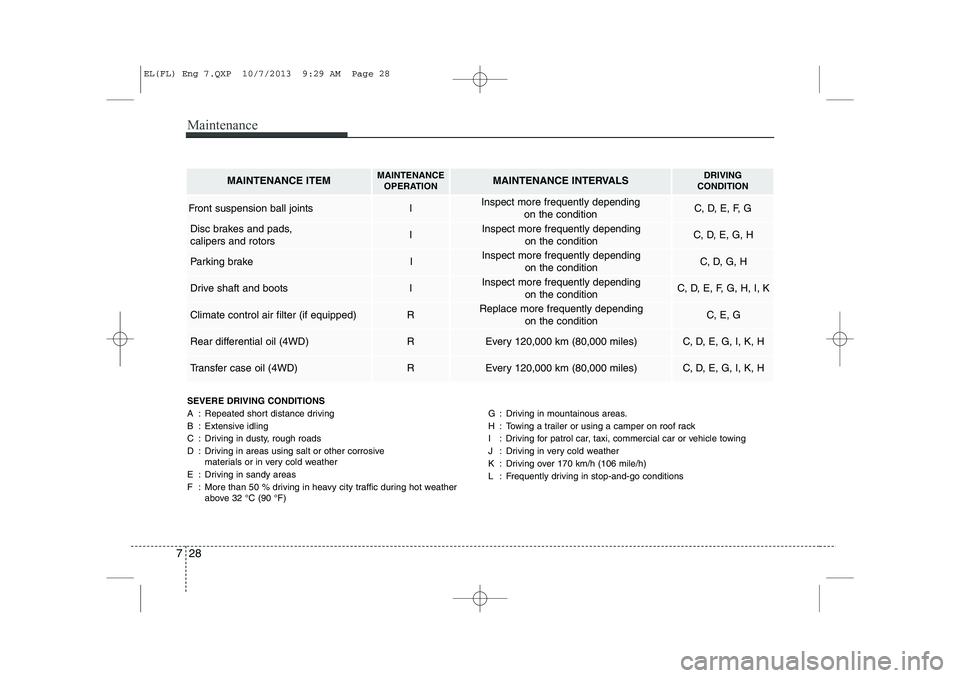
MAINTENANCE ITEMMAINTENANCE
OPERATIONMAINTENANCE INTERVALSDRIVING
CONDITION
Front suspension ball jointsIInspect more frequently depending
on the conditionC, D, E, F, G
Disc brakes and pads, calipers and rotorsIInspect more frequently depending on the conditionC, D, E, G, H
Parking brakeIInspect more frequently depending on the conditionC, D, G, H
Drive shaft and bootsIInspect more frequently depending on the conditionC, D, E, F, G, H, I, K
Climate control air filter (if equipped) RReplace more frequently depending on the conditionC, E, G
Rear differential oil (4WD)REvery 120,000 km (80,000 miles)C, D, E, G, I, K, H
Transfer case oil (4WD)REvery 120,000 km (80,000 miles)C, D, E, G, I, K, H
EL(FL) Eng 7.QXP 10/7/2013 9:29 AM Page 28
Page 903 of 1534
Maintenance
38
7
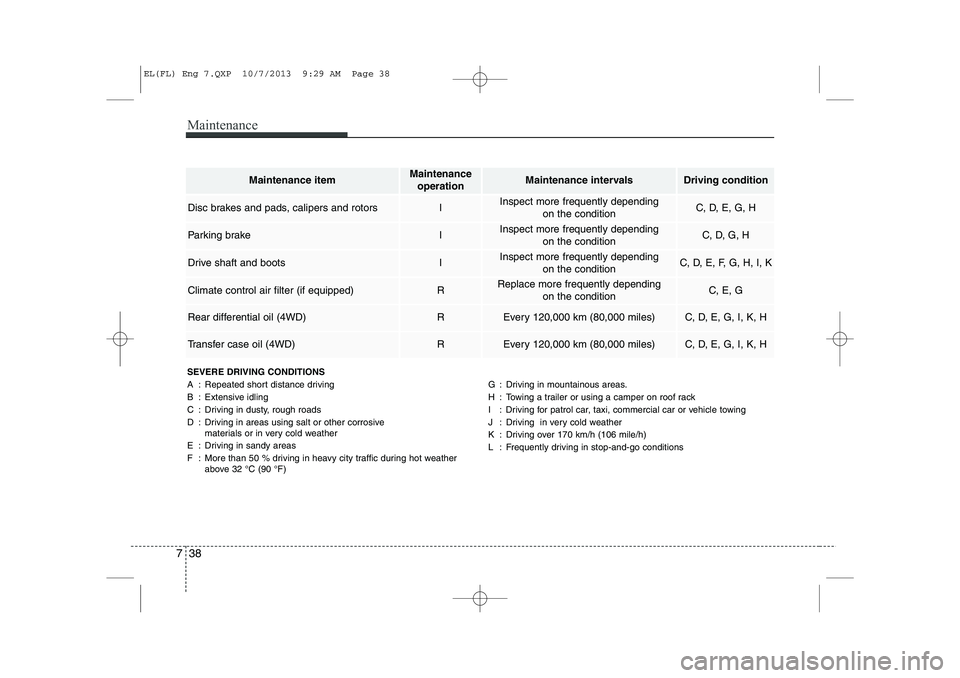
SEVERE DRIVING CONDITIONS
A : Repeated short distance driving
B : Extensive idling
C : Driving in dusty, rough roads
D : Driving in areas using salt or other corrosive
materials or in very cold weather
E : Driving in sandy areas
F : More than 50 % driving in heavy city traffic during hot weather above 32 °C (90 °F) G : Driving in mountainous areas.
H : Towing a trailer or using a camper on roof rack
I : Driving for patrol car, taxi, commercial car or vehicle towing
J : Driving in very cold weather
K : Driving over 170 km/h (106 mile/h)
L : Frequently driving in stop-and-go conditions
Maintenance itemMaintenance
operationMaintenance intervalsDriving condition
Disc brakes and pads, calipers and rotorsIInspect more frequently depending on the conditionC, D, E, G, H
Parking brakeIInspect more frequently depending on the conditionC, D, G, H
Drive shaft and bootsIInspect more frequently depending on the conditionC, D, E, F, G, H, I, K
Climate control air filter (if equipped) RReplace more frequently depending on the conditionC, E, G
Rear differential oil (4WD)REvery 120,000 km (80,000 miles)C, D, E, G, I, K, H
Transfer case oil (4WD)REvery 120,000 km (80,000 miles)C, D, E, G, I, K, H
EL(FL) Eng 7.QXP 10/7/2013 9:29 AM Page 38
Page 912 of 1534

747
Maintenance
SEVERE DRIVING CONDITIONS
A : Repeated short distance driving
B : Extensive idling
C : Driving in dusty, rough roads
D : Driving in areas using salt or other corrosive materials or in very cold weather
E : Driving in sandy areas
F : More than 50 % driving in heavy city traffic during hot weather above 32 °C (90 °F) G : Driving on uphill, downhill, or mountain roads
H : Towing a trailer or using a camper on roof rack
I : Driving for patrol car, taxi, commercial car or vehicle towing
J : Driving in very cold weather
K : Driving over 170 km/h (106 mile/h)
L : Frequently driving in stop-and-go conditions
MAINTENANCE ITEMMAINTENANCE
OPERATIONMAINTENANCE INTERVALSDRIVING
CONDITION
Disc brakes and pads, calipers and rotorsIInspect more frequently depending
on the conditionC, D, E, G, H
Parking brakeIInspect more frequently depending on the conditionC, D, G, H
Drive shaft and bootsIInspect more frequently depending on the conditionC, D, E, F, G, H, I, K
Climate control air filter (if equipped) RReplace more frequently depending on the conditionC, E, G
Rear differential oil (4WD)REvery 120,000 km (80,000 miles)C, D, E, G, I, K, H
Transfer case oil (4WD)REvery 120,000 km (80,000 miles)C, D, E, G, I, K, H
EL(FL) Eng 7.QXP 10/7/2013 9:29 AM Page 47
Page 917 of 1534

Maintenance
52
7
ENGINE COOLANT
Changing the engine oil and filter
We recommend that the engine oil and
filter be replaced by an authorized
HYUNDAI dealer. The high-pressure cooling system has a
reservoir filled with year-round antifreeze
coolant. The reservoir is filled at the fac-
tory.
Check the antifreeze protection and
coolant concentration level at least once
a year, at the beginning of the winter sea-
son, and before traveling to a colder cli-
mate.
Checking the coolant level
WARNING
Removing radiatorcap
Never attempt to remove the radi- ator cap while the engine is oper-
ating or hot. Doing so might leadto cooling system and engine
damage and could result in seri-
ous personal injury from escap-ing hot coolant or steam.
Turn the engine off and wait until it cools down. Use extreme care
when removing the radiator cap.
Wrap a thick towel around it, and
turn it counterclockwise slowly to
the first stop.
(Continued)
(Continued)Step back while the pressure is
released from the cooling sys-
tem. When you are sure all thepressure has been released,
press down on the cap, using a
thick towel, and continue turning
counterclockwise to remove it.
Even if the engine is not operat- ing, do not remove the radiatorcap or the drain plug while the
engine and radiator are hot. Hot
coolant and steam may still blow
out under pressure, causing seri-
ous injury.
WARNING
Used engine oil may cause irrita- tion or cancer of the skin if left in
contact with the skin for prolonged
periods of time. Used engine oil
contains chemicals that have
caused cancer in laboratory ani-
mals. Always protect your skin by
washing your hands thoroughlywith soap and warm water as soon
as possible after handling used oil.
EL(FL) Eng 7.QXP 10/7/2013 9:29 AM Page 52
Page 997 of 1534

15
Introduction
Biodiesel
Commercially supplied Diesel blends of no more than 7% biodiesel, commonly
known as "B7 Diesel" may be used in
your vehicle if Biodiesel meets EN 14214
or equivalent specifications. (EN stands
for "European Norm"). The use of biofu-
els exceeding 7%, made from rapeseed
methyl ester (RME), fatty acid methyl
ester (FAME), vegetable oil methyl ester
(VME) etc. or mixing diesel exceeding7% with biodiesel will cause increased
wear or damage to the engine and fuel
system. Repair or replacement of worn ordamaged components due to the use of
non approved fuels will not be covered by
the manufactures warranty.As with other vehicles of this type, failure
to operate this vehicle correctly mayresult in loss of control, an accident or
vehicle rollover.
Specific design characteristics (higher
ground clearance, track, etc.) give this
vehicle a higher centre of gravity than
other types of vehicles. In other words
they are not designed for cornering at the
same speeds as conventional 2-wheel
drive vehicles. Avoid sharp turns or
abrupt manoeuvres. Again, failure to
operate this vehicle correctly may result
in loss of control, an accident or vehicle
rollover.
Be sure to read the “Reducing
the risk of a rollover” driving guide-
lines, in section 5 of this manual. No special run-in period is needed. By
following a few simple precautions for the
first 600 miles (1,000 km) you may add to
the performance, economy and life of
your vehicle.
Do not race the engine.
Whilst driving, keep your engine speed
(rpm, or revolutions per minute)
between 2,000 rpm and 4,000 rpm.
Do not maintain a single speed for long
periods of time, either fast or slow.
Varying engine speed is needed to
properly run-in the engine.
Avoid hard stops, except in emergen- cies, to allow the brakes to seat prop-
erly.
Don't let the engine idle longer than 3
minutes at one time.
Don't tow a trailer/caravan during the first 1,200 miles (2,000 km) of opera-tion.
CAUTION
Never use any fuel, whether
diesel, B7 biodiesel or otherwise,that fails to meet the latest petro-leum industry specification.
Never use any fuel additives or treatments that are not recom-
mended or approved by the vehi-cle manufacturer.
VEHICLE HANDLING
INSTRUCTIONS VEHICLE RUN-IN PROCESS
EL(FL) UK 1.QXP 8/5/2013 6:21 PM Page 5
Page 1021 of 1534
315
Safety features of your vehicle
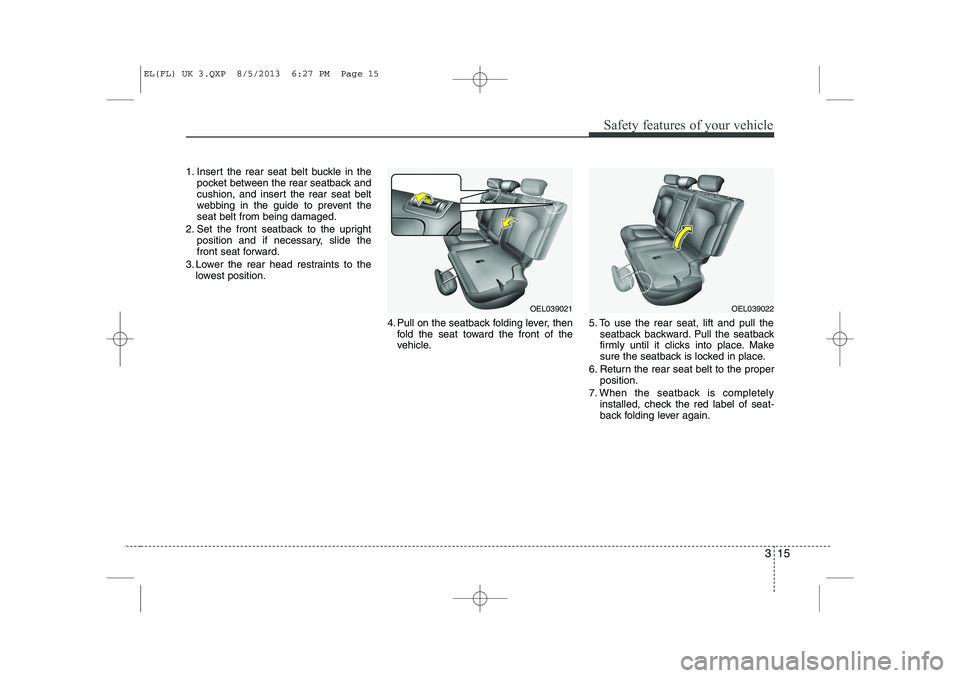
1. Insert the rear seat belt buckle in thepocket between the rear seatback and
cushion, and insert the rear seat belt
webbing in the guide to prevent theseat belt from being damaged.
2. Set the front seatback to the upright position and if necessary, slide the
front seat forward.
3. Lower the rear head restraints to the lowest position.
4. Pull on the seatback folding lever, thenfold the seat toward the front of the
vehicle. 5. To use the rear seat, lift and pull the
seatback backward. Pull the seatback
firmly until it clicks into place. Make
sure the seatback is locked in place.
6. Return the rear seat belt to the proper position.
7. When the seatback is completely installed, check the red label of seat-
back folding lever again.
OEL039021OEL039022
EL(FL) UK 3.QXP 8/5/2013 6:27 PM Page 15
Page 1029 of 1534
323
Safety features of your vehicle
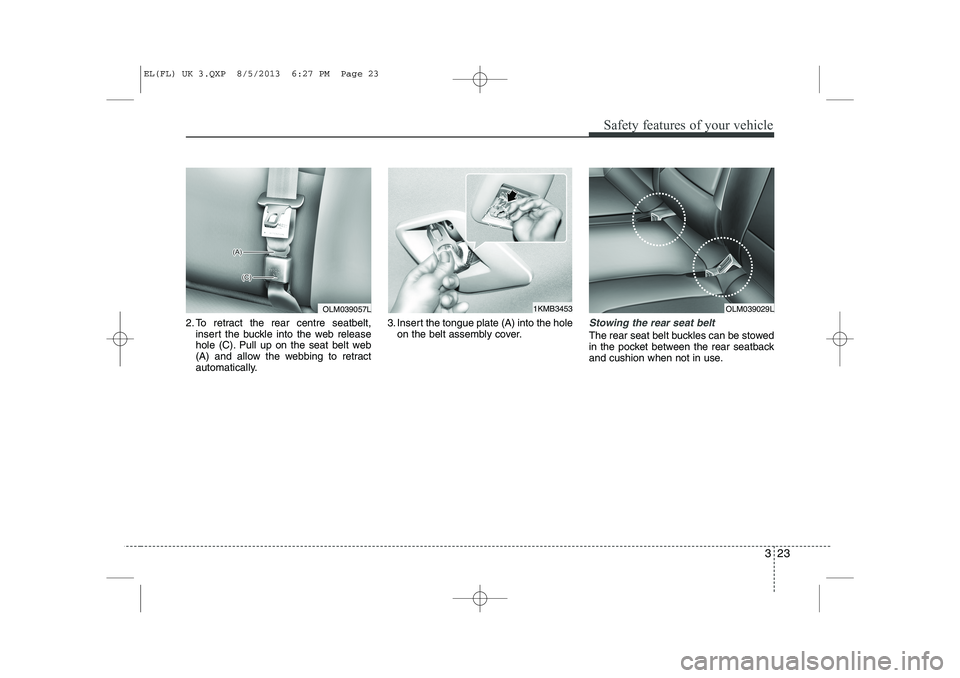
2. To retract the rear centre seatbelt,insert the buckle into the web release
hole (C). Pull up on the seat belt web
(A) and allow the webbing to retract
automatically. 3. Insert the tongue plate (A) into the hole
on the belt assembly cover.Stowing the rear seat belt
The rear seat belt buckles can be stowed
in the pocket between the rear seatback
and cushion when not in use.
OLM039057L1KMB3453OLM039029L
EL(FL) UK 3.QXP 8/5/2013 6:27 PM Page 23