Page 270 of 377
269
uuBraking uAnti-lock Brake System (ABS)
Driving
Anti-lock Brake System (ABS)
Helps prevent the wheels from locking up, and helps you retain steering control by
pumping the brakes rapidly, much faster than you.
The electronic brake distribu tion (EBD) system, which is part of the ABS, also
balances the front-to-rear braking distribution according to vehicle loading.
You should never pump the brake pedal. Let the ABS work for you by always
keeping firm, steady pressure on the brake pe dal. This is sometimes referred to as
“stomp and steer.”
■ABS operation
The brake pedal may pulsate slightly when the ABS is working. Keep holding the
pedal firmly down. On dry pavement, you will need to press on the brake pedal very
hard before the ABS activates. However, you may feel the ABS activate immediately
if you are trying to stop on snow or ice.
When the vehicle speed goes under 6 mph (10 km/h), the ABS stops.
■ABS1Anti-lock Brake System (ABS)
NOTICE
The ABS may not function correctly if you use an
incorrect tire type and size.
When the ABS indicator comes on while driving,
there may be a problem with the system.
While normal braking is not affected, there is a
possibility of the ABS not operating. Have the vehicle
checked by a dealer immediately.
The ABS does not reduce the ti me or distance it takes
to stop the vehicle. It only helps with steering control
during hard braking.
In the following cases, yo ur vehicle may need more
stopping distance than a vehicle without the ABS:
•When driving on rough road surfaces, including
when driving on uneven surf aces, such as gravel or
snow.
•When snow chains are installed.
You may hear a motor sound coming from the
engine compartment while system checks are being
performed immediately after starting the engine or
while driving. This is normal.
14 CIVIC IMA-31TR26200.book 269 ページ 2013年12月23日 月曜日 午後4時9分
Page 271 of 377
270
uuBraking uBrake Assist System
Driving
Brake Assist System
Designed to assist the driver by generating greater braking force when you depress
the brake pedal hard during emergency braking.
■Brake assist system operation
Press the brake pedal firmly for more powerful braking.
When brake assist operates, the pedal ma y wiggle slightly and an operating noise
may be heard. This is normal. Keep holding the brake pedal firmly down.
■Brake Assist System
14 CIVIC IMA-31TR26200.book 270 ページ 2013年12月23日 月曜日 午後4時9分
Page 280 of 377
279
Maintenance
This chapter discusses basic maintenance.
Before Performing MaintenanceInspection and Maintenance ............ 280
Safety When Performing Maintenance ..281
Parts and Fluids Used in Maintenance Service ........................................... 282
Maintenance Minder
TM..................... 283
Maintenance Under the Hood Maintenance Items Under the Hood .. 288
Opening the Hood ........................... 289
Recommended Engine Oil ................ 290
Oil Check ......................................... 291
Adding Engine Oil ............................ 292
Changing the Engine Oil and Oil Filter .. 293
Engine Coolant ................................ 295
Transmission Fluid ............................ 297
Brake Fluid ....................................... 298
Refilling Window Wa sher Fluid......... 299
Replacing Light Bulbs ....................... 300
Checking and Maintaining Wiper
Blades .......................................... 306
Checking and Maintaining Tires
Checking Tires ................................. 308
Tire and Loading Information Label .. 309
Tire Labeling .................................... 309
DOT Tire Quality Grading (U.S. Vehicles).. 311Wear Indicators................................ 313 Tire Service Life ................................ 313
Tire and Wheel Replacement ........... 314
Tire Rotation .................................... 315
Winter Tires ..................................... 316
12 Volt Battery .................................. 317
Remote Transmitter Care
Replacing the Button Battery ........... 318
Climate Control System Maintenance.. 319Cleaning
Interior Care .................................... 320
Exterior Care.................................... 322
14 CIVIC IMA-31TR26200.book 279 ページ 2013年12月23日 月曜日 午後4時9分
Page 281 of 377
280
Maintenance
Before Performing Maintenance
Inspection and Maintenance
For your safety, perform all listed inspections and maintenance to keep your vehicle
in good condition. If you become aware of any abnormality (noise, smell, insufficient
brake fluid, oil residue on the ground, etc.), have your vehicle inspected by a dealer.
(Note, however, that service at a dealer is not mandatory to keep your warranties in
effect.) Refer to the separate maintena nce booklet for detailed maintenance and
inspection information.
■Daily inspections
Perform inspections before long distance tri ps, when washing the vehicle, or when
refueling.
■Periodic inspections
• Check the continuously variable transmission fluid level monthly.
2 Continuously Variable Transmission (CVT) Fluid P. 297
•Check the brake fluid level monthly.
2 Checking the Brake Fluid P. 298
•Check the tire pressure monthly. Examin e the tread for wear and foreign objects.
2Checking and Maintaining Tires P. 308
•Check the operation of the exterior lights monthly.
2 Replacing Light Bulbs P. 300
•Check the condition of the wiper bl ades at least every six months.
2Checking and Maintaining Wiper Blades P. 306
■Types of Inspection and Maintenance
1Inspection and Maintenance
Maintenance, replacement, or repair of
emissions control devices and systems may be
done by any automotive repair establishment or
individuals using parts that are “certified” to
EPA standards.
According to state and fede ral regulations, failure to
perform maintenance on the maintenance main
items marked with # will not void your emissions
warranties. However, all ma intenance services should
be performed in accordan ce with the intervals
indicated by the i-MID.
2 Maintenance Service Items P. 286
If you want to perform complex maintenance tasks
that require more skills a nd tools, you can purchase a
subscription to the Service Express website at
www.techinfo.honda.com .
2 Authorized Manuals P. 367
If you want to perform ma intenance yourself, make
sure that you have the necessary tools and skills first.
After performing ma intenance, update the records in
the separate maintenance booklet.
U.S. models
14 CIVIC IMA-31TR26200.book 280 ページ 2013年12月23日 月曜日 午後4時9分
Page 290 of 377
289
uuMaintenance Under the Hood uOpening the Hood
Maintenance
Opening the Hood
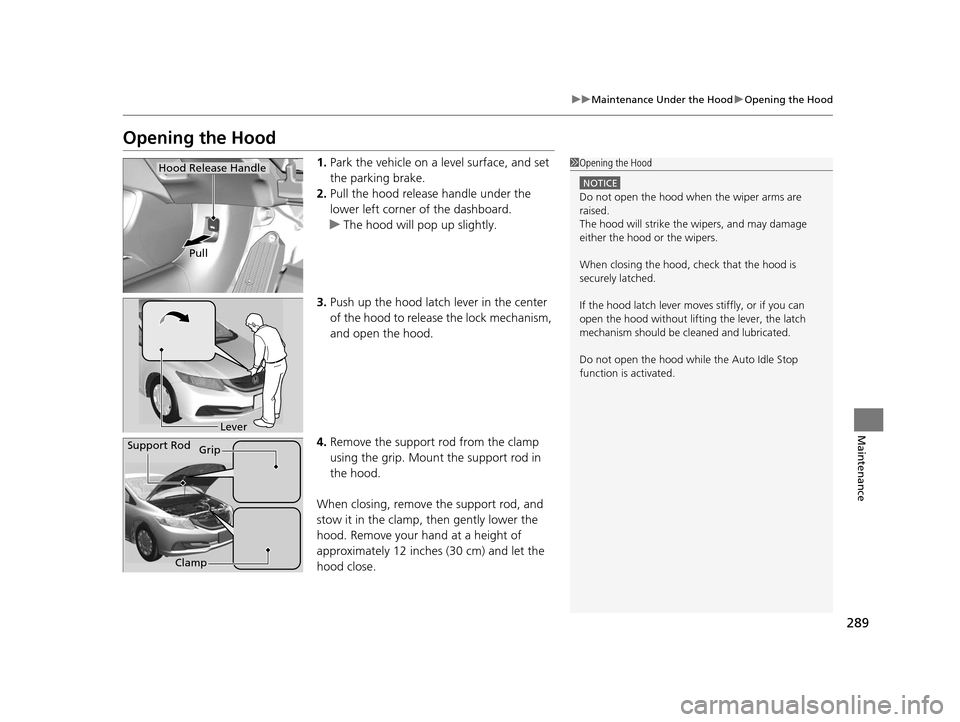
1. Park the vehicle on a level surface, and set
the parking brake.
2. Pull the hood release handle under the
lower left corner of the dashboard.
u The hood will pop up slightly.
3. Push up the hood latch lever in the center
of the hood to release the lock mechanism,
and open the hood.
4. Remove the support rod from the clamp
using the grip. Mount the support rod in
the hood.
When closing, remove the support rod, and
stow it in the clamp, then gently lower the
hood. Remove your hand at a height of
approximately 12 inches (30 cm) and let the
hood close.1 Opening the Hood
NOTICE
Do not open the hood when the wiper arms are
raised.
The hood will strike the wipers, and may damage
either the hood or the wipers.
When closing the hood, check that the hood is
securely latched.
If the hood latch lever moves stiffly, or if you can
open the hood without lifti ng the lever, the latch
mechanism should be cl eaned and lubricated.
Do not open the hood while the Auto Idle Stop
function is activated.
Hood Release Handle
Pull
Lever
Support Rod Grip
Clamp
14 CIVIC IMA-31TR26200.book 289 ページ 2013年12月23日 月曜日 午後4時9分
Page 304 of 377
303
uuReplacing Light Bulbs uRear Turn Signal Light Bulbs
Maintenance
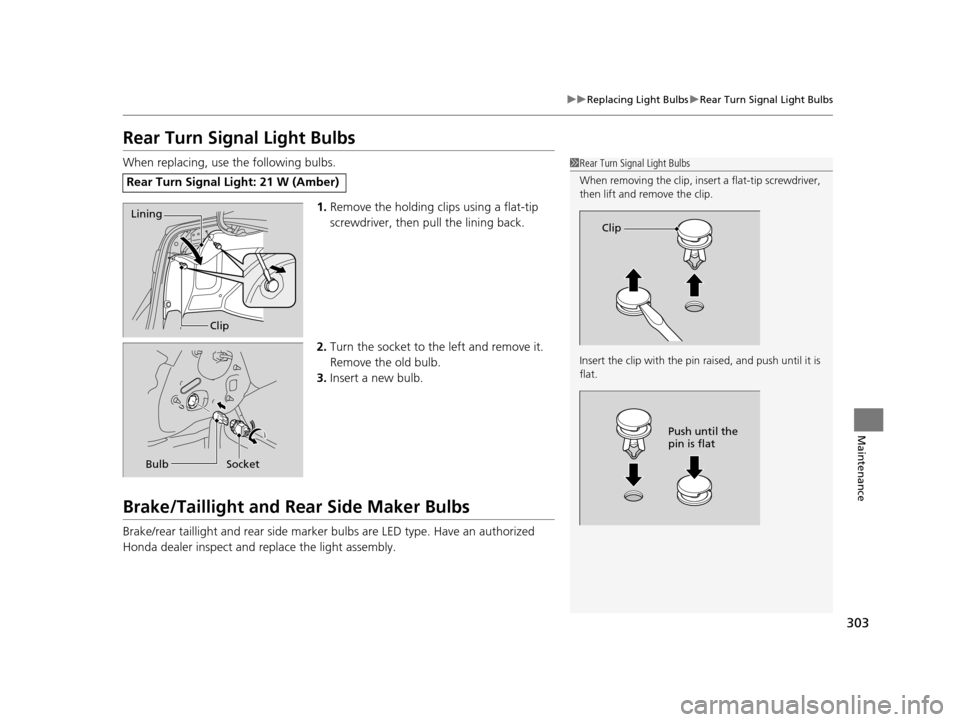
Rear Turn Signal Light Bulbs
When replacing, use the following bulbs.
1.Remove the holding cl ips using a flat-tip
screwdriver, then pull the lining back.
2. Turn the socket to th e left and remove it.
Remove the old bulb.
3. Insert a new bulb.
Brake/Taillight and R ear Side Maker Bulbs
Brake/rear taillight and rear side marker bulbs are LED type. Have an authorized
Honda dealer inspect and replace the light assembly.
Rear Turn Signal Light: 21 W (Amber)
1 Rear Turn Signal Light Bulbs
When removing the clip, insert a flat-tip screwdriver,
then lift and remove the clip.
Insert the clip with the pin raised, and push until it is
flat.
Clip
Push until the
pin is flat
Lining
Clip
Bulb Socket
14 CIVIC IMA-31TR26200.book 303 ページ 2013年12月23日 月曜日 午後4時9分
Page 306 of 377
305
uuReplacing Light Bulbs uRear License Plate Light Bulbs
Maintenance
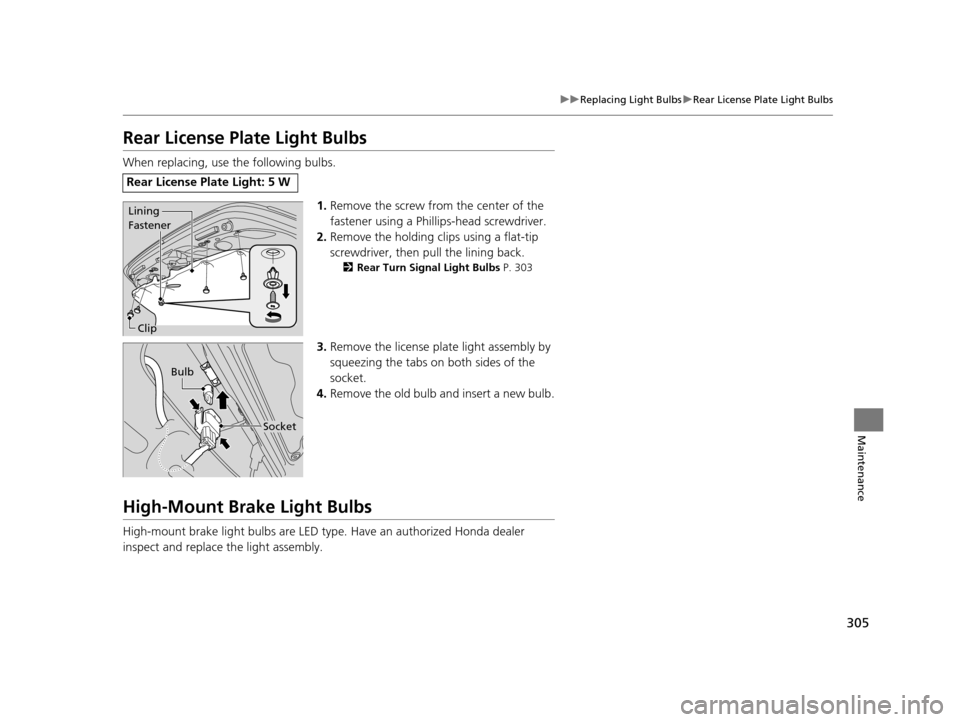
Rear License Plate Light Bulbs
When replacing, use the following bulbs.
1.Remove the screw from the center of the
fastener using a Phillips-head screwdriver.
2. Remove the holding cl ips using a flat-tip
screwdriver, then pull the lining back.
2Rear Turn Signal Light Bulbs P. 303
3.Remove the license plat e light assembly by
squeezing the tabs on both sides of the
socket.
4. Remove the old bulb and insert a new bulb.
High-Mount Bra ke Light Bulbs
High-mount brake light bulbs are LED type . Have an authorized Honda dealer
inspect and replace the light assembly.
Rear License Plate Light: 5 W
Lining
Fastener
Clip
Bulb
Socket
14 CIVIC IMA-31TR26200.book 305 ページ 2013年12月23日 月曜日 午後4時9分
Page 325 of 377
324
uuCleaning uExterior Care
Maintenance
Aluminum is susceptible to deterioration caused by salt and other road
contaminants. Use a sponge and mild detergent to wipe away promptly.
Be careful not to use harsh chemicals (inc luding some commercial wheel cleaners) or
a stiff brush. They can damage the clear coat of the aluminum alloy wheels that
helps keep the aluminum from corroding and tarnishing.
The inside lenses of exterior lights (headlig hts, brake lights, etc.) may fog temporarily
if you have driven in the rain, or after the vehicle has been run through a car wash.
Dew condensation also may build up inside the lenses when there is a significant
enough difference between the ambient and inside lens temperatures (similar to
vehicle windows fogging up in rainy conditions). These conditions are natural
processes, not structural design problems in the exterior lights.
Lens design characteristics may result in mo isture developing on the light lens frame
surfaces. This also is not a malfunction.
However, if you see large amounts wate r accumulation, or large water drops
building up inside the lenses, have your vehicle inspected by a dealer.
■Maintaining Aluminum Wheels
■Fogged Exterior Light Lenses
14 CIVIC IMA-31TR26200.book 324 ページ 2013年12月23日 月曜日 午後4時9分