2014 HONDA CIVIC COUPE check engine
[x] Cancel search: check enginePage 7 of 46
Indicators
6
Instrument Panel
IndicatorName On/Blinking ExplanationMessage
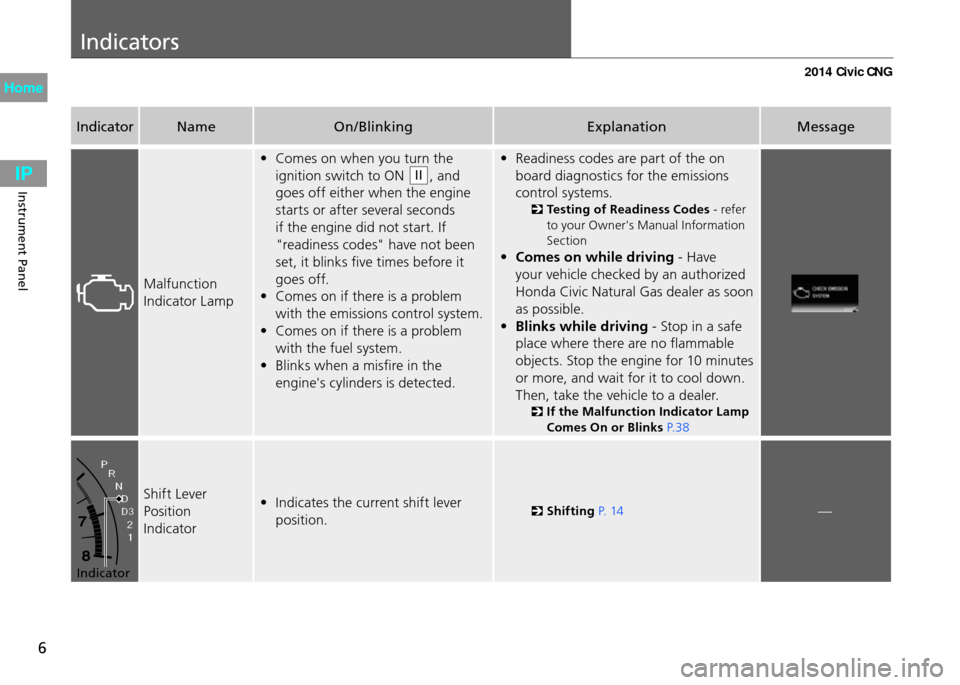
Malfunction
Indicator Lamp• Comes on when you turn the
ignition switch to ON
II, and
goes off either when the engine
starts or after several seconds
if the engine did not start. If
"readiness codes" have not been
set, it blinks five times before it
goes off.
• Comes on if there is a problem with the emissions control system.
• Comes on if there is a problem with the fuel system.
• Blinks when a misfire in the engine's cylinders is detected. • Readiness codes are part of the on
board diagnostics for the emissions
control systems.
Testing of Readiness Code s - refer
to your Owner's Manual Information
Section
• Comes on while driving - Have
your vehicle checked by an authorized
Honda Civic Natural Gas dealer as soon
as possible.
• Blinks while driving - Stop in a safe
place where there are no flammable
objects. Stop the engine for 10 minutes
or more, and wait for it to cool down.
Then, take the vehicle to a dealer.
If the Malfunction Indicator Lamp
Comes On or Blinks P. 3 8
Shift Lever
Position
Indicator • Indicates the current shift lever
position.
Shifting P. 14—
Indicator
2014 Civic CNG
Page 8 of 46
Indicators
7
Instrument Panel
IndicatorName On/Blinking ExplanationMessage
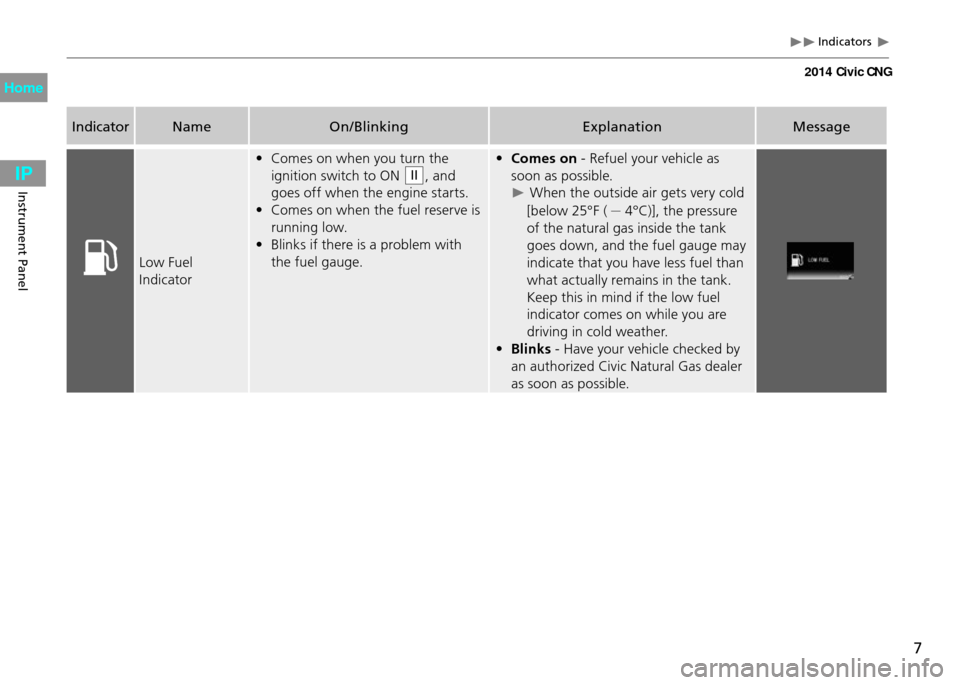
Low Fuel
Indicator• Comes on when you turn the
ignition switch to ON
II, and
goes off when the engine starts.
• Comes on when the fuel reserve is running low.
• Blinks if there is a problem with the fuel gauge. •
Comes on - Refuel your vehicle as
soon as possible.
When the outside air gets very cold
[below 25°F (
-4°C)], the pressure
of the natural gas inside the tank
goes down, and the fuel gauge may
indicate that you have less fuel than
what actually remains in the tank.
Keep this in mind if the low fuel
indicator comes on while you are
driving in cold weather.
• Blinks - Have your vehicle checked by
an authorized Civic Natural Gas dealer
as soon as possible.
2014 Civic CNG
Page 12 of 46

11
When Driving
Continued
Driving
Starting the Engine
Starting the Engine
Keep your foot firmly on the brake pedal when
starting the engine.
The engine is harder to start in cold weather and
in thinner air found at altitudes above 8,000 feet
(2,400 meters).
When starting the engine in cold weather, turn
off all electrical accessories (the lights, heating
and cooling system, and rear defogger) in order to
reduce battery drain.
If you live in a region where winter is extremely
cold, an engine block heater will improve starting
and warming of the engine. If temperatures
consistently below -22°F (-30°C) are expected, the
coolant mixture should be changed to a higher
concentration to prevent freezing. Consult a dealer
for details.
If the exhaust system sounds abnormal or you
can smell exhaust gas inside the vehicle, have
your vehicle checked by a dealer. There may be a
problem with the engine or exhaust system.
Brake Pedal
1. Make sure the parking brake is applied.
2. Check that the shift lever is in P
, then
depress the brake pedal.
Although it is possible to start the vehicle
in
N, it is safer to start it in P.
2014 Civic CNG
Page 16 of 46

When Driving Shifting
15Continued
Driving
Shift Lever Operation
Shift Lever Position Indicator
Tachometer’s red zone
Depress the brake pedal and press
the shift lever release button to
shift.
Shift without pressing the shift
lever release button.
Press the shift lever release button
and shift.
Shift Lever Operation
NOTICE
When you change the shift lever from D to R and
vice versa, come to a complete stop and keep the
brake pedal depressed.
Operating the shift lever before the vehicle has
come to a complete standstill can damage the
transmission.
Use the shift lever position indicator to check the
lever position before pulling away.
Whichever position the shift lever is in when driving,
a blinking
D indicator indicates a transmission
problem.
Avoid sudden acceleration and have the
transmission checked by a dealer as soon as
possible.
The fuel supply may be cut off if you drive at engine
speeds in or over the tachometer’s red zone (engine
speed limit). If this happens, you may experience a
slight jolt.
It may not be possible to operate the shift lever
if the brake pedal is applied while the shift lever
release button is held down.
Depress the brake pedal first.
2014 Civic CNG
Page 22 of 46

21
Maintenance
Maintenance MinderTM To Use Maintenace MinderTM
Maintenance Service Items
2345
Maintenance Service ItemsIndependent of the Maintenance Minder
•information, replace the brake fluid every 3 years.
Inspect idle speed every 160,000 miles (256,000
•km).
Adjust the valves during services A, B, 1, 2, or 3 if
•they are noisy.
CODE Maintenance Main Items
A Replace engine oil •
*1
B Replace engine oil• *1 and oil filter
Replace fuel filter element (low pressure)
•
Drain fuel filter (high pressure)
•
Inspect front and rear brakes/service as necessary
•
Check parking brake adjustment
•
Inspect tie rod ends, steering gearbox, and boots
•
Inspect suspension components
•
Inspect driveshaft boots
•
Inspect brake hoses and lines (Including ABS/ VSA)
•
Inspect all fluid levels and condition of fluids
•
Inspect exhaust system
• #
Inspect fuel lines and connections
• #
Check the expiration date for TRK bottle
• *2
CODE Maintenance Sub Items
1 Rotate tires •
2 Replace air cleaner element• *3
Replace dust and pollen filter
• *4
Replace fuel filter element (high pressure)
•
Inspect drive belt
•
Inspect valve clearance
•
Inspect fuel tank
• *5
3 Replace transmission fluid •
4 Replace spark plugs•
5 Replace engine coolant•
*1: If a message SERVICE does not appear more than 12 months after the display is reset, change the
engine oil every year.
*2: Models with tire repair kit
# : See information on maintenance and emissions warranty. *3: If you drive in dusty conditions, replace the air cleaner element every 15,000 miles (24,000 km).
*4: If you drive primarily in urban areas that have high concentrations of soot in the air from industry and
from diesel-powered vehicles, replace the dust and pollen filter every 15,000 miles (24,000 km).
*5: If sub item 2 does not appear more than 36 months after the display is reset, inspect the fuel tank
every three years.
See CNG tank expiration and production dates on page 5 for inspection and replacement
information. Fuel tank should be replaced 15 years after it was manufactured.
System Message
Indicator
Maintenance Minder
Message
Main
Item Sub Items
2014 Civic CNG
Page 23 of 46
Maintenance Under the Hood
22
Maintenance
Transmission Fluid
Automatic Transmission Fluid
Specified fluid: Honda ATF DW-1 (automatic transmission fluid)
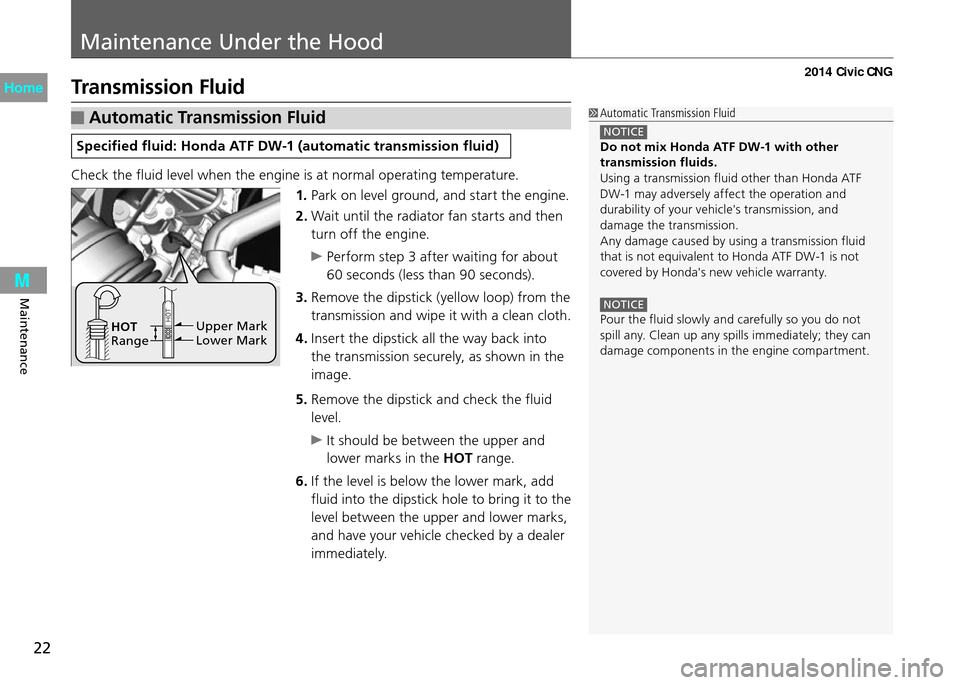
Check the fluid level when the engine is at normal operating temperature.
HOT
Range Upper Mark
Lower Mark
1.
Park on level ground, and start the engine.
2. Wait until the radiator fan starts and then
turn off the engine.
Perform step 3 after waiting for about
60 seconds (less than 90 seconds).
3. Remove the dipstick (yellow loop) from the
transmission and wipe it with a clean cloth.
4. Insert the dipstick all the way back into
the transmission securely, as shown in the
image.
5. Remove the dipstick and check the fluid
level.
It should be between the upper and
lower marks in the HOT range.
6. If the level is below the lower mark, add
fluid into the dipstick hole to bring it to the
level between the upper and lower marks,
and have your vehicle checked by a dealer
immediately.
Automatic Transmission Fluid
NOTICE Do not mix Honda ATF DW-1 with other
transmission fluids.
Using a transmission fluid other than Honda ATF
DW-1 may adversely affect the operation and
durability of your vehicle's transmission, and
damage the transmission.
Any damage caused by using a transmission fluid
that is not equivalent to Honda ATF DW-1 is not
covered by Honda's new vehicle warranty.
NOTICE Pour the fluid slowly and carefully so you do not
spill any. Clean up any spills immediately; they can
damage components in the engine compartment.
2014 Civic CNG
Page 33 of 46
32
Handling the Unexpected
If a Tire Goes Flat Temporarily Repairing a Flat Tire
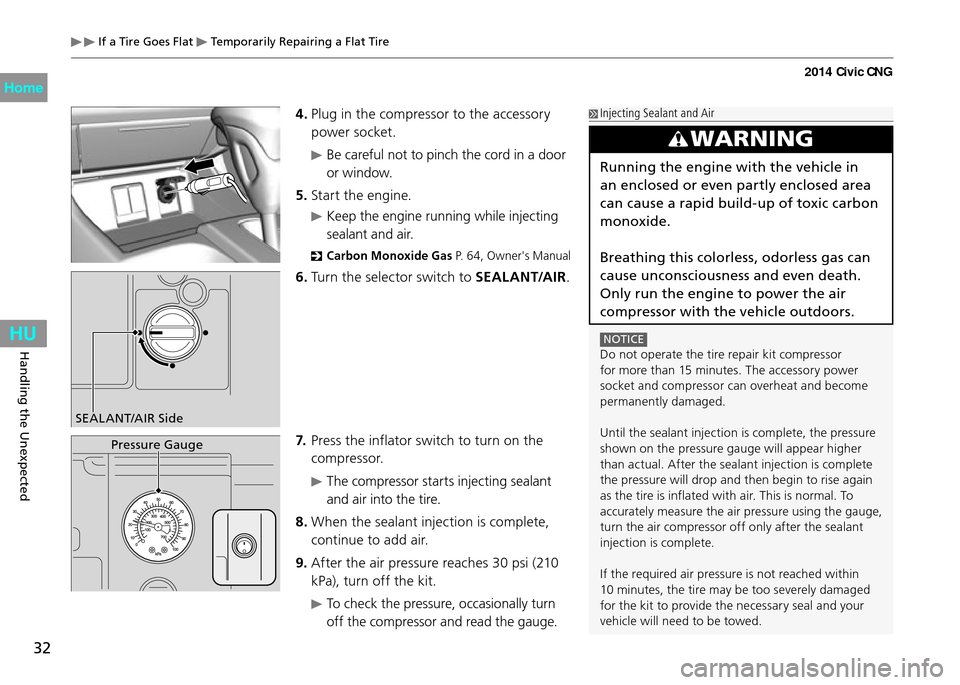
4. Plug in the compressor to the accessory
power socket.
Be careful not to pinch the cord in a door
or window.
5. Start the engine.
Keep the engine running while injecting
sealant and air.
Carbon Monoxide Ga s
P. 64, Owner's Manual
6. Turn the selector switch to SEALANT/AIR .
7. Press the inflator switch to turn on the
compressor.
The compressor starts injecting sealant
and air into the tire.
8. When the sealant injection is complete,
continue to add air.
9. After the air pressure reaches 30 psi (210
kPa), turn off the kit.
To check the pressure, occasionally turn
off the compressor and read the gauge.
Injecting Sealant and Air
SEAL ANT/AIR Side
Pressure Gauge
WARNING
Running the engine with the vehicle in
an enclosed or even partly enclosed area
can cause a rapid build-up of toxic carbon
monoxide.
Breathing this colorless, odorless gas can
cause unconsciousness and even death.
Only run the engine to power the air
compressor with the vehicle outdoors.
NOTICE Do not operate the tire repair kit compressor
for more than 15 minutes. The accessory power
socket and compressor can overheat and become
permanently damaged.
Until the sealant injection is complete, the pressure
shown on the pressure gauge will appear higher
than actual. After the sealant injection is complete
the pressure will drop and then begin to rise again
as the tire is inflated with air. This is normal. To
accurately measure the air pressure using the gauge,
turn the air compressor off only after the sealant
injection is complete.
If the required air pressure is not reached within
10 minutes, the tire may be too severely damaged
for the kit to provide the necessary seal and your
vehicle will need to be towed.
2014 Civic CNG
Page 35 of 46
34
Handling the Unexpected
If a Tire Goes Flat Temporarily Repairing a Flat Tire
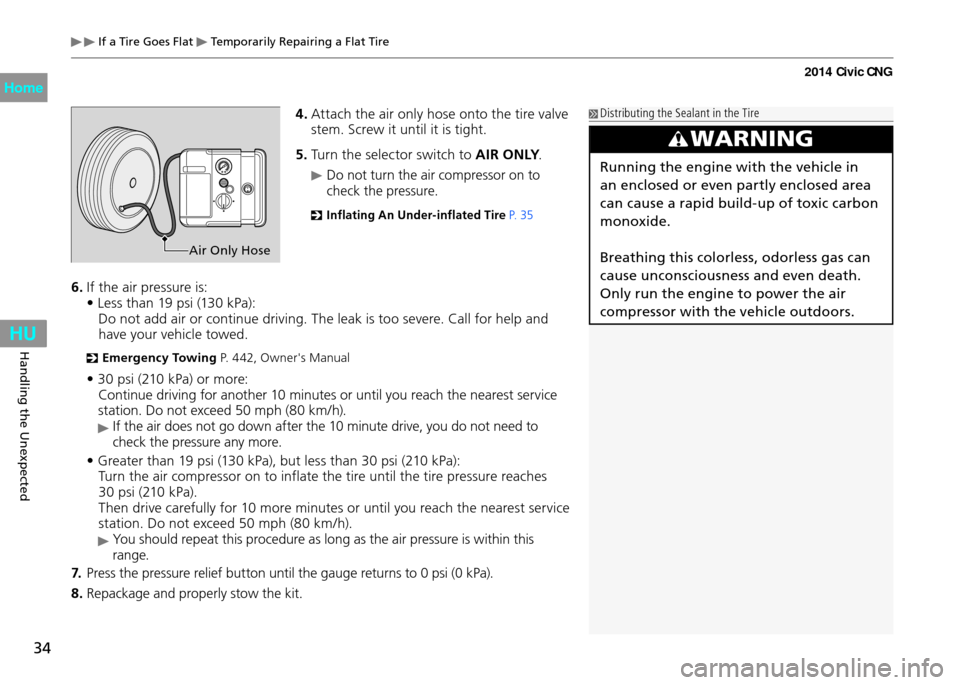
4. Attach the air only hose onto the tire valve
stem. Screw it until it is tight.
5. Turn the selector switch to AIR ONLY .
Do not turn the air compressor on to
check the pressure.
Inflating An Under-inflated Tire
P. 35
Air Only Hose
Distributing the Sealant in the Tire
WARNING
Running the engine with the vehicle in
an enclosed or even partly enclosed area
can cause a rapid build-up of toxic carbon
monoxide.
Breathing this colorless, odorless gas can
cause unconsciousness and even death.
Only run the engine to power the air
compressor with the vehicle outdoors.
6. If the air pressure is:
• Less than 19 psi (130 kPa):
Do not add air or continue driving. The leak is too severe. Call for help and
have your vehicle towed.
Emergency Towin g
P. 442, Owner's Manual
• 30 psi (210 kPa) or more:
Continue driving for another 10 minutes or until you reach the nearest service
station. Do not exceed 50 mph (80 km/h).
If the air does not go down after the 10 minute drive, you do not need to
check the pressure any more.
• Greater than 19 psi (130 kPa), but less than 30 psi (210 kPa):
Turn the air compressor on to inflate the tire until the tire pressure reaches
30 psi (210 kPa).
Then drive carefully for 10 more minutes or until you reach the nearest service
station. Do not exceed 50 mph (80 km/h).
You should repeat this procedure as long as the air pressure is within this
range.
7. Press the pressure relief button until the gauge returns to 0 psi (0 kPa).
8. Repackage and properly stow the kit.
2014 Civic CNG