2014 FORD SUPER DUTY reset
[x] Cancel search: resetPage 8 of 82
The powertrain and glow plug control
modules electronically control the glow
plug system. After you switch the ignition
on the glow plug control module
immediately energizes the glow plugs. The
glow plug control module using the engine
coolant temperature, barometric pressure
sensor and environmental temperature
sensor will determine how long the glow
plugs stay energized. The required time for
the glow plugs to be energized decreases
as the coolant temperature, barometric
pressure and environmental temperature
increase.
Glow Plug
Engine and secondary cooling system
The cooling system contains a primary
cooling loop to cool the engine and
exhaust gases and a secondary cooling
loop to cool the transmission, exhaust
gases, charge air, and fuel. The coolant
serves three primary purposes: to provide
heat transfer, freeze point protection, and
corrosion protection using additives.
Vehicles with diesel engines typically are
used to carry heavy loads and accumulate
mileage rapidly. These two factors may
cause the additives in the coolant to wear
out in a shorter time. For more information
about coolant additives and coolant
change intervals See General
Maintenance Information (page 58). .
Operating the engine with insufficient
coolant or coolant additive can cause
severe engine damage
Selective catalytic reduction system
Your vehicle is equipped with a selective
catalytic reduction system designed to
reduce emission levels of nitrogen oxides
from the exhaust of your diesel engine. This
system relies on the use of diesel exhaust
fluid that you must replenish at certain intervals. Failure to maintain proper diesel
exhaust fluid levels or if the diesel exhaust
fluid becomes contaminated will result in
vehicle speed limitations or result in your
vehicle entering an idle-only mode. See
Selective Catalytic Reduction System
(page
20).
Speed control
If your vehicle speed goes outside a
predetermined range from the set speed,
the RSM (Resume) function will not reset
your vehicle speed. You will need to reset
your vehicle speed with the SET+ or SET-
button after reaching the desired speed
using the accelerator pedal.
Minor Troubleshooting Guide
If the engine won ’t crank WARNING
Battery posts, terminals and related
accessories contain lead and lead
compounds. Wash hands after
handling. Turn on the headlights. If the lights are dim,
do not go on at all or when the ignition is
turned to START the lights become dim or
go out, the battery connections may be
loose or corroded, or the battery may be
discharged. If there is a clicking or
stuttering sound coming from the engine
compartment when you turn the key to
START, this may also indicate a loose or
corroded battery connection.
Check the battery connections at the
battery posts, cable connection to the
engine grounding point and at the starter
connection.
If you suspect a discharged battery, have
it checked and corrected.
5
Super Duty (TFA) Introduction
Page 9 of 82
•
The gearshift lever must be in P (Park)
or N (Neutral) in order for the starter
to operate.
• Try operating the starter switch several
times. This operation may clean
potentially corroded contacts or make
the switch temporarily operable until
you can reach the dealer.
• If all electrical connections are tight
and you need assistance to start, refer
to Jump Starting in the Roadside
Emergencies chapter of your Owner ’s
Manual.
If engine cranks but won ’t start
Prolonged starter cranking (in excess of 10
seconds) could cause damage to the
starter motor or the high-pressure fuel
pump.
• Check the fuel gauge. You may be out
of fuel. If the gauge shows that there
is fuel in the tank, the trouble may be
in the electrical system or the fuel
system. If equipped with an auxiliary
tank, be sure that the tank control
switch is set for the tank with fuel and
not on an empty tank.
• Leaving your ignition key turned to on
for over two minutes without starting
may make starting difficult because
the glow plugs will cease activation.
Reset the system by turning the ignition
key to off and then back to on again.
Note: If the system is out of fuel and the
engine will not start, do not continue
cranking the engine. Continued cranking can
damage the high-pressure fuel pump.
If the engine runs hot
The following could cause the engine to
overheat:
• Lack of coolant
• Dirty cooling system. •
Plugged radiator fins, A/C condenser
and/or oil cooler
• Malfunctioning fan drive
• Driving with frozen coolant
• Sticking thermostat
• Overloading or pulling heavy trailers
during hot weather
• Grill or radiator air blockage
• Slipping or missing drive belt
• Plugged or very dirty air filter
If fuses burn out WARNING
Replacement fuses and circuit
breakers must always be the same
rating as the original equipment
shown. Never replace a fuse or circuit
breaker with one of a higher rating. Higher
rated fuses or circuit breakers could allow
circuit overloading in the event of a circuit
malfunction, resulting in severe vehicle
damage or personal injury due to fire. Burned-out or blown fuses usually indicate
an electrical short-circuit, although a fuse
may occasionally burn out from vibration.
Insert a second fuse. If this fuse
immediately burns out and you cannot
locate the cause, return your vehicle to
your dealer for a circuit check.
Refer to the Owner
’s Manual for
replacement of fuses.
Selective catalytic reduction system
speed limit and Idle-only modes
If the vehicle ’s speed is limited or in an
idle-only mode, the selective catalytic
reduction system may be limiting the
vehicle ’s functions due to low or
contaminated diesel exhaust fluid. Check
the diesel exhaust fluid. See
Selective
Catalytic Reduction System (page 20).
6
Super Duty (TFA) Introduction
Page 12 of 82
STARTING A DIESEL ENGINE
Read all starting instructions carefully
before you start your vehicle.
For temperatures below 32°F (0°C), the
use of the correct grade engine oil is
essential for proper operation. Refer to
Engine oil specifications for more
information. See Technical
Specifications (page 56).
Your vehicle may be equipped with a cold
weather starting strategy that prevents
severe engine damage by assisting in
engine lubrication warm-up. In extremely
cold ambient temperatures, this strategy
activates and prevents the accelerator
pedal from being used for 30 seconds after
starting your vehicle. A message will
appear in the information display as your
vehicle warms up. By not allowing the
accelerator pedal to be used, the engine
oil is allowed to properly lubricate the
bearings preventing engine damage due
to lack of proper lubrication. After the 30
second warm-up period, the accelerator
pedal will be operational again and a
message will appear informing you the
vehicle is ok to drive.
When starting the engine in extremely cold
temperatures (-15°F [– 26°C]), it is
recommended to allow the engine to idle
for several minutes before driving the
vehicle.
Make sure the gearshift lever is in P (Park)
and the parking brake is fully set before
you turn the key. Do not press the
accelerator during starting.
Cold Weather Starting WARNINGS
Do not use starting fluid, such as
ether, in the air intake system (see
air filter decal). Such fluid could
cause immediate explosive damage to the
engine and possible personal injury WARNINGS
Do not add gasoline, gasohol, alcohol
or Kerosene to diesel fuel. This
practice creates a serious fire hazard
and causes engine performance problems. It is recommended that the engine block
heater be used for starting when the
temperature is -10°F (-23°C) or colder.
Refer to Engine block heater later in this
chapter for more information.
When operating in cold weather,
Motorcraft® cetane improvers or
non-alcohol-based cetane improvers from
a reputable manufacturer may be used as
needed.
Do not crank the engine for more than 10
seconds as starter damage may occur. If
the engine fails to start, turn the key to
position 3 (off) and wait 30 seconds
before trying again.
1. Turn the key to on without turning the
key to start. Do not start the engine
until the glow-plug indicator turns off.
2. When the glow plug pre-heat indicator
turns off, turn the key to start and
release the key as soon as the engine
starts. After starting the engine, the
glow plugs may remain on for a period.
If you do not start the engine before
the glow plug activation time ends, you
will need to reset the glow plugs by
turning the key to off.
3. After the engine starts, allow it to idle for about 15 seconds. This is to protect
the engine. Do not increase engine
speed until the oil pressure gauge
indicates normal pressure.
9
Super Duty (TFA) Starting and Stopping the Engine
Page 15 of 82
Operation in Snow and Rain
Vehicle operation in heavy snowfall or
extreme rain conditions may feed
excessive amounts of snow or water into
the air intake system. This could plug the
air filter with snow and may cause the
engine to lose power and possibly shut
down.
We recommend the following actions after
operating your vehicle up to 200 miles
(320 kilometers) in snowfall or extreme
rain:
•
Snow: At the earliest opportunity, open
the hood and clear all the snow and ice
from the air filter housing inlet (do not
remove the foam filter) and reset the
air filter restriction gauge.
Note: Removal of the foam filter degrades
your vehicle performance during snow and
hot weather conditions.
• Extreme rain: The air filter dries after
about 15– 30 minutes at highway
speeds. At the earliest opportunity,
open the hood and reset the air filter
restriction gauge.
Refer to Air filter and restriction gauge in
the Maintenance chapter for more
information. See Changing the Engine
Air Filter (page 49).
Operation in Standing Water
Ingestion of water into the diesel engine
can result in immediate and severe
damage to the engine. If driving through
water, slow down to avoid splashing water
into the intake. If the engine stalls, and you
suspect ingestion of water into the engine,
do not try to restart the engine. Consult
your dealer for service immediately. Your fuel tank vents to the atmosphere by
valves on top of the tank and through the
fuel cap. If water reaches the top of the
tank, the valves may pull water into the
fuel tank. Water in the fuel can cause
performance issues and damage the fuel
injection system.
SWITCHING OFF THE ENGINE
Turn the ignition to the off position.
To prolong engine life (especially after
extended high speed, high ambient
temperature, or high GVW/GCW operation,
such as heavy loads or heavy trailers), it is
recommended that a hot engine be idled
for 3-5 minutes. This allows the
turbocharged engine to cool down. For
more information on GVW/GCW, see the
Load Carrying chapter in your Owner
’s
Manual.
ENGINE IDLE SHUTDOWN
Your vehicle may be equipped with an
engine idle shutdown system. This system
automatically shuts down your engine
when it has been idling in
P (Park) or N
(Neutral) for five minutes (parking brake
set) or 15 minutes (parking brake not set).
When the engine idle shutdown process
has started:
• A chime sounds and the information
display will show ENGINE TURNS OFF
IN 30 (seconds) and start counting
down
• You can restart the five or 15-minute
timer by changing the position of the
accelerator pedal, brake pedal or the
park brake within the final 30 seconds
• When the timer reaches zero, the
engine shuts down and this message
will appear in your information display
ENGINE TURNED OFF
12
Super Duty (TFA) Starting and Stopping the Engine
Page 16 of 82
•
One minute after the engine has shut
down, the electrical system simulates
key off, even though the ignition is still
in the on position, initiating normal
accessory delay period
• You must move the ignition to the off
position to reset the system before
restarting your vehicle.
The engine idle shutdown idle timer does
not start if:
• The engine is operating in power
take-off mode.
• The engine coolant temperature is
below 60°F (16°C).
• The exhaust emission control device is
regenerating.
ENGINE BLOCK HEATER (IF
EQUIPPED)
Refer to the Starting and Stopping the
Engine chapter in your Owner ’s Manual.
Rapid Heat Supplemental Heating
System
Note: Additional aftermarket electrical
loads operated during engine warm up may
affect the performance of the rapid heat
supplemental heater.
The optional rapid heat feature is an
electrically powered device that provides
supplemental heat during engine warm up.
During initial warm up, you should use a
mid to low blower speed for maximum
effectiveness. When operating in
automatic mode (when equipped) the
climate control unit determines the
appropriate blower speed for existing
conditions.
13
Super Duty (TFA) Starting and Stopping the Engine
Page 41 of 82
FUEL SHUTOFF
In the event of a moderate to severe
collision, this vehicle is equipped with a
fuel pump shut-off feature that stops the
flow of fuel to the engine. Not every impact
will cause a shut-off.
After an accident, if the engine cranks but
does not start, this switch may have been
activated.
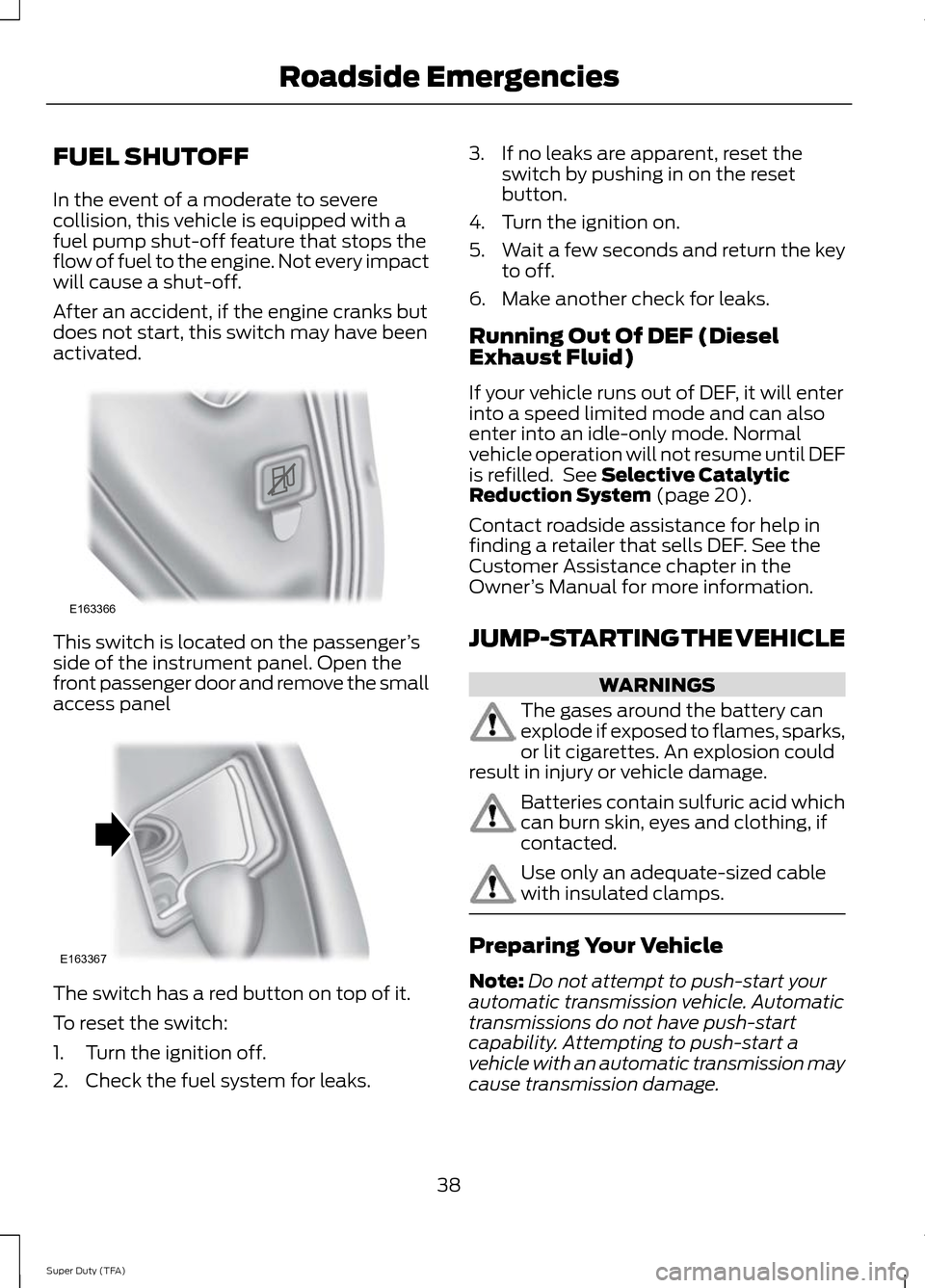
This switch is located on the passenger
’s
side of the instrument panel. Open the
front passenger door and remove the small
access panel The switch has a red button on top of it.
To reset the switch:
1. Turn the ignition off.
2. Check the fuel system for leaks. 3. If no leaks are apparent, reset the
switch by pushing in on the reset
button.
4. Turn the ignition on.
5. Wait a few seconds and return the key
to off.
6. Make another check for leaks.
Running Out Of DEF (Diesel
Exhaust Fluid)
If your vehicle runs out of DEF, it will enter
into a speed limited mode and can also
enter into an idle-only mode. Normal
vehicle operation will not resume until DEF
is refilled. See Selective Catalytic
Reduction System (page 20).
Contact roadside assistance for help in
finding a retailer that sells DEF. See the
Customer Assistance chapter in the
Owner ’s Manual for more information.
JUMP-STARTING THE VEHICLE WARNINGS
The gases around the battery can
explode if exposed to flames, sparks,
or lit cigarettes. An explosion could
result in injury or vehicle damage. Batteries contain sulfuric acid which
can burn skin, eyes and clothing, if
contacted.
Use only an adequate-sized cable
with insulated clamps.
Preparing Your Vehicle
Note:
Do not attempt to push-start your
automatic transmission vehicle. Automatic
transmissions do not have push-start
capability. Attempting to push-start a
vehicle with an automatic transmission may
cause transmission damage.
38
Super Duty (TFA) Roadside EmergenciesE163366 E163367
Page 47 of 82
5.
Reset the Intelligent Oil Life Monitor™.
See the Information Displays chapter
in the Owner's Manual for more
information.
Engine lubrication for severe service
operation
The following conditions define severe
operation for which engine operation with
SAE 5W-40 API CJ-4 is recommended. Oil
and oil filter change intervals will be
determined by the Intelligent Oil Life
Monitor™ as noted previously.
• Frequent or extended idling (over 10
minutes per hour of normal driving)
• Low-speed operation/stationary use
• If vehicle is operated in sustained
ambient temperatures below -10°F
(-23°C) or above 100°F (38°C)
• Frequent low-speed operation,
consistent heavy traffic less than 25
mph (40 km/h)
• Operating in severe dust conditions
• Operating the vehicle off road
• Towing a trailer over 1,000 miles (1,600
km)
• Sustained, high-speed driving at Gross
Vehicle Weight Rating (maximum
loaded weight for vehicle operation)
• Use of fuels with sulfur content other
than ultra-low sulfur diesel (ULSD)
• Use of high-sulfur diesel fuel
ENGINE COOLANT CHECK
Checking the Engine Coolant
The concentration and level of the engine
coolant should be checked at the intervals
listed in the scheduled maintenance
information. See Scheduled
Maintenance (page 58). Note:
Make sure that the level is between
the MIN and MAX marks on the coolant
reservoirs.
Note: Coolant expands when it is hot. The
level may extend beyond the MAX mark
Note: If the level is at the MIN mark, below
the MIN mark, or empty, add coolant
immediately. See
Adding Engine Coolant
in this chapter.
Note: The coolant concentration should be
maintained within 48% to 50%, which
equates to a freeze point between -30 °F
(-34 °C) and -34 °F (-37 °C).
Note: For best results, the coolant
concentration should be tested with a
refractometer such as Rotunda tool
300-ROB75240 available from your dealer.
Ford does not recommend the use of
hydrometers or coolant test strips for
measuring coolant concentrations.
Note: Automotive fluids are not
interchangeable. Do not use engine coolant
or antifreeze or windshield washer fluid
outside of its specified function and vehicle
location.
Adding Engine Coolant WARNINGS
Do not add engine coolant when the
engine is hot. Steam and scalding
liquids released from a hot cooling
system can burn you badly. Also, you can
be burned if you spill coolant on hot engine
parts. Do not put engine coolant in the
windshield washer fluid container. If
sprayed on the windshield, engine
coolant could make it difficult to see
through the windshield.
44
Super Duty (TFA) Maintenance
Page 52 of 82
Coolant Change
At specific mileage intervals, as listed in
the scheduled maintenance information,
the coolant should be changed. The
optional information display, if equipped,
will also display the message COOLANT
CHANGE REQUIRED at this time.
See Capacities and Specifications
(page 54). for the proper coolant.
Engine-driven Cooling Fan (Fan
Clutch)
Your vehicle is equipped with an engine
driven cooling fan drive (also called a fan
clutch). This fan drive changes the fan
speed to match the vehicle ’s changing
cooling air flow requirements. Fan speed,
fan noise level and fuel consumption all
will increase based on the driving
conditions that include trailer towing, hill
climbing, heavy loads, high speed and high
ambient temperature, individually or in
combination.
The fan drive is designed to provide the
minimum fan speed (and resulting
minimum fan noise and fuel consumption)
required to meet the ever changing vehicle
cooling air flow requirements. You will hear
the amount of fan noise increasing and
decreasing as the engine power
requirements and vehicle driving conditions
change as you drive. This is to be expected
as being normal to the operation of your
vehicle. High levels of fan noise might also
be heard when your engine is first started,
and should normally decrease after driving
for a short time. CHANGING THE ENGINE AIR
FILTER
Air Filter Restriction Gauge WARNING
To reduce the risk of vehicle damage
and/or personal burn injuries do not
start your engine with the air filter
removed and do not remove it while the
engine is running. Note:
Vehicle operation in heavy snowfall
or extreme rain conditions may feed
excessive amounts of snow/water into the
air intake system. This could plug/soak the
air filter with snow and may cause the
engine to lose power and possibly shut
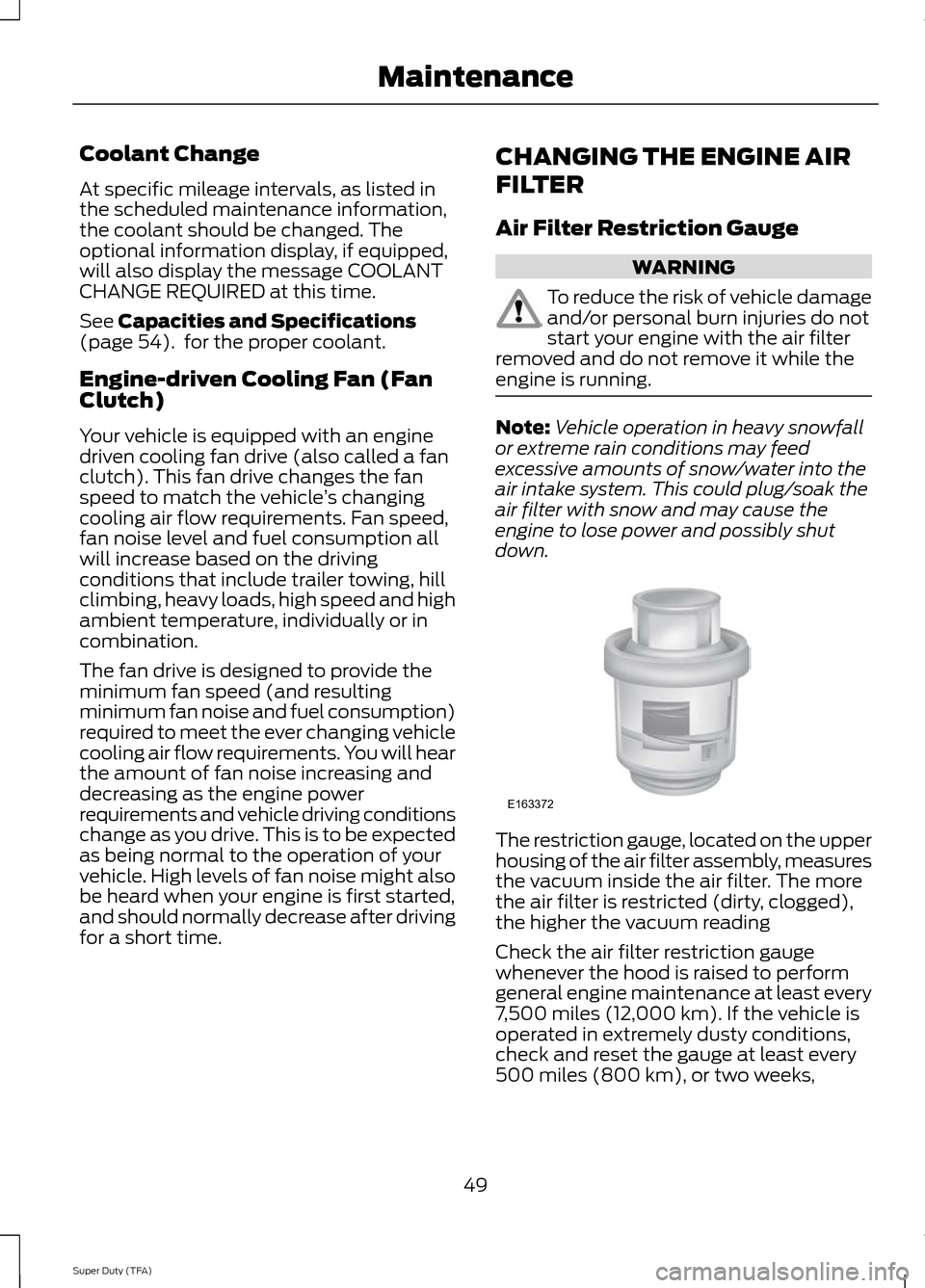
down. The restriction gauge, located on the upper
housing of the air filter assembly, measures
the vacuum inside the air filter. The more
the air filter is restricted (dirty, clogged),
the higher the vacuum reading
Check the air filter restriction gauge
whenever the hood is raised to perform
general engine maintenance at least every
7,500 miles (12,000 km). If the vehicle is
operated in extremely dusty conditions,
check and reset the gauge at least every
500 miles (800 km), or two weeks,
49
Super Duty (TFA) MaintenanceE163372