2014 FORD SUPER DUTY warning
[x] Cancel search: warningPage 14 of 82
In order to operate the engine in
temperatures of 32°F (0°C) or lower, read
the following instructions:
•
Make sure that the batteries are of
sufficient size and are fully charged.
Check other electrical components to
make sure they are in optimum
condition
• Use the proper coolant solution at the
concentration recommended
protecting the engine against damage
from freezing
• Try to keep the fuel tank full as much
as possible at the end of operation to
prevent condensation in the fuel
system
• Make sure you use proper cold weather
engine oil and that it is at its proper
level. Also, if necessary, make sure to
follow the engine oil and filter change
schedule found under the Special
operating conditions section listed in
the scheduled maintenance
information
• At temperatures of -10°F (-23°C) or
below, it is recommended that you use
an engine block heater to improve cold
engine starting
• If operating in arctic temperatures of
-20°F (-29°C) or lower, consult your
truck dealer for information about
special cold weather equipment and
precautions
The following cold weather idling
guidelines are recommended:
• You can use Motorcraft® cetane
improvers or non-alcohol-based
cetane improvers from a reputable
manufacturer as needed.
• Maintain the engine cooling system
properly. •
Avoid shutting the engine down after
an extensive idling period. Drive your
vehicle for several miles with the
engine at normal operating
temperatures under a moderate load.
• Consider using an engine block heater.
• For extended idle times use an
approved idle speed increase device.
Winter Operating Tips for Arctic
Operation -20°F (-29°C) and Below
The following information is a guideline
only and is no to be the only source of
possible solutions in resolving extreme
cold temperature issues.
Starting Aids WARNING
Do not use starting fluid, such as
ether, in the air intake system (see
air filter decal). Such fluid could
cause immediate explosive damage to the
engine and possible personal injury. The use of the factory engine block heater
assists in engine starting in extreme cold
ambient temperatures. Refer to Engine
block heater in the Starting and Stopping
the Engine chapter of your Owner
’s
Manual.
Idle Control
Your vehicle may have a factory option for
a stationary elevated idle control through
dash-mounted upfitter switches that
allows the operator to elevate the idle rpm
for extended idle periods, as well as
aftermarket equipment such as PTO
operation. You must configure this feature
even if ordered from the factory. See your
authorized dealer for required upfitting.
11
Super Duty (TFA) Starting and Stopping the Engine
Page 18 of 82
Biodiesel
WARNING
Do not use home heating oil,
agricultural fuel, raw fats and oils,
waste cooking greases, biodiesel
fuels greater than 20% or any diesel fuel
not intended for highway use. Damage to
the fuel injection system, engine and
exhaust catalyst can occur if an improper
fuel is used. Do not add gasoline, gasohol
or alcohol to diesel fuel. This practice
creates a serious fire hazard and engine
performance problems. You may operate your vehicle on diesel
fuels containing up to 20% biodiesel, also
known as B20.
Biodiesel fuel is a chemically converted
product from renewable fuel sources, such
as vegetable oils, animal fats and waste
cooking greases.
To help achieve acceptable engine
performance and durability when using
biodiesel in your vehicle:
•
Confirm the biodiesel content of the
fuel to be B20 (20% biodiesel) or less
• Only use biodiesel fuel of good quality
that complies with industry standards
• Follow the recommended service
maintenance intervals. See General
Maintenance Information (page 58).
• Do not store biodiesel fuel in the fuel
tank for more than 1 month
• Consider changing brands or reducing
biodiesel content if you have cold
temperature fuel gelling issues or a
frequent LOW FUEL PRESSURE
message appearing
• Do NOT use raw oils, fats or waste
cooking greases Use of biodiesel in concentrations greater
than 20% may cause damage to your
vehicle, including engine and/or exhaust
after-treatment hardware (exhaust
catalyst and particulate filter) failures.
Concentrations greater than 20% can also
cause fuel filter restrictions that may result
in a lack of power or damage to fuel
system components, including fuel pump
and fuel injector failures.
SAE 5W-40 or SAE 15W-40 oil is
recommended for fuels with greater than
5% biodiesel (B5). Refer to the Special
operating conditions section under the
Schedule Maintenance chapter for more
information about oil change intervals and
other maintenance when operating on
biodiesel.
Look for a label on the fuel pump to
confirm the amount of biodiesel contained
in a diesel fuel. Biodiesel content is often
indicated with the letter B followed by the
percent of biodiesel in the fuel. For
example, B20 indicates a fuel containing
20% biodiesel. Ask the service station
attendant to confirm the biodiesel content
of a diesel fuel if you do not see a label on
the fuel pump.
Biodiesel fuels degrade more easily than
diesel fuels not containing biodiesel and
should not be stored in the fuel tank for
more than 1 month. If you plan to park or
store your vehicle for more than 1 month,
then you should empty your vehicle fuel
tank of biodiesel fuel. You should fill the
tank with a pure petroleum-based diesel
fuel and run your vehicle for a minimum of
30 minutes.
Note:
Degraded or oxidized biodiesel can
damage fuel system seals and plastics and
corrode steel parts.
During cold weather, if you have problems
operating on biodiesel, you may need to
use a diesel fuel with lower biodiesel
content, try another brand, or discontinue
the use of biodiesel.
15
Super Duty (TFA) Fuel and Refueling
Page 19 of 82
Diesel Fuel Additives
It should not be necessary to add any
aftermarket additives to your fuel if you
use a high quality diesel fuel that conforms
to ASTM industry specifications.
Aftermarket additives can damage the fuel
injector system or engine.
Use Motorcraft® cetane booster or an
equivalent cetane booster additive if you
suspect fuel has low cetane. Use
Motorcraft® anti-gel & performance
improver or an equivalent additive if there
is fuel gelling.
Do not use alcohol-based additives to
improve cetane quality, to prevent fuel
gelling or any other use. The use of alcohol
additives may result in damage to the fuel
injectors and system. See Technical
Specifications (page 56).
Your warranty may not cover repairs
needed to correct the effects of using an
aftermarket product that does not meet
Ford specifications in your fuel.
Note: Ultra Low Sulfur Diesel fuel is
designed to meet the emissions standards
for the 6.7L engine and is backward
compatible as well (for example, it can be
used in the 7.3L, 6.9L, 6.4L and 6.0L diesel
engines in Ford vehicles.
Fuel And Water Separator
Your vehicle is equipped with a diesel fuel
conditioner module located on the
frame-rail under the driver-side floorboard
near the transmission. You should drain water from the
module assembly whenever the
warning light comes on and the
message center directs you to drain the
water separator. This will occur when
approximately 0.32 pints (150 ml) of water
accumulates in the module. If you allow
the water level to exceed this level, the
water may pass through to the engine and
may cause fuel injection equipment
damage.
Draining the Diesel Fuel Conditioner
Module (DFCM) WARNING
Your vehicle must be stopped with
the engine off when draining the
Diesel Fuel Conditioner Module. Fuel
may ignite if the separator is drained while
the engine is running or vehicle is moving. Note:
If you drain the diesel fuel conditioner
module while the system is running air will
enter into the fuel system. The engine will
not operate properly if air enters the system.
Note: With fuel tank levels above 3⁄4 tank
it may be necessary to loosen the bowl 3
turns before opening the drain. This will
actuate an anti-siphon valve at the fuel and
water separator inlet and prevent the fuel
from siphoning out of the tank.
Note: A loose drain valve can allow air to
enter the fuel system and cause drivetrain
issues. The engine will not operate properly.
Be sure that you fully tighten the drain valve.
1. Stop your vehicle and shut off the engine.
2. Locate the diesel fuel conditioner module and place an appropriate
container under the drain port.
16
Super Duty (TFA) Fuel and Refueling
Page 23 of 82
SELECTIVE CATALYTIC
REDUCTION SYSTEM
Your vehicle is equipped with a selective
catalytic reduction system to help reduce
emission levels of oxides of nitrogen from
the exhaust of the diesel engine. The
system automatically injects diesel
exhaust fluid into the exhaust system to
enable proper selective catalytic reduction
function.
Importance of maintaining the
Diesel Exhaust Fluid level
In order for the selective catalytic reduction
system to operate properly, the diesel
exhaust fluid level must be maintained.
Generally, the diesel exhaust fluid tank
should be filled during the oil change
service interval. See General
Maintenance Information (page 58).
However, certain conditions or driving
styles, such as trailer towing or fast rates
of acceleration, will require the refilling of
the diesel exhaust fluid tank more often.
The engine control unit will monitor the
amount of fluid available in the diesel
exhaust fluid tank. Running a system check
in the message center will indicate whether
the diesel exhaust fluid level is ok or if it is
less than 1/2 full. A message will display in
the message center when the diesel
exhaust fluid level is low and needs to be
refilled. When you see this message, you
should refill your tank. See the Information
displays chapter of your Owner ’s Manual
for information display functions. For
instructions on refilling your diesel exhaust
fluid tank, see filling the diesel exhaust
fluid tank in this supplement. Diesel Exhaust Fluid warning
messages and vehicle operations WARNINGS
Diesel exhaust fluid must be refilled
when low or replaced when
contaminated or the vehicle speed
will be speed limited to 50 mph (80 km/h).
In these conditions, drive with caution and
refill diesel exhaust fluid immediately. If
the diesel exhaust fluid becomes empty
or contaminated and fluid is not replaced,
your vehicle will become limited to idle
speed only once stopped. In these
conditions, be cautious where you stop
your vehicle because you may not be able
to drive long distances and will not be able
to maintain highway speeds until diesel
exhaust fluid is refilled or replaced. Tampering or disabling your vehicle
’s
exhaust aftertreatment system will
result in severe vehicle performance
limitation including eventual speed limiting
to 5 mph. Your vehicle
’s information display will
display a series of messages regarding the
amount of diesel exhaust fluid available.
A systems check will display messages
indicating the amount of diesel exhaust
fluid available (OK or under 1⁄2 full) or will
produce a warning message that displays
the mileage (kilometers) remaining as the
fluid in the diesel exhaust fluid tank nears
empty. For more information on warning
messages, see the Information Displays
chapter of your Owner ’s Manual. As the diesel exhaust fluid level
nears empty, the diesel exhaust
fluid warning symbol will be
displayed and chimes will sound with the
messages starting at 500 miles (805 km)
remaining before diesel exhaust fluid is
depleted. The warning symbol and
messages will continue until you refill the
diesel exhaust fluid tank.
20
Super Duty (TFA) Fuel and RefuelingE163176
Page 24 of 82
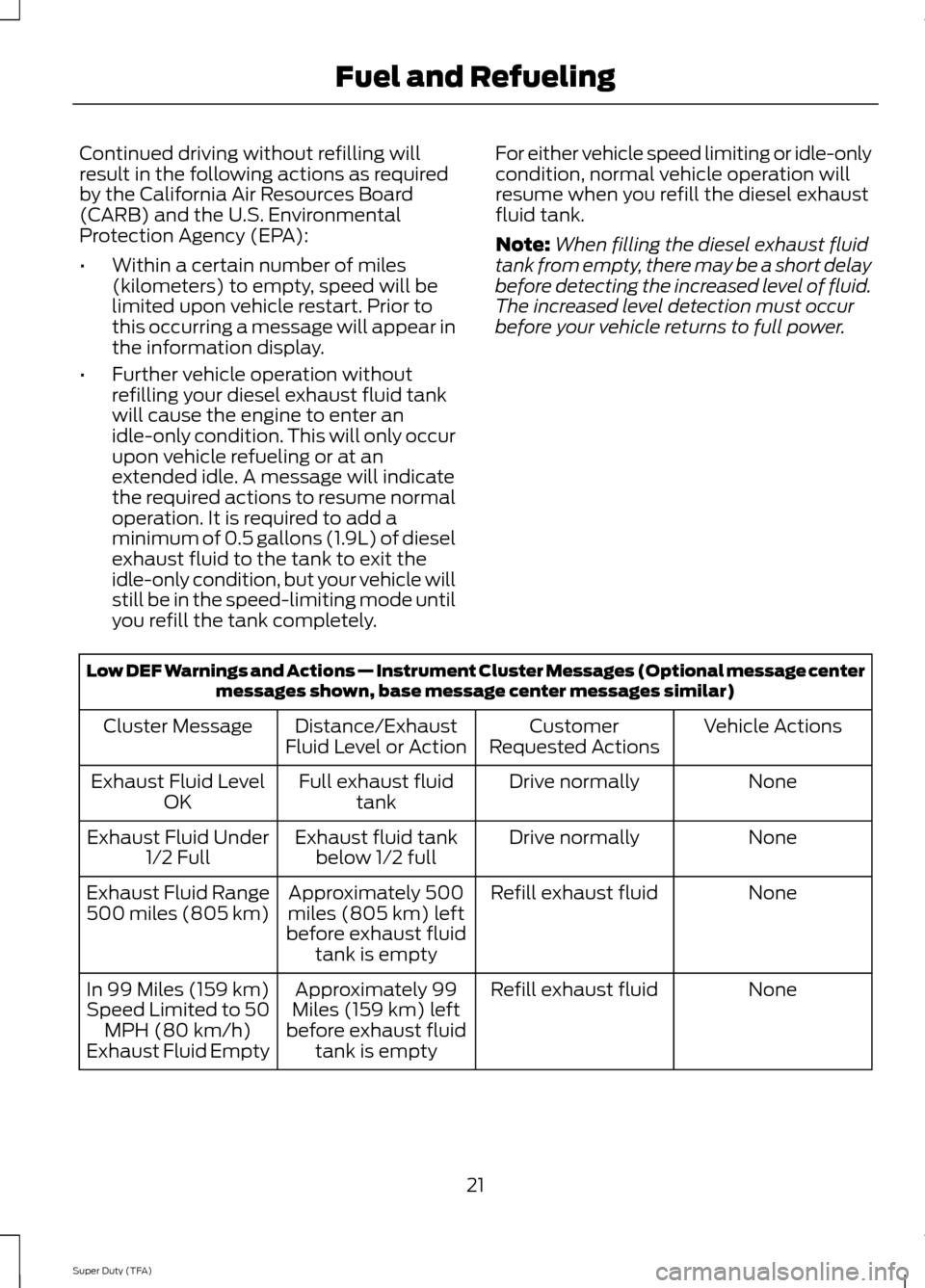
Continued driving without refilling will
result in the following actions as required
by the California Air Resources Board
(CARB) and the U.S. Environmental
Protection Agency (EPA):
•
Within a certain number of miles
(kilometers) to empty, speed will be
limited upon vehicle restart. Prior to
this occurring a message will appear in
the information display.
• Further vehicle operation without
refilling your diesel exhaust fluid tank
will cause the engine to enter an
idle-only condition. This will only occur
upon vehicle refueling or at an
extended idle. A message will indicate
the required actions to resume normal
operation. It is required to add a
minimum of 0.5 gallons (1.9L) of diesel
exhaust fluid to the tank to exit the
idle-only condition, but your vehicle will
still be in the speed-limiting mode until
you refill the tank completely. For either vehicle speed limiting or idle-only
condition, normal vehicle operation will
resume when you refill the diesel exhaust
fluid tank.
Note:
When filling the diesel exhaust fluid
tank from empty, there may be a short delay
before detecting the increased level of fluid.
The increased level detection must occur
before your vehicle returns to full power. Low DEF Warnings and Actions — Instrument Cluster Messages (Optional message center
messages shown, base message center messages similar)
Vehicle Actions
Customer
Requested Actions
Distance/Exhaust
Fluid Level or Action
Cluster Message
None
Drive normally
Full exhaust fluid
tank
Exhaust Fluid Level
OK
None
Drive normally
Exhaust fluid tank
below 1⁄2 full
Exhaust Fluid Under
1⁄2 Full
None
Refill exhaust fluid
Approximately 500
miles (805 km) left
before exhaust fluid tank is empty
Exhaust Fluid Range
500 miles (805 km)
None
Refill exhaust fluid
Approximately 99
Miles (159 km) left
before exhaust fluid tank is empty
In 99 Miles (159 km)
Speed Limited to 50
MPH (80 km/h)
Exhaust Fluid Empty
21
Super Duty (TFA) Fuel and Refueling
Page 25 of 82
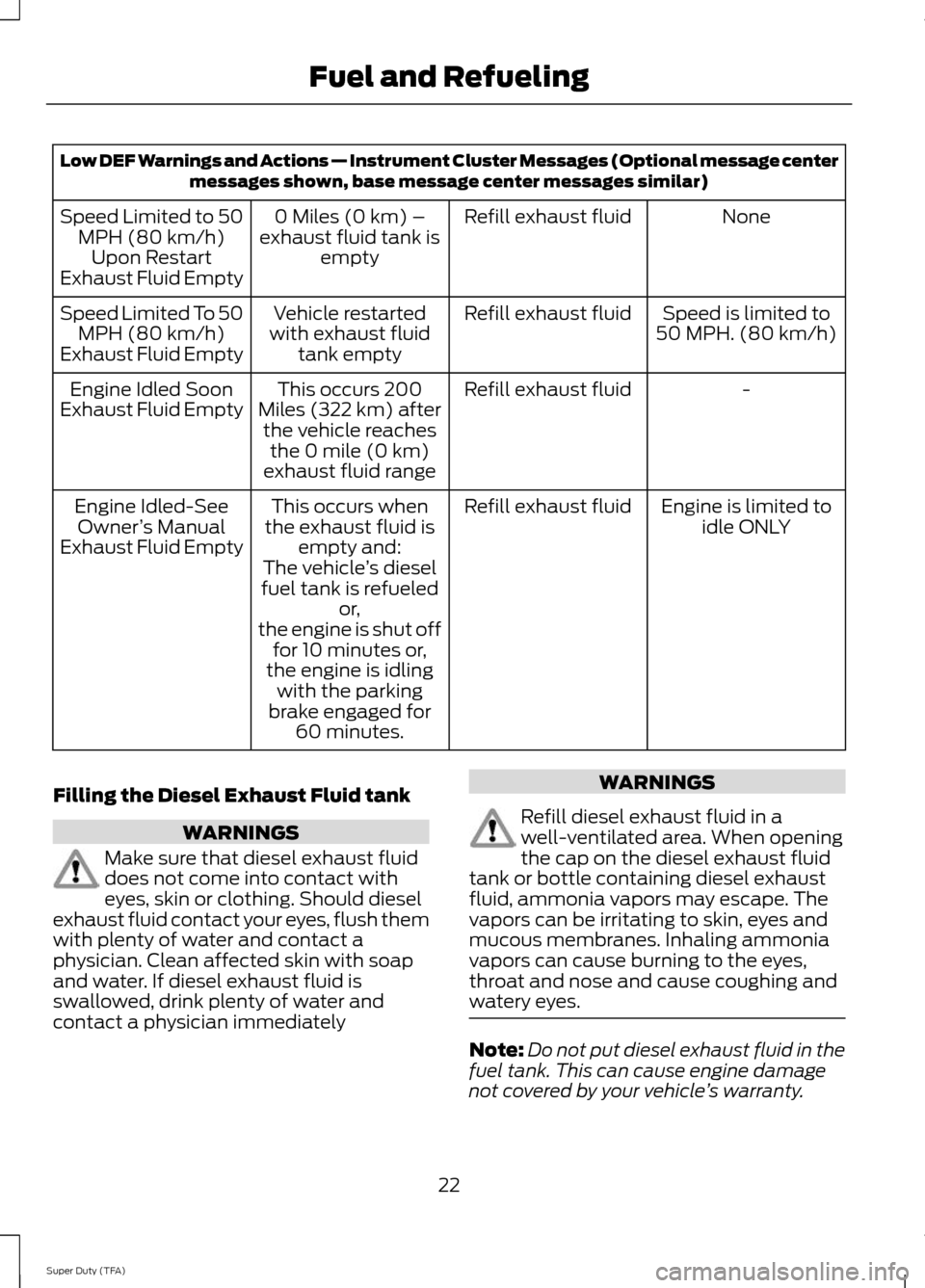
Low DEF Warnings and Actions — Instrument Cluster Messages (Optional message center
messages shown, base message center messages similar)
None
Refill exhaust fluid
0 Miles (0 km) –
exhaust fluid tank is empty
Speed Limited to 50
MPH (80 km/h)Upon Restart
Exhaust Fluid Empty
Speed is limited to
50 MPH. (80 km/h)
Refill exhaust fluid
Vehicle restarted
with exhaust fluid tank empty
Speed Limited To 50
MPH (80 km/h)
Exhaust Fluid Empty
-
Refill exhaust fluid
This occurs 200
Miles (322 km) after the vehicle reaches the 0 mile (0 km)
exhaust fluid range
Engine Idled Soon
Exhaust Fluid Empty
Engine is limited toidle ONLY
Refill exhaust fluid
This occurs when
the exhaust fluid is empty and:
Engine Idled-See
Owner ’s Manual
Exhaust Fluid Empty The vehicle’s diesel
fuel tank is refueled or,
the engine is shut off for 10 minutes or,
the engine is idling with the parking
brake engaged for 60 minutes.
Filling the Diesel Exhaust Fluid tank WARNINGS
Make sure that diesel exhaust fluid
does not come into contact with
eyes, skin or clothing. Should diesel
exhaust fluid contact your eyes, flush them
with plenty of water and contact a
physician. Clean affected skin with soap
and water. If diesel exhaust fluid is
swallowed, drink plenty of water and
contact a physician immediately WARNINGS
Refill diesel exhaust fluid in a
well-ventilated area. When opening
the cap on the diesel exhaust fluid
tank or bottle containing diesel exhaust
fluid, ammonia vapors may escape. The
vapors can be irritating to skin, eyes and
mucous membranes. Inhaling ammonia
vapors can cause burning to the eyes,
throat and nose and cause coughing and
watery eyes. Note:
Do not put diesel exhaust fluid in the
fuel tank. This can cause engine damage
not covered by your vehicle ’s warranty.
22
Super Duty (TFA) Fuel and Refueling
Page 31 of 82
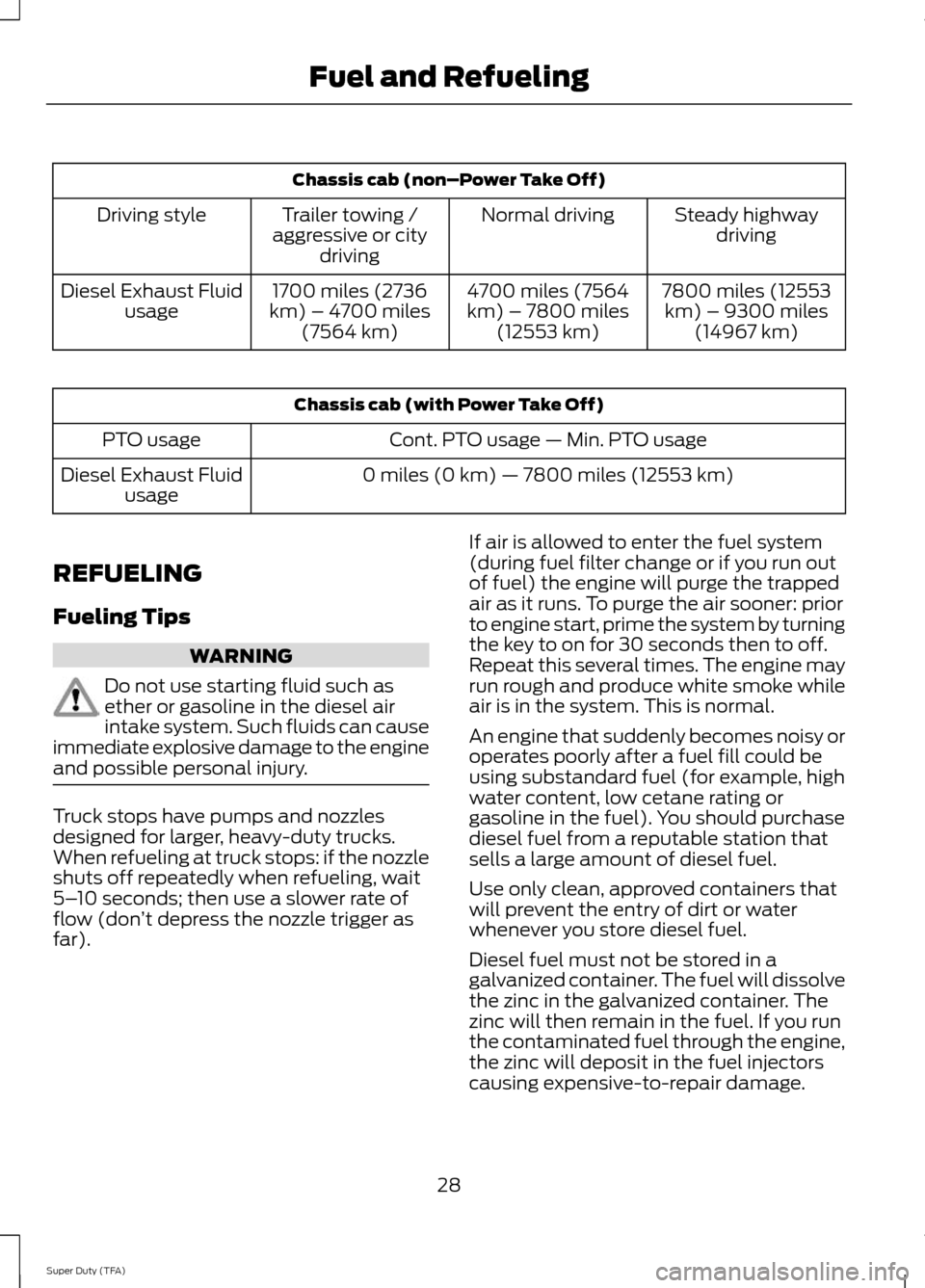
Chassis cab (non–Power Take Off)
Steady highwaydriving
Normal driving
Trailer towing /
aggressive or city driving
Driving style
7800 miles (12553km) – 9300 miles (14967 km)
4700 miles (7564
km) – 7800 miles (12553 km)
1700 miles (2736
km) – 4700 miles (7564 km)
Diesel Exhaust Fluid
usage Chassis cab (with Power Take Off)
Cont. PTO usage — Min. PTO usage
PTO usage
0 miles (0 km) — 7800 miles (12553 km)
Diesel Exhaust Fluid
usage
REFUELING
Fueling Tips WARNING
Do not use starting fluid such as
ether or gasoline in the diesel air
intake system. Such fluids can cause
immediate explosive damage to the engine
and possible personal injury. Truck stops have pumps and nozzles
designed for larger, heavy-duty trucks.
When refueling at truck stops: if the nozzle
shuts off repeatedly when refueling, wait
5–
10 seconds; then use a slower rate of
flow (don ’t depress the nozzle trigger as
far). If air is allowed to enter the fuel system
(during fuel filter change or if you run out
of fuel) the engine will purge the trapped
air as it runs. To purge the air sooner: prior
to engine start, prime the system by turning
the key to on for 30 seconds then to off.
Repeat this several times. The engine may
run rough and produce white smoke while
air is in the system. This is normal.
An engine that suddenly becomes noisy or
operates poorly after a fuel fill could be
using substandard fuel (for example, high
water content, low cetane rating or
gasoline in the fuel). You should purchase
diesel fuel from a reputable station that
sells a large amount of diesel fuel.
Use only clean, approved containers that
will prevent the entry of dirt or water
whenever you store diesel fuel.
Diesel fuel must not be stored in a
galvanized container. The fuel will dissolve
the zinc in the galvanized container. The
zinc will then remain in the fuel. If you run
the contaminated fuel through the engine,
the zinc will deposit in the fuel injectors
causing expensive-to-repair damage.
28
Super Duty (TFA) Fuel and Refueling
Page 32 of 82
Diesel fuel dispensing nozzle fill rate
Your truck is equipped with a fuel fill pipe
that is able to accept fuel up to 20 gallons
per minute from an 11⁄8 fuel-dispensing
nozzle. Pumping fuel at greater flow rates
may result in premature nozzle shut-off or
spit back.
Fuel filler cap
WARNINGS
The fuel system may be under
pressure. If the fuel filler cap is
venting vapor or if you hear a hissing
sound, wait until it stops before completely
removing the fuel filler cap. Otherwise, fuel
may spray out and injure you or others. If you do not use the proper fuel filler
cap, excessive pressure or vacuum
in the fuel tank may damage the fuel
system or cause the fuel cap to disengage
in a collision, which may result in possible
personal injury. Note:
If you must replace the fuel filler cap,
replace it with a fuel filler cap designed for
your vehicle. The vehicle warranty may be
void for any damage to the fuel tank or fuel
system if the correct genuine Ford or
Motorcraft® fuel filler cap is not used.
Your fuel tank filler cap has an indexed
design with a 1/4 turn on/off feature.
When fueling your vehicle:
1. Turn the engine off.
2. Carefully turn the filler cap counterclockwise until it spins off.
3. Pull to remove the cap from the fuel filler pipe.
4. To install the cap, align the tabs on the
cap with the notches on the filler pipe.
5. Turn the filler cap clockwise 1/4 of a turn until it clicks at least once. EMISSION CONTROL SYSTEM
Diesel Exhaust System: Oxidation
Catalyst And Diesel Particulate
Filter System (If Equipped)
Your vehicle is equipped with a diesel
particulate filter. The diesel particulate
filter is an inline filter in the exhaust system
that reduces carbon emissions by trapping
exhaust particles before they reach the
tailpipe. The diesel particulate filter looks
similar to a traditional exhaust catalyst,
except larger, and is part of the exhaust
system under the vehicle. The filter couples
to a diesel oxidation catalyst that reduces
the amount of harmful exhaust emitted
from the tailpipe. As soot gathers in the
system, it begins to restrict the filter. You
need to periodically clean the soot that
gathers inside the. You can clean the soot
in two different ways, passive regeneration
and active regeneration. Both methods
occur automatically and require no actions
from the driver. During either one of these
regeneration methods, you may notice a
change in exhaust tone. At certain times,
the information display will display various
messages related to the diesel particulate
filter. See the Information Displays chapter
in the Owner Guide for more information.
Passive regeneration
In passive regeneration, the high
temperature of the exhaust system
automatically cleans the filter, or reduces
the soot level, by burning (oxidizing) the
soot. This high exhaust temperature occurs
naturally because of normal engine
operating conditions (at varying levels, due
to driving patterns.
29
Super Duty (TFA) Fuel and Refueling