2014 FORD SUPER DUTY oil temperature
[x] Cancel search: oil temperaturePage 46 of 82
•
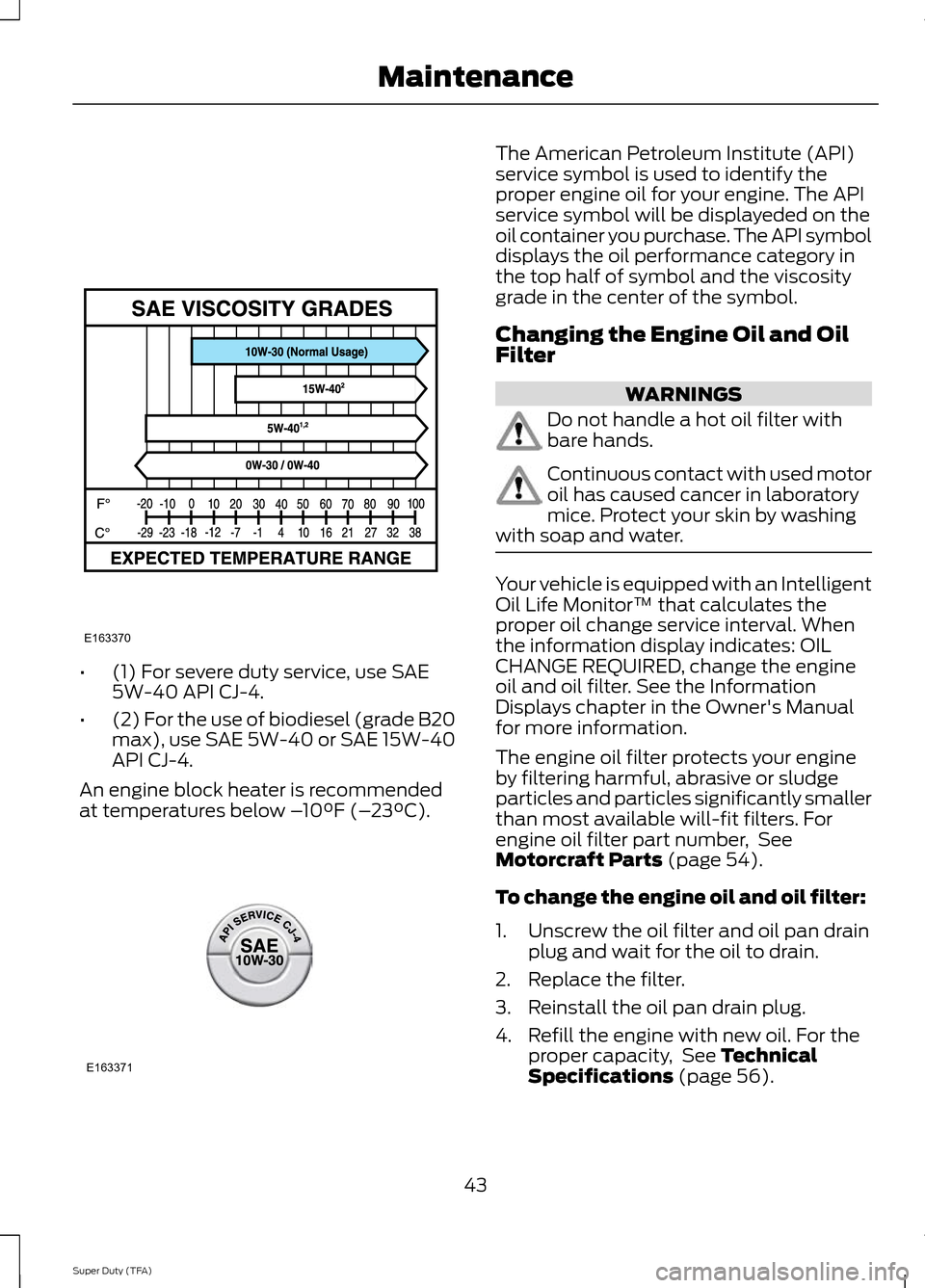
(1) For severe duty service, use SAE
5W-40 API CJ-4.
• (2) For the use of biodiesel (grade B20
max), use SAE 5W-40 or SAE 15W-40
API CJ-4.
An engine block heater is recommended
at temperatures below – 10°F (–23°C). The American Petroleum Institute (API)
service symbol is used to identify the
proper engine oil for your engine. The API
service symbol will be displayeded on the
oil container you purchase. The API symbol
displays the oil performance category in
the top half of symbol and the viscosity
grade in the center of the symbol.
Changing the Engine Oil and Oil
Filter
WARNINGS
Do not handle a hot oil filter with
bare hands.
Continuous contact with used motor
oil has caused cancer in laboratory
mice. Protect your skin by washing
with soap and water. Your vehicle is equipped with an Intelligent
Oil Life Monitor™ that calculates the
proper oil change service interval. When
the information display indicates: OIL
CHANGE REQUIRED, change the engine
oil and oil filter. See the Information
Displays chapter in the Owner's Manual
for more information.
The engine oil filter protects your engine
by filtering harmful, abrasive or sludge
particles and particles significantly smaller
than most available will-fit filters. For
engine oil filter part number, See
Motorcraft Parts (page 54).
To change the engine oil and oil filter:
1. Unscrew the oil filter and oil pan drain plug and wait for the oil to drain.
2. Replace the filter.
3. Reinstall the oil pan drain plug.
4. Refill the engine with new oil. For the proper capacity, See
Technical
Specifications (page 56).
43
Super Duty (TFA) MaintenanceE163370 E163371
Page 47 of 82
5.
Reset the Intelligent Oil Life Monitor™.
See the Information Displays chapter
in the Owner's Manual for more
information.
Engine lubrication for severe service
operation
The following conditions define severe
operation for which engine operation with
SAE 5W-40 API CJ-4 is recommended. Oil
and oil filter change intervals will be
determined by the Intelligent Oil Life
Monitor™ as noted previously.
• Frequent or extended idling (over 10
minutes per hour of normal driving)
• Low-speed operation/stationary use
• If vehicle is operated in sustained
ambient temperatures below -10°F
(-23°C) or above 100°F (38°C)
• Frequent low-speed operation,
consistent heavy traffic less than 25
mph (40 km/h)
• Operating in severe dust conditions
• Operating the vehicle off road
• Towing a trailer over 1,000 miles (1,600
km)
• Sustained, high-speed driving at Gross
Vehicle Weight Rating (maximum
loaded weight for vehicle operation)
• Use of fuels with sulfur content other
than ultra-low sulfur diesel (ULSD)
• Use of high-sulfur diesel fuel
ENGINE COOLANT CHECK
Checking the Engine Coolant
The concentration and level of the engine
coolant should be checked at the intervals
listed in the scheduled maintenance
information. See Scheduled
Maintenance (page 58). Note:
Make sure that the level is between
the MIN and MAX marks on the coolant
reservoirs.
Note: Coolant expands when it is hot. The
level may extend beyond the MAX mark
Note: If the level is at the MIN mark, below
the MIN mark, or empty, add coolant
immediately. See
Adding Engine Coolant
in this chapter.
Note: The coolant concentration should be
maintained within 48% to 50%, which
equates to a freeze point between -30 °F
(-34 °C) and -34 °F (-37 °C).
Note: For best results, the coolant
concentration should be tested with a
refractometer such as Rotunda tool
300-ROB75240 available from your dealer.
Ford does not recommend the use of
hydrometers or coolant test strips for
measuring coolant concentrations.
Note: Automotive fluids are not
interchangeable. Do not use engine coolant
or antifreeze or windshield washer fluid
outside of its specified function and vehicle
location.
Adding Engine Coolant WARNINGS
Do not add engine coolant when the
engine is hot. Steam and scalding
liquids released from a hot cooling
system can burn you badly. Also, you can
be burned if you spill coolant on hot engine
parts. Do not put engine coolant in the
windshield washer fluid container. If
sprayed on the windshield, engine
coolant could make it difficult to see
through the windshield.
44
Super Duty (TFA) Maintenance
Page 56 of 82
CLEANING THE ENGINE
Engines are more efficient when they are
clean because grease and dirt buildup keep
the engine warmer than normal.
When washing:
•
Take care when using a power washer
to clean the engine. The high-pressure
fluid could penetrate the sealed parts
and cause damage.
• Do not spray a hot engine with cold
water to avoid cracking the engine
block or other engine components.
• Spray Motorcraft Engine Shampoo and
Degreaser on all parts that require
cleaning and pressure rinse clean. In
Canada, use Motorcraft Engine
Shampoo.
• Never wash or rinse the engine while it
is hot or running; water in the running
engine may cause internal damage.
• Never wash or rinse any ignition coil,
spark plug wire or spark plug well, or
the area in and around these locations.
• Cover the battery, power distribution
box, and air filter assembly to prevent
water damage when cleaning the
engine.
CLEANING THE EXHAUST WARNINGS
Failure to maintain the functional
holes, in the tailpipe section of the
exhaust, clean and free of debris or
foreign material may result in the holes
becoming blocked or plugged. Do not
modify or remove the tail-pipe section.
Blocked or plugged holes or
removal/modification of the system could
result in elevated exhaust gas
temperatures which may result in
vehicle/property damage or personal
injury. WARNINGS
The normal operating temperature
of the exhaust system is very high.
Never work around or attempt to
repair any part of the exhaust system until
it has cooled. Use special care when
working around the diesel oxidation
catalytic converter and/or the diesel
particulate filter (DPF). The diesel
oxidation catalytic converter and/or the
DPF heats up to a high temperature after
only a short period of engine operation and
can stay hot even after the engine is turned
off. Failure to follow these instructions may
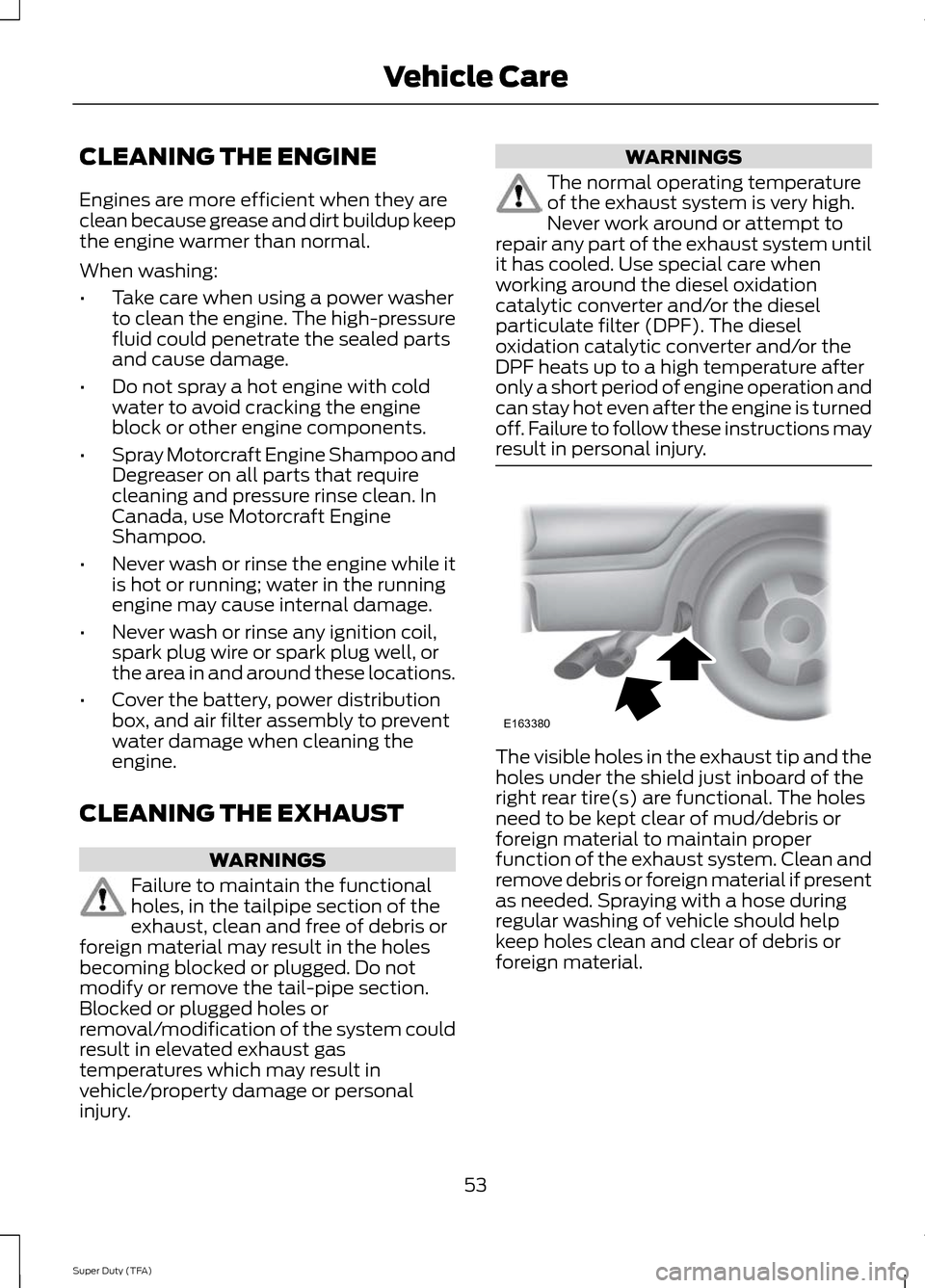
result in personal injury. The visible holes in the exhaust tip and the
holes under the shield just inboard of the
right rear tire(s) are functional. The holes
need to be kept clear of mud/debris or
foreign material to maintain proper
function of the exhaust system. Clean and
remove debris or foreign material if present
as needed. Spraying with a hose during
regular washing of vehicle should help
keep holes clean and clear of debris or
foreign material.
53
Super Duty (TFA) Vehicle CareE163380
Page 59 of 82

TECHNICAL SPECIFICATIONS
Ford part number /
Ford specification
Ford part name or
equivalent
Capacity
Item
VC-3DIL-B (US)CVC-3DIL-B
(Canada) / WSS- M97B44-D2
Motorcraft Orange
Antifreeze/Coolant Prediluted
29.4 quarts
(27.8L)
Engine coolant (primary
high-temperature
cooling system loop) 1
VC-12 / —
Motorcraft Specialty
Orange Engine
Coolant Revitalizer
48.0 fl. oz. (1.4L)
per addition if required
Engine coolant additive
(primary high-temper- ature cooling system loop)
16 fl. oz. (473
mL) per addition if required
Engine coolant additive
(secondary cooling system)
VC-3DIL-B (US)CVC-3DIL-B
(Canada) / WSS- M97B44-D2
Motorcraft Orange
Antifreeze/Coolant Prediluted
11.7 quarts (11.1L)
Engine coolant
(secondary cooling
system) 1
XO-10W30–QSD /WSS-M2C171–E
Motorcraft Motor Oil
SAE 10W30 Super Duty
13.0 quarts
(12.4L)
Engine oil (includes
filter change) XO-15W40-QSD /WSS-M2C171-E
Motorcraft Motor Oil
SAE 15W40 Super Duty XO-5W40-5QSD /
WSS-M2C171-E
Motorcraft Motor Oil SAE 5W40 Full
Synthetic Diesel Motor Oil XO-0W40-DAS /
WSS-M2C171-E
Motorcraft Motor Oil SAE 0W40 Full
Synthetic Diesel Motor Oil
PM-27-GAL/PM-27-JUG / WSS-
M99C130-A
Motorcraft Diesel
Exhaust Fluid
5 gallons (18.9L)
Diesel Exhaust Fluid
(DEF) — Pick-up
6 gallons (22.7L)
Diesel Exhaust Fluid —
Chassis Cab
PM-22-A (US) PM-22-B (Canada) / —
Motorcraft Cetane
Booster & Perform- ance Improver
—
Cetane Booster &
Performance Improver
56
Super Duty (TFA) Capacities and Specifications
Page 70 of 82

Operating in sustained ambient temperatures below -10°F (-23°C) or above 100°F (38°C)
Change the engine oil and filter as indicated by the
information display, and perform the services listed in the
scheduled maintenance chart.
As required
Replace the engine-mounted and frame-mounted fuel
filters.
Every 15000 miles (24000
km), six months, 600 engine
hours, or as indicated by the
information display
Replace the wheel bearing grease and grease seals if using
non-sealed bearings. (Two-wheel drive vehicles)
Every 30000 miles (48000
km)
Change the transfer case fluid. (Four-wheel drive vehicles)
Every 60000 miles (96000
km) Operating in dusty or sandy conditions (such as unpaved or dusty roads)
Rotate the tires*
, inspect the tires for wear and measure
tread depth.
Every 7500 miles (12000
km)
Inspect the brake system pads and rotors.
Inspect the air filter restriction gauge. Replace the filter if
necessary.
Inspect the steering and suspension ball joints and tie rods.
Lubricate any grease fittings.
Change the engine oil and filter. **
Every 7500 miles (12000
km), six months or 300
engine hours Inspect and lubricate the U-joints.
Replace the engine-mounted and frame-mounted fuel
filters.
Every 15000 miles (24000
km), six months, 600 engine
hours, or as indicated by the
information display
Replace the air inlet foam filter.
Every 30000 miles (48000
km)
Replace the wheel bearing grease and grease seals if using
non-sealed bearings. (Two-wheel drive vehicles)
* Vehicles with dual rear wheels should rotate the front wheels when specified; rear wheels
only if unusual wear is noted.
** Reset the Intelligent Oil-Life Monitor after engine oil and filter changes.
67
Super Duty (TFA) Scheduled Maintenance
Page 72 of 82
Using biodiesel, up to and including 20% biodiesel (B20)
Change the engine oil and filter as indicated by the
information display, and perform the services listed in the
scheduled maintenance chart.
As required
Replace the engine-mounted and frame-mounted fuel
filters.
Every 15000 miles (24000
km), six months, 600 engine
hours, or as indicated by the
information display Using fuel other than ultra-low sulfur diesel fuel - vehicles operated where ultra-low
sulfur diesel fuel is not required or available
Change engine oil and filter.
Every 2500 miles (4000
km) or three months (if
using high sulfur fuel with
more than 500 ppm sulfur)
Change engine oil and filter.
Every 5000 miles (8000
km) or six months (if using
high sulfur fuel with fewer
than 500 ppm sulfur)
Exceptions
There are several exceptions to the Normal
Schedule:
Normal vehicle axle maintenance: Rear
axles and power take-off units with
synthetic fluid and light-duty trucks
equipped with Ford-design axles are
lubricated for life; do not check or change
fluid unless a leak is suspected, service is
required or the assembly has been
submerged in water. During long periods
of trailer towing with outside temperatures
above 70°F (21°C) and at wide-open
throttle for long periods above 45 mph (72
km/h), change non-synthetic rear axle fluid
every 3000 miles (4800 kilometers) or
three months, whichever comes first. This
interval can be waived if the axle is filled with 75W140 synthetic gear fluid meeting
Ford specification WSL-M2C192-A, part
number F1TZ-19580-B, or equivalent. Add
friction modifier XL-3 (EST-M2C118-A) or
equivalent for complete refill of
Traction-Lok rear axles.
F-450 and F-550 axle maintenance:
Change rear axle fluid every 100000 miles
(160000 kilometers) under normal driving
conditions on all commercial applications.
When operating your vehicle at or near
maximum Gross Vehicle Weights, change
the rear axle fluid every 50000 miles
(80000 kilometers). In addition, follow
this 50000-mile (80000 kilometer)
schedule when operating your vehicle
under the special operating conditions,
where noted.
69
Super Duty (TFA) Scheduled Maintenance