2014 FORD MONDEO fuel type
[x] Cancel search: fuel typePage 156 of 446
Downloaded from www.Manualslib.com manuals search engine FUEL CONSUMPTION
We derive CO2 and fuel consumptionfigures in laboratory tests according toRegulation (EC) 715/2007 or CR (EC)692/2008 and subsequent amendments.
They are intended as a comparisonbetween makes and models of vehicles.They are not intended to represent the realworld fuel consumption you may get fromyour vehicle.
Real world fuel consumption is governedby many factors, for example driving style,high speed driving, stop-start driving, airconditioning usage, the accessories fitted,payload and towing.
The advertised capacity is the indicatedcapacity and the empty reserve combined.Indicated capacity is the difference in theamount of fuel in the fuel tank and whenthe fuel gauge indicates empty. Emptyreserve is the amount of fuel in the fueltank after the fuel gauge indicates empty.
Note: The amount of fuel in the emptyreserve varies and should not be relied uponto increase driving range. When refuelingyour vehicle after the fuel gauge indicatesempty, you might not be able to refuel thefull amount of the advertised capacity dueto the empty reserve still present in the fueltank.
Filling the Fuel Tank
For consistent results when refueling:
•Switch the ignition off.
•Allow no more than two automaticshut-offs when refueling.
Results are most accurate when therefueling method is consistent.
Calculating Fuel Economy
Do not measure fuel economy during thefirst 1000 mi (1,600 km) of driving (this isthe engine break-in period). A moreaccurate measurement is obtained after2500 mi (4,000 km). Also, fuel expense,frequency of fill ups or fuel gauge readingsare not accurate ways to measure fueleconomy.
1.Fill the fuel tank completely and recordthe initial odometer reading.
2.Each time you fill the fuel tank, recordthe amount of fuel added.
3.After at least three fill ups, fill the fueltank and record the current odometerreading.
4.Subtract your initial odometer readingfrom the current odometer reading.
5.Calculate fuel economy by dividingmiles traveled by gallons used (ForMetric: Multiply liters used by 100, thendivide by kilometers traveled).
Keep a record for at least one month andrecord the type of driving (city or freeway).This provides an accurate estimate of yourvehicle’s fuel economy under currentdriving conditions. Additionally, keepingrecords during summer and winter showhow temperature impacts fuel economy.In general, your vehicle will use more fuelin cold temperatures.
154Mondeo (CNG) Vehicles Built From: 08-09-2014 Vehicles Built Up To: 19-04-2015, CG3633en enGBR, Edition date: 10/2014, First PrintingFuel and Refueling
Page 232 of 446
Downloaded from www.Manualslib.com manuals search engine Protected componentsFuse amp ratingFuse or relay number
Power seats.10A153
Fuel operated heater remote control.5A254
Not used (spare).5A255
1Micro fuse.2Dual micro fuse.3M-type fuse.
Power Distribution Box - Bottom
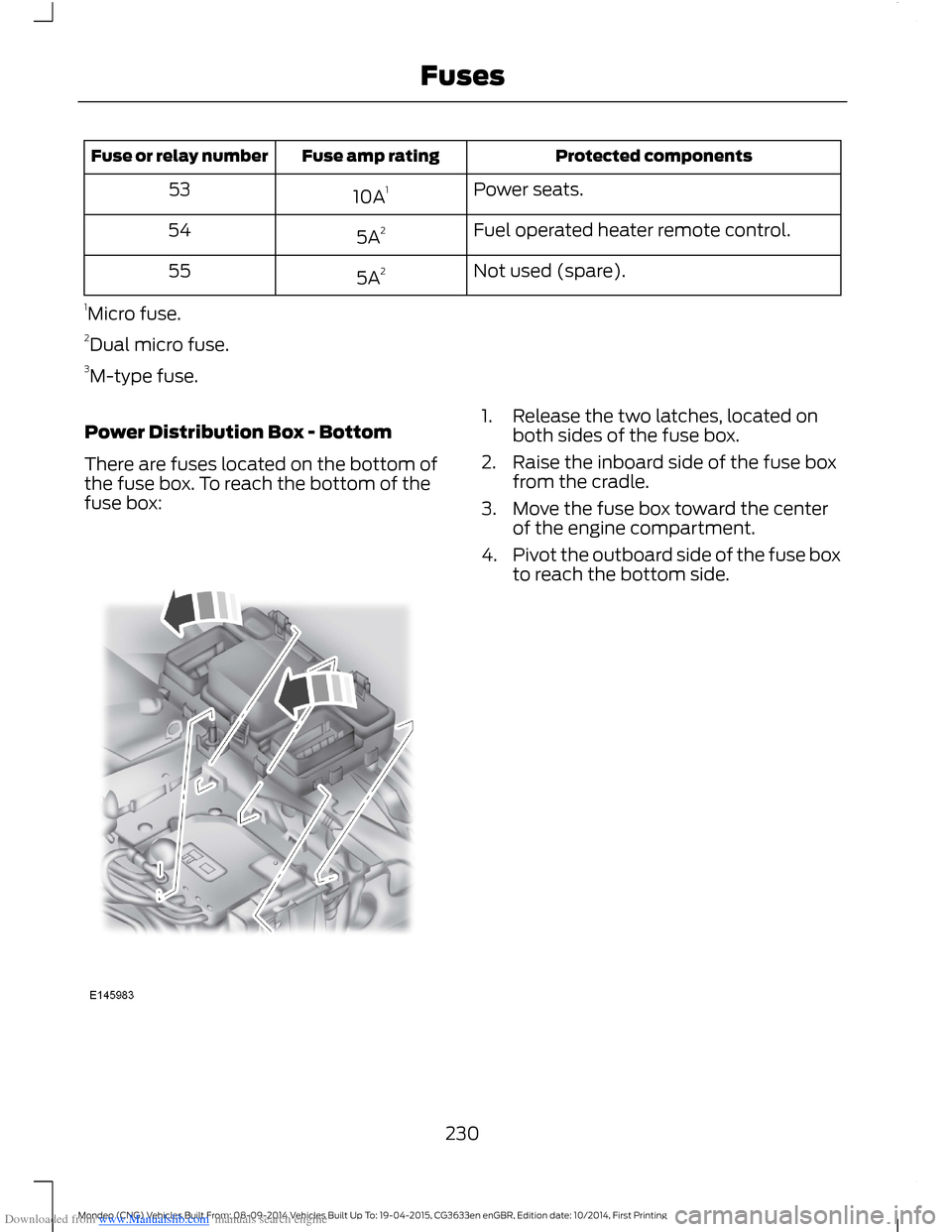
There are fuses located on the bottom ofthe fuse box. To reach the bottom of thefuse box:
1.Release the two latches, located onboth sides of the fuse box.
2.Raise the inboard side of the fuse boxfrom the cradle.
3.Move the fuse box toward the centerof the engine compartment.
4.Pivot the outboard side of the fuse boxto reach the bottom side.
230Mondeo (CNG) Vehicles Built From: 08-09-2014 Vehicles Built Up To: 19-04-2015, CG3633en enGBR, Edition date: 10/2014, First PrintingFuses
Page 235 of 446
Downloaded from www.Manualslib.com manuals search engine Protected componentsFuse amp ratingFuse or relay number
Starter solenoid.30A184
Fuel fire heater.20A185
1 M-type fuse.2J-type fuse.
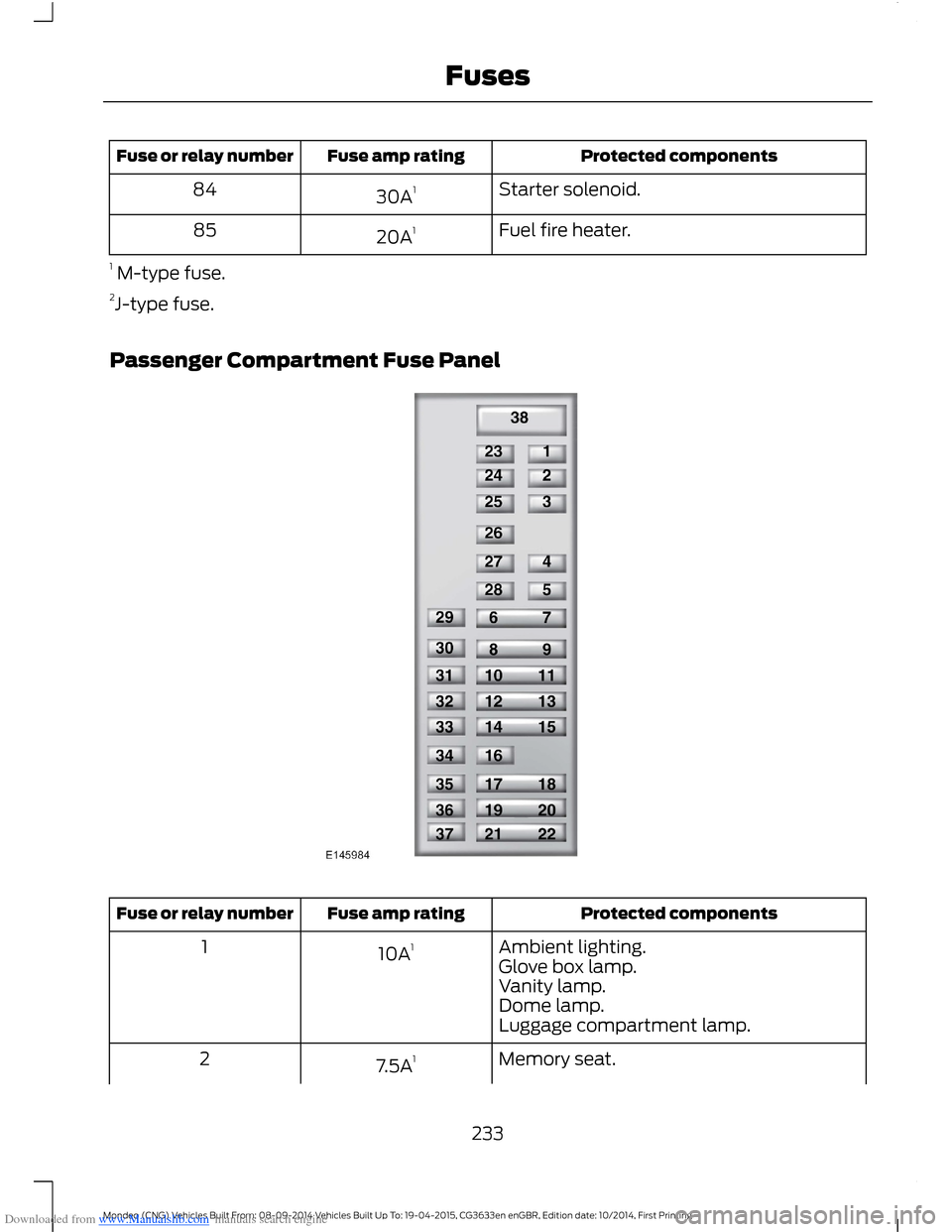
Passenger Compartment Fuse Panel
Protected componentsFuse amp ratingFuse or relay number
Ambient lighting.10A11Glove box lamp.Vanity lamp.Dome lamp.Luggage compartment lamp.
Memory seat.7.5A12
233Mondeo (CNG) Vehicles Built From: 08-09-2014 Vehicles Built Up To: 19-04-2015, CG3633en enGBR, Edition date: 10/2014, First PrintingFuses
Page 262 of 446
Downloaded from www.Manualslib.com manuals search engine GENERAL INFORMATION
A decal with tire pressure data is locatedin the driver’s door opening.
Check and set the tire pressure at theambient temperature in which you areintending to drive your vehicle and whenthe tires are cold.
Note:Check your tire pressures regularly tooptimize fuel economy.
Note:Use only approved wheel and tiresizes. Using other sizes could damage yourvehicle and will make the National TypeApproval invalid.
Note:If you change the diameter of the tiresfrom that fitted at the factory, thespeedometer may not display the correctspeed. Take your vehicle to an authorizeddealer to have the engine managementsystem reprogrammed.
Note:If you intend to change the size of thewheels from that fitted at the factory, checkthe suitability with an authorized dealer.
TEMPORARY MOBILITY KIT
Your vehicle may not have a spare wheeland tire. In these cases it will be suppliedwith a temporary mobility kit which willonly repair one damaged tire.
The kit is located in the spare wheel well.
General Information
WARNINGS
Depending on the type and extent oftire damage, some tires can only bepartially sealed or not sealed at all.Loss of tire pressure can affect vehiclehandling, leading to loss of vehicle control.
Do not use the temporary mobilitykit on a previously damaged tire. Forexample, when a tire has been drivenunder inflated.
WARNINGS
Do not use the temporary mobilitykit on run flat tires.
Do not use the temporary mobilitykit to repair the sidewall of adamaged tire.
The temporary mobility kit seals most tirepunctures with a diameter of up to ¼ in (6mm) to temporarily restore mobility.
You must observe the following rules whenusing the temporary mobility kit:
•Drive with caution and avoid makingsudden steering or driving manoeuvresespecially if your vehicle is heavilyloaded or towing a trailer.
•Only continue your journey to the nextvehicle or tire dealer or drive amaximum distance of 125 mi (200 km).
•Do not exceed a maximum speed of50 mph (80 km/h).
•Keep the temporary mobility kit out ofthe reach of children.
•Only use the temporary mobility kitwhen the ambient temperature isbetween -30° and 70° C (-22° and158° F).
Using the Temporary Mobility Kit
WARNINGS
Park your vehicle so that you do notobstruct the flow of traffic or placeyourself in any danger and set up awarning triangle.
Compressed air can act as anexplosive or propellant.
Never leave the temporary mobilitykit unattended while in use.
Do not keep the compressoroperating for longer than 10 minutes.
260Mondeo (CNG) Vehicles Built From: 08-09-2014 Vehicles Built Up To: 19-04-2015, CG3633en enGBR, Edition date: 10/2014, First PrintingWheels and Tires
Page 270 of 446
Downloaded from www.Manualslib.com manuals search engine CHANGING A ROAD WHEEL
Lug Nuts
You can obtain a replacement locking lugnut key and replacement locking lug nutsfrom your dealer using the referencenumber certificate.
Vehicles with a Spare Wheel
If the spare wheel is exactly the same typeand size as the other fitted road wheels,you can replace the existing road wheelwith the spare wheel and continue to drivein the normal manner.
If the spare wheel is different to the otherroad wheels, it will carry a yellow label withthe appropriate speed limit.
Refer to the following information beforechanging the road wheel.
WARNINGS
Drive the shortest possible distances.
Do not fit more than one spare wheelon your vehicle at any one time.
Do not carry out any tire repairs on aspare wheel.
Do not drive through an automaticcar wash.
If you are unsure what type of sparewheel you have do not exceed 80km/h (50 mph).
Only fit snow chains to specifiedtires. See Using Snow Chains(page 264).
The ground clearance of your vehiclemay be reduced. Take care whenparking next to a curb.
Note:Your vehicle may exhibit someunusual driving characteristics.
Vehicle Jack
WARNINGS
The vehicle jack supplied with yourvehicle should only be used whenchanging a wheel in emergencysituations.
Before using the vehicle jack, checkthat it is not damaged or deformedand that the thread is lubricated andfree from foreign matter.
Never place anything between thejack and the ground, or the jack andyour vehicle.
Note:Vehicles with a temporary mobilitykit do not have a vehicle jack or a lug nutwrench
It is recommended to use a workshop typehydraulic jack for changing betweensummer and winter tires.
Note:Use a jack with a minimum liftingcapacity of 1.5 tonnes and a lifting plate witha minimum diameter of 3.1 inches (80millimeters).
Vehicles without a Temporary MobilityKit
Your vehicle jack, lug nut wrench andscrew-in towing eye are located in thespare wheel well or behind the rear seatwith the fuel funnel.
Jacking and Lifting Points
WARNING
Use only the specified jacking points.If you use other positions, you maydamage the body, steering,suspension, engine, braking system or thefuel lines.
268Mondeo (CNG) Vehicles Built From: 08-09-2014 Vehicles Built Up To: 19-04-2015, CG3633en enGBR, Edition date: 10/2014, First PrintingWheels and Tires
Page 437 of 446

Downloaded from www.Manualslib.com manuals search engine Fuse Specification Chart...........................227Passenger Compartment Fuse Panel........233Power Distribution Box.....................................227
G
Gauges...............................................................78Engine Coolant Temperature Gauge............80Fuel Gauge.............................................................80Information Display.............................................79Type 1 and 2............................................................78Type 3........................................................................79General Information on RadioFrequencies...................................................32Global Opening and Closing......................73Closing the Windows..........................................73Opening the Windows........................................73
H
Hazard Warning Flashers..........................224Headlamp Exit Delay....................................65Headlamp Leveling........................................67Head Restraints.............................................126Adjusting the Head Restraint..........................127Tilting Head Restraints ....................................128Heated Seats..................................................133Heated Steering Wheel...............................59Heated Windows and Mirrors....................121Heated Exterior Mirror.......................................122Heated Rear Window.........................................121Heated Windshield.......................................122HeatingSee: Climate Control...........................................111Hill Start Assist..............................................163Switching the System On and Off...............164Using Hill Start Assist.......................................163Hints on Controlling the InteriorClimate...........................................................119Cooling the Interior Quickly..............................121General Hints........................................................119Heating the Interior Quickly............................120Recommended Settings for Cooling ...........121Recommended Settings for Heating..........120Side Window Defogging in ColdWeather..............................................................121Hints on Driving With Anti-LockBrakes............................................................160
Hood LockSee: Opening and Closing the Hood...........237
I
Ignition Switch...............................................138Inflatable Safety Belts.................................30Rear Inflatable Safety Belt...............................30Information Display Control......................58Information Display Control Features..........59Information Displays....................................86General Information...........................................86Information....................................................383Calendar...............................................................384Emergency Assistance....................................384Notifications........................................................383
435Mondeo (CNG) Vehicles Built From: 08-09-2014 Vehicles Built Up To: 19-04-2015, CG3633en enGBR, Edition date: 10/2014, First PrintingIndex