Page 185 of 403
HIGH-VOLTAGE SHUTOFF
In the event of a crash:
•Take the same actions as you would take in a crash involving a
gasoline-powered vehicle — exit the vehicle safely or await the
assistance of an emergency responder if they are unable to get out on
their own, move a safe distance away from the vehicle, and notify the
authorities of the crash.
•If possible, inform emergency responders that the vehicle is electric
powered.
•Vehicle owners should not store a severely damaged vehicle in a
garage or near other vehicles.
The high-voltage shutoff operation shuts off power from the high voltage
battery after a collision, or if your vehicle receives a substantial physical
jolt.
To reactivate the vehicle after either event perform the following steps:
1. Press the POWER START/STOP button to power the vehicle on.
2. Press the POWER START/STOP button to power the vehicle off.
3. Press the POWER START/STOP button to power the vehicle on again.
Note:After completing this procedure the vehicle will detect if the
electrical system is safe and reactivate automatically. Once your vehicle
determines the electrical system safe you can start your vehicle as you
would normally by pressing the brake pedal in combination with the
POWER START/STOP button.
JUMP STARTING THE VEHICLE (12 VOLT BATTERY ONLY)
WARNING:Batteries contain sulfuric acid which can burn skin,
eyes and clothing, if contacted.
Note:This procedure is only for the low voltage, 12 volt underhood
battery only. Do not attempt to jump start your high-voltage battery.
Do not attempt to push-start your automatic transmission vehicle.
Automatic transmissions do not have push-start capability. Attempting
to push-start a vehicle with an automatic transmission may cause
transmission damage.
184Roadside Emergencies
2014 Focus Electric Vehicle(fob)
Owners Guide gf, 1st Printing, May 2013
USA(fus)
Page 186 of 403

Preparing Your Vehicle
Note:Your vehicle has a 12 volt battery that is easily accessible under
the hood. The 12 volt battery controls the switches and contacts that
engage the high voltage battery.The high-voltage battery cannot be
jumped with a standard 12 volt battery.If your high voltage battery
does not accept a regular charge, your vehicle must be towed to your
authorized dealership.
1.Use only a 12 volt supply to start your vehicle.
2. Do not disconnect the battery of the disabled vehicle as this could
damage the vehicle’s electrical system.
3. Park the booster vehicle close to the hood of the disabled vehicle
making sure the two vehiclesdo nottouch. Set the parking brake on
both vehicles. Stay clear of the motor cooling fan and other moving parts
on both vehicles.
4. Check all battery terminals and remove any excessive corrosion before
you attach the battery cables. Ensure that vent caps are tight and level.
5. Turn the heater fan on in both vehicles to protect from any electrical
surges. Turn all other accessories off.
Connecting the Jumper Cables
WARNING:Do not connect the end of the second cable to the
negative (-) terminal of the battery to be jumped. A spark may
cause an explosion of the gases that surround the battery or a surge
within the battery.
Note:Do not attach the negative (-) cable to fuel lines, engine rocker
covers, the intake manifold or electrical components as grounding points.
Note:In the illustration, the vehicle on the bottom is used to designate
the assisting (boosting) battery.
Roadside Emergencies185
2014 Focus Electric Vehicle(fob)
Owners Guide gf, 1st Printing, May 2013
USA(fus)
Page 189 of 403
•Venting/off-gassing high-voltage battery vapors are potentially toxic
and flammable.
•Physical damage to the vehicle or high-voltage battery may result in
immediate or delayed release of toxic and/or flammable gases and fire.
Vehicle information and general safety practices:
•Know the make and model of your vehicle.
•Review the Owner’s Manual and become familiar with your vehicle’s
safety information and recommended safety practices.
•Do not attempt to repair damaged electric and hybrid-electric vehicles
yourself. Contact an authorized Ford Dealer or vehicle manufacturer
representative for service.
Crashes
A crash or impact significant enough to require an emergency response
for conventional vehicles would also require the same response for an
electric or hybrid-electric vehicle.
If possible
•Move your car to a safe, nearby location and remain on the scene.
•Roll down windows before shutting vehicle off.
•Place vehicle in Park, set parking brake, turn off the vehicle, activate
hazard lights, and move key(s) at least 16 feet (5 meters) away from
the vehicle.
Always
•Call 911 if assistance is needed and advise that an electric or
hybrid-electric vehicle is involved.
•Do not touch exposed electrical components or the engine
compartment, as a shock hazard may exist.
•Avoid contact with leaking fluids and gases, and remain out of the way
of oncoming traffic until emergency responders arrive.
•When emergency responders arrive, tell them that the vehicle involved
is an electric vehicle or hybrid-electric vehicle.
188Roadside Emergencies
2014 Focus Electric Vehicle(fob)
Owners Guide gf, 1st Printing, May 2013
USA(fus)
Page 201 of 403
The high-current fuses are coded as follows:
Fuse or relay
locationFuse amp
ratingProtected circuits
F7 40A** Anti-lock brakes pump
F8 30A** Anti-lock brakes valve
F9 — Not used
F10 40A** Heater blower motor,
Temperature sensor
F11 40A** Vacuum pump
F12 40A** Motor control relay fuse
F13 40A** On-board charger
F14 40A** Heater element 1
F15 — Not used
F16 40A** Heater element 2
F17 — Not used
F30 F31
F24 F21 F20
F25 F22
F23F17
R10R9 R6
F15F19 F8 F7
F37
F38
F39
F40
F41 F43
F42
F44
F45 F46
F48
F47 F13 F11 F9
F16 F14 F12 F10
R11
R8R7R16R15
R3
R5 R4 R2R1
F18 F26 F27 F32
F33
F34
F35 F28
F29
R12
R13 R14
F36
200Fuses
2014 Focus Electric Vehicle(fob)
Owners Guide gf, 1st Printing, May 2013
USA(fus)
Page 202 of 403

Fuse or relay
locationFuse amp
ratingProtected circuits
F18 20A** Front wiper motor
F19 5A* Anti-lock brake control module
F20 15A* Horn
F21 5A* Stop light switch
F22 15A* Battery monitoring sensor
F23 5A* Relay coils
F24 5A* Light switch module
F25 — Not used
F26 10A* Powertrain control module
F27 15A* Charger port light ring
F28 5A* Vacuum pump monitor
F29 — Not used
F30 5A* Transmission control module
F31 10A* Smart datalink connector;
Diagnostic connector
F32 10A* Compressor bypass valves,
Coolant valves, Electronic fan
control module relay
F33 10A* Powertrain control module (PSR
feedback), A/C compressor
solenoid
F34 15A* Powertrain control module
(contactor sense), Battery
electronics control module (PSR)
F35 — Not used
F36 20A* Coolant water pumps
F37 5A* Vehicle audible speaker for
pedestrians
F38 15A* Powertrain control module
(electronic control module KL15)
F39 5A* Not used (spare)
F40 5A* Electronic power assist steering
Fuses201
2014 Focus Electric Vehicle(fob)
Owners Guide gf, 1st Printing, May 2013
USA(fus)
Page 203 of 403
Fuse or relay
locationFuse amp
ratingProtected circuits
F41 20A* Body control module
F42 15A* Rear wiper
F43 15A* Not used (spare)
F44 — Not used
F45 — Not used
F46 — Not used
F47 5A* In-Car temperature sensor
F48 5A* Mechanical relay
R1 — Not used
R2 Micro relay Horn relay
R3 — Not used
R4 Micro relay Contactor relay
R5 — Not used
R6 — Not used
R7 Power relay Heater element 3
R8 Power relay Heater element1&2
R9 — Not used
R10 Mini relay Anti-lock brake system vacuum
pump (solid state relay)
R11 — Not used
R12 Power relay Electronic fan control module
relay
R13 Mini relay Heater blower relay
R14 Mini relay Motor control relay
R15 Power relay Mechanical relay
R16 Power relay Ignition 15
*Mini Fuses **Cartridge Fuses
202Fuses
2014 Focus Electric Vehicle(fob)
Owners Guide gf, 1st Printing, May 2013
USA(fus)
Page 209 of 403
GENERAL INFORMATION
Have your vehicle serviced regularly to help maintain its roadworthiness
and resale value. There is a large network of Ford authorized dealers
who are there to help you with their professional servicing expertise.
We believe that their specially trained technicians are best qualified to
service your vehicle properly and expertly. They are supported by a wide
range of highly specialized tools developed specifically for servicing your
vehicle.
To help you service your vehicle, we providescheduled maintenance
Informationwhich makes tracking routine service easy.
If your vehicle requires professional service, your authorized dealer
can provide the necessary parts and service. Check your warranty
information to find out which parts and services are covered.
Use only the recommended lubricants, fluids and service parts
conforming to specifications. Motorcraft parts are designed and built to
provide the best performance in your vehicle.
Precautions
•Always treat the high-voltage battery and electrical components with
caution.
•Make sure the vehicle is off before performing any service,
maintenance or repair.
•Make sure the vehicle is in (P) Park with the parking brake applied.
208Maintenance
2014 Focus Electric Vehicle(fob)
Owners Guide gf, 1st Printing, May 2013
USA(fus)
Page 212 of 403
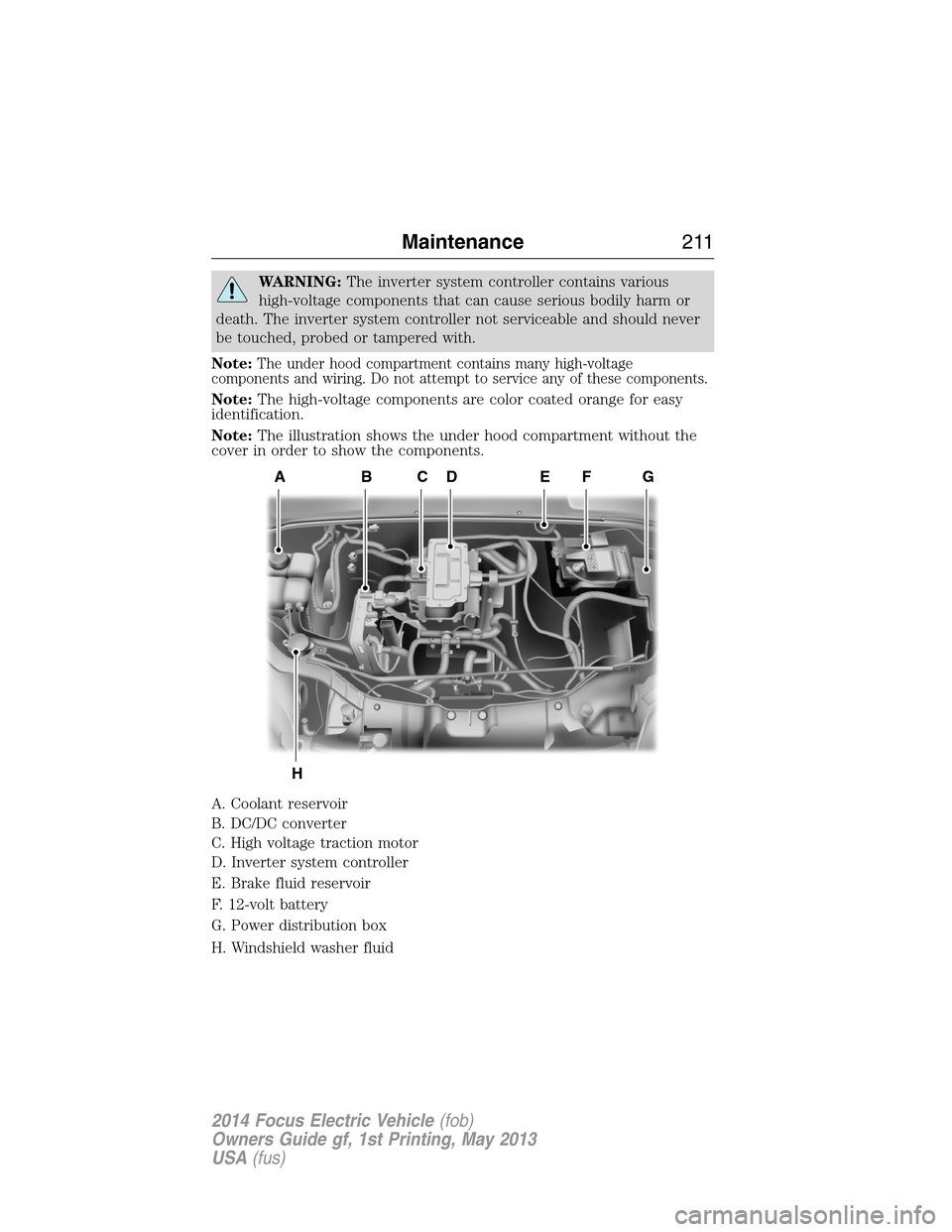
WARNING:The inverter system controller contains various
high-voltage components that can cause serious bodily harm or
death. The inverter system controller not serviceable and should never
be touched, probed or tampered with.
Note:
The under hood compartment contains many high-voltage
components and wiring. Do not attempt to service any of these components.
Note:The high-voltage components are color coated orange for easy
identification.
Note:The illustration shows the under hood compartment without the
cover in order to show the components.
A. Coolant reservoir
B. DC/DC converter
C. High voltage traction motor
D. Inverter system controller
E. Brake fluid reservoir
F. 12-volt battery
G. Power distribution box
H. Windshield washer fluid
A
H
BCDFEG
Maintenance211
2014 Focus Electric Vehicle(fob)
Owners Guide gf, 1st Printing, May 2013
USA(fus)