Page 172 of 472
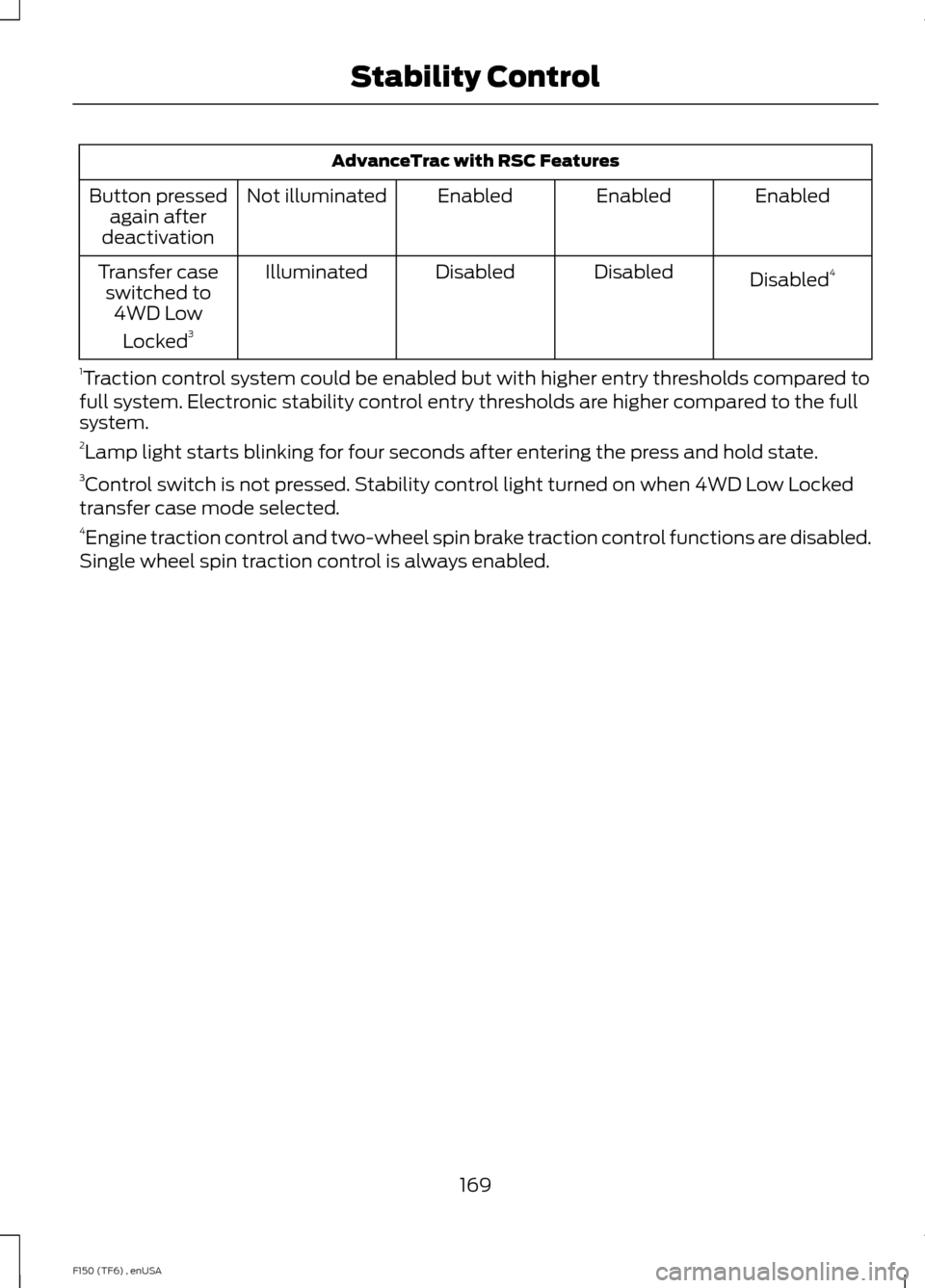
AdvanceTrac with RSC Features
Enabled
Enabled
Enabled
Not illuminated
Button pressed
again after
deactivation
Disabled4
Disabled
Disabled
Illuminated
Transfer case
switched to 4WD Low
Locked 3
1 Traction control system could be enabled but with higher entry thresholds compared to
full system. Electronic stability control entry thresholds are higher compared to the full
system.
2 Lamp light starts blinking for four seconds after entering the press and hold state.
3 Control switch is not pressed. Stability control light turned on when 4WD Low Locked
transfer case mode selected.
4 Engine traction control and two-wheel spin brake traction control functions are disabled.
Single wheel spin traction control is always enabled.
169
F150 (TF6) , enUSA Stability Control
Page 180 of 472
STEERING
Electric Power Steering (3.7L, 5.0L
and 3.5L EcoBoost™ engines) (If
Equipped) WARNINGS
The electric power steering system
has diagnostic checks that
continuously monitor the system to
ensure proper operation. When a system
error is detected a steering message will
appear in the information display. The electric power steering system
has diagnostic checks that
continuously monitor the system to
ensure proper operation of the electronic
system. When an electronic error is
detected, a message will be displayed in
the information display. If this happens,
stop the vehicle in a safe place, and turn
off the engine. After at least 10 seconds,
reset the system by restarting the engine,
and watch the information display for a
steering message. If a steering message
returns, or returns while driving, take the
vehicle to your dealer to have it checked. Obtain immediate service if a system
error is detected. You may not notice
any difference in the feel of your
steering, but a serious condition may exist.
Failure to do so may result in loss of
steering control. Your vehicle is equipped with an electric
power-assisted steering system. There is
no fluid reservoir to check or fill.
If your vehicle loses electrical power while
you are driving (or if the ignition is turned
off), you can steer the vehicle manually,
but it takes more effort. Extreme
continuous steering may increase the effort
it takes for you to steer. This occurs to
prevent internal overheating and
permanent damage to your steering system. If this should occur, you will neither
lose the ability to steer the vehicle
manually nor will it cause permanent
damage. Typical steering and driving
maneuvers will allow the system to cool
and steering assist will return to normal.
Hydraulic Steering (6.2L engine)
(If Equipped)
To help prevent damage to the power
steering system, never hold the steering
wheel at its furthest turning points (until
it stops) for more than a few seconds
when the engine is running. If the power
steering system breaks down (or if the
engine is turned off), you can steer the
vehicle manually, but it takes more effort.
•
Never hold the steering wheel at its
furthest turning points (until it stops)
for more than three to five seconds
when the engine is running.
• Do not operate the vehicle with a low
power steering pump fluid level (below
the MIN mark on the reservoir).
• Some noise is normal during operation.
If excessive, check for low power
steering pump fluid level before
seeking service by your dealer.
• Heavy or uneven efforts may be caused
by low power steering fluid. Check for
low power steering pump fluid level
before seeking service by your dealer.
• Do not fill the power steering pump
reservoir above the MAX mark on the
reservoir, as this may result in leaks
from the reservoir.
If the power steering system breaks down
(or if the engine is turned off), you can
steer the vehicle manually, but it takes
more effort.
177
F150 (TF6) , enUSA Driving Aids
Page 186 of 472
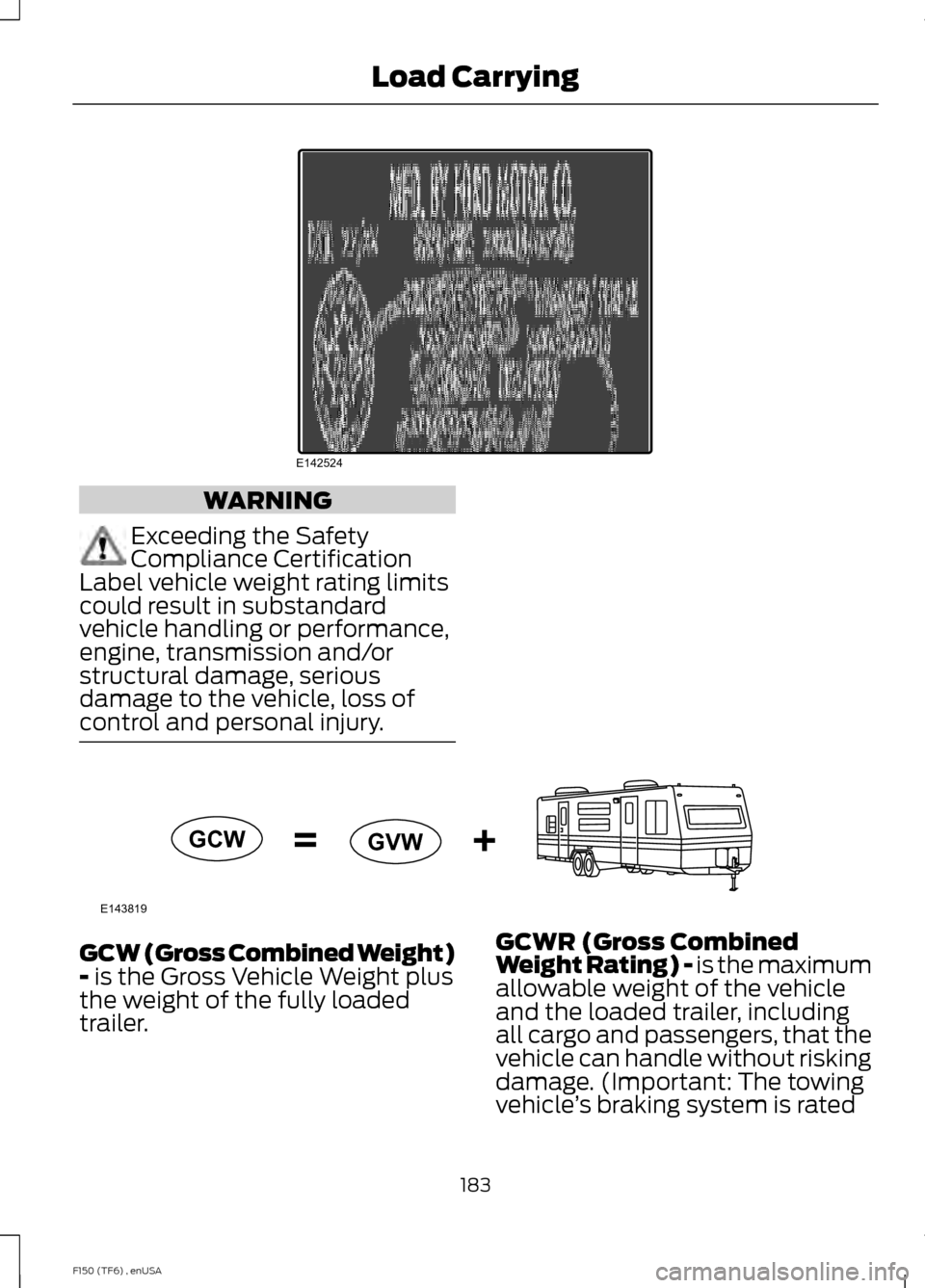
WARNING
Exceeding the Safety
Compliance Certification
Label vehicle weight rating limits
could result in substandard
vehicle handling or performance,
engine, transmission and/or
structural damage, serious
damage to the vehicle, loss of
control and personal injury. GCW (Gross Combined Weight)
- is the Gross Vehicle Weight plus
the weight of the fully loaded
trailer. GCWR (Gross Combined
Weight Rating) - is the maximum
allowable weight of the vehicle
and the loaded trailer, including
all cargo and passengers, that the
vehicle can handle without risking
damage. (Important: The towing
vehicle
’s braking system is rated
183
F150 (TF6) , enUSA Load CarryingE142524 E143819GCW
GVW
Page 194 of 472

TOWING A TRAILER
WARNINGS
Do not exceed the GVWR or
the GAWR specified on the
certification label. Towing trailers beyond the
maximum recommended
gross trailer weight exceeds the
limit of the vehicle and could
result in engine damage,
transmission damage, structural
damage, loss of vehicle control,
vehicle rollover and personal
injury. Your vehicle may have electrical
items, such as fuses or relays,
related to towing. See the Fuses
chapter.
Your vehicle's load capacity
designation is by weight, not by
volume, so you cannot necessarily
use all available space when
loading a vehicle.
Towing a trailer places an extra
load on your vehicle's engine,
transmission, axle, brakes, tires
and suspension. Inspect these
components periodically during,
and after, any towing operation. Load Placement
To help minimize how trailer
movement affects your vehicle
when driving:
•
Load the heaviest items closest
to the trailer floor.
• Load the heaviest items
centered between the left and
right side trailer tires.
• Load the heaviest items above
the trailer axles or just slightly
forward toward the trailer
tongue. Do not allow the final
trailer tongue weight to go
above or below 10-15% of the
loaded trailer weight.
• Select a tow bar with the
correct rise or drop. When both
the loaded vehicle and trailer
are connected, the trailer frame
should be level, or slightly
angled down toward your
vehicle, when viewed from the
side.
When driving with a trailer or
payload, a slight takeoff vibration
or shudder may be present due to
the increased payload weight.
Additional information regarding
proper trailer loading and setting
your vehicle up for towing is
located in another chapter of this
manual. See
Load Limit (page
179). You can also find the
information in the RV & Trailer
Towing Guide, available at an
authorized dealer.
191
F150 (TF6) , enUSA Towing
Page 195 of 472
TRAILER SWAY CONTROL (IF
EQUIPPED) WARNING
Turning off trailer sway control
increases the risk of loss of vehicle
control, serious injury or death. Ford
does not recommend disabling this feature
except in situations where speed reduction
may be detrimental (such as hill climbing),
the driver has significant trailer towing
experience, and can control trailer sway
and maintain safe operation. Note:
This feature does not prevent trailer
sway, but reduces it once it begins.
Note: This feature cannot stop all trailers
from swaying.
Note: In some cases, if vehicle speed is too
high, the system may activate multiple
times, gradually reducing vehicle speed.
This feature applies your vehicle brakes at
individual wheels and, if necessary, reduces
engine power. If the trailer begins to sway,
the stability control light flashes and the
message
TRAILER SWAY REDUCE
SPEED appears in the information display.
The first thing to do is slow your vehicle
down, then pull safely to the side of the
road and check for proper tongue load and
trailer load distribution. See
Load
Carrying (page 179).
RECOMMENDED TOWING
WEIGHTS
Note: Do not exceed a trailer
weight of 5000 pounds (2268
kilograms) when towing with, or
by, bumper only. Note:
Do not exceed a trailer
weight of 5000 pounds (2268
kilograms) if your vehicle is not
equipped with a Heavy Duty Trailer
Towing Package.
Note: Make sure to take into
consideration trailer frontal area.
Vehicles not equipped with the
Trailer Tow Package or the Heavy
Duty Payload Package should not
exceed 36 feet 2
lb (3.35 meters 2
)
trailer frontal area. Vehicles
equipped with the Trailer Tow
Package or the Heavy Duty Payload
Package should not exceed 60
feet 2
lb (5.6 meters 2
) trailer frontal
area.
Note: Exceeding this limitation
may significantly reduce the
performance of your towing
vehicle. Selecting a trailer with a
low aerodynamic drag and rounded
front design helps optimize
performance and fuel economy.
Note: For high altitude operation,
reduce the gross combined weight
by 2% per 1000 feet (300 meters)
starting at the 1000 foot (300
meter) elevation point.
Note: Certain states require
electric trailer brakes for trailers
over a specified weight. Be sure to
check state regulations for this
specified weight. The maximum
trailer weights listed may be limited
to this specified weight, as your
vehicle's electrical system may not
include the wiring connector
needed to use electric trailer
brakes.
192
F150 (TF6) , enUSA Towing
Page 196 of 472
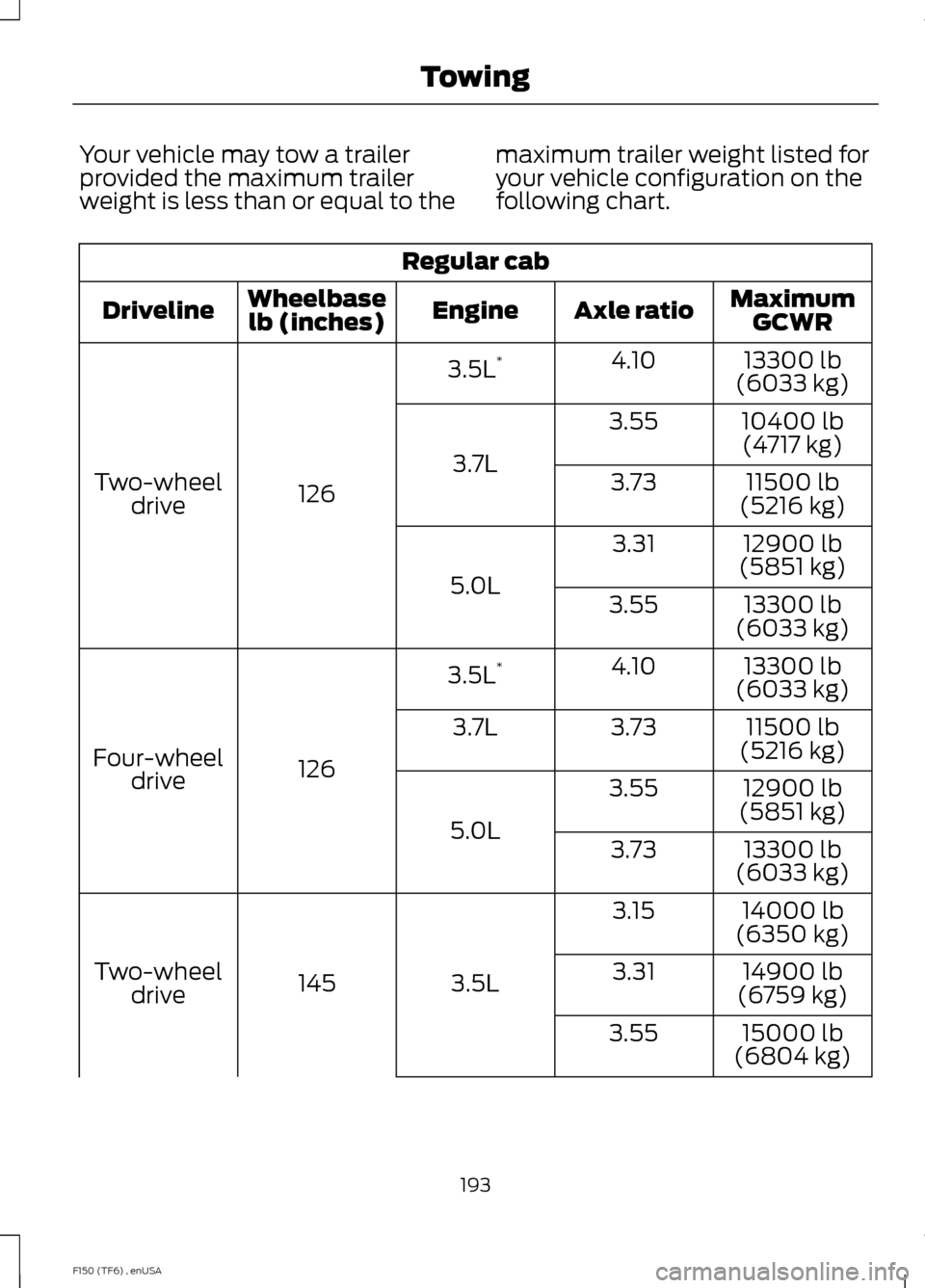
Your vehicle may tow a trailer
provided the maximum trailer
weight is less than or equal to the
maximum trailer weight listed for
your vehicle configuration on the
following chart.Regular cab
MaximumGCWR
Axle ratio
Engine
Wheelbase
lb (inches)
Driveline
13300 lb
(6033 kg)
4.10
3.5L *
126
Two-wheel
drive 10400 lb
(4717 kg)
3.55
3.7L 11500 lb
(5216 kg)
3.73
12900 lb
(5851 kg)
3.31
5.0L 13300 lb
(6033 kg)
3.55
13300 lb
(6033 kg)
4.10
3.5L *
126
Four-wheel
drive 11500 lb
(5216 kg)
3.73
3.7L
12900 lb
(5851 kg)
3.55
5.0L 13300 lb
(6033 kg)
3.73
14000 lb
(6350 kg)
3.15
3.5L
145
Two-wheel
drive 14900 lb
(6759 kg)
3.31
15000 lb
(6804 kg)
3.55
193
F150 (TF6) , enUSA Towing
Page 197 of 472
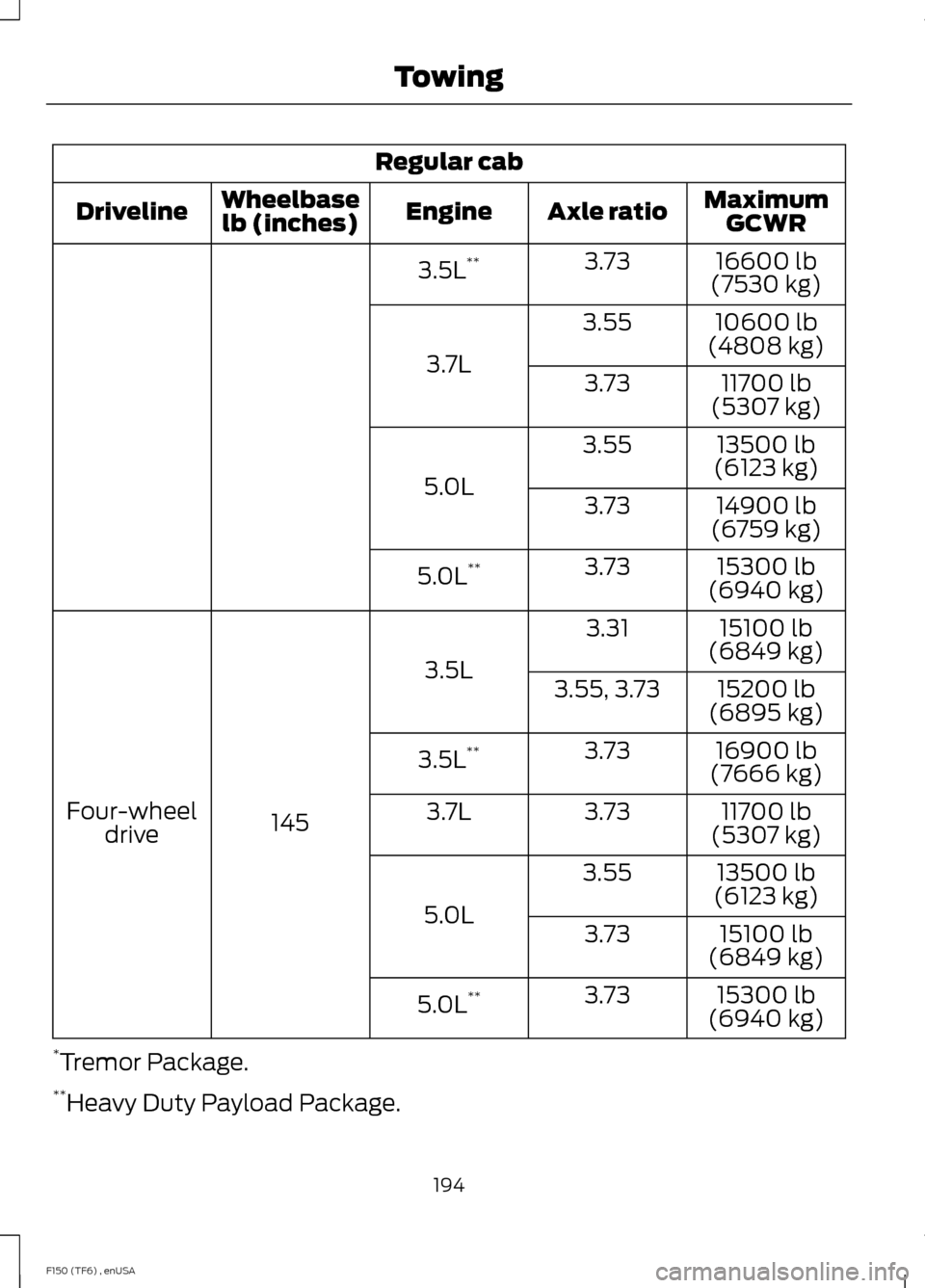
Regular cab
MaximumGCWR
Axle ratio
Engine
Wheelbase
lb (inches)
Driveline
16600 lb
(7530 kg)
3.73
3.5L **
10600 lb
(4808 kg)
3.55
3.7L 11700 lb
(5307 kg)
3.73
13500 lb
(6123 kg)
3.55
5.0L 14900 lb
(6759 kg)
3.73
15300 lb
(6940 kg)
3.73
5.0L **
15100 lb
(6849 kg)
3.31
3.5L
145
Four-wheel
drive 15200 lb
(6895 kg)
3.55, 3.73
16900 lb
(7666 kg)
3.73
3.5L **
11700 lb
(5307 kg)
3.73
3.7L
13500 lb
(6123 kg)
3.55
5.0L 15100 lb
(6849 kg)
3.73
15300 lb
(6940 kg)
3.73
5.0L **
* Tremor Package.
** Heavy Duty Payload Package.
194
F150 (TF6) , enUSA Towing
Page 198 of 472
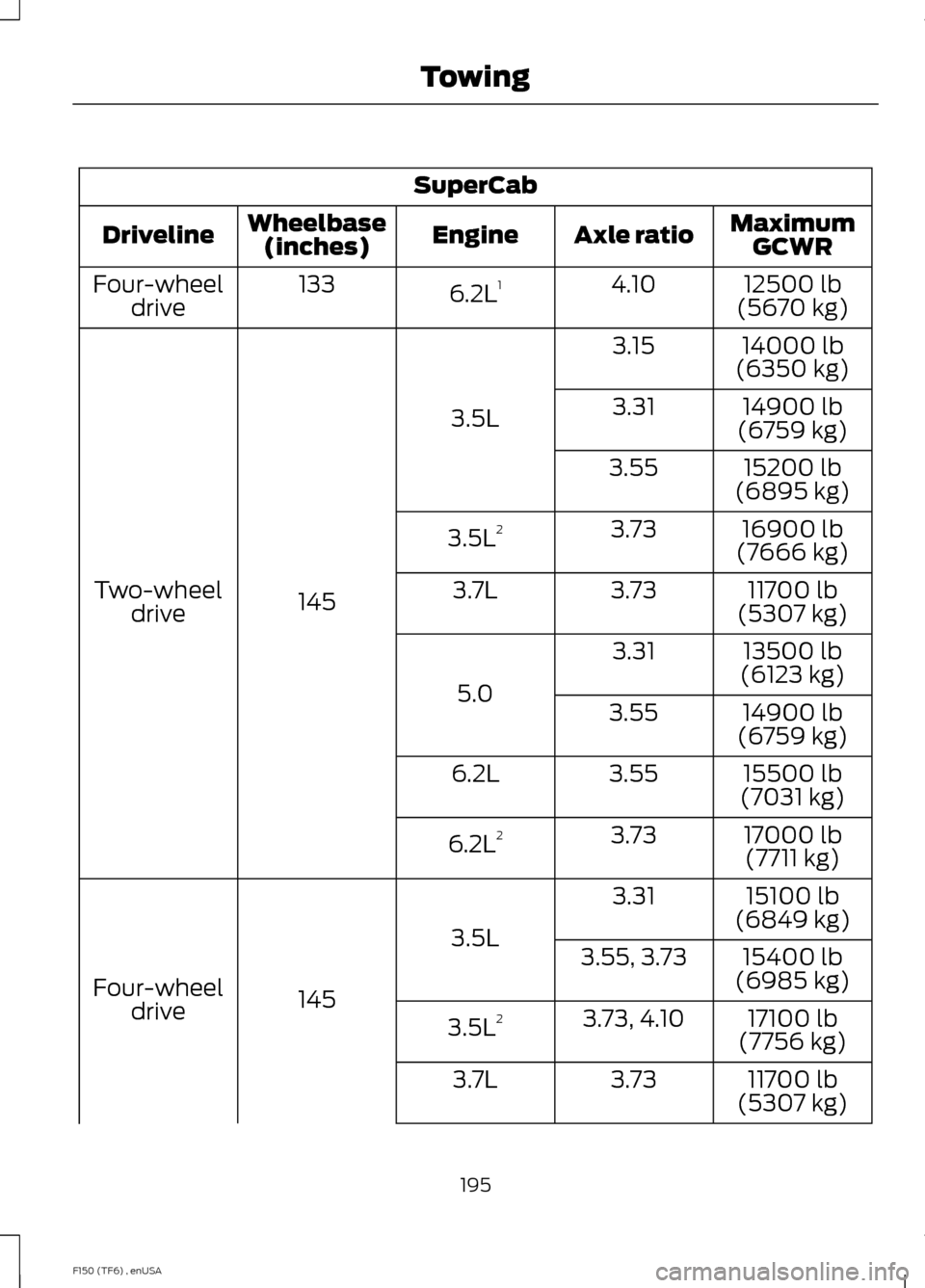
SuperCab
MaximumGCWR
Axle ratio
Engine
Wheelbase
(inches)
Driveline
12500 lb
(5670 kg)
4.10
6.2L 1
133
Four-wheel
drive
14000 lb
(6350 kg)
3.15
3.5L
145
Two-wheel
drive 14900 lb
(6759 kg)
3.31
15200 lb
(6895 kg)
3.55
16900 lb
(7666 kg)
3.73
3.5L 2
11700 lb
(5307 kg)
3.73
3.7L
13500 lb
(6123 kg)
3.31
5.0 14900 lb
(6759 kg)
3.55
15500 lb
(7031 kg)
3.55
6.2L
17000 lb(7711 kg)
3.73
6.2L 2
15100 lb
(6849 kg)
3.31
3.5L
145
Four-wheel
drive 15400 lb
(6985 kg)
3.55, 3.73
17100 lb
(7756 kg)
3.73, 4.10
3.5L 2
11700 lb
(5307 kg)
3.73
3.7L
195
F150 (TF6) , enUSA Towing