Page 383 of 586

8. Remove the jack and fully tighten the lug
nuts in the order shown. SeeWheel Lug
Nut Torque Specificationslater in this
chapter for the proper lug nut torque
specification.
Stowing the mini-spare and jack
1. Adjust the jack to the proper
height to install the wrench. Turn
the jack lead screw until the arrow
on the upper link is slightly below
the circle indicator shown on the
lower link.
Push the button (A) to retract the
wrench handle and place the wrench
over the raised tab on the lower link
and drop the tang (B) through the
hole in the diagonally opposite upper
link. Turn the lead screw of the jack
clockwise until the arrow aligns with
the circle indicator to secure the
wrench onto the jack.
2. Place the jack in the foam tray and secure it with the attached strap.
3. Place the foam tray over the mounting bracket on the floor of the
spare tire well.
4. Replace the mini-spare over the jack and secure with the wing nut.
A
B
382Wheels and Tires
2014 Explorer(exp)
Owners Guide gf, 1st Printing, April 2013
USA(fus)
Page 384 of 586
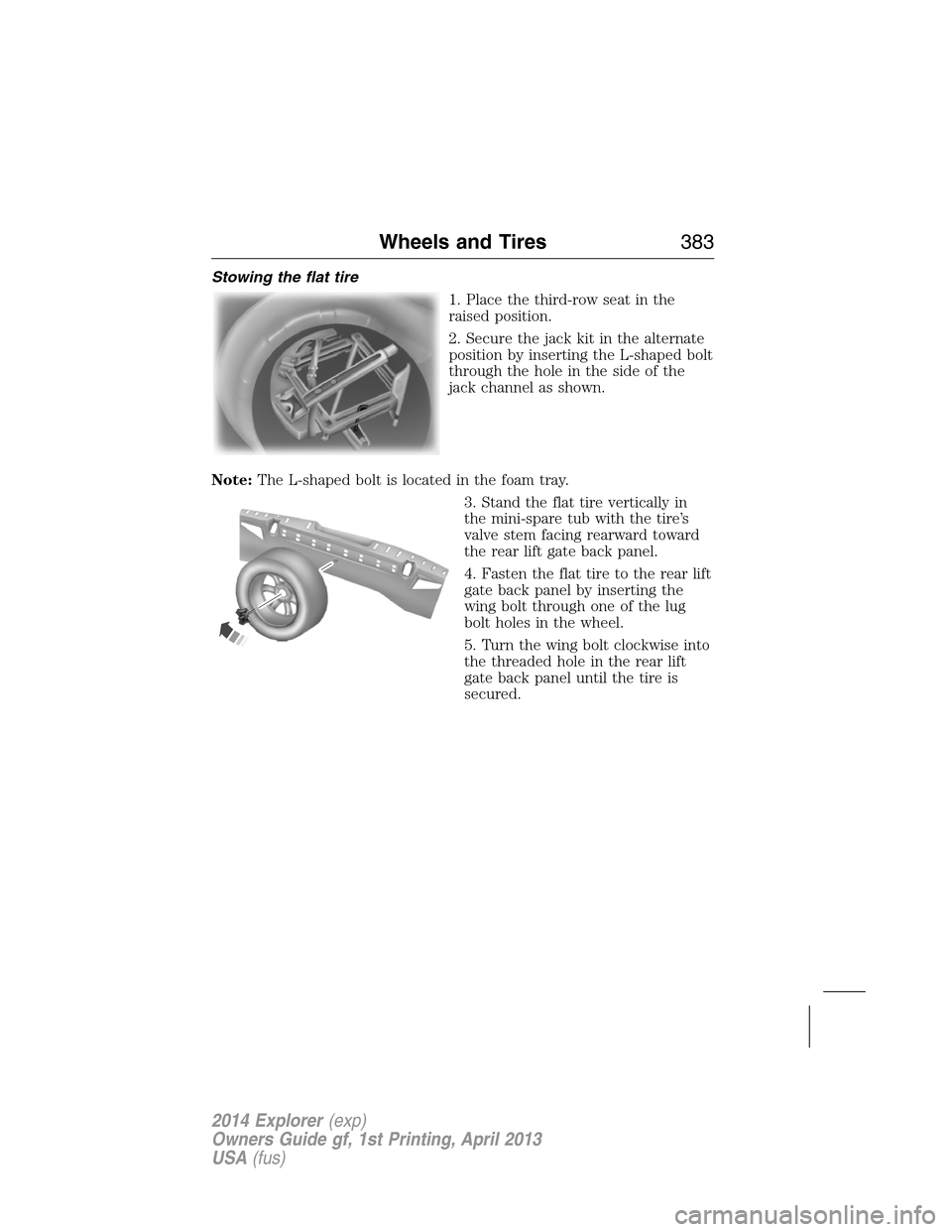
Stowing the flat tire
1. Place the third-row seat in the
raised position.
2. Secure the jack kit in the alternate
position by inserting the L-shaped bolt
through the hole in the side of the
jack channel as shown.
Note:The L-shaped bolt is located in the foam tray.
3. Stand the flat tire vertically in
the mini-spare tub with the tire’s
valve stem facing rearward toward
the rear lift gate back panel.
4. Fasten the flat tire to the rear lift
gate back panel by inserting the
wing bolt through one of the lug
bolt holes in the wheel.
5. Turn the wing bolt clockwise into
the threaded hole in the rear lift
gate back panel until the tire is
secured.
Wheels and Tires383
2014 Explorer(exp)
Owners Guide gf, 1st Printing, April 2013
USA(fus)
Page 564 of 586

Oils, Fluids and Flushing
In many cases, fluid discoloration is a normal operating characteristic
and, by itself, does not necessarily indicate a concern or that the fluid
needs to be changed. However, discolored fluids that also show signs of
overheating and foreign material contamination should be inspected
immediately by a qualified expert, such as the factory-trained technicians
at your dealership. Your vehicle’s oils and fluids should be changed at the
specified intervals or in conjunction with a repair. Flushing is a viable
way to change fluid for many vehicle sub-systems during scheduled
maintenance. It is critical that systems are flushed only with new fluid
that is the same as that required to fill and operate the system, or using
a Ford-approved flushing chemical.
Owner Checks and Services
Certain basic maintenance checks and inspections should be performed
every month or at six month intervals.
Check every month
Engine oil level.
Function of all interior and exterior lights.
Tires (including spare) for wear and proper pressure.
Windshield washer fluid level.
Check every six months
Battery connections. Clean if necessary.
Body and door drain holes for obstructions. Clean if necessary.
Cooling system fluid level and coolant strength.
Door weatherstrips for wear. Lubricate if necessary.
Hinges, latches and outside locks for proper operation. Lubricate if
necessary.
Parking brake for proper operation.
Safety belts and seat latches for wear and function.
Safety warning lamps (brake, ABS, airbag, safety belt) for operation.
Washer spray and wiper operation. Clean or replace blades as
necessary.
Scheduled Maintenance563
2014 Explorer(exp)
Owners Guide gf, 1st Printing, April 2013
USA(fus)
Page 565 of 586
Multi-point Inspection
In order to keep your vehicle running right, it is important to have the
systems on your vehicle checked regularly. This can help identify
potential issues and prevent major problems. Ford Motor Company
recommends the following multi-point inspection be performed at every
scheduled maintenance interval to help make sure your vehicle keeps
running great.
Multi-point inspection
Accessory drive belt(s) Hazard warning system operation
Battery performance Horn operation
Engine air filter Radiator, cooler, heater and A/C hoses
Exhaust system Suspension components for leaks or
damage
Exterior lamps operation Steering and linkage
Fluid levels
*; fill if necessary Tires (including spare) for wear and
proper pressure**
For oil and fluid leaks Windshield for cracks, chips or pits
Half-shaft dust boots Washer spray and wiper operation
*Brake, coolant recovery reservoir, automatic transmission (with an
underhood dipstick) and window washer.
**If your vehicle is equipped with a temporary mobility kit, check the tire
sealant expiration Use By date on the canister. Replace as needed.
Be sure to ask your dealership service advisor or technician about the
multi-point vehicle inspection. It is a comprehensive way to perform a
thorough inspection of your vehicle. It is your checklist that gives you
immediate feedback on the overall condition of your vehicle. You will
know what has been checked, what is okay, as well as those things that
may require future or immediate attention. The multi-point vehicle
inspection is one more way to keep your vehicle running great!
564Scheduled Maintenance
2014 Explorer(exp)
Owners Guide gf, 1st Printing, April 2013
USA(fus)
Page 585 of 586
Setting a destination ................530
Setting a destination by
voice ...........................................531
Settings ......................................516
Setting the clock ...............402, 516
Side air curtain ...........................57
Side-curtain airbags system .......57
SIRIUS® satellite radio ....402, 484
SIRIUS satellite radio voice
commands .................................486
SIRIUS Travel Link ...................508
SIRIUS Travel Link voice
commands .................................510
Snowplowing ...............................15
SOS Post Crash Alert .................50
Spark plugs,
specifications .....................385, 391
Special notice
ambulance conversions ............15
utility-type vehicles ..................15
Specification chart,
lubricants ...................................387
Stability system .........................225
Starting your vehicle ................190
jump starting ..........................291
push button start system .......189
Steering wheel ............................90
controls ......................................92
tilting .........................................90
Supplemental Restraint System
(SRS) (see airbags) ....................51
Supported media file types ......494
Supported player, media
formats and metadata
information ................................494SYNC® customer
support ..............................419, 468
SYNC® Services ................443, 505
System settings .........................519
T
Temperature control
(see Climate
control) ..............144, 146, 148, 527
Text messaging .................430, 500
Text messaging (sending,
downloading, deleting) .....431, 433
Third-row power fold seat .......176
Tilt steering wheel ......................90
Tires ...........................355–356, 376
alignment ................................369
care ..........................................354
changing ..........................376, 378
checking the pressure ............365
inflating ...................................363
label .........................................362
replacing ..................................367
rotating ....................................369
safety practices .......................368
sidewall information ...............358
snow tires and chains ............370
spare tire .................................376
terminology .............................357
tire grades ...............................356
treadwear ........................356, 365
Touchscreen features
(climate) ....................................527
Towing .......................275, 282–283
recreational towing .................283
trailer towing ..........................275
wrecker ....................................282
Traction control ........................223
584Index
2014 Explorer(exp)
Owners Guide gf, 1st Printing, April 2013
USA(fus)