Page 225 of 367

The front ring is located in the tool box
beneath the passenger side seat. On
versions with Fix&Go kit and without
spare wheel, the tool box is available
only on request for versions/markets
where provided.
In the absence of the tool box the
vehicle front tow hook is housed in the
on-board documentation container,
together with the Owner Handbook.To use it, proceed as follows:
❒Open the flap A and remove it as
illustrated in fig. 232;
❒turn retaining knob B fig. 232
anticlockwise and remove it to allow
the box fig. 233 to come out;
❒take the screwdriver provided from
the box and prise up at the point
shown to raise the cap C fig. 235;
❒take the tow ring D from the box and
screw it onto the threaded pin fig.
235.
The rear ring B fig. 236 is located at the
point shown in the diagram.
WARNING
166) Screw on the tow hook and
check that it stops at the end
of travel position.
167) Before towing, switch off the
steering lock (see "Starting
device" paragraph under the
"Knowing your car" section).
168) Remember that the brake servo
and the electric power steering
are not available during towing
operations. Significantly greater
force must be exerted on the
brake pedal and on the steering
wheel to operate them.
169) Do not use flexible cables for
towing and avoid jerking. During
towing operations, make sure that
the fastened joint does not
damage adjoining components.
170) When towing the vehicle
comply with the specific rules of
the Highway Code regarding
the towing device and the
behaviour on the road.
171) Do not start the engine while
towing the vehicle.
234
F1A0344
235
F1A0223
236
F1A0224
221
Page 228 of 367

SCHEDULED
SERVICINGCorrect servicing is essential for
ensuring long vehicle life under the best
conditions.
This is why Fiat has planned a series of
checks and maintenance operations
every 48,000 km depending on the
engine version.
The scheduled maintenance does not,
however, cover all the needs of the
vehicle: also during the initial period,
before the 48,000 km service and
between one service and the next,
ordinary care such as systematic fluid
level checks with top ups and tyre
pressure checks, etc. remain
necessary.
IMPORTANT The Scheduled Servicing
services are set out by the
Manufacturer. Failure to have them
carried out may invalidate the warranty.
Scheduled Servicing can be carried
out by any Fiat Dealership, at
pre-established times.
If during each operation, in addition to
the ones scheduled, the need arises for
further replacements or repairs, these
may only be carried out with the
express agreement of the Customer.IMPORTANT It is advisable to inform a
Fiat Dealership of any small operating
irregularities without waiting for the next
service.
If your vehicle is used frequently for
towing, the interval between service
coupons must be reduced.
224
SERVICING AND MAINTENANCE
Page 230 of 367

Thousands of miles 30 60 90 120 150
Thousands of kilometres 48 96 144 192 240
Months 24 48 72 96 120
Visual check of accessory drive belt(s) (versions without automatic
tensioner) (110 (°)- 130 - 150 - 180 MultiJet versions)●●
Check tension of accessory drive belt (versions without automatic tensioner)
(^)●●
Check tension of accessory drive belt (versions without automatic tensioner)
(115 MultiJet versions) (°)) (^)●●●
Check condition of toothed timing drive belt (110 (°)- 130 - 150 MultiJet
versions)●
Check condition of toothed timing drive belt (115 MultiJet versions) (°))●●●●●
Check handbrake lever travel and adjust, if required●●●●●
Check exhaust emissions/smokiness●●●●●
Check engine control system operation (through diagnosis socket)●●●●●
Check cleanliness of sliding side door lower guides for versions with S.S.D.
(or every 6 months)●●●●●
Replace the fuel filter cartridge (diesel versions)●●●●●
Replace accessory drive belt(s)●
Replace the accessory drive belt(s) (115 MultiJet versions) (°))●●(°)Version for specific markets
(^) When the engine oil is changed for the first time, check the tension of the accessory drive belt
226
SERVICING AND MAINTENANCE
Page 239 of 367

50) Do not press the power steering
end of travel lock for longer than 8
consecutive seconds with the
engine running because it will
cause noise and risk damaging
the system.
WARNING
175) Never smoke when performing
operations in the engine
compartment. Flammable gases
and fumes may be present and
risk igniting.
176) Be very careful when working in
the engine compartment when
the engine is hot: you may get
burned. Remember that the fan
may start up if the engine is hot:
this could injure you. Scarves, ties
and other loose clothing might
be pulled by moving parts.
177) The cooling system is
pressurised. If necessary, only
replace the plug with another
original one or the operation of
the system may be adversely
affected. Do not remove the
reservoir plug when the engine is
hot: risk of burns.178) Do not travel with the
windscreen washer reservoir
empty: the windscreen washer is
essential for improving visibility.
179) Some commercial windscreen
washer additives are flammable.
The engine compartment contains
hot parts which could start a fire
on contact.
180) Do not release the cap from
the extension without previously
extracting the system using the
ring.
181) Brake fluid is poisonous and
highly corrosive. In the event of
accidental contact, immediately
wash the affected parts with
water and mild soap. Then rinse
thoroughly. Call a doctor
immediately if swallowed.
182) The
symbol on the container
indicates a synthetic brake fluid,
which is different from a mineral
fluid. Using a mineral fluid will
damage the special rubber seals
of the braking system beyond
repair.
183) Prevent power steering fluid
from coming into contact with
hot engine parts: it is flammable.
IMPORTANT
3) Power steering fluid consumption
is extremely low; if another top-up
is required after only a short
period of time, have the system
checked for leaks at a Fiat
Dealership.
235
Page 250 of 367
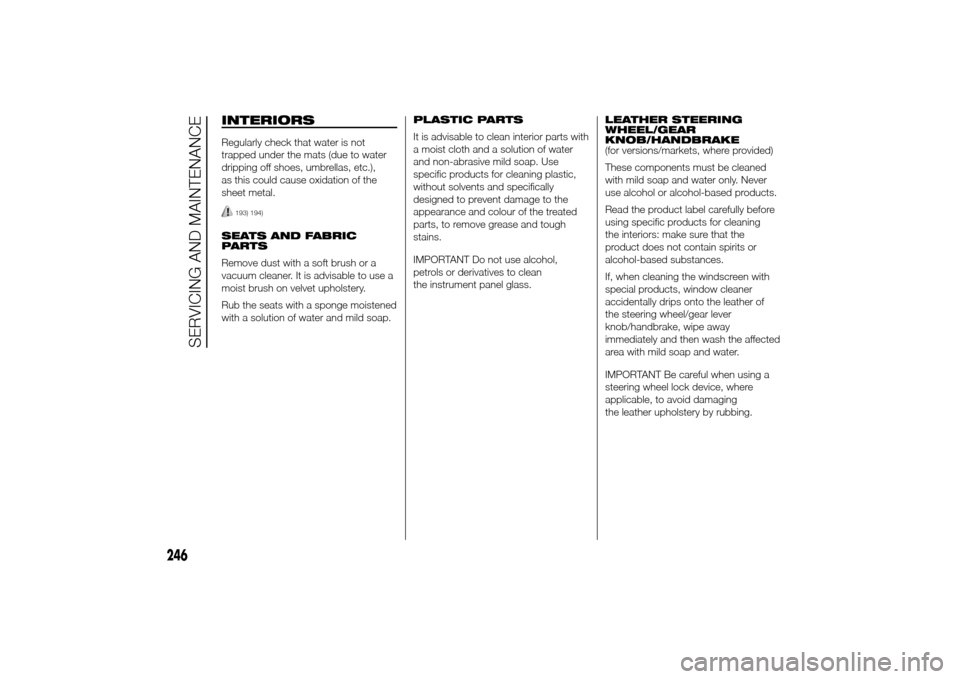
INTERIORSRegularly check that water is not
trapped under the mats (due to water
dripping off shoes, umbrellas, etc.),
as this could cause oxidation of the
sheet metal.
193) 194)
SEATS AND FABRIC
PARTS
Remove dust with a soft brush or a
vacuum cleaner. It is advisable to use a
moist brush on velvet upholstery.
Rub the seats with a sponge moistened
with a solution of water and mild soap.PLASTIC PARTS
It is advisable to clean interior parts with
a moist cloth and a solution of water
and non-abrasive mild soap. Use
specific products for cleaning plastic,
without solvents and specifically
designed to prevent damage to the
appearance and colour of the treated
parts, to remove grease and tough
stains.
IMPORTANT Do not use alcohol,
petrols or derivatives to clean
the instrument panel glass.LEATHER STEERING
WHEEL/GEAR
KNOB/HANDBRAKE
(for versions/markets, where provided)
These components must be cleaned
with mild soap and water only. Never
use alcohol or alcohol-based products.
Read the product label carefully before
using specific products for cleaning
the interiors: make sure that the
product does not contain spirits or
alcohol-based substances.
If, when cleaning the windscreen with
special products, window cleaner
accidentally drips onto the leather of
the steering wheel/gear lever
knob/handbrake, wipe away
immediately and then wash the affected
area with mild soap and water.
IMPORTANT Be careful when using a
steering wheel lock device, where
applicable, to avoid damaging
the leather upholstery by rubbing.
246
SERVICING AND MAINTENANCE
Page 257 of 367
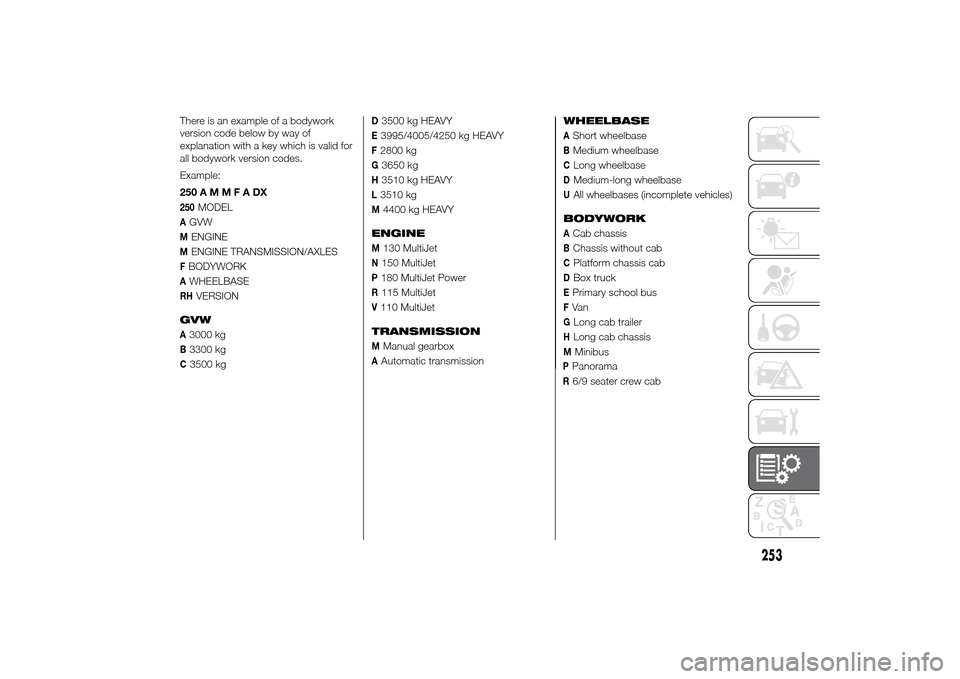
PPanoramaR6/9 seater crew cab
253
There is an example of a bodywork
version code below by way of
explanation with a key which is valid for
all bodywork version codes.
Example:
250AMMFADX250
MODEL
AGVWM
ENGINE
M
ENGINE TRANSMISSION/AXLES
FBODYWORKAWHEELBASERH
VERSION
GVW
A3000 kgB3300 kgC3500 kg
D3500 kg HEAVYE3995/4005/4250 kg HEAVYF2800 kgG3650 kgH3510 kg HEAVYL3510 kgM
4400 kg HEAVY
ENGINE
M
130 MultiJet
N150 MultiJetP180 MultiJet PowerR115 MultiJetV110 MultiJet
TRANSMISSIONM
Manual gearbox
AAutomatic transmissionWHEELBASE
AShort wheelbaseBMedium wheelbaseCLong wheelbaseDMedium-long wheelbaseUAll wheelbases (incomplete vehicles)
BODYWORKACab chassisBChassis without cabCPlatform chassis cabDBox truckEPrimary school busFVa nGLong cab trailerHLong cab chassisM
Minibus
Page 260 of 367
TRANSMISSIONVersions Gearbox Clutch Drive115 MultiJet(*)Five forward gears and
reverse with synchronizers
for forward gear
engagement
Self-adjusting pedal without
idle strokeFront 110 MultiJet(*)
Six forward gears plus
reverse with synchronisers
for forward gear
engagement 130 MultiJet
150 MultiJet
180 MultiJet Power(*)Version for specific markets
256
TECHNICAL SPECIFICATIONS
Page 280 of 367

WEIGHTSVAN WEIGHTS
2800 kg GVW versions(*) 3510 kg GVW versions(*)
110 (**)
/130/150 MultiJet
110 (**)
/130/150 MultiJet
Unladen weight (with all fluids, fuel tank filled to
90% and without optional equipment)1845 ÷ 1860 1860 ÷ 2000
Payload (***)
including the driver:
Maximum permitted loads (°)
– front axle: 1630 1850
– rear axle: 1650 2000
– total: 2800 3510
Towable loads
– braked trailer: 2000 2500
– non-braked trailer: 750 750
Maximum load on ball joint (braked trailer): 100 100(*) The values indicated refer to panel and glazed Vans in medium and short wheelbases with high and low sides.
(**) Version for specific markets
(***) If special equipment is fitted (trailer towing equipment, etc.) the empty weight will increase and consequently the payload will decrease in relation to the
maximum permitted loads.
(°) Loads not to be exceeded. The user is responsible for arranging goods in the luggage compartment and/or load platform within the maximum permittedloads.
276
TECHNICAL SPECIFICATIONS