Page 224 of 275
ADVICE FOR PRESERVING THE
BODYWORK
Paint
Paintwork does not only serve an aesthetic purpose,
but also protects the underlying sheet metal.
Touch up abrasions and scratches immediately to
prevent rust formation. Use only original paint
products for touch-ups (see “Bodywork paint
identification plate” in the “Technical specifications”
section).
Normal maintenance of paintwork consists in
washing the car: the frequency depends on the
conditions and environment where the car is used.
For example, in highly polluted areas, or if the roads
are spread with salt, it is advisable to wash the car
more frequently.To correctly wash the vehicle, proceed as follows:
❒remove the aerial from the roof to prevent damage
to it if the car is washed in an automatic system;
❒if high pressure jets or cleaners are used to wash
the vehicle, keep a distance of at least 40 cm
from the bodywork to avoid damage or alteration.
It should be remembered that the build up of
water can damage the car over a period of time;
❒wash the body using a low pressure jet of water;
❒wipe a sponge with a slightly soapy solution over
the bodywork, frequently rinsing with the sponge;
❒rinse well with water and dry with a jet of air or a
chamois leather.
Dry the less visible parts particularly carefully, such
as the door frames, bonnet and the headlight frames,
where water may stagnate more easily. The car
should not be taken to a closed area immediately,
but left outside so that residual water can evaporate.
Do not wash the car after it has been left in the
sun or with the bonnet hot: this may alter the shine
of the paintwork.
220GETTING TO KNOW
YOUR CAR
SAFETY
STARTING AND
DRIVING
WARNING LIGHTS
AND MESSAGES
IN AN EMERGENCYSERVICING AND
MAINTENANCE
TECHNICAL
SPECIFICATIONS
INDEX
Page 225 of 275

External plastic parts must be cleaned in the same
way as the rest of the car.
Where possible, do not park under trees; the
resinous substance that many species release give the
paint a dull appearance and increase the possibility
of triggering rusting processes.
IMPORTANT Bird droppings must be washed off
immediately and thoroughly as the acid they contain
is particularly aggressive.
Detergents pollute the environment .
Therefore the engine compartment should
be washed in areas equipped for
collecting and purifying the liquid used in the
washing process.
Glasses
To clean glasses, use specific window cleaner
products.
Also use clean cloths to avoid scratching the glass or
damaging the transparency.
IMPORTANT Wipe the rear window inside gently
with a cloth in the direction of the filaments to avoid
damaging the heating device.Engine compartment
IMPORTANT The washing should take place with the
engine cold and the ignition key in the STOP
position. After the washing operation, make sure
that the various protections (e.g. rubber caps and
guards) have not been removed or damaged.
Front headlights
IMPORTANT Never use aromatic substances (e.g.
petrol) or ketenes (e.g. acetone) for cleaning the
plastic lenses of the front headlights.
221GETTING TO KNOW
YOUR CAR
SAFETY
STARTING AND
DRIVING
WARNING LIGHTS
AND MESSAGES
IN AN EMERGENCYSERVICING AND
MAINTENANCETECHNICAL
SPECIFICATIONS
INDEX
Page 226 of 275
INTERIORSPeriodically check for water puddles under the mats
that could cause the panels to rust.
Replace the worn carpet mats, if present, with
genuine products and make sure they remain
securely fastened to the passenger compartment
carpet. It is not advisable to use non genuine mats
that could move whilst driving.
WARNING
Never use flammable products, such as
petrol ether or rectified petrol to clean
the inside of the car.The electrostatic charges
which are generated by rubbing during the
cleaning operation may cause a fire.
WARNING
Do not keep aerosol cans in the car:
they might explode. Aerosol cans must
not be exposed to a temperature exceeding
50°C .When the car is exposed to sunlight ,
internal temperature can greatly exceed this
value.
SEATS AND FABRIC PARTS
Remove dust with a soft brush or a vacuum cleaner.
Rub the seats with a sponge and a solution of water
and mild soap.
222GETTING TO KNOW
YOUR CAR
SAFETY
STARTING AND
DRIVING
WARNING LIGHTS
AND MESSAGES
IN AN EMERGENCYSERVICING AND
MAINTENANCE
TECHNICAL
SPECIFICATIONS
INDEX
Page 230 of 275
CHASSIS MARKING
This is printed on the passenger compartment floor,
near the front right seat.
Slide flap A fig. 184 forward to access:
The marking includes:
❒car model (ZFA 198000);
❒chassis serial number.BODYWORK PAINT IDENTIFICATION
PLATE
This is fitted to the inside of the tailgate and bears
the following data fig. 185:
APaint manufacturer.
BColour name.
CFiat colour code.
DRespray and touch up code.
ENGINE MARKING
This is stamped on the cylinder block and gives the
model and the chassis serial number.
fig. 184
F0Q0667
fig. 185
F0Q0100
226GETTING TO KNOW
YOUR CAR
SAFETY
STARTING AND
DRIVING
WARNING LIGHTS
AND MESSAGES
IN AN EMERGENCY
SERVICING AND
MAINTENANCE
TECHNICAL
SPECIFICATIONS
INDEX
Page 237 of 275
WHEELSRIMS AND TYRES
Pressed steel or alloy rims. Tubeless radial carcass
tyres. The vehicle registration document also lists all
type-approved tyres.
IMPORTANT If there are any discrepancies between
the Owner Handbook and the registration
document, take the information from the latter. For
safe driving, the car must be fitted with tyres of
the same make and type on all wheels.
IMPORTANT Do not use air chambers with Tubeless
tyres.
SPARE WHEEL
Pressed steel rim. Tubeless tyre.
WHEEL GEOMETRY
Front wheel toe-in measured from rim to rim:
-1mm+/-1mm
The values refer to the car in running order.
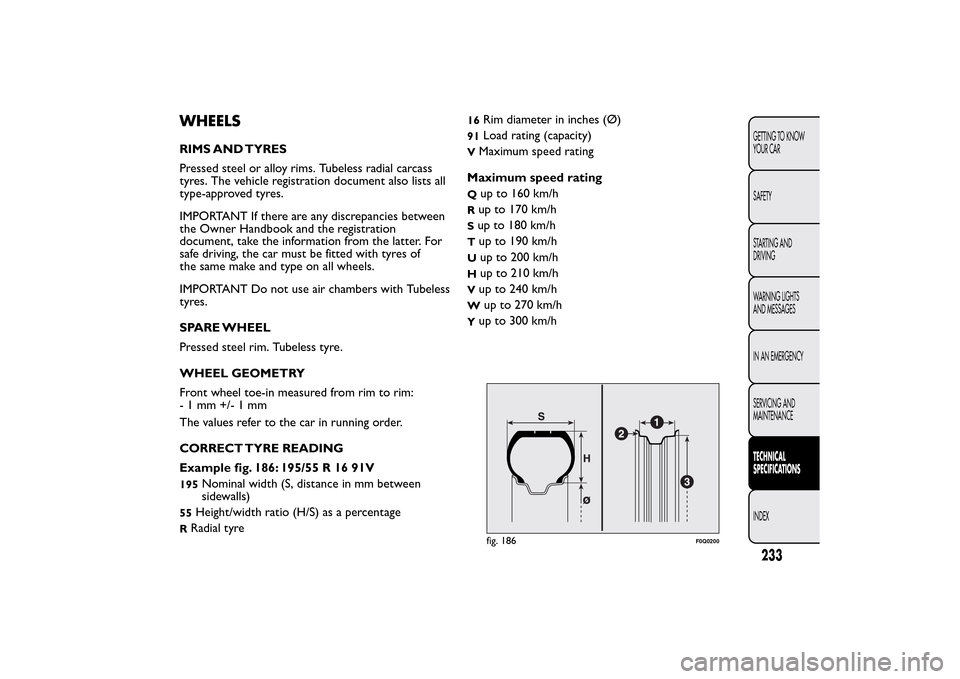
CORRECT TYRE READING
Example fig. 186: 195/55 R 16 91V195
Nominal width (S, distance in mm between
sidewalls)
55
Height/width ratio (H/S) as a percentage
RRadial tyre
16
Rim diameter in inches (Ø)
91
Load rating (capacity)
V
Maximum speed rating
Maximum speed rating
Q
up to 160 km/h
Rup to 170 km/hSup to 180 km/hT
up to 190 km/h
U
up to 200 km/h
H
up to 210 km/h
V
up to 240 km/h
W
up to 270 km/h
Y
up to 300 km/hfig. 186
F0Q0200
233GETTING TO KNOW
YOUR CAR
SAFETY
STARTING AND
DRIVING
WARNING LIGHTS
AND MESSAGES
IN AN EMERGENCY
SERVICING AND
MAINTENANCETECHNICAL
SPECIFICATIONSINDEX
Page 238 of 275
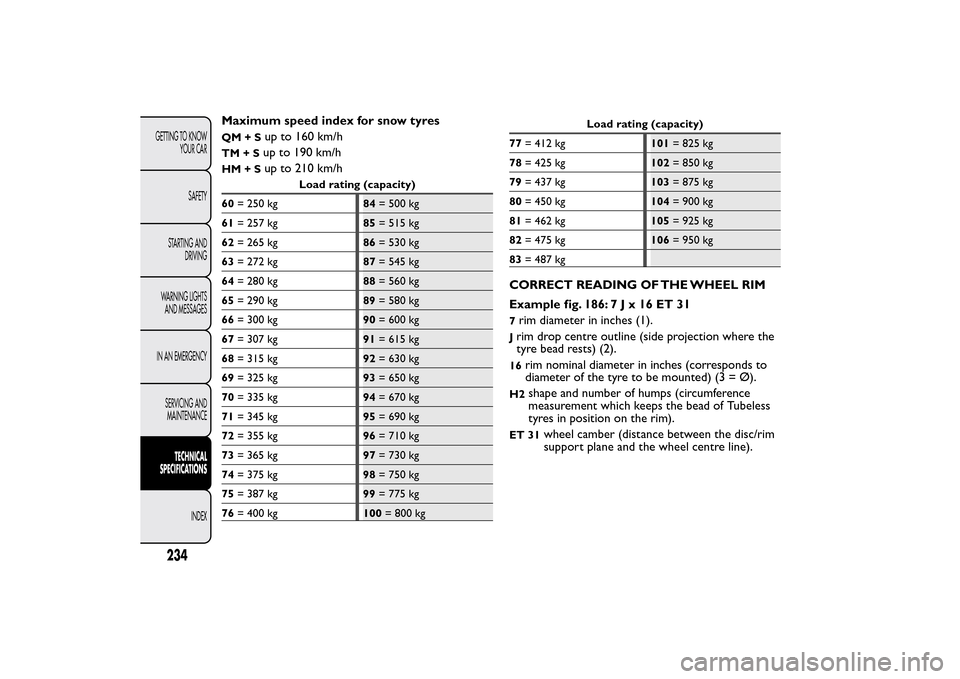
Maximum speed index for snow tyresQM+S
up to 160 km/h
TM+S
up to 190 km/h
HM+S
up to 210 km/h
Load rating (capacity)
60= 250 kg84= 500 kg
61= 257 kg85= 515 kg
62= 265 kg86= 530 kg
63= 272 kg87= 545 kg
64= 280 kg88= 560 kg
65= 290 kg89= 580 kg
66= 300 kg90= 600 kg
67= 307 kg91= 615 kg
68= 315 kg92= 630 kg
69= 325 kg93= 650 kg
70= 335 kg94= 670 kg
71= 345 kg95= 690 kg
72= 355 kg96= 710 kg
73= 365 kg97= 730 kg
74= 375 kg98= 750 kg
75= 387 kg99= 775 kg
76= 400 kg100= 800 kg
Load rating (capacity)
77= 412 kg101= 825 kg
78= 425 kg102= 850 kg
79= 437 kg103= 875 kg
80= 450 kg104= 900 kg
81= 462 kg105= 925 kg
82= 475 kg106= 950 kg
83= 487 kg
CORRECT READING OF THE WHEEL RIM
Example fig. 186:7Jx16ET317rim diameter in inches (1).Jrim drop centre outline (side projection where the
tyre bead rests) (2).16
rim nominal diameter in inches (corresponds to
diameter of the tyre to be mounted) (3 = Ø).
H2
shape and number of humps (circumference
measurement which keeps the bead of Tubeless
tyres in position on the rim).
ET 31
wheel camber (distance between the disc/rim
support plane and the wheel centre line).
234GETTING TO KNOW
YOUR CAR
SAFETY
STARTING AND
DRIVING
WARNING LIGHTS
AND MESSAGES
IN AN EMERGENCY
SERVICING AND
MAINTENANCE
TECHNICAL
SPECIFICATIONS
INDEX
Page 248 of 275
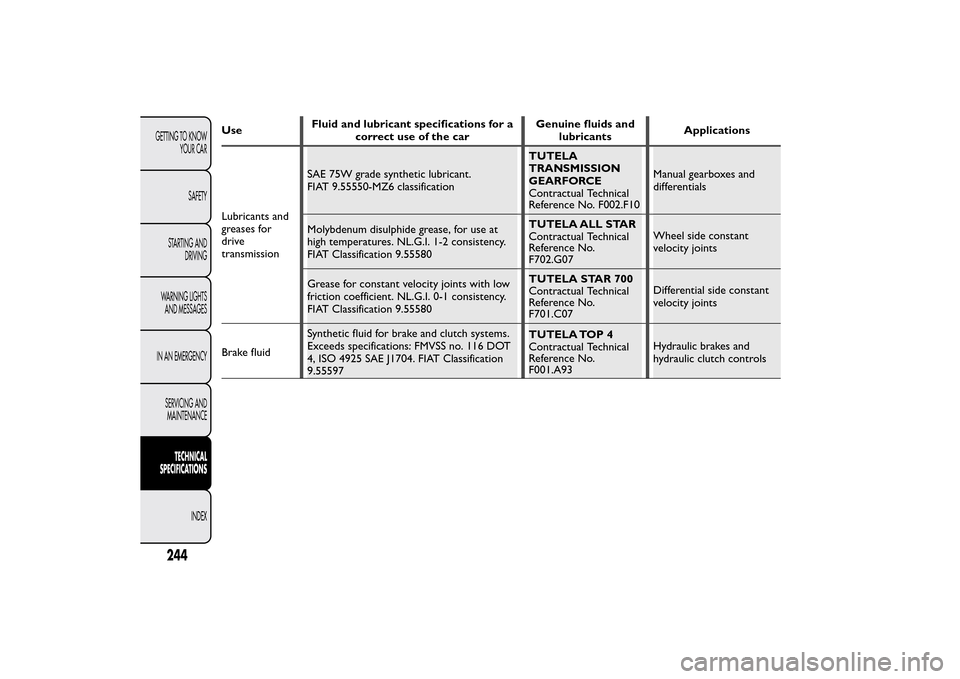
UseFluid and lubricant specifications for a
correct use of the carGenuine fluids and
lubricantsApplications
Lubricants and
greases for
drive
transmissionSAE 75W grade synthetic lubricant.
FIAT 9.55550-MZ6 classificationTUTELA
TRANSMISSION
GEARFORCE
Contractual Technical
Reference No. F002.F10Manual gearboxes and
differentials
Molybdenum disulphide grease, for use at
high temperatures. NL.G.I. 1-2 consistency.
FIAT Classification 9.55580TUTELA ALL STAR
Contractual Technical
Reference No.
F702.G07Wheel side constant
velocity joints
Grease for constant velocity joints with low
friction coefficient. NL.G.I. 0-1 consistency.
FIAT Classification 9.55580TUTELA STAR 700
Contractual Technical
Reference No.
F701.C07Differential side constant
velocity joints
Brake fluidSynthetic fluid for brake and clutch systems.
Exceeds specifications: FMVSS no. 116 DOT
4, ISO 4925 SAE J1704. FIAT Classification
9.55597TUTELA TOP 4
Contractual Technical
Reference No.
F001.A93Hydraulic brakes and
hydraulic clutch controls
244GETTING TO KNOW
YOUR CAR
SAFETY
STARTING AND
DRIVING
WARNING LIGHTS
AND MESSAGES
IN AN EMERGENCY
SERVICING AND
MAINTENANCE
TECHNICAL
SPECIFICATIONS
INDEX
Page 255 of 275
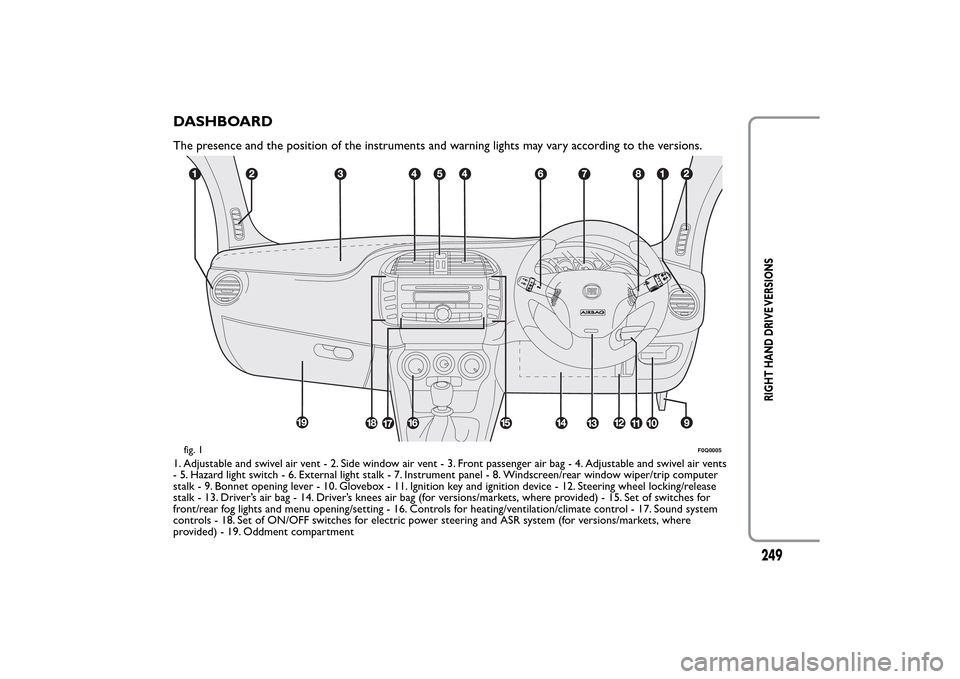
DASHBOARDThe presence and the position of the instruments and warning lights may vary according to the versions.1. Adjustable and swivel air vent - 2. Side window air vent - 3. Front passenger air bag - 4. Adjustable and swivel air vents
- 5. Hazard light switch - 6. External light stalk - 7. Instrument panel - 8. Windscreen/rear window wiper/trip computer
stalk - 9. Bonnet opening lever - 10. Glovebox - 11. Ignition key and ignition device - 12. Steering wheel locking/release
stalk - 13. Driver’s air bag - 14. Driver’s knees air bag (for versions/markets, where provided) - 15. Set of switches for
front/rear fog lights and menu opening/setting - 16. Controls for heating/ventilation/climate control - 17. Sound system
controls - 18. Set of ON/OFF switches for electric power steering and ASR system (for versions/markets, where
provided) - 19. Oddment compartmentfig. 1
F0Q0005
249
RIGHT HAND DRIVE VERSIONS