Page 197 of 275

FUSE SUMMARY TABLEDashboard fuse box FUSE AMPS
Right dipped headlight (halogen headlights) F12 7,5
Right dipped headlight (Bi-Xenon headlights) F12 15
Left dipped headlight (halogen headlights) F13 7,5
Left dipped headlight (Bi-Xenon headlights) F13 15
Reverse F35 5
3rd brake light F37 7,5
Rear fog light (driver's side) F53 7,5
Headlight alignment corrector system
(halogen headlights)F13 7,5
Relay switch coils on engine compartment fuse box
(CVM)/Body Computer control unit (NBC)F31 5
HI-FI audio system subwoofer amplifier F32 15
Left rear electric window F33 20
Right rear electric window F34 20
Control on brake pedal (NC contact)/Water presence
in diesel sensor/Air flow meterF35 5
Central locking system control unit (CGP)
(door opening/closing, safe lock, tailgate release)F36 20
Control on brake pedal (normally open contact NO)/
Instrument panel (NQS)/Gas discharge bulbs control
units on front headlightsF37 7,5
193GETTING TO KNOW
YOUR CAR
SAFETY
STARTING AND
DRIVING
WARNING LIGHTS
AND MESSAGESIN AN
EMERGENCYSERVICING AND
MAINTENANCE
TECHNICAL
SPECIFICATIONS
INDEX
Page 198 of 275
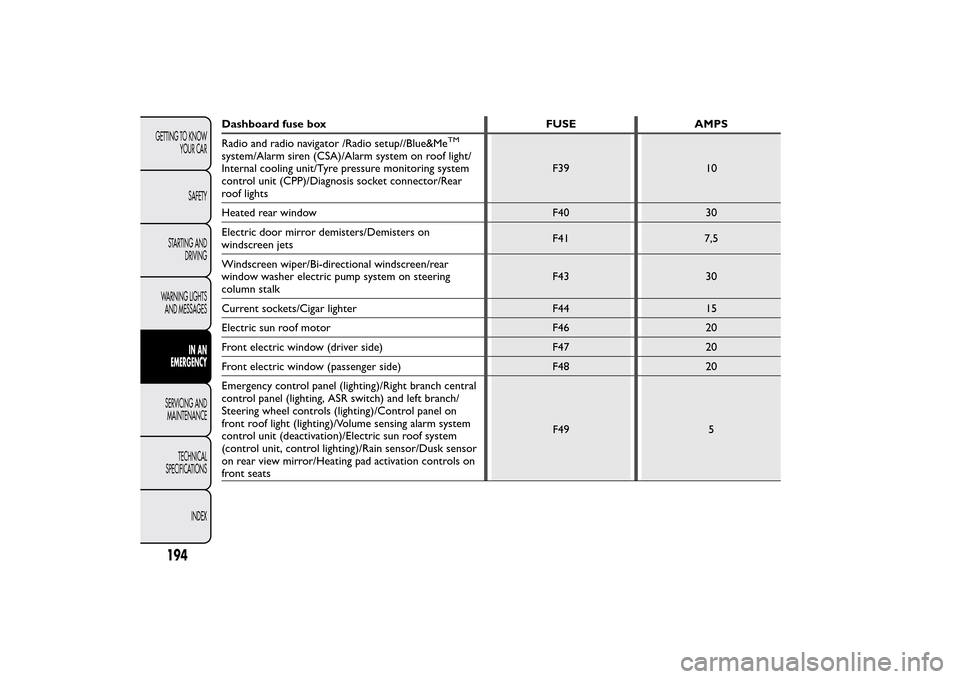
Dashboard fuse box FUSE AMPS
Radio and radio navigator /Radio setup//Blue&Me
TM
system/Alarm siren (CSA)/Alarm system on roof light/
Internal cooling unit/Tyre pressure monitoring system
control unit (CPP)/Diagnosis socket connector/Rear
roof lightsF39 10
Heated rear window F40 30
Electric door mirror demisters/Demisters on
windscreen jetsF41 7,5
Windscreen wiper/Bi-directional windscreen/rear
window washer electric pump system on steering
column stalkF43 30
Current sockets/Cigar lighter F44 15
Electric sun roof motor F46 20
Front electric window (driver side) F47 20
Front electric window (passenger side) F48 20
Emergency control panel (lighting)/Right branch central
control panel (lighting, ASR switch) and left branch/
Steering wheel controls (lighting)/Control panel on
front roof light (lighting)/Volume sensing alarm system
control unit (deactivation)/Electric sun roof system
(control unit, control lighting)/Rain sensor/Dusk sensor
on rear view mirror/Heating pad activation controls on
front seatsF49 5
194GETTING TO KNOW
YOUR CAR
SAFETY
STARTING AND
DRIVING
WARNING LIGHTS
AND MESSAGES
IN AN
EMERGENCY
SERVICING AND
MAINTENANCE
TECHNICAL
SPECIFICATIONS
INDEX
Page 203 of 275
RAISING THE CARIf the car needs to be jacked up, go to a Fiat
Dealership which is equipped with jack arms or
workshop lifts.
The car must only be lifted laterally by positioning
the end of the arms or the workshop lift in the
points illustrated in fig. 173
IMPORTANT For Sport versions, take care not to
damage the side skirts when lifting the car with
the workshop lift.
TOWING THE CARThe tow hook, which is supplied with the car, is
housed in the tool box, under the carpet in the
luggage compartment.
ATTACHING THE TOW HOOK
Proceed as follows:
❒release the cap by operating on tab A fig. 174–
fig. 175;
❒take the tow hook B from its support;
❒fully screw in the hook on the rear or front
threaded pin.
fig. 173
F0Q0729
fig. 174
F0Q0730
199GETTING TO KNOW
YOUR CAR
SAFETY
STARTING AND
DRIVING
WARNING LIGHTS
AND MESSAGESIN AN
EMERGENCYSERVICING AND
MAINTENANCE
TECHNICAL
SPECIFICATIONS
INDEX
Page 209 of 275

PERIODIC CHECKSEvery 1,000 km or before long journeys, check and, if
necessary, restore:
❒engine coolant, brake fluid and windscreen washer
fluid level;
❒tyre inflation pressure and condition;
❒operation of lighting system (headlamps, direction
indicators, hazard warning lights, etc.);
❒operation of screen washer/wiper system and
positioning/wear of windscreen/rear window wiper
blades.
Every 3,000 km, check and top up, if required, the
engine oil level.
HEAVY-DUTY USE OF THE CARIf the car is used mainly under one of the following
conditions:
❒towing a trailer or caravan;
❒dusty roads;
❒short, repeated journeys (less than 7-8 km) at
sub-zero outside temperatures;
❒engine often idling or driving long distances at low
speeds or long periods of idleness;
you need to perform the following inspections more
frequently than shown in the Scheduled Servicing
Plan:
❒check front disc brake pad conditions and wear;
❒check cleanliness of bonnet and boot locks,
cleanliness and lubrication of linkage;
❒visually inspect conditions of: engine, gearbox,
transmission, pipes and hoses (exhaust - fuel
system - brakes) and rubber elements (boots -
sleeves - bushes - etc.);
❒check battery charge and battery fluid level
(electrolyte);
❒visually inspect condition of the accessory drive
belts;
❒check and, if necessary, change engine oil and
replace oil filter;
❒check and, if necessary, replace pollen filter.
205GETTING TO KNOW
YOUR CAR
SAFETY
STARTING AND
DRIVING
WARNING LIGHTS
AND MESSAGES
IN AN EMERGENCYSERVICING AND
MAINTENANCETECHNICAL
SPECIFICATIONS
INDEX
Page 213 of 275

ENGINE OIL
Engine oil level check
Check the oil level a few minutes (about five) after
the engine has stopped, with the vehicle parked
on level ground.
Take out engine oil dipstick A, clean it and then fully
reinsert it, take it out and check that the level is
between the MIN and MAX marks on the dipstick.
The range between the MIN and MAX marks
corresponds to approximately 1 litre of oil.
Topping up the engine oil
If the level of the oil is close to or below the MIN
mark, add oil via filler B until the MAX mark is
reached.
IMPORTANT If the engine oil level after the check is
over the MAX level, go to a Fiat Dealership to
have the correct level restored.
IMPORTANT After adding or changing the oil, let the
engine run for a few seconds and wait a few minutes
after switching it off before checking the level.
Engine oil consumption
The maximum engine oil consumption is
approximately 400 grams every 1,000 km.During the initial period of usage for the vehicle, the
engine is bedding in, therefore the engine oil
consumption may settle down only after the first
5,000 - 6,000 km.
IMPORTANT The oil consumption depends on
driving style and the conditions under which the car
is used.
IMPORTANT Do not add oil with specifications
other than those of the oil already in the engine.
WARNING
When the engine is hot , take care when
working inside the engine compartment
to avoid burns. Remember that the fan may
start up if the engine is hot : this could injure
you. Make sure that scarves, ties and other
loose fitting garments do not get caught up in
moving parts.Used engine oil and oil filters contain
substances which are harmful to the
environment .To change the oil and filters,
we advise you to contact a Fiat Dealership.
209GETTING TO KNOW
YOUR CAR
SAFETY
STARTING AND
DRIVING
WARNING LIGHTS
AND MESSAGES
IN AN EMERGENCYSERVICING AND
MAINTENANCETECHNICAL
SPECIFICATIONS
INDEX
Page 216 of 275

AIR CLEANER/POLLEN
FILTER/DIESEL FILTERFor filter replacement, contact a Fiat Dealership.
BATTERYThe battery does not require the electrolyte to be
topped up with distilled water. A periodic check,
which can be carried out at a Fiat Dealership is,
however, necessary to check efficiency.
REPLACING THE BATTERY
If necessary, replace the battery with another of
equivalent quality and the same specifications as the
original. Follow the battery manufacturer’s
instructions for maintenance.
USEFUL ADVICE FOR EXTENDING THE
LIFE OF YOUR BATTERY
To avoid draining your battery and make it last
longer, observe the following instructions:
❒when you park the car, ensure that the doors,
tailgate and bonnet are closed properly, to prevent
any roof lights from remaining on inside the
passenger's compartment;
❒switch off the internal roof lights. The car is,
however, equipped with a system which switches
the interior lights off automatically;
❒do not keep accessories (e.g. sound system, hazard
lights, etc.) switched on for a long time when the
engine is not running;
❒before performing any operation on the electrical
system, disconnect the negative battery cable;
❒completely tighten the battery terminals.
212GETTING TO KNOW
YOUR CAR
SAFETY
STARTING AND
DRIVING
WARNING LIGHTS
AND MESSAGES
IN AN EMERGENCYSERVICING AND
MAINTENANCE
TECHNICAL
SPECIFICATIONS
INDEX
Page 219 of 275

The tyres must be replaced when the tread is less
than 1.6 mm thick. In any case, follow the laws
in force in the country where you are driving.
IMPORTANT
Take the following precautions to prevent damage to
the tyres:
❒avoid braking suddenly, racing starts and violent
impact against the curb, potholes or other
obstacles and driving for extended periods on
uneven road surfaces;
❒periodically check that the tyres have no cuts in
the side wall, abnormal swelling or irregular tyre
wear;
❒avoid travelling with the car overloaded. If you
have a puncture, stop immediately and change the
tyre;
❒tyres age even if they are not used much. Cracks in
the tread rubber and at the sides are a sign of
ageing. In any case, if the tyres have been on the
car for over 6 years, they should be checked
by specialised personnel. Also remember to check
the space-saver wheel very carefully (for
versions/markets, where provided);❒change the position of the tyres every 10-15
thousand kilometres, keeping them on the same
side of the car to avoid inverting the rotation
direction;
❒In the case of replacement, always fit new tyres,
avoiding those of dubious origin;
❒if a tyre is changed, also change the inflation valve.
WARNING
The road holding qualities of the car
also depend on the correct inflation
pressure of the tyres.
WARNING
If the pressure is too low the tyre
overheats and can be seriously
damaged.
215GETTING TO KNOW
YOUR CAR
SAFETY
STARTING AND
DRIVING
WARNING LIGHTS
AND MESSAGES
IN AN EMERGENCYSERVICING AND
MAINTENANCETECHNICAL
SPECIFICATIONS
INDEX
Page 223 of 275
BODYWORKPROTECTION FROM ATMOSPHERIC
AGENTS
The main causes of corrosion are the following:
❒atmospheric pollution
❒salty air and humidity (coastal areas, or hot humid
climates);
❒seasonal environmental conditions.
The abrasive action of wind-borne atmospheric dust
and sand, as well as mud and gravel raised by other
vehicles is also not to be underestimated.
On your car, Fiat has adopted the best manufacturing
technologies to effectively protect the bodywork
against corrosion.These are the most important:
❒Painting products and systems which give the car
particular resistance to corrosion and abrasion;
❒Use of galvanised (or pretreated) steel sheets, with
high resistance to corrosion;
❒spraying the underbody, engine compartment,
wheel arch interiors and other parts with highly
protective wax products;
❒spraying of plastic parts, with a protective function
in the more exposed points: underdoor, inner
wing, edges, etc;
❒Use of “open” boxed sections to prevent
condensation and pockets of moisture from
triggering rust inside.
BODY AND UNDERBODY WARRANTY
Your car is covered by warranty against perforation
due to rust of any original element of the structure
or body.
For the general terms of this warranty, refer to the
Warranty Booklet.
219GETTING TO KNOW
YOUR CAR
SAFETY
STARTING AND
DRIVING
WARNING LIGHTS
AND MESSAGES
IN AN EMERGENCYSERVICING AND
MAINTENANCETECHNICAL
SPECIFICATIONS
INDEX
