Page 208 of 476
WARNING!
•Do not leave children or animals inside parked
vehicles in hot weather. Interior heat build-up
may cause serious injury or death.
• It is extremely dangerous to ride in a cargo area,
inside or outside of a vehicle. In a collision,
people riding in these areas are more likely to be
seriously injured or killed.
• Do not allow people to ride in any area of your
vehicle that is not equipped with seats and seat
belts.
• Be sure everyone in your vehicle is in a seat and
using a seat belt properly.
Exhaust Gas
WARNING!
Exhaust gases can injure or kill. They contain
carbon monoxide (CO), which is colorless and odor-
less. Breathing it can make you unconscious and
can eventually poison you. To avoid breathing
(CO), follow these safety tips:
(Continued)
WARNING! (Continued)
•Do not run the engine in a closed garage or in
confined areas any longer than needed to move
your vehicle in or out of the area.
• If you are required to drive with the trunk/
liftgate/rear doors open, make sure that all win-
dows are closed and the climate control BLOWER
switch is set at high speed. DO NOT use the
recirculation mode.
• If it is necessary to sit in a parked vehicle with the
engine running, adjust your heating or cooling
controls to force outside air into the vehicle. Set
the blower at high speed.
The best protection against carbon monoxide entry into
the vehicle body is a properly maintained engine ex-
haust system.
Whenever a change is noticed in the sound of the
exhaust system, when exhaust fumes can be detected
inside the vehicle, or when the underside or rear of the
vehicle is damaged, have a competent mechanic inspect
the complete exhaust system and adjacent body areas
for broken, damaged, deteriorated, or mispositioned
parts. Open seams or loose connections could permit
exhaust fumes to seep into the passenger compartment.
206 SAFETY
Page 285 of 476
Towing Tips
Before setting out on a trip, practice turning, stopping,
and backing the trailer in an area located away from
heavy traffic.
Automatic Transmission — If Equipped
Select the DRIVE range when towing. The transmission
controls include a drive strategy to avoid frequent
shifting when towing. However, if frequent shifting
does occur while in DRIVE, you can use the AutoStick
shift control to manually select a lower gear.
NOTE:Using a lower gear while operating the vehicle
under heavy loading conditions will improve perfor-
mance and extend transmission life by reducing exces-
sive shifting and heat build up. This action will also
provide better engine braking.
AutoStick
• When using the AutoStick shift control, select the
highest gear that allows for adequate performance
and avoids frequent downshifts. For example, choose
“5” if the desired speed can be maintained. Choose
“4” or “3” if needed to maintain the desired speed. •
To prevent excess heat generation, avoid continuous
driving at high RPM. Reduce vehicle speed as nec-
essary to avoid extended driving at high RPM.
Return to a higher gear or vehicle speed when grade
and road conditions allow.
Speed Control — If Equipped
• Do not use in hilly terrain or with heavy loads.
• When using the speed control, if you experience
speed drops greater than 10 mph (16 km/h), disen-
gage until you can get back to cruising speed.
• Use speed control in flat terrain and with light loads
to maximize fuel efficiency.
Cooling System
To reduce potential for engine and transmission over-
heating, take the following actions:
City Driving
When stopped for short periods of time, shift the
transmission into NEUTRAL and increase engine idle
speed.
7
STARTING AND OPERATING 283
Page 311 of 476
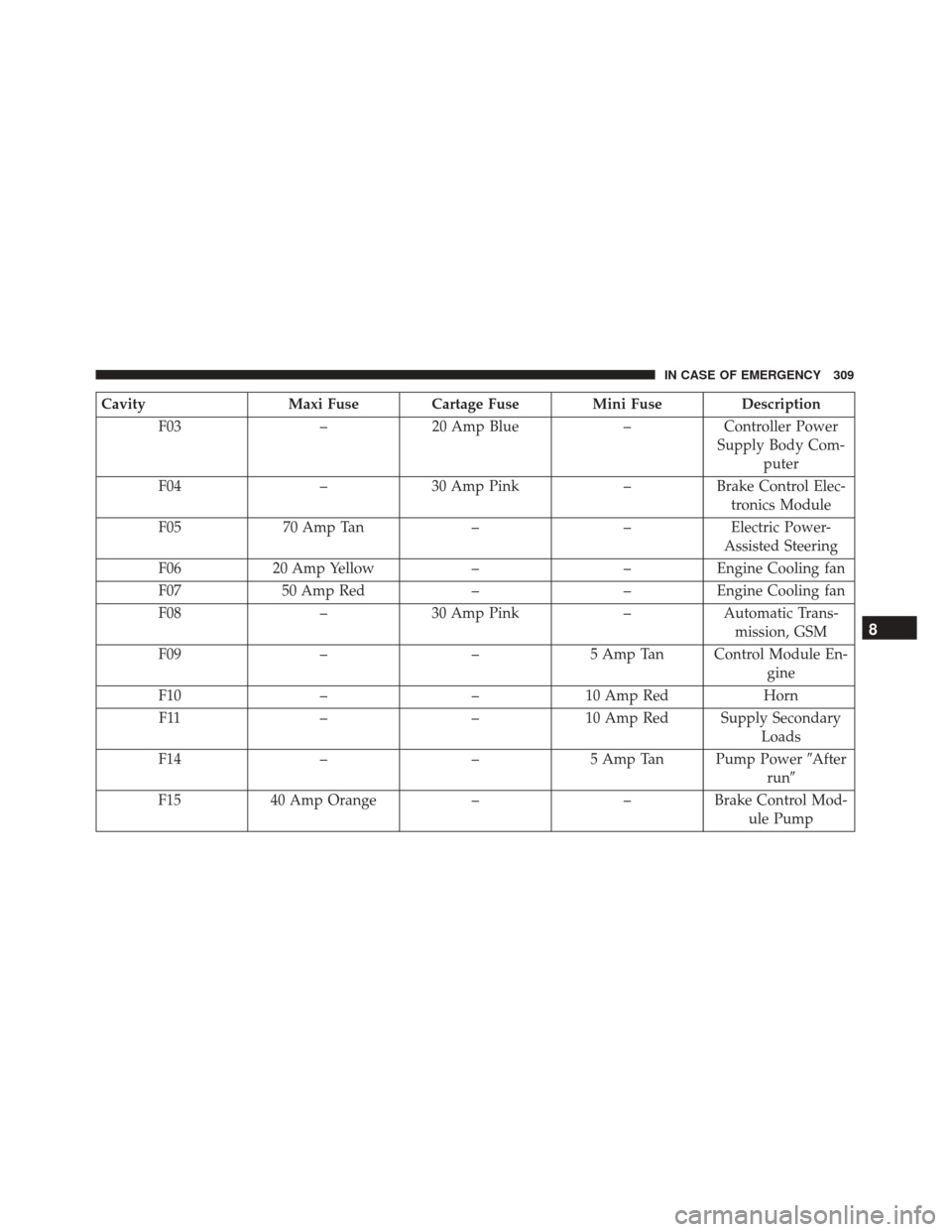
CavityMaxi Fuse Cartage Fuse Mini Fuse Description
F03 –20 Amp Blue –Controller Power
Supply Body Com- puter
F04 –30 Amp Pink –Brake Control Elec-
tronics Module
F05 70 Amp Tan ––Electric Power-
Assisted Steering
F06 20 Amp Yellow ––Engine Cooling fan
F07 50 Amp Red ––Engine Cooling fan
F08 –30 Amp Pink –Automatic Trans-
mission, GSM
F09 ––5 Amp Tan Control Module En-
gine
F10 ––10 Amp Red Horn
F11 ––10 Amp Red Supply Secondary
Loads
F14 ––5 Amp Tan Pump Power �After
run �
F15 40 Amp Orange ––Brake Control Mod-
ule Pump
8
IN CASE OF EMERGENCY 309
Page 330 of 476
WARNING!
•Take care to avoid the radiator cooling fan when-
ever the hood is raised. It can start anytime the
ignition switch is ON. You can be injured by
moving fan blades.
• Remove any metal jewelry such as rings, watch
bands and bracelets that could make an inadver-
tent electrical contact. You could be seriously
injured.
• Batteries contain sulfuric acid that can burn your
skin or eyes and generate hydrogen gas which is
flammable and explosive. Keep open flames or
sparks away from the battery.
Proceed as follows:
1. Set the Electric Park Brake, shift the automatic trans- mission into PARK (manual transmission in NEU-
TRAL) and place the ignition OFF.
2. Turn off the heater, radio, and all unnecessary elec- trical accessories. 3. If using another vehicle to jump start the battery,
park the vehicle within the jumper cables reach, set
the parking brake and make sure the ignition is OFF.
WARNING!
Do not allow vehicles to touch each other as this
could establish a ground connection and personal
injury could result.
Jump Starting Procedure
WARNING!
Failure to follow this jump-starting procedure
could result in personal injury or property damage
due to battery explosion.
CAUTION!
Failure to follow these procedures could result in
damage to the charging system of the booster ve-
hicle or the discharged vehicle.
328 IN CASE OF EMERGENCY
Page 332 of 476
CAUTION!
Accessories plugged into the vehicle power outlets
draw power from the vehicle’s battery, even when
not in use (i.e., cellular devices, etc.). Eventually, if
plugged in long enough without engine operation,
the vehicle’s battery will discharge sufficiently to
degrade battery life and/or prevent the engine from
starting.
REFUELING IN EMERGENCY
The fuel filling procedure in case of emergency is
described in the “Emergency Refueling Procedure”.
Refer to “Adding Fuel” in “Starting And Operating” for
further information.
IF YOUR ENGINE OVERHEATS
In any of the following situations, you can reduce the
potential for overheating your engine by taking the
appropriate action.
•On the highways — slow down.
• In city traffic — while stopped, put transmission in
NEUTRAL, but do not increase engine idle speed.
CAUTION!
Driving with a hot cooling system could damage
your vehicle. If the temperature gauge reads “H,”
pull over and stop the vehicle. Idle the vehicle with
the air conditioner turned off until the pointer
drops back into the normal range. If the pointer
remains on the “H” and you hear continuous
chimes, turn the engine off immediately and call for
service.
NOTE: There are steps that you can take to slow down
an impending overheat condition:
• If your air conditioner (A/C) is on, turn it off. The
A/C system adds heat to the engine cooling system
and turning the A/C off can help remove this heat.
• You can also turn the temperature control to maxi-
mum heat, the mode control to floor and the blower
control to high. This allows the heater core to act as a
supplement to the radiator and aids in removing heat
from the engine cooling system.
330 IN CASE OF EMERGENCY
Page 333 of 476
WARNING!
You or others can be badly burned by hot engine
coolant (antifreeze) or steam from your radiator. If
you see or hear steam coming from under the hood,
do not open the hood until the radiator has had time
to cool. Never try to open a cooling system pressure
cap when the radiator or coolant bottle is hot.
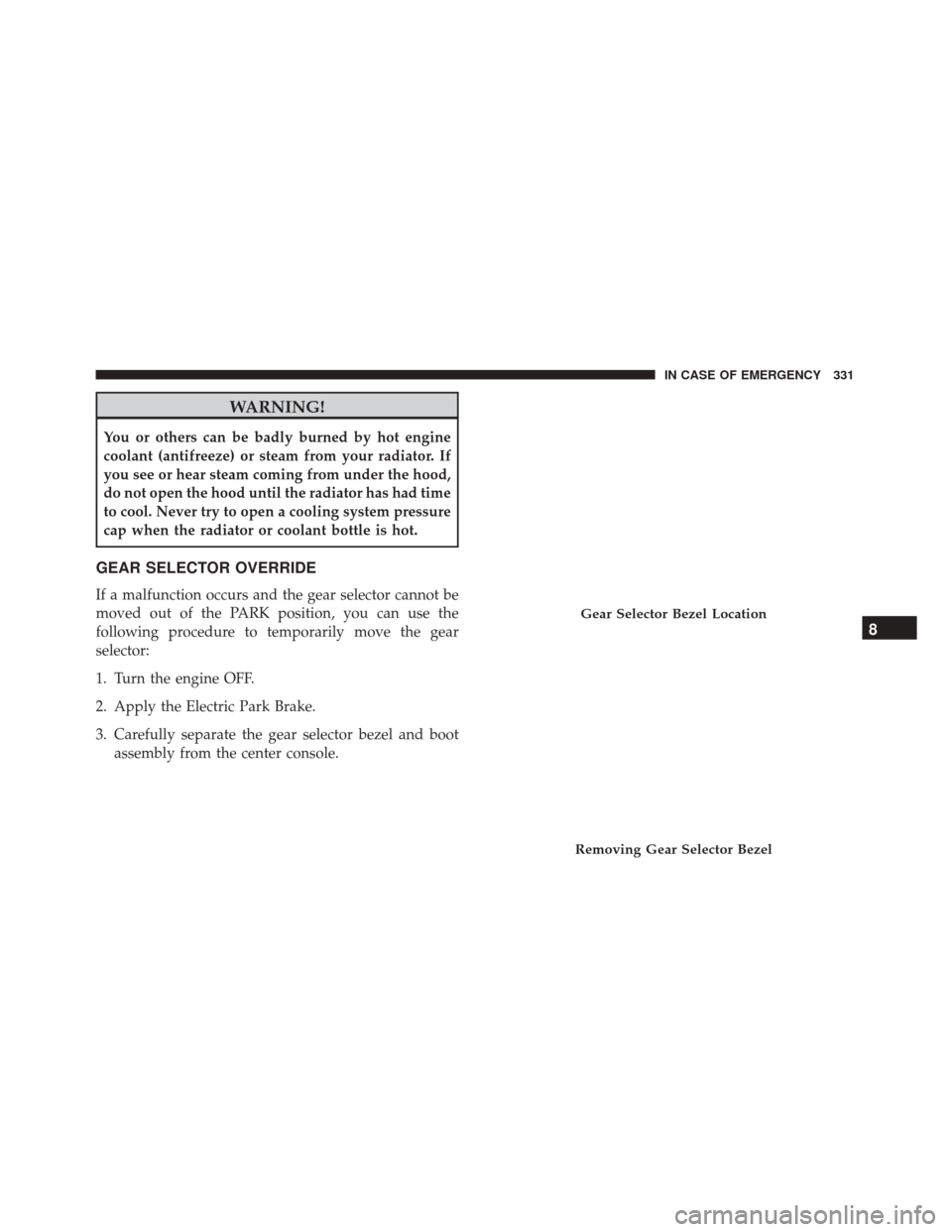
GEAR SELECTOR OVERRIDE
If a malfunction occurs and the gear selector cannot be
moved out of the PARK position, you can use the
following procedure to temporarily move the gear
selector:
1. Turn the engine OFF.
2. Apply the Electric Park Brake.
3. Carefully separate the gear selector bezel and bootassembly from the center console.
Gear Selector Bezel Location
Removing Gear Selector Bezel
8
IN CASE OF EMERGENCY 331
Page 343 of 476
MAINTAINING AND CARING FOR YOUR VEHICLE
CONTENTS
�EMISSIONS INSPECTION AND MAINTENANCE
PROGRAMS ........................ .343
� REPLACEMENT PARTS .................344
� DEALER SERVICE ....................344
� MAINTENANCE SCHEDULE .............344
▫ Maintenance Chart ...................346
� ENGINE COMPARTMENT — 1.4L TURBO
ENGINE ........................... .353
� ENGINE COMPARTMENT — 2.4L ENGINE . . .354
� MAINTENANCE PROCEDURES ..........354
▫ Engine Oil ........................ .355
▫ Engine Oil Filter .....................357
▫ Engine Air Cleaner Filter ...............357
▫ Maintenance-Free Battery ..............358
▫ Air Conditioner Maintenance ............358▫
Body Lubrication ....................360
▫ Wiper Blades ...................... .360
▫ Adding Washer Fluid .................362
▫ Exhaust System .....................362
▫ Cooling System .....................364
▫ Brake System ...................... .368
▫ Manual Transmission — If Equipped ......370
▫ Automatic Transmission — If Equipped . . . .371
▫ Appearance Care And Protection From
Corrosion ......................... .372
� RAISING THE VEHICLE ................379
� TIRE SAFETY INFORMATION ............380
▫ Tire Markings ...................... .380
▫ Tire Identification Number (TIN) ..........383
9
Page 348 of 476
Once A Month Or Before A Long Trip:
•Check engine oil level.
• Check windshield washer fluid level.
• Check the tire inflation pressures and look for un-
usual wear or damage.
• Check the fluid levels of the coolant reservoir, and
brake master cylinder reservoir, and fill as needed.
• Check function of all interior and exterior lights.Maintenance Chart
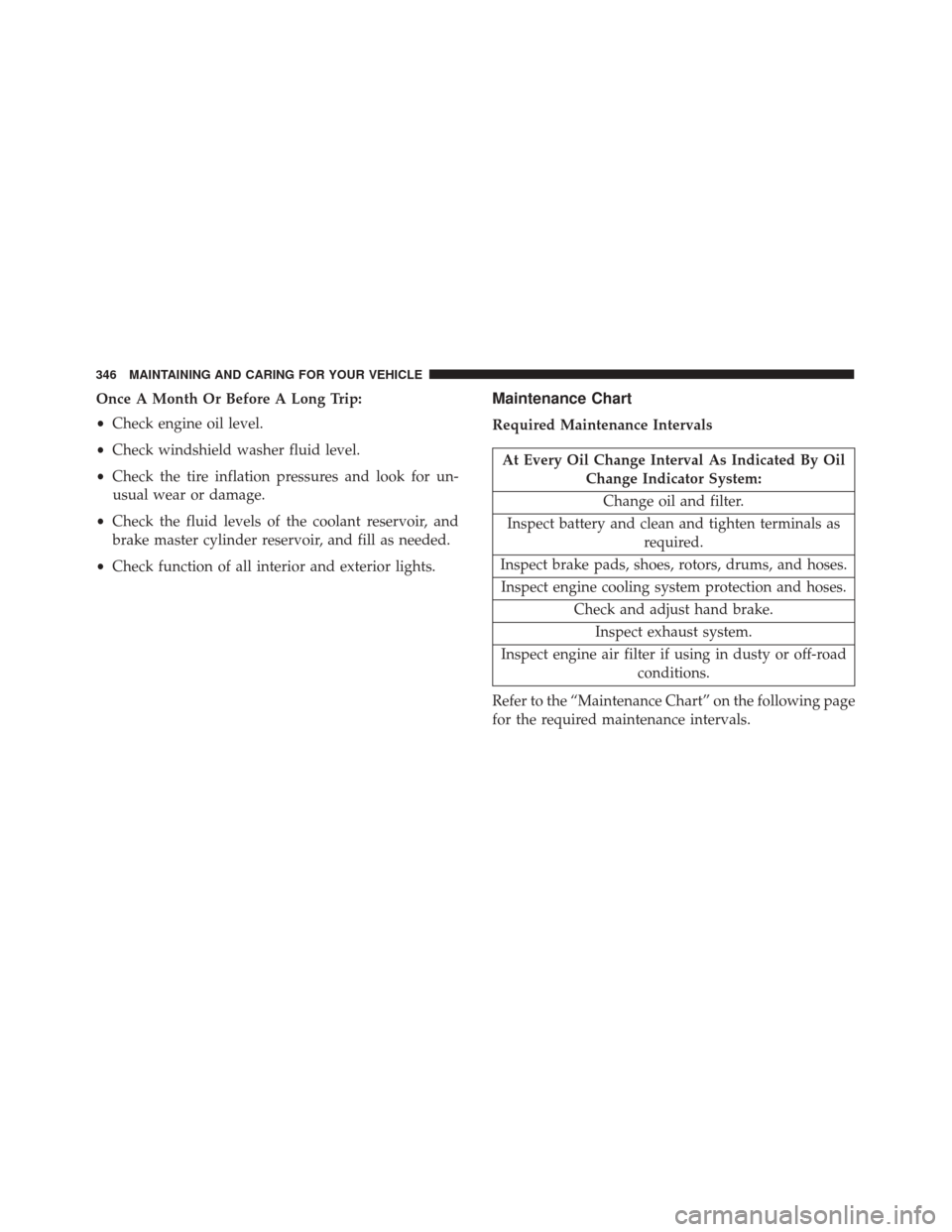
Required Maintenance Intervals
At Every Oil Change Interval As Indicated By Oil
Change Indicator System:
Change oil and filter.
Inspect battery and clean and tighten terminals as required.
Inspect brake pads, shoes, rotors, drums, and hoses. Inspect engine cooling system protection and hoses. Check and adjust hand brake.Inspect exhaust system.
Inspect engine air filter if using in dusty or off-road conditions.
Refer to the “Maintenance Chart” on the following page
for the required maintenance intervals.
346 MAINTAINING AND CARING FOR YOUR VEHICLE