Page 398 of 635

WARNING!(Continued)
•If the vehicle has a discharged battery, booster
cables may be used to obtain a start from a booster
battery or the battery in another vehicle. This type
of start can be dangerous if done improperly. Refer
to “Jump Starting” in “What To Do In Emergen-
cies” for further information.
Clearing A Flooded Engine (Using ENGINE
START/STOP Button)
If the engine fails to start after you have followed the
“Normal Starting” or “Extreme Cold Weather� proce-
dures, it may be flooded. To clear any excess fuel:
1. Press and hold the brake pedal.
2. Press the accelerator pedal all the way to the floor and hold it. 3. Press and release the ENGINE START/STOP button
once.
The starter motor will engage automatically, run for 10
seconds, and then disengage. Once this occurs, release
the accelerator pedal and the brake pedal, wait 10 to 15
seconds, then repeat the “Normal Starting” procedure.
After Starting
The idle speed is controlled automatically and it will
decrease as the engine warms up.
ENGINE BLOCK HEATER — IF EQUIPPED
The engine block heater warms the engine, and permits
quicker starts in cold weather. Connect the cord to a
standard 110-115 Volt AC electrical outlet with a
grounded, three-wire extension cord.
The engine block heater must be plugged in at least one
hour to have an adequate warming effect on the engine.
396 STARTING AND OPERATING
Page 399 of 635
The engine block heater cord is routed under the hood on
the driver side of the vehicle. It has a removable cap that
is located on the driver side of the Integrated Power
Module.
WARNING!
Remember to disconnect the engine block heater
cord before driving. Damage to the 110-115 Volt
electrical cord could cause electrocution.
AUTOMATIC TRANSMISSION
WARNING!
•Unintended movement of a vehicle could injure
those in or near the vehicle. As with all vehicles,
you should never exit a vehicle while the engine is
running. Before exiting a vehicle, always apply the
parking brake, shift the transmission into PARK,
turn the engine OFF, and remove the Key Fob.
When the ignition is in the OFF position, the
transmission is locked in PARK, securing the ve-
hicle against unwanted movement.
(Continued)
5
STARTING AND OPERATING 397
Page 486 of 635

Starting
The characteristics of E-85 fuel make it unsuitable for use
when ambient temperatures fall below 0°F (-18°C). In the
range of 0°F (-18°C) to 32°F (0°C), you may experience an
increase in the time it takes for your engine to start, and
a deterioration in driveability (sags and/or hesitations)
until the engine is fully warmed up.
NOTE:Use of the engine block heater (if equipped) is
beneficial for E-85 startability when the ambient tempera-
ture is less than 32°F (0°C).
Cruising Range
Because E-85 fuel contains less energy per gallon/liter
than gasoline, you will experience an increase in fuel
consumption. You can expect your miles per gallon
(mpg)/miles per liter and your driving range to decrease
by about 30%, compared to gasoline operation.
Replacement Parts
Many components in your Flexible Fuel Vehicle (FFV) are
designed to be compatible with ethanol. Always be sure
that your vehicle is serviced with correct ethanol com-
patible parts.
CAUTION!
Replacing fuel system components with non-ethanol
compatible components can damage your vehicle.
Maintenance
CAUTION!
Do not use ethanol mixture greater than 85% in your
vehicle. It will cause difficulty in cold starting and
may affect drivability.
484 STARTING AND OPERATING
Page 508 of 635

•You can also turn the temperature control to maximum
heat, the mode control to floor and the blower control
to high. This allows the heater core to act as a
supplement to the radiator and aids in removing heat
from the engine cooling system.
CAUTION!
Driving with a hot cooling system could damage
your vehicle. If the temperature gauge reads “H,”
pull over and stop the vehicle. Idle the vehicle with
the air conditioner turned off until the pointer drops
back into the normal range. If the pointer remains on
the “H,” turn the engine off immediately and call for
service.
WARNING!
You or others can be badly burned by hot engine
coolant (antifreeze) or steam from your radiator. If
you see or hear steam coming from under the hood,
do not open the hood until the radiator has had time
to cool. Never try to open a cooling system pressure
cap when the radiator or coolant bottle is hot.
WHEEL AND TIRE TORQUE SPECIFICATIONS
Proper lug nut/bolt torque is very important to ensure
that the wheel is properly mounted to the vehicle. Any
time a wheel has been removed and reinstalled on the
vehicle the lug nuts/bolts should be torqued using a
properly calibrated torque wrench.
506 WHAT TO DO IN EMERGENCIES
Page 521 of 635

WARNING!
•Take care to avoid the radiator cooling fan when-
ever the hood is raised. It can start anytime the
ignition switch is ON. You can be injured by
moving fan blades.
• Remove any metal jewelry such as watch bands or
bracelets that might make an inadvertent electrical
contact. You could be seriously injured.
• Batteries contain sulfuric acid that can burn your
skin or eyes and generate hydrogen gas which is
flammable and explosive. Keep open flames or
sparks away from the battery.
1. Set the parking brake, shift the automatic transmission into PARK and turn the ignition to LOCK.
2. Turn off the heater, radio, and all unnecessary electri- cal accessories. 3. If using another vehicle to jump-start the battery, park
the vehicle within the jumper cables reach, set the
parking brake and make sure the ignition is OFF.
WARNING!
Do not allow vehicles to touch each other as this
could establish a ground connection and personal
injury could result.
Jump-Starting Procedure
WARNING!
Failure to follow this jump-starting procedure could
result in personal injury or property damage due to
battery explosion.
6
WHAT TO DO IN EMERGENCIES 519
Page 590 of 635
FLUID CAPACITIES
U.S.Metric
Fuel (Approximate)
All Engines 19 Gallons 72 Liters
Engine Oil With Filter
3.6 Liter Engine (SAE 5W-20, API Certified) 6 Quarts 5.6 Liters
5.7 Liter Engine (SAE 5W-20, API Certified) 7 Quarts 6.6 Liters
Cooling System *
3.6 Liter Engine – We recommend you use MOPAR® Antifreeze/Engine
Coolant 10 Year/150,000 Mile Formula or equivalent. 10 Quarts 9.5 Liters
5.7 Liter Engine without Severe Duty II Cooling System – We recommend
you use MOPAR® Antifreeze/Engine Coolant 10 Year/150,000 Mile For-
mula. 14.5 Quarts 13.9 Liters
5.7 Liter Engine with Severe Duty II Cooling System – We recommend you
use MOPAR® Antifreeze/Engine Coolant 10 Year/150,000 Mile Formula. 15 Quarts 14.3 Liters
* Includes heater and coolant recovery bottle filled to MAX level.
588 MAINTAINING YOUR VEHICLE
Page 617 of 635

Electronic Vehicle Information Center (EVIC) . . . .324
Electronic Vehicle Information Center (EVIC) Setup
Menu............................... .324
EVIC Display ......................... .326
EVIC Messages ........................ .324
Remote Start ...........................29
Emergency Deck Lid Release ..................44
Emergency, In Case of Freeing Vehicle When Stuck ................521
Hazard Warning Flasher ..................505
Jacking .............................. .508
Jump Starting ......................... .517
Overheating .......................... .505
Towing ............................. .527
Emergency Trunk Release ....................44
Emission Control System Maintenance ..........535
Engine ................................ .534
Air Cleaner .......................... .543
Block Heater ......................... .396Break-In Recommendations
.................95
Checking Oil Level ..................... .538
Compartment ......................... .533
Compartment Identification ................533
Coolant (Antifreeze) .....................552
Cooling ............................. .552
Exhaust Gas Caution .....................96
Fails to Start .......................... .395
Flooded, Starting ...................... .395
Fuel Requirements ..................... .477
Jump Starting ......................... .517
Oil................................. .538
Oil Change Interval ..................... .334
Oil Filler Cap ......................... .541
Oil Selection .......................... .540
Oil Synthetic ......................... .542
Overheating .......................... .505
Starting ............................. .392
Temperature Gauge ..................... .323
10
INDEX 615
Page 620 of 635
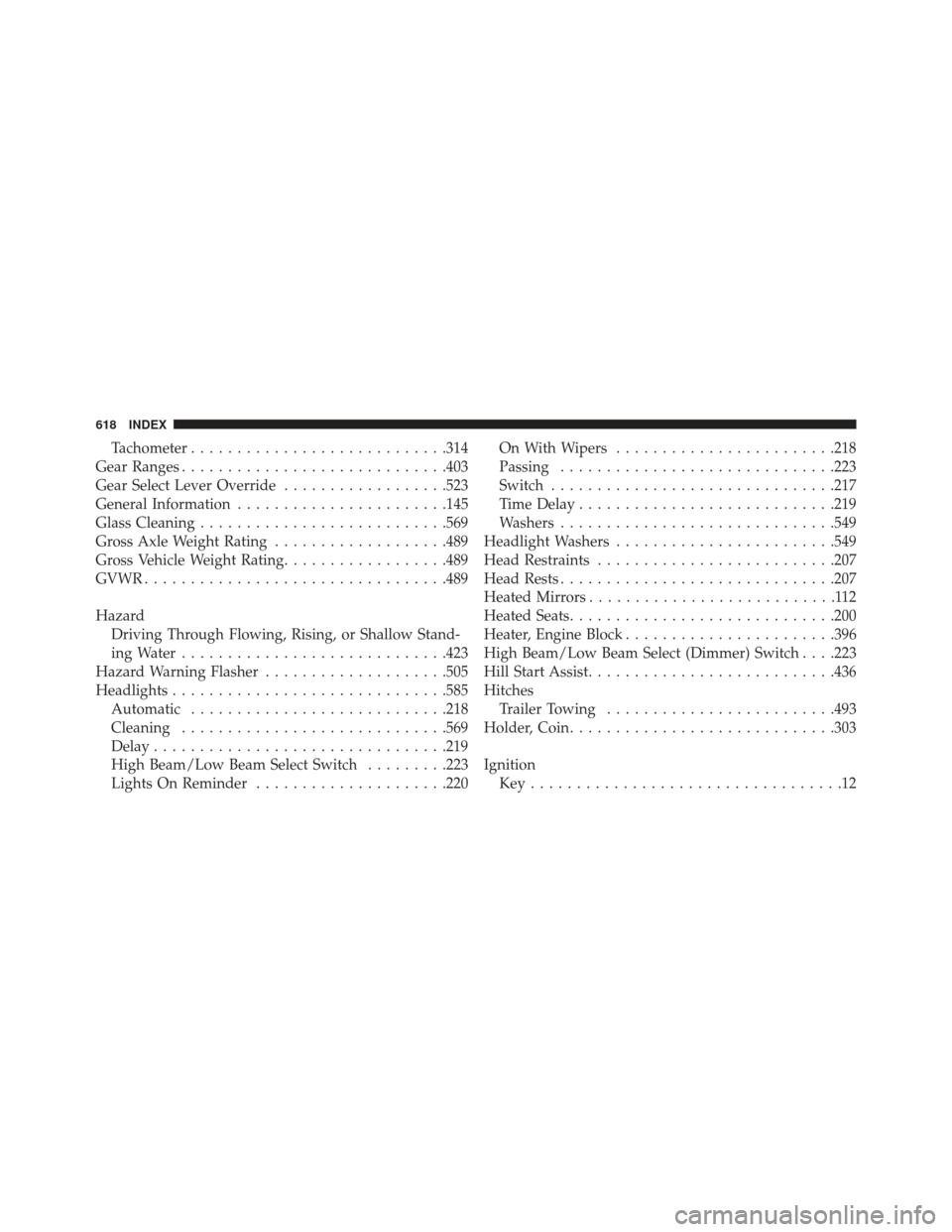
Tachometer........................... .314
Gear Ranges ............................ .403
Gear Select Lever Override ..................523
General Information ...................... .145
Glass Cleaning .......................... .569
Gross Axle Weight Rating ...................489
Gross Vehicle Weight Rating ..................489
GVWR ................................ .489
Hazard Driving Through Flowing, Rising, or Shallow Stand-
ing Water ............................ .423
Hazard Warning Flasher ....................505
Headlights ............................. .585
Automatic ........................... .218
Cleaning ............................ .569
Delay ............................... .219
High Beam/Low Beam Select Switch .........223
Lights On Reminder .....................220 On With Wipers
....................... .218
Passing ............................. .223
Switch .............................. .217
Time Delay ........................... .219
Washers ............................. .549
Headlight Washers ....................... .549
Head Restraints ......................... .207
Head Rests ............................. .207
Heated Mirrors ...........................112
Heated Seats ............................ .200
Heater, Engine Block ...................... .396
High Beam/Low Beam Select (Dimmer) Switch . . . .223
Hill Start Assist .......................... .436
Hitches Trailer Towing ........................ .493
Holder, Coin ............................ .303
Ignition Key..................................12
618 INDEX

