2014 Citroen C3 PICASSO belt
[x] Cancel search: beltPage 103 of 292

101
C3Picasso_en_Chap07_securite-enfants_ed01-2014
Installing child seats attached using the seat beltIn accordance with European regulations, this table indicates the options for installing child seats secured using a seat belt and universally approved (a)
in accordance with the weight of the child and the seat in the vehicle.
a Universal child seat: child seat that can be installed in all vehicles using a seat belt.
b
G
roup 0: from birth to 10 kg. Shells seats and baby carriers cannot be installed in the front
passenger seat. When installed in the 2nd row, they may prevent use of the other seats.
c Consult the legislation in force in your country before installing your child on this seat.
U:
S
eat suitable for the installation of a child seat secured using a seat belt and universally
approved, "rear ward facing" and/or "for ward facing".
X:
S
eat position not suitable for installation of a child seat for the weight class indicated.
CITROËN recommends that children travel in the rear seats, with the rear seats in the fully back
position. Weight of the child and indicative age
Seat Under 13 kg
(groups 0 (b) a n d 0 +)
Up to approx 1 year From 9 to 18 kg
(g r o u p 1)
1 to 3 years approx From 15 to 25 kg
(group 2)
3 to 6 years approx From 22 to 36 kg
(group 3)
6 to 10 years approx
Front passenger seat (c) UUUU
ou
ter rear seats UUUU
Centre rear seat XXXX
Remove and stow the head restraint
before installing a child seat with a
backrest on a passenger seat. Refit the
head restraint once the child seat has
been removed.
7
Child safety
Page 104 of 292

102
C3Picasso_en_Chap07_securite-enfants_ed01-2014
"ISoFIX" mountings
- 2 rings A, located between the backrest
and the seat cushion, identified by a label, -
a r
ing B
, located in the roof, with the TOP
TETHER logo, for fixing the top tether belt.
The TOP TETHER is used to secure the
upper strap of child seats that have one. This
arrangement limits the for ward tipping of the
child seat in the event of a front impact. To secure the child seat to the TOP TETHER
:
-
r
aise the head restraint,
-
p
ass the child seat upper strap between
the rods of the head restraint,
-
f
ix the hook on the upper strap to the
ring B
,
-
t
ighten the upper strap.
Your vehicle is approved to the latest
ISOFIX
regulations .
The seats represented below, are fitted with
regulation IS
oF
IX mountings:
If a child is not installed in a vehicle
correctly, the child's protection in the
event of an accident will be compromised.
There are 3 rings for each seat: Follow strictly the advice given in the
installation instructions provided with
the child seat.
This IS
oF
IX mounting system provides reliable,
safe and fast fitting of the child seat in your
vehicle.
ISOFIX child seats are fitted with two latches
which are secured easily on these rings A .
Some also have a top tether belt which can be
attached to ring B . Refer to the table for the possibilities for fitting
IS
oF
IX child seats in your vehicle.
The rear seats must be in the fully back
position to install IS
oF
IX seats.
Child safety
Page 105 of 292

103
C3Picasso_en_Chap07_securite-enfants_ed01-2014
ISoFIX child seat recommended by CITRoËn and approved for
your vehicle
RÖMER Duo Plus ISOFIX
(size category B1 )
Group 1: from 9 to 18 kg
Installed only in the for wards-facing position.
Fitted with an upper strap to be secured on the upper ring B , referred to as the T
oP T
ETHER.
Three seat body angles: sitting, reclining, lying.
a
d
just the front seat of the vehicle so that the child's feet do not touch the back of the seat. Can be installed for wards-facing by attaching it to the seat using a three-point seat belt.
This child seat can also be used on seats which are not fitted with ISOFIX mountings. In this case, it must be attached to the vehicle seat using
the three point seat belt.
Follow the instructions for fitting the child seat given in the seat manufacturer's installation guide.
7
Child safety
Page 106 of 292

104
C3Picasso_en_Chap07_securite-enfants_ed01-2014
Table of seating positions for ISoFIX child seatsIn accordance with European Regulations, this table indicates the options for installing ISOFIX child seats on seats in the vehicle fitted with ISOFIX
mountings.
In the case of universal and semi-universal IS
oF
IX child seats, the IS
oF
IX size category, determined by a letter from A to G, is indicated on the child
seat next to the ISOFIX logo.
I UF: seat suitable for the installation of an I sofix Universal seat, " For wards-facing" secured using
the top belt.
IL- SU: seat suitable for the installation of an I sofix Semi-Universal seat either:
-
"
rear wards-facing" fitted with a top belt or a stay,
-
"
for wards-facing" fitted with a stay,
-
a s
hell seat fitted with an upper strap or a stay.
For advice on securing the top tether belt, refer to the " I
SoFI
X
m
ountings" section.
*
The ISOFIX infant car seat (shell seat), secured on the lower rings of a vehicle ISOFIX seat, occupies two rear seats.
Weight of the child / indicative age
Less than 10 kg (group 0)
Up to approx. 6
months Less than 10 kg
(group 0)
Less than 13 kg (group 0+)
Up to approx. 1 year From 9 to 18 kg (group 1)
From approx. 1 to 3 years
Type of ISOFIX child seat Shell"rearwards-facing"
"rearwards-facing""forwards-facing"
ISOFIX size categor y F G C D E C D A B B1
ISOFIX universal and semi-universal child
seats which can be installed on the outer
rear seats IL- SU
* IL- SU IL- SU IUF
IL- SU
Remove and stow the head restraint
before installing a child seat with a
backrest on a passenger seat. Refit the
head restraint once the child seat has
been removed.
Child safety
Page 107 of 292

105
C3Picasso_en_Chap07_securite-enfants_ed01-2014
The incorrect installation of a child seat in a
vehicle compromises the child's protection in
the event of an accident.
Ensure that there is no seat belt or seat belt
buckle under the child seat, as this could
destabilise it.
Remember to fasten the seat belts or the
child seat harnesses keeping the slack
relative to the child's body to a minimum,
even for short journeys.
When installing a child seat using the seat
belt, ensure that the seat belt is tightened
correctly on the child seat and that it secures
the child seat firmly on the seat of your
vehicle. If your passenger seat is adjustable,
move it for wards if necessary.
At rear seating positions, always leave
sufficient space between the front seat and:
-
a "
rear ward facing" child seat,
-
t
he child's feet for a child seat fitted
"forward facing".
To do this, move the front seat for wards
and, if necessary, move its backrest into the
upright position. For optimum installation of the "for ward-
facing" child seat, ensure that the back of
the child seat is as close as possible to the
backrest of the vehicle's seat , in contact if
possible.
You mst remove the head restraint before
installing a child seat with backrest to a
passenger seat.
Ensure that the head restraint is stored or
attached securely to prevent it from being
thrown around the vehicle in the event of
sharp braking. Refit the head restraint when
the child seat is removed.Installing a booster seat
The legislation on carrying children on the front
passenger seat is specific to each country. Refer
to the legislation in force in your country.
Deactivate the passenger airbag when a
"rear ward-facing" child seat is installed on the
front seat.
Otherwise, the child would risk being seriously
injured or killed if the airbag were to inflate.
The chest part of the seat belt must be
positioned on the child's shoulder without
touching the neck.
Ensure that the lap part of the seat belt
passes correctly over the child's thighs.
CITR
oËn
recommends the use of a booster
seat which has a back, fitted with a seat belt
guide at shoulder level.
advice on child seats
Children at the front
as a safety precaution, do not leave:
- a c hild or children alone and
unsupervised in a vehicle,
-
a c
hild or an animal in a vehicle which
is exposed to the sun, with the windows
closed,
-
t
he keys within reach of children inside
the vehicle.
To prevent accidental opening of the doors
and rear windows, use the "Child lock".
Take care not to open the rear windows by
more than one third.
To protect young children from the rays of
the sun, fit side blinds on the rear windows.
7
Child safety
Page 117 of 292

115
C3Picasso_en_Chap08_securite_ed01-2014
Seat belt not fastened /
unfastened warning lamp
Fastening
F Pull the strap, then insert the tongue in the
buckle.
F
C
heck that the seat belt is fastened
correctly by pulling the strap.
Height adjustment
F To lower the attachment point, squeeze the control A and slide it downwards.
F
T
o raise the attachment point, slide the
control A upwards.
When the ignition is switched on, this warning
lamp comes on, either on the instrument panel
or on the seat belt and passenger's front airbag
warning lamp display, if the driver and/or the
front passenger has not fastened their seat belt.
Unfastening
F Press the red button on the buckle.
F G uide the seat belt as it rolls up.
Seat belts
Front seat belts
The front seat belts are fitted with a
pretensioning and force limiting system.
This system improves safety in the front
seats in the event of a front or side impact.
dep
ending on the severity of the impact, the
pretensioning system instantly tightens the seat
belts against the body of the occupants.
The pretensioning seat belts are active when
the ignition is on.
The force limiter reduces the pressure of the
seat belt on the chest of the occupant, so
improving their protection.
From approximately 12 mph (20 km/h) this warning lamp flashes
for two minutes accompanied by an audible signal. Once these
two minutes have elapsed, this warning lamp remains on until
the driver and/or the front passenger fastens their seat belt.
8
Safety
Page 118 of 292

116
C3Picasso_en_Chap08_securite_ed01-2014
Seat belt not fastened /
unfastened warning lamp display
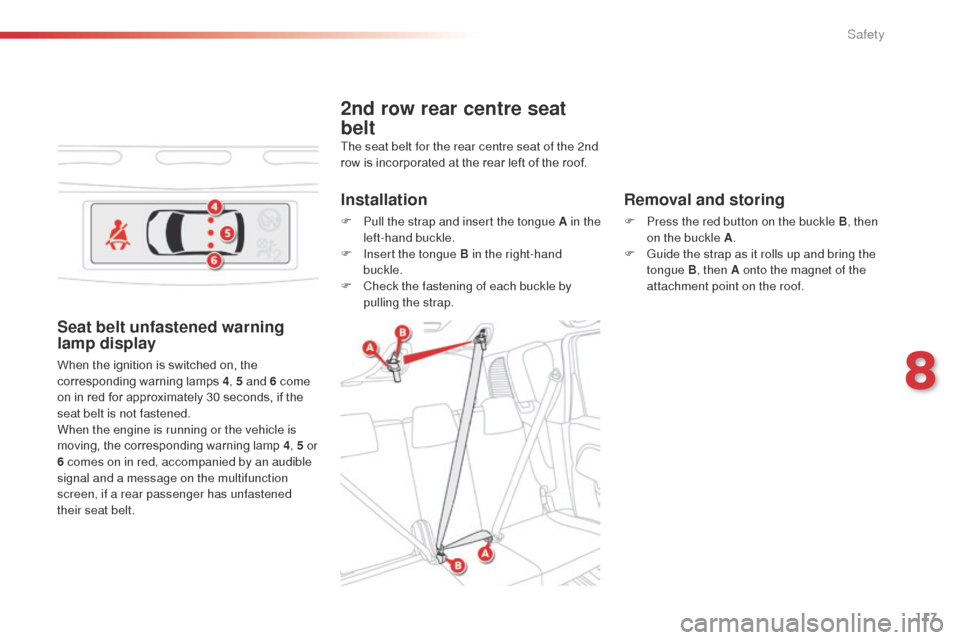
1. Front and/or rear seat belts not fastened / unfastened warning lamp.
2.
F
ront left seat belt warning lamp.
3.
F
ront right seat belt warning lamp.
4.
R
ear right seat belt warning lamp.
5.
R
ear centre seat belt warning lamp.
6.
R
ear left seat belt warning lamp.
Rear seat belts
The rear seats are each fitted with a three-point
inertia reel seat belt with force limiter (with the
exception of the rear centre seat).
Locking
When the rear side side belts are not being
used, you can lock them in place. To do so:
F
Ra
ise the grip A to its maximum height.
Fastening
F Pull the strap, then insert the tongue in the buckle.
F
C
heck that the seat belt is fastened
correctly by pulling the strap.
Unfastening
F Press the red button on the buckle.
F G uide the seat belt as it rolls up.
The corresponding warning lamp 2 or 3 comes
on in red on the seat belt and passenger's front
airbag warning lamp display if the seat belt is
not fastened or is unfastened.Seat belt unfastened warning
lamp
This warning lamp comes on, either on
the instrument panel or on the seat belt
and passenger's front airbag warning
lamp display, when one or more rear
passengers unfasten their seat belt.
From approximately 12 mph (20 km/h), this warning lamp
flashes for two minutes accompanied by an audible signal
of increasing volume. Once these two minutes have
elapsed, this warning lamp remains on until the one or
more rear passengers fasten their seat belt.
Safety
Page 119 of 292
117
C3Picasso_en_Chap08_securite_ed01-2014
2nd row rear centre seat
belt
Removal and storing
F Press the red button on the buckle B, then on the buckle A .
F
G
uide the strap as it rolls up and bring the
tongue B , then A
onto the magnet of the
attachment point on the roof.
Installation
F Pull the strap and insert the tongue A in the left-hand buckle.
F
I
nsert the tongue B in the right-hand
buckle.
F
C
heck the fastening of each buckle by
pulling the strap.
The seat belt for the rear centre seat of the 2nd
row is incorporated at the rear left of the roof.
Seat belt unfastened warning
lamp display
When the ignition is switched on, the
corresponding warning lamps
4, 5 and 6 come
on in red for approximately 30 seconds, if the
seat belt is not fastened.
When the engine is running or the vehicle is
moving, the corresponding warning lamp 4, 5 or
6 comes on in red, accompanied by an audible
signal and a message on the multifunction
screen, if a rear passenger has unfastened
their seat belt.
8
Safety