2014 Citroen C3 light
[x] Cancel search: lightPage 108 of 284

106
C3_en_Chap08_Securite_ed01-2014
airbags
Impact detection zones
A. Front impact zone.
B. Side impact zone.
Front airbags
Deployment
The airbags are deployed, except the
passenger's front airbag if it is deactivated, in the
event of a serious front impact applied to all or
part of the front impact zone A , in the longitudinal
centreline of the vehicle on a horizontal plane and
directed from the front to the rear of the vehicle.
The front airbag inflates between the head-thorax
of the front occupant of the vehicle and the
dashboard to cushion their for ward movement.
System designed to contribute towards
improving the safety of the occupants (with
the exception of the rear centre passenger)
in the event of violent collisions. The airbags
supplement the action of the force-limiting
seat belts (with the exception of the centre rear
passenger).
If a collision occurs, the electronic detectors
record and analyse the front and side impacts
sustained in the impact detection zones:
-
i
n the case of a serious impact, the airbags
are deployed instantly and contribute
towards better protection of the occupants
of the vehicle (with the exception of the
rear centre passenger); immediately after
the impact, the airbags deflate rapidly so
that they do not hinder visibility or the exit
of the occupants,
-
i
n the case of a minor or rear impact or in
certain roll-over conditions, the airbags
may not be deployed; the seat belt
alone contributes towards ensuring your
protection in these situations.
The airbags do not operate when the
ignition is switched off.
de
ployment of one or more of the
airbags is accompanied by a slight
emission of smoke and a noise, due
to the activation of the pyrotechnic
cartridge incorporated in the system.
This smoke is not harmful, but sensitive
individuals may experience slight
irritation.
The noise of detonation related to the
deployment of one or more airbags may
result in a slight loss of hearing for a
short time. System which protects the driver and front
passenger in the event of a serious front impact
in order to limit the risk of injury to the head and
chest.
The driver's airbag is fitted in the centre of the
steering wheel; the front passenger's airbag is
fitted in the dashboard above the glove box.
This equipment will only deploy once.
If a second impact occurs (during the
same or a subsequent accident), the
airbag will not be deployed again.
Safety
Page 120 of 284

118
C3_en_Chap09_Conduite_ed01-2014
C3_en_Chap09_Conduite_ed01-2014
Stopping the vehicleOperating fault
When the ignition is on, the lighting
of this warning lamp, accompanied
by an audible signal and a message in the
multifunction screen, indicates a gearbox fault.
In this case, the gearbox switches to back-up
mode and is locked in 3rd gear. You may feel
a substantial knock when changing from P
to R and from N to R . This will not cause any
damage to the gearbox.
do n
ot exceed 60 mph (100 km/h), local speed
restrictions permitting.
Contact a CITR
oËn
dealer or a qualified
workshop as soon as possible. To reduce fuel consumption when at
a prolonged standstill with the engine
running (traffic jam...), put the gear lever
in the N position and apply the parking
brake.There is a risk of damage to the
gearbox:
-
i
f you press the accelerator and
brake pedals at the same time,
-
i
f you force the movement of the gear
lever from the P position to another
position when the battery is flat.
If the lever is not in position P
, when the
driver's door is opened or approximately
45 seconds after the ignition is switched
off, a warning message appears in the
screen.
F
R
eturn the lever to position P ; the
message disappears.
If the ambient temperature is below
-23°C, the engine should be left running
at idle for four minutes, in order to
ensure the correct operation and
durability of the engine and gearbox.
When traversing a flooded road or a
ford, drive at walking pace.
Before switching off the engine, you can engage
position
P or N to place the gearbox in neutral.
In both cases, apply the parking brake to
immobilise the vehicle.
driving
Page 122 of 284

120
C3_en_Chap09_Conduite_ed01-2014
C3_en_Chap09_Conduite_ed01-2014
The Stop & Start system puts the engine temporarily into standby - SToP mode - during stops in the traffic (red lights, traffic jams, or other...). The
engine restarts automatically - START mode - as soon as you want to move off. The restart takes place instantly, quickly and silently.
Per fect for urban use, the Stop & Start system reduces fuel consumption and exhaust emissions as well as the noise level
when stationary.
Operation
- with a manual gearbox , at speeds below
12 mph (20 km/h), when you put the gear
lever into neutral, and you release the
clutch pedal.
-
w
ith a 5 or 6-speed electronic gearbox ,
when stationary or at speeds below 5 mph
(8 km/h) (depending on version), when you
press the brake pedal or put the gear lever
in position N .
Going into engine STOP
mode
The "ECO" warning lamp comes
on in the instrument panel and the
engine goes into standby:
a
time counter calculates the sum
of the periods in ST
oP m
ode
during a journey. It rests itself
to zero every time the ignition is
switched on with the key.
Special cases: STOP mode not
available
STOP mode is not invoked when:
- t he driver's door is open,
-
t
he driver's seat belt is not fastened,
-
t
he vehicle has not exceeded 6 mph
(10 km/h) since the last engine start using
t h e key,
-
t
he engine is needed to maintain a
comfortable temperature in the passenger
compartment,
-
d
emisting is active,
-
s
ome special conditions (battery charge,
engine temperature, braking assistance,
ambient temperature...) where the engine is
needed to assure control of a system.
The "ECO" warning lamp flashes for
a few seconds then goes off.
This operation is perfectly normal.
Stop & Start
Never refuel with the engine in STOP
mode; you must switch off the ignition
with the key. For your comfort, during parking
manoeuvres, ST
oP m
ode is not
available for a few seconds after
coming out of reverse gear.
ST
oP m
ode does not affect the
functionality of the vehicle, such as for
example, braking, power steering...
driving
Page 142 of 284

140
Manual gearbox
The gearbox does not require any
maintenance (no oil change).
Refer to the maintenance and
warranty guide for the checking
interval for this component.
Automatic
gearbox
The gearbox does not require any
maintenance (no oil change).
Refer to the maintenance and
warranty guide for details of the level
checking interval for this component.
Parking brake
If excessive travel or a loss of
effectiveness of this system is
noticed, the parking brake must be
checked, even between two services.
Electronic gearbox
The gearbox does not require any
maintenance (no oil change).
Refer to the maintenance and
warranty guide for details of the
checking interval for this component.
Brake pads
Brake disc wear
Brake wear depends on the style
of driving, particularly in the case
of vehicles used in town, over short
distances. It may be necessary to have
the condition of the brakes checked,
even between vehicle services.
For information on checking brake
disc wear, contact a CITROËN dealer
or a qualified workshop.
on
ly use products recommended by
CITRoËn or products of equivalent
quality and specification.
In order to optimise the operation of
units as important as those in the
braking system, CITR
oËn
selects and
offers very specific products.
Unless there is a leak in the circuit, a drop in
the brake fluid level indicates that the brake
pads are worn.
Checking this system must be done by a
CITROËN dealer or a qualified workshop. After washing the vehicle, dampness,
or in wintry conditions, ice can form
on the brake discs and pads: braking
efficiency may be reduced. Make light
brake applications to dry and defrost
the brakes.
Checks
Page 150 of 284

148
C3_en_Chap11_Info-pratiques_ed01-2014
Taking out the wheel
F Unscrew the yellow central bolt.
F R aise the spare wheel towards you from
the rear.
F
T
ake the wheel out of the boot.
Putting the wheel back in place
F Put the wheel back in its housing.
F U nscrew the yellow central bolt by a few
turns then put it in place in the centre of the
wheel.
F
T
ighten fully until the central bolt clicks to
retain the wheel correctly. F
P ut the box back in place in the centre of
the wheel and clip it.
F
P
ut the polystyrene storage box back in
place.
F
R
efit the boot floor carpet by lightly
folding it in two (refer to the section
"Fittings
- § Storage box").
On vehicles equipped with a "space-
saver" type spare wheel, the punctured
wheel cannot be stowed in place of the
"space-saver" wheel.
Practical information
Page 162 of 284

160
C3_en_Chap11_Info-pratiques_ed01-2014
Interior lighting
Interior lamp (1 / W5W)
S ide reading lamps (2 / W5W) Central storage lamp (W5W)
Boot lamp (W5W)
Unclip the cover of the interior lamp 1 with a
thin screwdriver, close to the button, to access
the faulty bulb.
Unclip the cover of the reading lamp 2 with a
small screwdriver at the switch end for access
to the faulty bulb. Unclip the unit by pushing it from the rear.
Glove box lamps (W5W)
Unclip the lamp to access the bulb.Unclip the lamp to access the bulb.
Practical information
Page 164 of 284

162
C3_en_Chap11_Info-pratiques_ed01-2014
Dashboard fusebox
The fusebox is located in the lower dashboard
(left-hand side).
Access to the fuses
F Refer to the paragraph "access to the
to o ls".
Fuse tables
Fuse N° Rating Functions
FH36 5 ATrailer relay unit.
FH37 -
no
t used.
FH38 20 AHi-Fi amplifier.
FH39 20 AHeated seats.
FH40 40 ATrailer relay unit.
Fuse N° Rating Functions
F1 -
no
t used.
F2 -
no
t used.
F3 5 A
ai
rbags and pretensioners control unit.
F4 10 AAir conditioning, clutch switch, electrochrome mirror, particle
filter pump (Diesel), diagnostic socket, air flow sensor (Diesel).
F5 30 AElectric windows panel, passenger's electric window control,
front electric window motor.
F6 30 ARear electric windows motors and driver's electric window motor.
F7 5 ACourtesy lamp, glove box lighting, side reading lamps.
Practical information
Page 178 of 284
176
C3_en_Chap11_Info-pratiques_ed01-2014
Braking
Towing a trailer increases the braking distance.
To avoid overheating of the brakes on a long
mountain type of descent, the use of engine
braking is recommended.
Ty r e s
F Check the tyre pressures of the towing vehicle and of the trailer, observing the
recommended pressures.
Lighting
F Check the electrical lighting and signalling on the trailer.
The rear parking sensors will be
deactivated automatically if a genuine
CITROËN towbar is used.
Cooling
Towing a trailer on a slope increases the
temperature of the coolant.
as t
he fan is electrically controlled, its cooling
capacity is not dependent on the engine speed.
F
T
o lower the engine speed, reduce your
speed.
The maximum towed load on a long incline
depends on the gradient and the ambient
temperature.
In all cases, keep a check on the coolant
temperature.
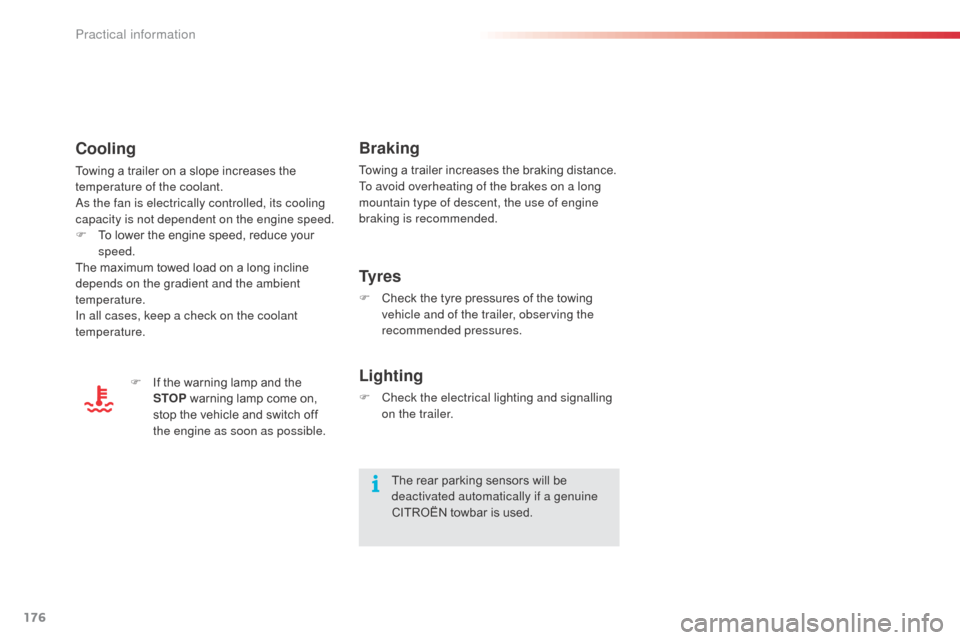
F
I
f the warning lamp and the
STOP warning lamp come on,
stop the vehicle and switch off
the engine as soon as possible.
Practical information