2014 Citroen C3 light
[x] Cancel search: lightPage 54 of 284

52
C3_en_Chap03_Confort_ed01-2014
Steering wheel adjustment
F When stationary, pull the control lever to
release the adjustment mechanism.
F
a
d
just the height and reach to suit your
driving position.
F
P
ush the control lever to lock the
adjustment mechanism.
Rear view mirror
Adjustable mirror providing a central rear ward
view.
Equipped with an anti-dazzle system, which
darkens the mirror glass and reduces the
nuisance to the driver caused by the sun,
headlamps from other vehicles...
Adjustment
F adjust the mirror so that the glass is directed correctly in the "day" position.
Day / night position
F Pull the lever to change to the "night" anti-dazzle position.
F
P
ush the lever to change to the normal
"day" position.
Automatic day/night model
By means of a sensor, which measures the
light from the rear of the vehicle, this system
automatically and progressively changes
between the day and night uses.
Manual day/night model
as a safety measure, the mirrors should
be adjusted to reduce the "blind spot". In order to ensure optimum visibility
during your manoeuvres, the mirror
lightens automatically when reverse
gear is engaged.
as a s
afety precaution, these
operations should only be carried out
with the vehicle stationary.
Comfort
Page 55 of 284

53
C3_en_Chap04_ouvertures_ed01-2014
Remote control keySystem which permits central unlocking or locking of the vehicle using the lock or from a distance. It is also used to locate and start the vehicle, as well
as providing protection against theft.
Unlocking the vehicle
Unfolding the key
F First press this button to unfold the key.
Unlocking using the remote
control
F Press the open padlock to unlock
the vehicle.
Unlocking using the key
F Turn the key to the left in the driver's door lock to unlock the vehicle.
Locking the vehicle
Locking using the remote
control
F Press the closed padlock to lock the vehicle.
Locking using the key
F Turn the key to the right in the driver's door lock to lock the vehicle completely.
Locking is confirmed by fixed lighting of
the direction indicators for approximately
two
seconds.
ac
cording to version, the door mirrors fold at
the same time. Unlocking is confirmed by rapid flashing of
the direction indicators for approximately
two seconds.
ac
cording to version, the door mirrors unfold at
the same time. If one of the doors or the boot is still
open, the central locking does not take
place.
When the vehicle is locked, if it is
unlocked inadvertently, it will relock
automatically after thirty seconds
unless a door or the boot is open.
The folding and unfolding of the door
mirrors using the remote control can be
deactivated by a CITR
oËn
dealer or a
qualified workshop.
4
access
Page 56 of 284

54
C3_en_Chap04_ouvertures_ed01-2014
Folding the key
F First press this button to fold the key.
If you do not press the button when folding
the key, there is a risk of damage to the
mechanism.
Anti-theft protection
Electronic engine immobiliser
The key contains an electronic chip which has
a special code. When the ignition is switched
on, this code must be recognised in order for
starting to be possible.
This electronic engine immobiliser locks the
engine management system a few minutes
after the ignition is switched off and prevents
starting of the engine by anyone who does not
have the key.
In the event of a fault, you are
informed by illumination of this
warning lamp, an audible signal and
a message in the screen.
Ignition switch
- Position 1: Stop
- P osition 2: Ignition
-
P
osition 3: Starting
Starting the vehicle
F Insert the key in the ignition switch. The system recognises the starting code.
F
T
urn the key fully towards the dashboard to
position 3 (Starting) .
F
W
hen the engine starts, release the key.Locating your vehicle
F Press the closed padlock to locate your locked vehicle in a
car park.
This is indicated by lighting of the courtesy
lamps and flashing of the direction indicators
for a few seconds. In this case, your vehicle will not start; contact
a CITR
oËn
dealer as soon as possible.
Keep safely, away from your vehicle, the label
attached to the keys given to you on acquisition
of the vehicle.
access
Page 68 of 284
66
C3_en_Chap05_Visibilite_ed01-2014
Lighting controls
Main lighting
The various front and rear lamps of the vehicle
are designed to adapt the driver's visibility
progressively according to climatic conditions:
-
s
idelamps, to be seen,
-
d
ipped beam headlamps to see without
dazzling other drivers,
-
m
ain beam headlamps to see clearly when
the road is clear.
Additional lighting
other lamps are installed to fulfil the
requirements of particular conditions of
visibility:
-
a r
ear foglamp to be seen from afar,
-
f
ront foglamps for even better for ward
vision.
Programming
Various automatic lighting control modes
are also available according to the following
options:
-
gu
ide-me-home lighting,
-
a
utomatic illumination of headlamps.
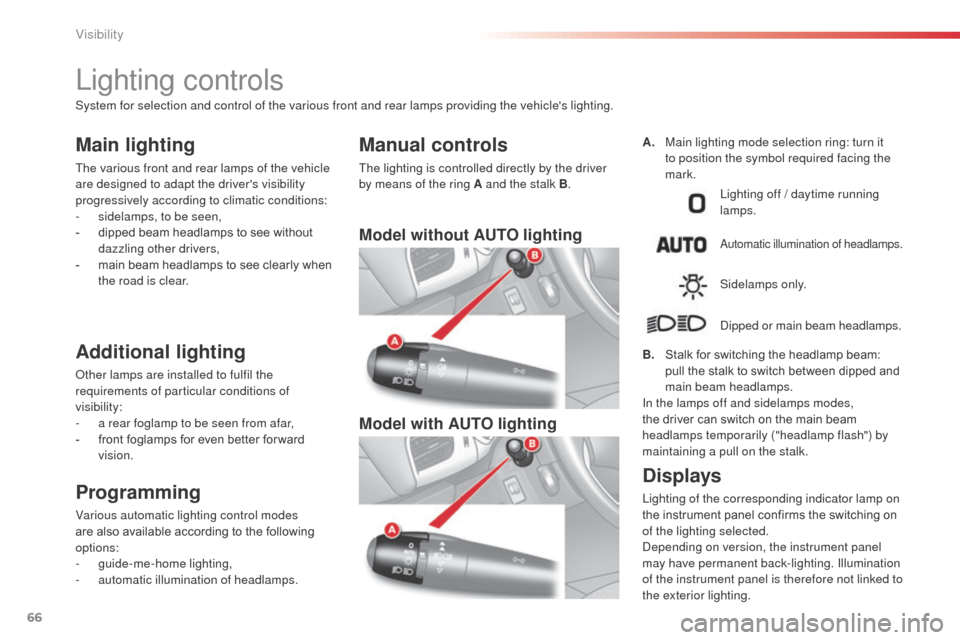
Model without AUTO lighting
Model with AUTO lighting
Lighting off / daytime running
lam ps.
automatic illumination of headlamps.
Sidelamps only.
dip
ped or main beam headlamps.
B.
S
talk for switching the headlamp beam:
pull the stalk to switch between dipped and
main beam headlamps.
In the lamps off and sidelamps modes,
the
driver can switch on the main beam
headlamps temporarily ("headlamp flash") by
maintaining a pull on the stalk.
Displays
Lighting of the corresponding indicator lamp on
the instrument panel confirms the switching on
of the lighting selected.
dep
ending on version, the instrument panel
may have permanent back-lighting. Illumination
of the instrument panel is therefore not linked to
the exterior lighting.
Manual controls
The lighting is controlled directly by the driver
by means of the ring A and the stalk B .A.
M
ain lighting mode selection ring: turn it
to position the symbol required facing the
mark.
System for selection and control of the various front and rear lamps providing the vehicle's lighting.
Visibility
Page 69 of 284

67
C3_en_Chap05_Visibilite_ed01-2014
C. Foglamp selection ring.
The foglamps operate with the dipped and main
beam headlamps.Rear foglamp
Rotate and release the ring C :
F
f
or wards a first time to switch on the front
foglamps,
F
f
or wards a second time to switch on the
rear foglamp,
F
r
ear wards a first time to switch off the rear
foglamp,
F
r
ear wards a second time to switch of the
front fog lamps.Model with rear foglamp only
F To switch on the foglamp, turn the ring C forwards.
When the lighting is switched off automatically
(with AUTO model), the foglamp and the dipped
beam headlamps will remain on.
F
T
o switch off all of the lighting, turn the
ring
C rearwards.
Model with front foglamps and a
rear foglamp
Front and rear foglamps When the lighting is switched off automatically
(with AUTO model) or when the dipped
headlamps are switched off manually, the
foglamps and sidelamps will remain on.
F
T
urn the ring rear wards to switch off the
foglamps, the sidelamps will then switch
of f.
In good or rainy weather, by both day
and night, the front foglamps and the
rear foglamp are prohibited. In these
situations, the power of their beams
may dazzle other drivers.
Do not forget to switch off the front
foglamps and the rear foglamp when
they are no longer necessary.
5
Visibility
Page 70 of 284

68
C3_en_Chap05_Visibilite_ed01-2014
Manual guide-me-home
lighting
The temporary illumination of the dipped beam
headlamps after the vehicle's ignition has been
switched off makes the driver's exit easier
when the light is poor.
Switching on
F With the ignition off, "flash" the headlamps using the lighting stalk.
F
A f
urther "headlamp flash" switches the
function off.
Switching off
The manual guide-me-home lighting switches
off automatically after a set time.
In some weather conditions (e.g. low
temperature or humidity), the presence
of misting on the internal sur face of the
glass of the headlamps and rear lamps
is normal; it disappears after the lamps
have been on for a few minutes.
Lighting on audible warning
When the ignition is switched off, all
of the lamps switch off automatically,
unless guide-me-home lighting is
activated.
If the lighting is switched on manually
after switching off the ignition, there
is an audible signal when a front door
is opened to warn the driver that they
have forgotten to switch off the vehicle's
lighting, with the ignition off.
Visibility
Page 71 of 284

69
C3_en_Chap05_Visibilite_ed01-2014
Association with the automatic
"Guide-me-home" lighting
Association with the automatic illumination of
headlamps provides "guide-me-home" lighting
with the following additional options:
-
s
election of the lighting duration to 15, 30 or
60 seconds in the functions that can be set
in the vehicle configuration menu (except in
the case of the monochrome screen
a
, f
or
which the duration is set: 60 seconds),
-
a
utomatic activation of "guide-me-home"
lighting when automatic illumination of
headlamps is in operation.
Operating fault
In the event of a fault with the
sunshine sensor, the lighting
come on, this warning lamp is displayed in the
instrument panel and/or a message appears in
the screen, accompanied by an audible signal.
Contact a CITR
oËn
dealer or a qualified
workshop.
In fog or snow, the sunshine sensor
may detect sufficient light. Therefore,
the lighting will not come on
automatically.
do n
ot cover the sunshine sensor,
coupled with the rain sensor and
located in the centre of the windscreen
behind the rear view mirror; the
associated functions would no longer
be controlled.
Automatic illumination of headlamps
Activation
F Turn ring to the "AUTO" position. The
automatic illumination of headlamps is
accompanied by a message in the screen.
Deactivation
F Turn ring to a position other than "AUTO" . de
activation is accompanied by a message
in the screen.
The sidelamps and dipped beam headlamps
are switched on automatically, without any
action on the part of the driver, when a low level
of external light is detected or in certain cases
of activation of the windscreen wipers.
as s
oon as the brightness returns to a sufficient
level or after the windscreen wipers are switched
off, the lamps are switched off automatically.
5
Visibility
Page 72 of 284
70
C3_en_Chap05_Visibilite_ed01-2014
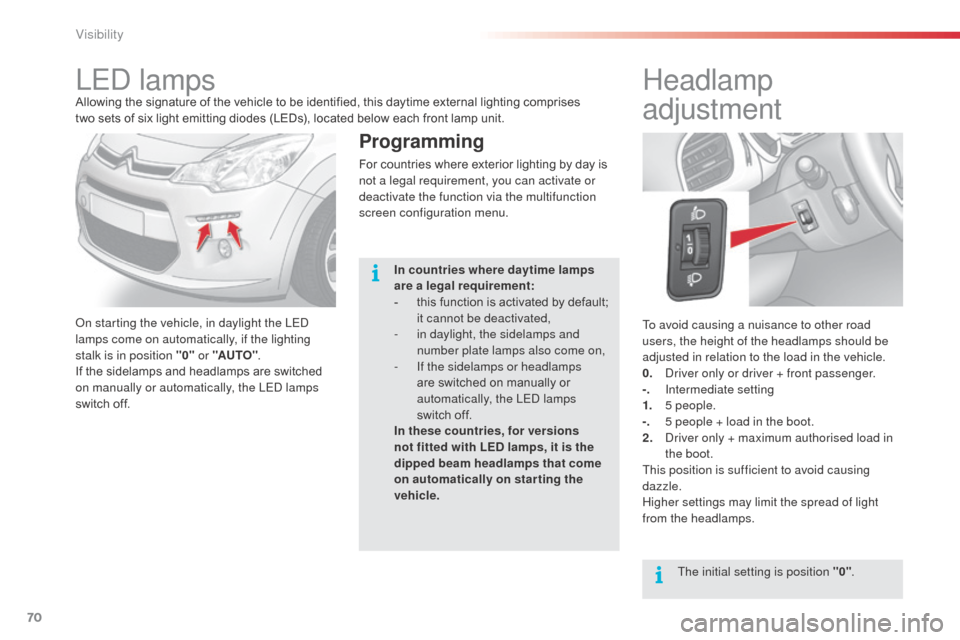
To avoid causing a nuisance to other road
users, the height of the headlamps should be
adjusted in relation to the load in the vehicle.
0. d
r
iver only or driver + front passenger.
-.
I
ntermediate setting
1.
5
people.
-.
5 p
eople + load in the boot.
2.
d
r
iver only + maximum authorised load in
the boot.
This position is sufficient to avoid causing
dazzle.
Higher settings may limit the spread of light
from the headlamps.
Headlamp
adjustment
The initial setting is position "0" .
LEd lampsAllowing the signature of the vehicle to be identified, this daytime external lighting comprises
two
sets of six light emitting diodes (LEDs), located below each front lamp unit.
on s
tarting the vehicle, in daylight the LE
d
lamps come on automatically, if the lighting
stalk is in position "0" or "AUTO".
If the sidelamps and headlamps are switched
on manually or automatically, the LE
d
lamps
switch off.
Programming
For countries where exterior lighting by day is
not a legal requirement, you can activate or
deactivate the function via the multifunction
screen configuration menu.
In countries where daytime lamps
are a legal requirement:
-
t
his function is activated by default;
it cannot be deactivated,
-
i
n daylight, the sidelamps and
number plate lamps also come on,
-
I
f the sidelamps or headlamps
are switched on manually or
automatically, the LE
d
lamps
switch off.
In these countries, for versions
not fitted with LED lamps, it is the
dipped beam headlamps that come
on automatically on starting the
vehicle.
Visibility