2014 Citroen C3 instrument panel
[x] Cancel search: instrument panelPage 75 of 284

73
C3_en_Chap05_Visibilite_ed01-2014
Automatic rain sensitive
windscreen wipers
The windscreen wipers operate automatically,
without any action on the part of the driver, if
rain is detected (sensor behind the rear view
mirror), adapting their speed to the intensity of
the rainfall.
Activation
Switching offOperating fault
If an automatic wiping fault occurs, the wipers
will operate in intermittent mode.
Have it checked by a CITR
oËn
dealer or a
qualified workshop.
Vertical windscreen wiper
position
This position allows the wiper blades to be lifted
for winter parking, cleaning or replacement
without damaging the bonnet.
In the minute following switching off of the
ignition, any action on the wiper stalk positions
the wipers vertically.
To park the wipers after this has been done,
switch on the ignition and operate the wiper stalk.
This is controlled manually by the driver by
pushing stalk A to the "AUTO"
position.
This is controlled manually by the driver
by moving stalk A upwards, returning it to
position
"0" . It is accompanied by the indicator lamp
in the instrument panel going off and a
message in the multifunction screen.
It is accompanied by the illumination of this
indicator lamp in the instrument panel and
a message in the multifunction screen.
The automatic wiping must be
reactivated if the ignition has been off
for more than one minute, by pushing
stalk A downwards.
Do not cover the rain sensor, linked with
the sunshine sensor and located in the
centre of the windscreen behind the
rear view mirror.
Switch off the automatic wiping when
using an automatic car wash.
In winter, it is advisable to wait until the
windscreen is completely clear of ice
before activating the automatic wiping.
To retain the effectiveness of the flat
wiper blades, it is advisable to:
-
h
andle them with care,
-
c
lean them regularly using soapy
water,
-
n
ot use them to hold a sheet of
cardboard against the windscreen,
-
r
eplace them at the first signs of
w e a r.
5
Visibility
Page 77 of 284

75
C3_en_Chap05_Visibilite_ed01-2014
Interior mood lighting
Switching on
at night, the illumination of the central
dashboard storage compartment comes
on automatically when the sidelamps are
switched on.
on c
ertain versions, three lamps located in the
support between the roof and the automatic
day/night interior mirror come on as well.
Switching off
The interior mood lighting switches off
automatically when the sidelamps are
switched
off.
It can be switched off manually using the
instrument panel lighting rheostat button.
F
W
ith the lighting on, press several times on
the left hand button of the instrument panel
to progressively reduce the dashboard
lighting level.
F
P
ress again to reduce the lighting level
to the minimum and switch off the interior
mood lighting. This comes on automatically when the boot is
opened and goes off automatically when the
boot is closed.
boot lamp
The dimmed passenger compartment lighting improves visibility in the vehicle when the light
i s
p o o r.
The lighting time varies according to
the
circumstances:
-
w
hen the ignition is off,
approximately ten minutes,
-
i
n energy economy mode,
approximately thirty seconds,
-
w
hen the engine is running, no limit.
5
Visibility
Page 105 of 284

103
C3_en_Chap08_Securite_ed01-2014
Trajectory control systems
Anti-slip regulation (ASR)
and dynamic stability
control (DSC)
The anti-slip regulation (also known as traction
control) optimises traction to prevent skidding
of the wheels, by acting on the brakes of the
driving wheels and on the engine.
The electronic stability control acts on the brake
of one or more wheels and on the engine to
keep the vehicle on the trajectory required by
the driver, within the limits of the laws of physics.
Activation
These systems are activated automatically
each time the vehicle is started.
They come into operation in the event of a grip
or trajectory problem.This is indicated by flashing of this
warning lamp in the instrument panel.
Deactivation
In exceptional conditions (starting a vehicle
which is bogged down, stuck in snow, on soft
ground...), if you are unable to make progress,
it may be advisable to temporarily deactivate
these systems, so that the wheels can spin
freely and allow the vehicle to move.
F
P
ress the "ESP OFF" button, located near
the steering wheel.
If this warning lamp comes on in the instrument panel
and the indicator lamp in the button comes on, this
indicates that these systems are deactivated.
It is recommended that the systems be
reactivated as soon as possible.
Reactivation
These systems are reactivated automatically
each time the ignition is switched back on or
from 30 mph (50 km/h).
F
P
ress the "ESP OFF" button again to
reactivate them manually.
Operating fault
If this warning lamp comes on,
accompanied by an audible signal
and a message in the screen, this
indicates a fault with these systems.
Have it checked by a CITR
oËn
dealer or a qualified workshop.
The trajectory control systems offer
increased safety in normal driving, but
this should not encourage the driver to
take extra risks or drive at high speed.
The correct functioning of these
systems is assured provided that
manufacturer's recommendations are
observed on:
-
w
heels (tyres and rims),
-
b
raking components,
-
el
ectronic components,
-
a
ssembly and repair procedures.
af
ter an impact, have these systems
checked by a CITR
oËn
dealer or a
qualified workshop.
8
Safety
Page 106 of 284

104
C3_en_Chap08_Securite_ed01-2014
Seat belts
Front seat belts
Fastening
F Pull the strap, then insert the tongue in the buckle.
F
C
heck that the seat belt is fastened
correctly by pulling the strap.
Unfastening
F Press the red button on the buckle.
F G uide the seat belt as it is reeled in.
Seat belt not fastened /
unfastened warning lamp
When the ignition is switched on, this
warning lamp comes on in the instrument
panel, if the driver and/or the front
passenger has not fastened their seat belt.
Rear seat belts
The rear seats are each fitted with a three-point
inertia reel seat belt.
Fastening
F Pull the strap, then insert the tongue in the buckle.
F
C
heck that the seat belt is fastened
correctly by pulling the strap.
Unfastening
F Press the red button on the buckle.
F G uide the seat belt as it is reeled in.
The front seat belts are fitted with a
pretensioning and force limiting system.
This system improves safety in the front
seats in the event of a front or side impact.
dep
ending on the severity of the impact, the
pretensioning system instantly tightens the seat
belts against the body of the occupants.
The pretensioning seat belts are active when
the ignition is on.
The force limiter reduces the pressure of the
seat belt on the chest of the occupant, so
improving their protection.
From approximately 12 mph (20 km/h)
this warning lamp flashes for two minutes
accompanied by an audible signal of increasing
volume. Once these two minutes have elapsed,
this warning lamp remains on until the driver and/
or the front passenger fastens their seat belt.
Safety
Page 109 of 284

107
C3_en_Chap08_Securite_ed01-2014
only the passenger's front airbag can be
deactivated:
F
w
ith the ignition off , insert the key in the
passenger airbag deactivation switch,
F
t
urn it to the "OFF" position,
F
t
hen, remove the key keeping the switch in
the new position.
This warning lamp comes on in the
instrument panel when the ignition
is on and until the airbag is re-
activated.
Reactivation
When you remove a child seat that has been
fitted "rear ward facing", with the ignition off,
turn switch to the "ON" position to re-activate
the airbag and so assure the safety of your
front passenger in the event of an impact.
Operating fault
If this warning lamp comes on in the
instrument panel, accompanied by
an audible warning and a message
in the multifunction screen, contact a
CITROËN dealer or qualified workshop
without delay to have the system
checked. The airbags may no longer be
deployed in the event of a serious impact.
If this warning lamp flashes, contact a
CITROËN dealer or a qualified workshop
without delay. The passenger's front
airbag may no longer be deployed in the
event of a serious impact.
If at least one of the two airbag
warning lamps come on continuously,
do not install a child seat on the front
passenger seat.
Have it checked by a CITR
oËn
dealer
or a qualified workshop.
To assure the safety of your child,
the passenger's front airbag must
be deactivated when you install a
"rear ward facing" child seat on the front
passenger seat.
Other wise, the child would risk being
seriously injured or killed if the airbag
were deployed.
Deactivation
8
Safety
Page 114 of 284
112
C3_en_Chap09_Conduite_ed01-2014
C3_en_Chap09_Conduite_ed01-2014
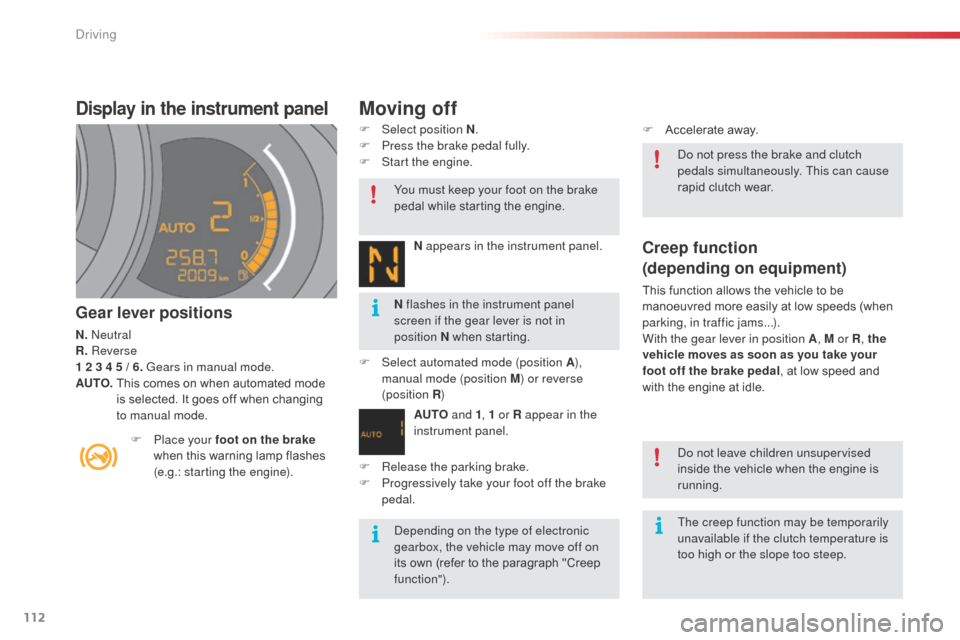
Display in the instrument panel
Gear lever positions
N. neutral
R. Reverse
1 2 3 4 5 / 6. Gears in manual mode.
AUTO.
T
his comes on when automated mode
is selected. It goes off when changing
to manual mode. F
Sel
ect position N
.
F
P
ress the brake pedal fully.
F
S
tart the engine.
N appears in the instrument panel.
F
Sel
ect automated mode (position A),
manual mode (position M) or reverse
(position R )
AUTO and 1, 1 or R appear in the
instrument panel.
F
P
lace your foot on the brake
when this warning lamp flashes
(e.g.: starting the engine).
Creep function
(depending on equipment)
This function allows the vehicle to be
manoeuvred more easily at low speeds (when
parking, in traffic jams...).
With the gear lever in position A , M or R, the
vehicle moves as soon as you take your
foot off the brake pedal , at low speed and
with the engine at idle.
F
R
elease the parking brake.
F
P
rogressively take your foot off the brake
pedal. F
A
ccelerate away.
de
pending on the type of electronic
gearbox, the vehicle may move off on
its own (refer to the paragraph "Creep
function").
do n
ot leave children unsupervised
inside the vehicle when the engine is
running.
You must keep your foot on the brake
pedal while starting the engine.
do n
ot press the brake and clutch
pedals simultaneously. This can cause
rapid clutch wear.
N flashes in the instrument panel
screen if the gear lever is not in
position
N when starting.
The creep function may be temporarily
unavailable if the clutch temperature is
too high or the slope too steep.
Moving off
driving
Page 115 of 284

113
C3_en_Chap09_Conduite_ed01-2014
C3_en_Chap09_Conduite_ed01-2014
Manual mode
The gears engaged appear in
succession in the instrument panel.
The gear change requests are only carried out
if the engine speed permits.
It is not necessary to release the accelerator
pedal during gear changes.
When braking or slowing down, the gearbox
changes down automatically so that the vehicle
picks up in the right gear.
Under full acceleration, the change up will
not take place unless the driver operates the
gear lever or steering mounted control paddle
(unless the engine is close to its maximum
speed).
Temporary control of gear
changing
You can temporarily take over control of gear
changes using the steering mounted "+" and
"-"
control paddles: if the engine speed allows, the
gear change is carried out.
This function allows you to anticipate certain
situations such as overtaking another vehicle or
approaching a bend.
After a few moments without any action on the
paddles, the gearbox resumes control of gear
changing automatically.
Automated mode
AUTO and the gear engaged appear
in the instrument panel.
The gearbox then operates in auto-adaptive
mode, without any action on the part of the
driver. It continuously selects the most suitable
gear taking account of:
-
o
ptimisation of fuel consumption,
-
d
riving style,
-
r
oad conditions,
-
v
ehicle load.
For optimum acceleration, when overtaking
another vehicle for example, press the
accelerator pedal fully down, beyond the point
of resistance.
You can change mode at any time by
moving the gear lever from A to M or
the other way round. You can change mode at any time by
moving the gear lever from A to M or
the other way round.
ne
ver select neutral (position N ) when
moving.
ne
ver select neutral (position N) when
moving.
F
Sel
ect position A
. F
Sel
ect position M
.
9
driving
Page 116 of 284

114
C3_en_Chap09_Conduite_ed01-2014
C3_en_Chap09_Conduite_ed01-2014
In exceptional circumstances, the
gearbox may need an automatic
reinitialisation: starting and gear
changing are no longer possible.
Reverse
To engage reverse, the vehicle must be
immobilised with your foot on the brake.
F
Sel
ect position R .
Operating fault
With the ignition on, if this warning
lamp comes on and AUTO flashes,
accompanied by an audible signal
and a message in the multifunction
screen, this indicates a gearbox
fault.
Have it checked by a CITR
oËn
dealer or a qualified workshop.
At low speed, if reverse gear is requested,
the N warning lamp flashes and the gearbox
goes into neutral automatically.
To engage reverse, put the gear lever into
position N
, then to position R .Stopping the vehicle
Before switching off the engine:
-
c hange to position N to be in neutral,
or
-
l
eave the vehicle in gear; in this case the
vehicle cannot be moved.
Reinitialisation
(5-speed electronic
gearbox)
Following disconnection of the battery, it is
necessary to reinitialise the gearbox.
F
S
witch on the ignition.AUTO and - - appear in the
instrument panel.
F
Sel
ect position N .
F
P
ress the brake pedal.
F
W
ait for around 30 seconds until N or a
gear appears in the instrument panel.
F
M
ove the gear lever to position A , then to
position N .
F
W
ith your foot still on the brake pedal, start
the engine.
The gearbox is operational again. AUTO
and - - appear in the
instrument panel.
Follow the procedure described above.
be
fore doing anything under the
bonnet, ensure that the gear lever is in
neutral (position N ) and that the parking
brake is applied.
There is an audible signal on
engagement of reverse.
For all parking situations, you must
apply the parking brake
to immobilise
the vehicle. When immobilising the vehicle with the
engine running, you must put the gear
lever into neutral (position N
).
driving