Page 39 of 590
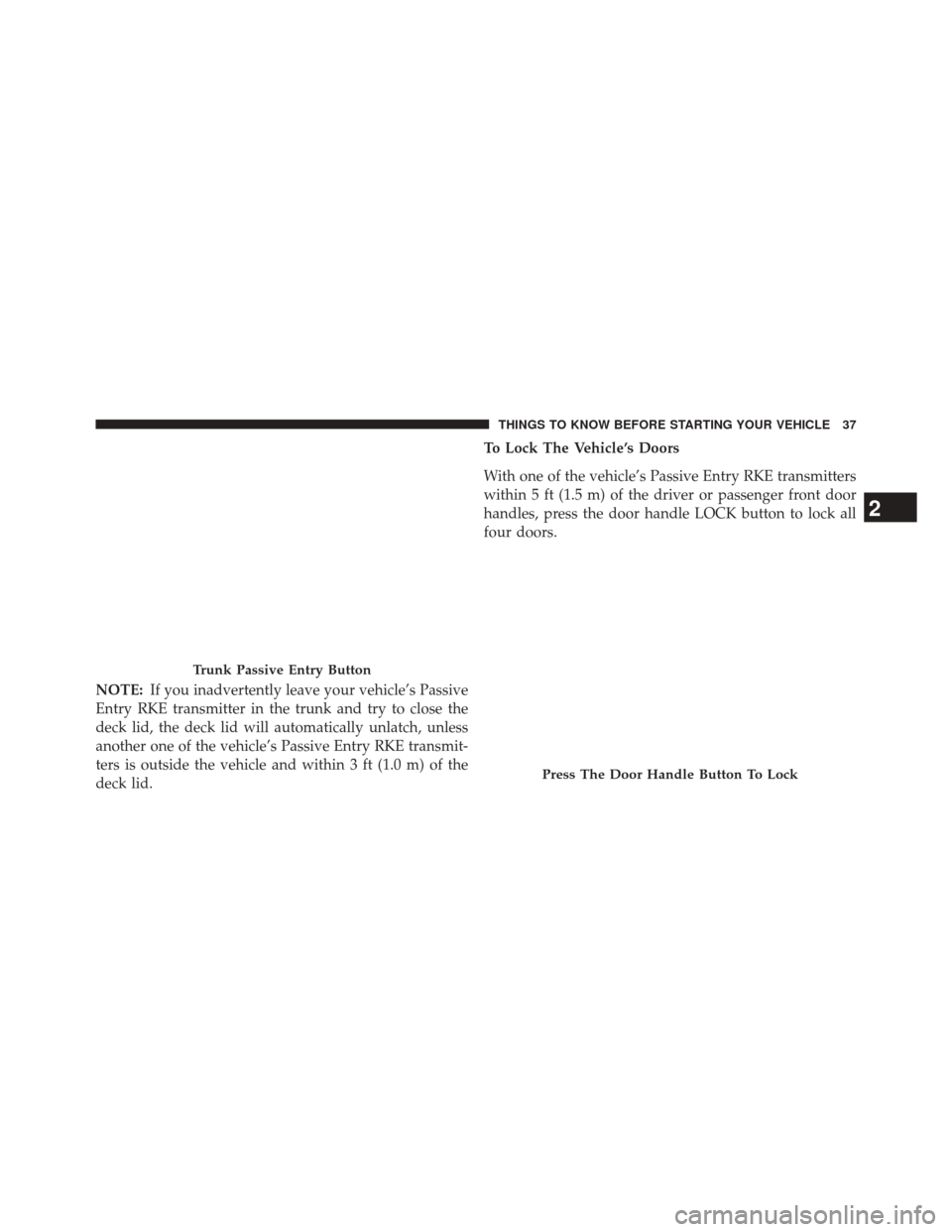
NOTE:If you inadvertently leave your vehicle’s Passive
Entry RKE transmitter in the trunk and try to close the
deck lid, the deck lid will automatically unlatch, unless
another one of the vehicle’s Passive Entry RKE transmit-
ters is outside the vehicle and within 3 ft (1.0 m) of the
deck lid. To Lock The Vehicle’s Doors
With one of the vehicle’s Passive Entry RKE transmitters
within 5 ft (1.5 m) of the driver or passenger front door
handles, press the door handle LOCK button to lock all
four doors.
Trunk Passive Entry Button
Press The Door Handle Button To Lock
2
THINGS TO KNOW BEFORE STARTING YOUR VEHICLE 37
Page 45 of 590
open or partially open positions. This is a normal occur-
rence and can be minimized. If the buffeting occurs with
the rear windows open, then open the front and rear
windows together to minimize the buffeting. If the
buffeting occurs with the sunroof open, adjust the sun-
roof opening to minimize the buffeting.
TRUNK LOCK AND RELEASE
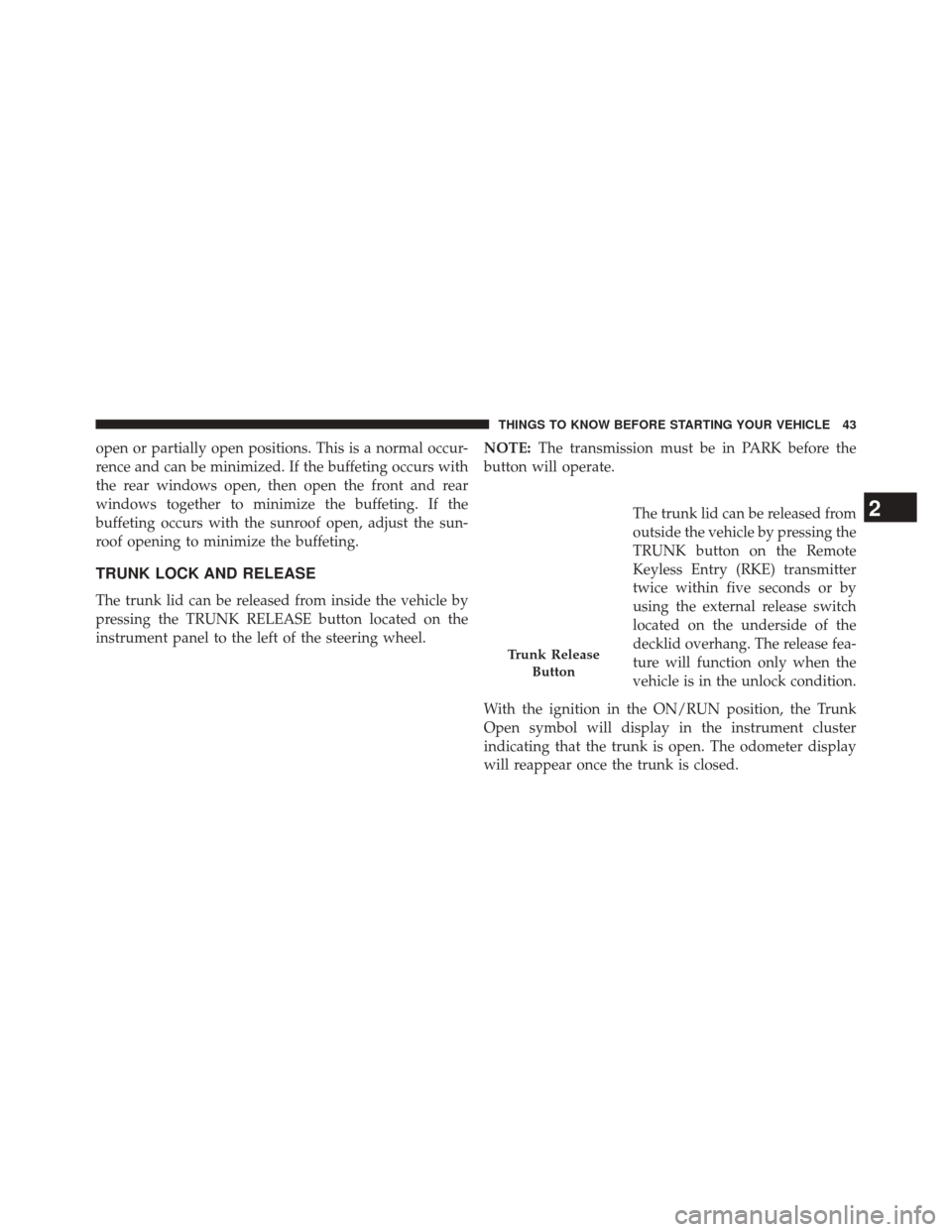
The trunk lid can be released from inside the vehicle by
pressing the TRUNK RELEASE button located on the
instrument panel to the left of the steering wheel.NOTE:
The transmission must be in PARK before the
button will operate.
The trunk lid can be released from
outside the vehicle by pressing the
TRUNK button on the Remote
Keyless Entry (RKE) transmitter
twice within five seconds or by
using the external release switch
located on the underside of the
decklid overhang. The release fea-
ture will function only when the
vehicle is in the unlock condition.
With the ignition in the ON/RUN position, the Trunk
Open symbol will display in the instrument cluster
indicating that the trunk is open. The odometer display
will reappear once the trunk is closed.
Trunk Release Button
2
THINGS TO KNOW BEFORE STARTING YOUR VEHICLE 43
Page 46 of 590
With the ignition in the OFF position, the Trunk Open
symbol will display until the trunk is closed.
Refer to “Keyless Enter-N-Go™” in “Things To Know
Before Starting Your Vehicle” for more information on
trunk operation with the Passive Entry feature.
TRUNK SAFETY WARNING
WARNING!
Do not allow children to have access to the trunk,
either by climbing into the trunk from outside, or
through the inside of the vehicle. Always close the
trunk lid when your vehicle is unattended. Once in
the trunk, young children may not be able to escape,
even if they entered through the rear seat. If trapped
in the trunk, children can die from suffocation or
heat stroke.
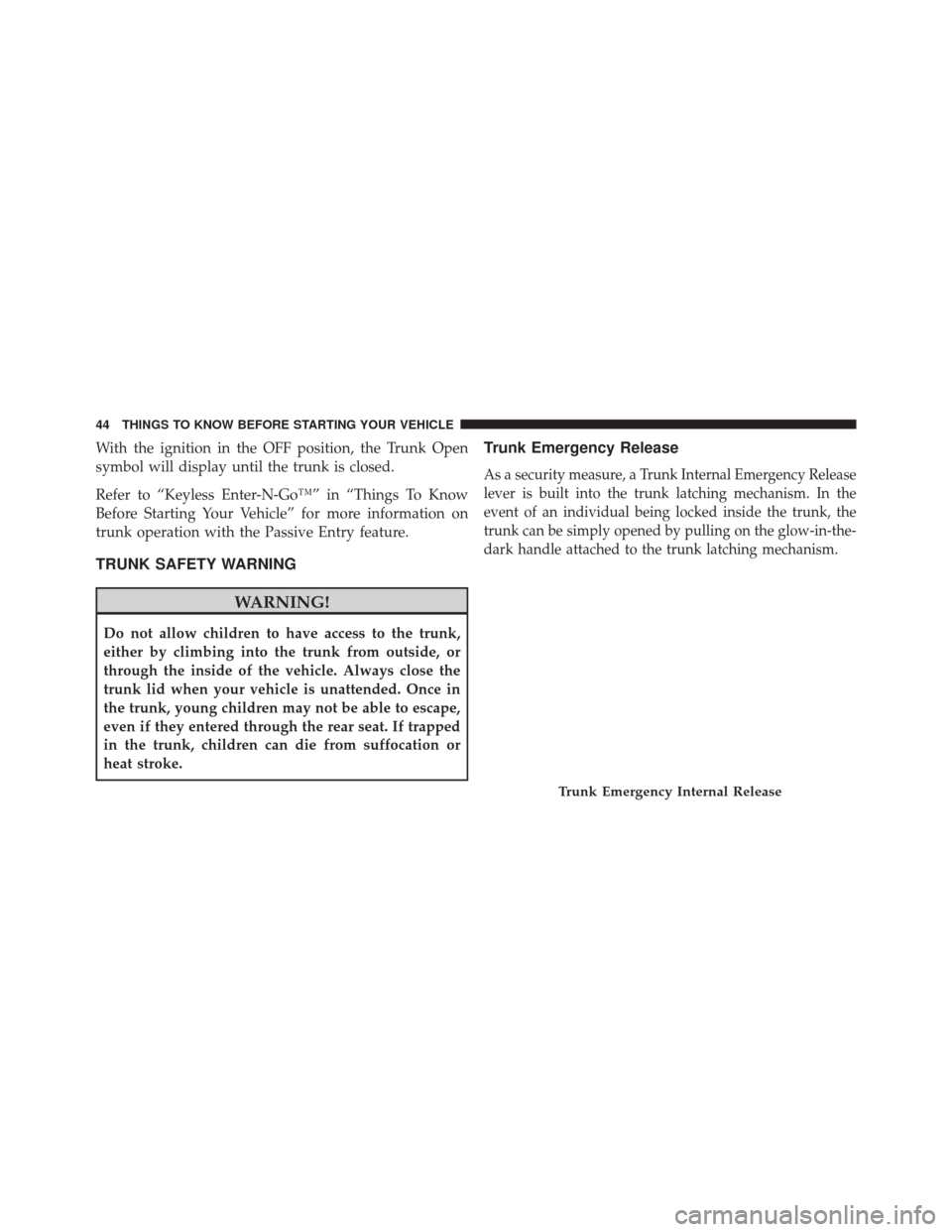
Trunk Emergency Release
As a security measure, a Trunk Internal Emergency Release
lever is built into the trunk latching mechanism. In the
event of an individual being locked inside the trunk, the
trunk can be simply opened by pulling on the glow-in-the-
dark handle attached to the trunk latching mechanism.
Trunk Emergency Internal Release
44 THINGS TO KNOW BEFORE STARTING YOUR VEHICLE
Page 103 of 590
WARNING!(Continued)
•It is extremely dangerous to ride in a cargo area,
inside or outside of a vehicle. In a collision, people
riding in these areas are more likely to be seriously
injured or killed.
• Do not allow people to ride in any area of your
vehicle that is not equipped with seats and seat
belts.
• Be sure everyone in your vehicle is in a seat and
using a seat belt properly.
Exhaust Gas
WARNING!
Exhaust gases can injure or kill. They contain carbon
monoxide (CO), which is colorless and odorless.
Breathing it can make you unconscious and can
(Continued)
WARNING! (Continued)
eventually poison you. To avoid breathing (CO),
follow these safety tips:
•Do not run the engine in a closed garage or in
confined areas any longer than needed to move
your vehicle in or out of the area.
• If you are required to drive with the trunk/liftgate/
rear doors open, make sure that all windows are
closed and the climate control BLOWER switch is
set at high speed. DO NOT use the recirculation
mode.
• If it is necessary to sit in a parked vehicle with the
engine running, adjust your heating or cooling
controls to force outside air into the vehicle. Set the
blower at high speed.
The best protection against carbon monoxide entry into
the vehicle body is a properly maintained engine exhaust
system.
2
THINGS TO KNOW BEFORE STARTING YOUR VEHICLE 101
Page 113 of 590
▫Closing Power Shade — Manual Mode ......281
▫ Venting Sunroof — Express ..............281
▫ Pinch Protect Feature ...................281
▫ Wind Buffeting ...................... .282
▫ Sunroof Maintenance ...................282
▫ Ignition OFF Operation .................282
� ELECTRICAL POWER OUTLETS ...........282
� CUPHOLDERS ....................... .286
▫ Front Seat Cupholders ..................286
▫ Rear Seat Cupholders ..................288
� STORAGE ........................... .290
▫ Glove Compartment ...................290 ▫
Console Features .....................291
▫ Door Storage ........................ .292
▫ Rear Seat Armrest Storage — If Equipped . . . .293
▫ Cargo Area — Vehicles Equipped With 60/40
Split-Folding Rear Seat ..................294
� CARGO AREA FEATURES ................295
▫ Trunk Mat — If Equipped ...............295
▫ Grocery Bag Hooks ....................295
▫ CargoNet.......................... .296
� REAR WINDOW FEATURES ..............297
▫ Rear Window Defroster .................297
3
UNDERSTANDING THE FEATURES OF YOUR VEHICLE 111
Page 206 of 590
Ambient Light — If Equipped
The overhead console is equipped with an ambient light
feature. This light casts illumination for improved visibil-
ity of the floor and center console area.
Interior Lights
The interior lights come on when a door is opened.
To protect the battery, the interior lights will turn off
automatically 10 minutes after the ignition is moved to
the LOCK position. This will occur if the interior lights
were switched on manually or are on because a door is
open. This includes the glove box light, but not the trunk
light. To restore interior light operation, either turn the
ignition to the ON/RUN position or cycle the light
switch.
Dimmer Controls
The dimmer control is part of the headlight switch and is
located on the left side of the instrument panel.
Ambient Light
204 UNDERSTANDING THE FEATURES OF YOUR VEHICLE
Page 297 of 590
WARNING!
The weight and position of cargo and passengers can
change the vehicle center of gravity and vehicle
handling. To avoid loss of control resulting in per-
sonal injury, follow these guidelines for loading your
vehicle:
•Always place cargo evenly on the cargo floor. Put
heavier objects as low and as far forward as pos-
sible.
• Place as much cargo as possible in front of the rear
axle. Too much weight or improperly placed weight
over or behind the rear axle can cause the rear of
the vehicle to sway.
• Do not pile luggage or cargo higher than the top of
the seatback. This could impair visibility or be-
come a dangerous projectile in a sudden stop or
collision.
CARGO AREA FEATURES
Trunk Mat — If Equipped
A trunk mat covers the bottom of the cargo area. The
trunk mat is used to protect the interior of the trunk from
mud, snow, and debris.
Grocery Bag Hooks
The rear cargo area is equipped with grocery bag hooks,
located on either side of the rear cargo area.
3
UNDERSTANDING THE FEATURES OF YOUR VEHICLE 295
Page 303 of 590
INSTRUMENT PANEL FEATURES
1 — Air Outlet8 — Uconnect® System Hard Controls 15 — Dimmer Controls
2 — Instrument Cluster 9 — SD Memory Card Slot16 — Hood Release
3 — Hazard Switch 10 — Power Outlet17 — Headlight Switch
4 — Uconnect® System 11 — CD/DVD Slot18 — Analog Clock
5 — Climate Control Hard Controls 12 — Storage Compartment 19 — Paddle Shifters
6 — Glove Compartment 13 — Engine Start/Stop Button
7 — ESC Off Switch 14 — Trunk Release Button
4
UNDERSTANDING YOUR INSTRUMENT PANEL 301