Page 365 of 615
▫Tire Terminology And Definitions ..........420
▫ Tire Loading And Tire Pressure ...........421
� TIRES — GENERAL INFORMATION ........426
▫ Tire Pressure ....................... .426
▫ Tire Inflation Pressures .................427
▫ Tire Pressures For High Speed Operation . . . .428
▫ Radial Ply Tires ..................... .429
▫ Tire Types .......................... .430
▫ Run Flat Tires — If Equipped .............431
▫ Spare Tires — If Equipped ...............432
▫ Tire Spinning ....................... .434
▫ Tread Wear Indicators ..................434
▫ Life Of Tire ........................ .435▫
Replacement Tires .....................436
� TIRE CHAINS (TRACTION DEVICES) .......437
� TIRE ROTATION RECOMMENDATIONS .....439
� TIRE PRESSURE MONITOR SYSTEM (TPMS) . .440
▫ Base System ........................ .443
▫ Premium System — If Equipped ...........446
▫ General Information ...................450
� FUEL REQUIREMENTS ..................451
▫ 3.6L Engine — If Equipped ...............451
▫ 5.7L Engine — If Equipped ...............451
▫ Reformulated Gasoline .................452
▫ Gasoline/Oxygenate Blends ..............452
▫ E-85 Usage In Non-Flex Fuel Vehicles .......453
5
STARTING AND OPERATING 363
Page 416 of 615
Synchronizing ESC
If the power supply is interrupted (battery
disconnected or discharged), the “ESC
Activation/Malfunction Indicator Light” may
illuminate with the engine running. If this
should occur, turn the steering wheel completely to the
left and then to the right. The “ESC Activation/
Malfunction Indicator Light” should go out. However, if
the light remains on, have the ESC and BAS checked at
your authorized dealer as soon as possible.
TIRE SAFETY INFORMATION
Tire Markings
1 — U.S. DOT Safety Standards
Code (TIN) 4 — Maximum Load
2 — Size Designation 5 — Maximum Pressure
3 — Service Description 6 — Treadwear, Traction and
Temperature Grades
414 STARTING AND OPERATING
Page 417 of 615
NOTE:
•P (Passenger) - Metric tire sizing is based on U.S.
design standards. P-Metric tires have the letter “P”
molded into the sidewall preceding the size designa-
tion. Example: P215/65R15 95H.
• European-Metric tire sizing is based on European
design standards. Tires designed to this standard have
the tire size molded into the sidewall beginning with
the section width. The letter �P�is absent from this tire
size designation. Example: 215/65R15 96H.
• LT (Light Truck) - Metric tire sizing is based on U.S.
design standards. The size designation for LT-Metric
tires is the same as for P-Metric tires except for the
letters “LT” that are molded into the sidewall preced-
ing the size designation. Example: LT235/85R16. •
Temporary spare tires are designed for temporary
emergency use only. Temporary high pressure com-
pact spare tires have the letter “T” or “S” molded into
the sidewall preceding the size designation. Example:
T145/80D18 103M.
• High flotation tire sizing is based on U.S. design
standards and it begins with the tire diameter molded
into the sidewall. Example: 31x10.5 R15 LT.
5
STARTING AND OPERATING 415
Page 419 of 615
EXAMPLE:
R = Construction code
–�R� means radial construction, or
– �D� means diagonal or bias construction
15, 16, 18 = Rim diameter in inches (in)
Service Description: 95= Load Index
– A numerical code associated with the maximum load a tire can carry
H = Speed Symbol
– A symbol indicating the range of speeds at which a tire can carry a load corresponding to
its load index under certain operating conditions
– The maximum speed corresponding to the speed symbol should only be achieved under
specified operating conditions (i.e., tire pressure, vehicle loading, road conditions, and
posted speed limits)
5
STARTING AND OPERATING 417
Page 420 of 615
EXAMPLE:
Load Identification:
Absence of the following load identification symbols on the sidewall of the tire indicates a Standard Load (SL)
tire:
•XL = Extra load (or reinforced) tire, or
•LL= Light load tire or
•C, D, E, F, G = Load range associated with the maximum load a tire can carry at a specified pressure
Maximum Load – Maximum load indicates the maximum load this tire is designed to carry
Maximum Pressure – Maximum pressure indicates the maximum permissible cold tire inflation pressure for this
tire
Tire Identification Number (TIN)
The TIN may be found on one or both sides of the tire,
however, the date code may only be on one side. Tires
with white sidewalls will have the full TIN, including the
date code, located on the white sidewall side of the tire. Look for the TIN on the outboard side of black sidewall
tires as mounted on the vehicle. If the TIN is not found on
the outboard side, then you will find it on the inboard
side of the tire.
418 STARTING AND OPERATING
Page 422 of 615
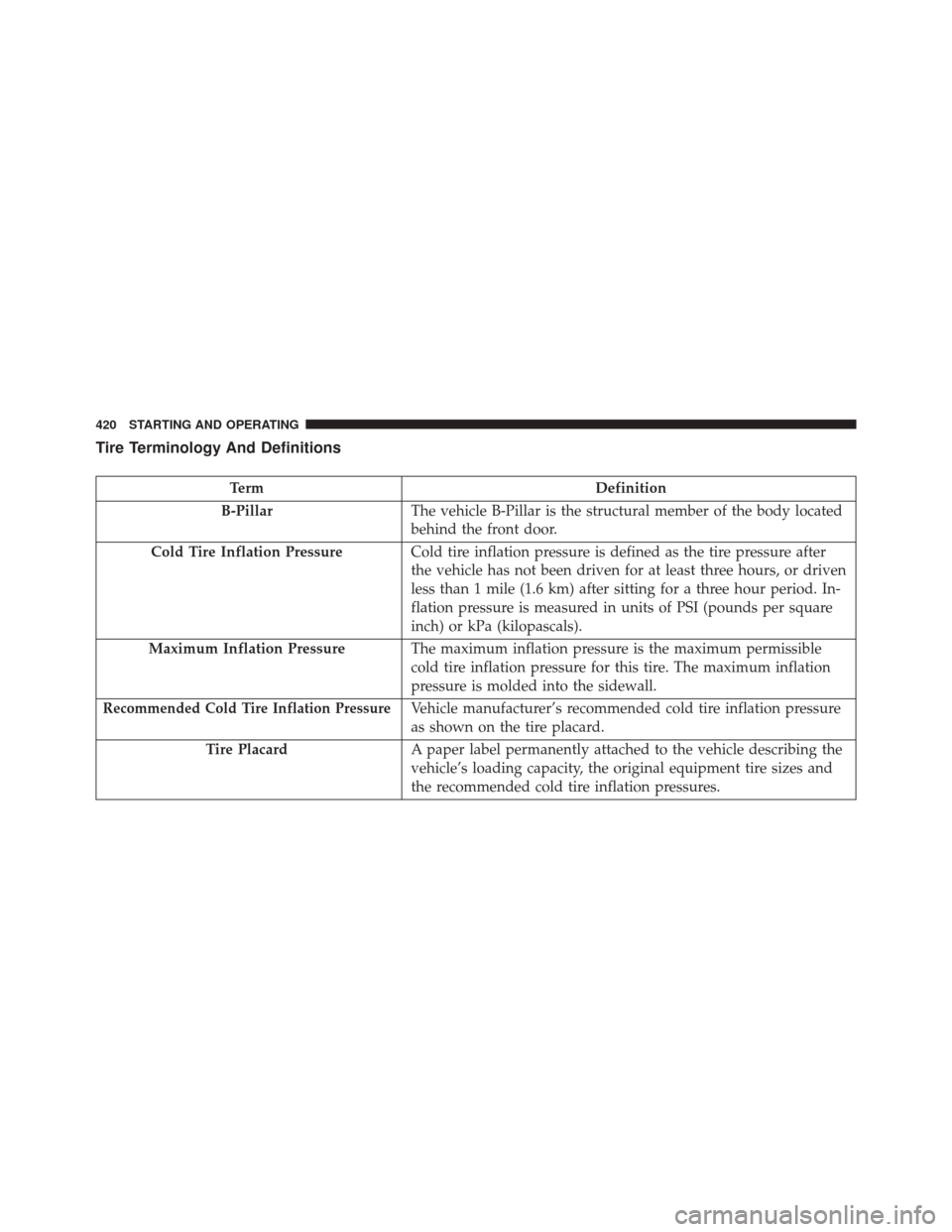
Tire Terminology And Definitions
TermDefinition
B-Pillar The vehicle B-Pillar is the structural member of the body located
behind the front door.
Cold Tire Inflation Pressure Cold tire inflation pressure is defined as the tire pressure after
the vehicle has not been driven for at least three hours, or driven
less than 1 mile (1.6 km) after sitting for a three hour period. In-
flation pressure is measured in units of PSI (pounds per square
inch) or kPa (kilopascals).
Maximum Inflation Pressure The maximum inflation pressure is the maximum permissible
cold tire inflation pressure for this tire. The maximum inflation
pressure is molded into the sidewall.
Recommended Cold Tire Inflation PressureVehicle manufacturer’s recommended cold tire inflation pressure
as shown on the tire placard.
Tire Placard A paper label permanently attached to the vehicle describing the
vehicle’s loading capacity, the original equipment tire sizes and
the recommended cold tire inflation pressures.
420 STARTING AND OPERATING
Page 423 of 615
Tire Loading And Tire Pressure
Tire And Loading Information Placard Location
NOTE:The proper cold tire inflation pressure is listed on
the driver ’s side B-Pillar or the rear edge of the driver’s
side door.
B-Pillar Location For Tire And Loading Information
Placard
5
STARTING AND OPERATING 421
Page 424 of 615
Tire And Loading Information PlacardThis placard tells you important information about the:
1. Number of people that can be carried in the vehicle.
2. Total weight your vehicle can carry.
3. Tire size designed for your vehicle.
4. Cold tire inflation pressures for the front, rear, andspare tires.
Tire And Loading Information Placard
422 STARTING AND OPERATING