Page 451 of 615

Vehicles With Full Size Spare
1. The matching full size spare wheel and tire assemblyhas a TPM sensor that can be monitored by the TPMS.
2. If you install the full size spare in place of a road tire that has a pressure below the low-pressure warning
limit, upon the next ignition switch cycle, a chime will
sound and the TPM Telltale Light will turn ON. In
addition, the EVIC will display a low pressure mes-
sage and a graphic showing the low tire pressure
value flashing or in a different color. An �Inflate to XX�
message will also be displayed.
3. After driving the vehicle for up to 20 minutes above 15 mph (24 km/h) the TPM Telltale Light will turn
OFF, and the pressure value displayed will be updated
and stop flashing or return to its original color as long
as no tire pressure is below the low-pressure warning
limit in any of the four active road tires. Vehicles With Compact Spare
1. The compact spare tire does not have a TPM sensor.
Therefore, the TPMS will not monitor the pressure in
the compact spare tire.
2. If you install the compact spare tire in place of a road tire that has a pressure below the low-pressure warn-
ing limit, upon the next ignition switch cycle, the TPM
Telltale Light will remain ON and a chime will sound.
In addition, the graphic in the EVIC will still display a
flashing pressure value or a pressure value in a
different color. An �Inflate to XX�message will also be
displayed.
3. After driving the vehicle for up to 20 minutes above 15 mph (24 km/h), the TPM Telltale Light will flash on
and off for 75 seconds and then remain on solid. In
addition, the EVIC will display a �SERVICE TPM
SYSTEM� message for a minimum of five seconds and
then display dashes (- -) in place of the pressure value.
5
STARTING AND OPERATING 449
Page 481 of 615
WHAT TO DO IN EMERGENCIES
CONTENTS
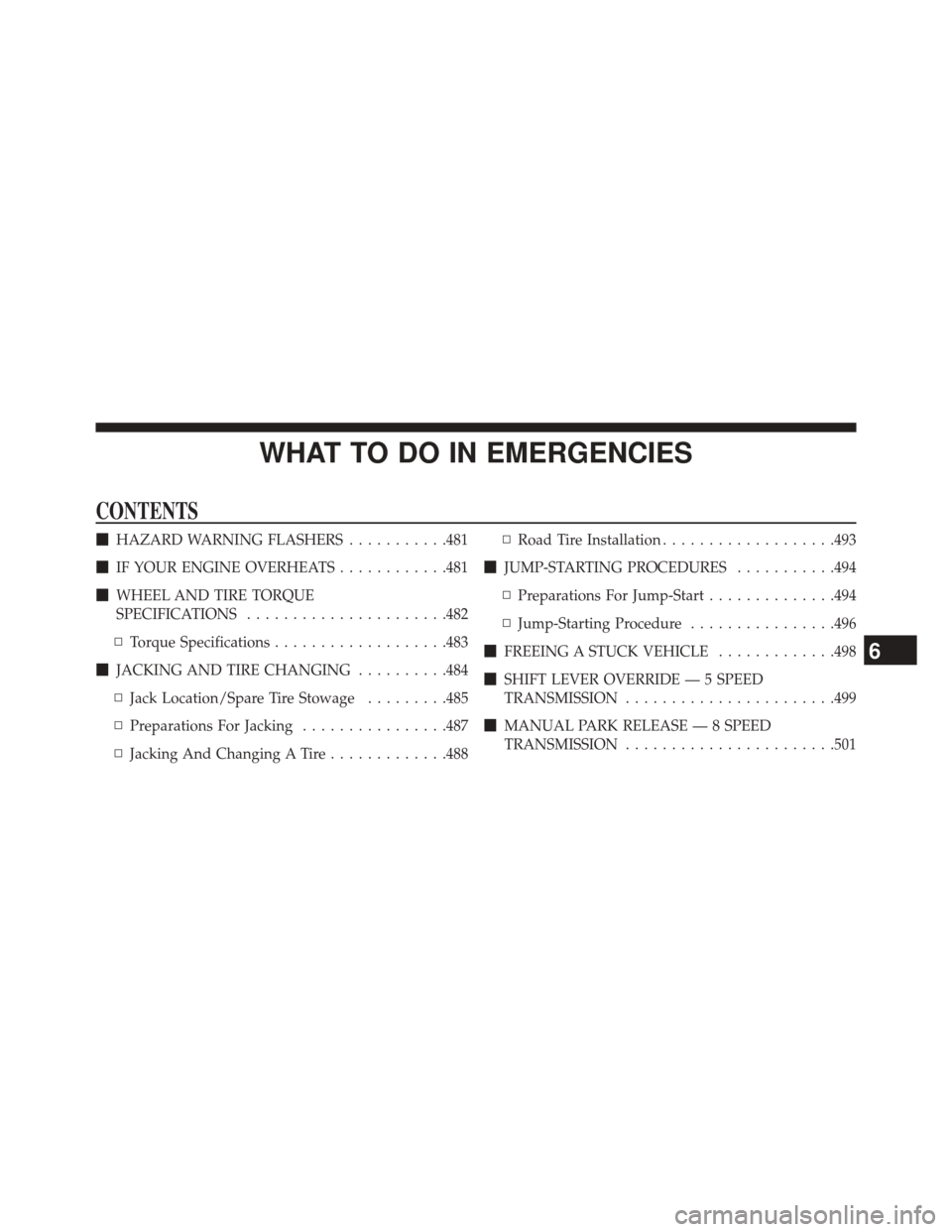
�HAZARD WARNING FLASHERS ...........481
� IF YOUR ENGINE OVERHEATS ............481
� WHEEL AND TIRE TORQUE
SPECIFICATIONS ..................... .482
▫ Torque Specifications ...................483
� JACKING AND TIRE CHANGING ..........484
▫ Jack Location/Spare Tire Stowage .........485
▫ Preparations For Jacking ................487
▫ Jacking And Changing A Tire .............488▫
Road Tire Installation ...................493
� JUMP-STARTING PROCEDURES ...........494
▫ Preparations For Jump-Start ..............494
▫ Jump-Starting Procedure ................496
� FREEING A STUCK VEHICLE .............498
� SHIFT LEVER OVERRIDE — 5 SPEED
TRANSMISSION ...................... .499
� MANUAL PARK RELEASE — 8 SPEED
TRANSMISSION ...................... .501
6
Page 489 of 615
WARNING!
A loose tire or jack thrown forward in a collision or
hard stop could endanger the occupants of the ve-
hicle. Always stow the jack parts and the spare tire in
the places provided. Have the deflated (flat) tire
repaired or replaced immediately.
Preparations For Jacking
1. Park the vehicle on a firm, level surface as far from theedge of the roadway as possible. Avoid icy or slippery
areas.
WARNING!
Do not attempt to change a tire on the side of the
vehicle close to moving traffic, pull far enough off
the road to avoid being hit when operating the jack
or changing the wheel. 2. Turn on the Hazard Warning flasher.
3. Set the parking brake.
4. Place the shift lever into PARK.
5. Turn OFF the ignition.
6. Block both the front and rear of the wheel diagonally
opposite of the jacking position. For
example, if changing the right front
tire, block the left rear wheel.
NOTE: Passengers should not remain in the vehicle
when the vehicle is being jacked.
6
WHAT TO DO IN EMERGENCIES 487
Page 491 of 615
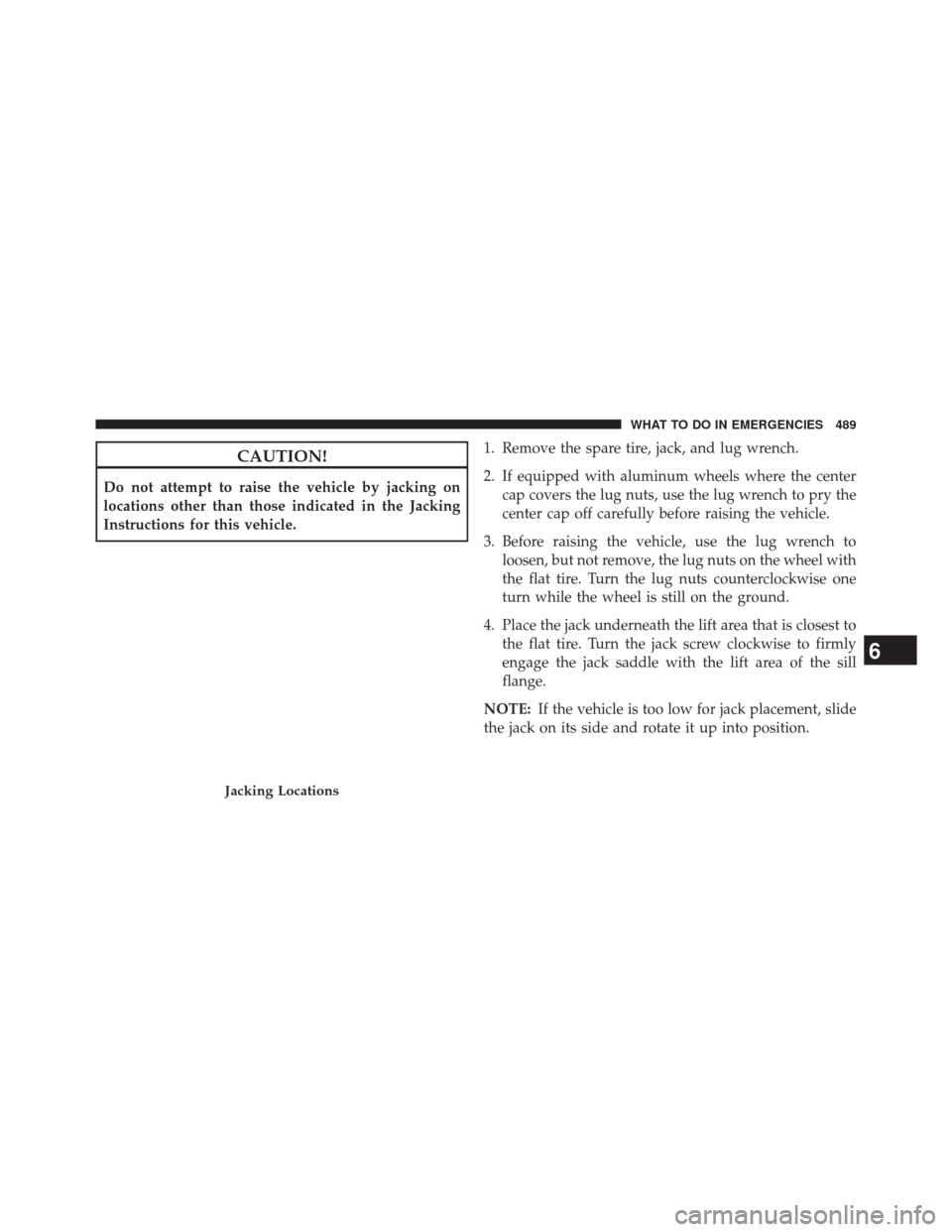
CAUTION!
Do not attempt to raise the vehicle by jacking on
locations other than those indicated in the Jacking
Instructions for this vehicle.1. Remove the spare tire, jack, and lug wrench.
2. If equipped with aluminum wheels where the center
cap covers the lug nuts, use the lug wrench to pry the
center cap off carefully before raising the vehicle.
3. Before raising the vehicle, use the lug wrench to loosen, but not remove, the lug nuts on the wheel with
the flat tire. Turn the lug nuts counterclockwise one
turn while the wheel is still on the ground.
4. Place the jack underneath the lift area that is closest to the flat tire. Turn the jack screw clockwise to firmly
engage the jack saddle with the lift area of the sill
flange.
NOTE: If the vehicle is too low for jack placement, slide
the jack on its side and rotate it up into position.
Jacking Locations
6
WHAT TO DO IN EMERGENCIES 489
Page 494 of 615

NOTE:•For vehicles so equipped, do not attempt to install a
center cap or wheel cover on the compact spare.
• Refer to “Compact Spare Tire” and to “Limited-Use
Spare” under “Tires—General Information” in
“Starting and Operating” for additional warnings,
cautions, and information about the spare tire, its
use, and operation.
8. Install the lug nuts with the cone shaped end of the lug nut toward the wheel. Lightly tighten the lug nuts.
WARNING!
To avoid the risk of forcing the vehicle off the jack,
do not tighten the lug nuts fully until the vehicle has
been lowered. Failure to follow this warning may
result in personal injury. 9. Lower the vehicle to the ground by turning the jack
handle counterclockwise.
10. Finish tightening the lug nuts. Push down on the wrench while at the end of the handle for increased
leverage. Tighten the lug nuts in a star pattern until
each nut has been tightened twice. For the correct lug
nut torque refer to Torque Specifications in this
section. If in doubt about the correct tightness, have
them checked with a torque wrench by your autho-
rized dealer or at a service station.
11. Stow the jack, tools and flat tire. Make sure the base of the jack faces the front of the vehicle before
tightening down the fastener.
492 WHAT TO DO IN EMERGENCIES
Page 495 of 615
WARNING!
A loose tire or jack thrown forward in a collision or
hard stop could endanger the occupants of the ve-
hicle. Always stow the jack parts and the spare tire in
the places provided. Have the deflated (flat) tire
repaired or replaced immediately.
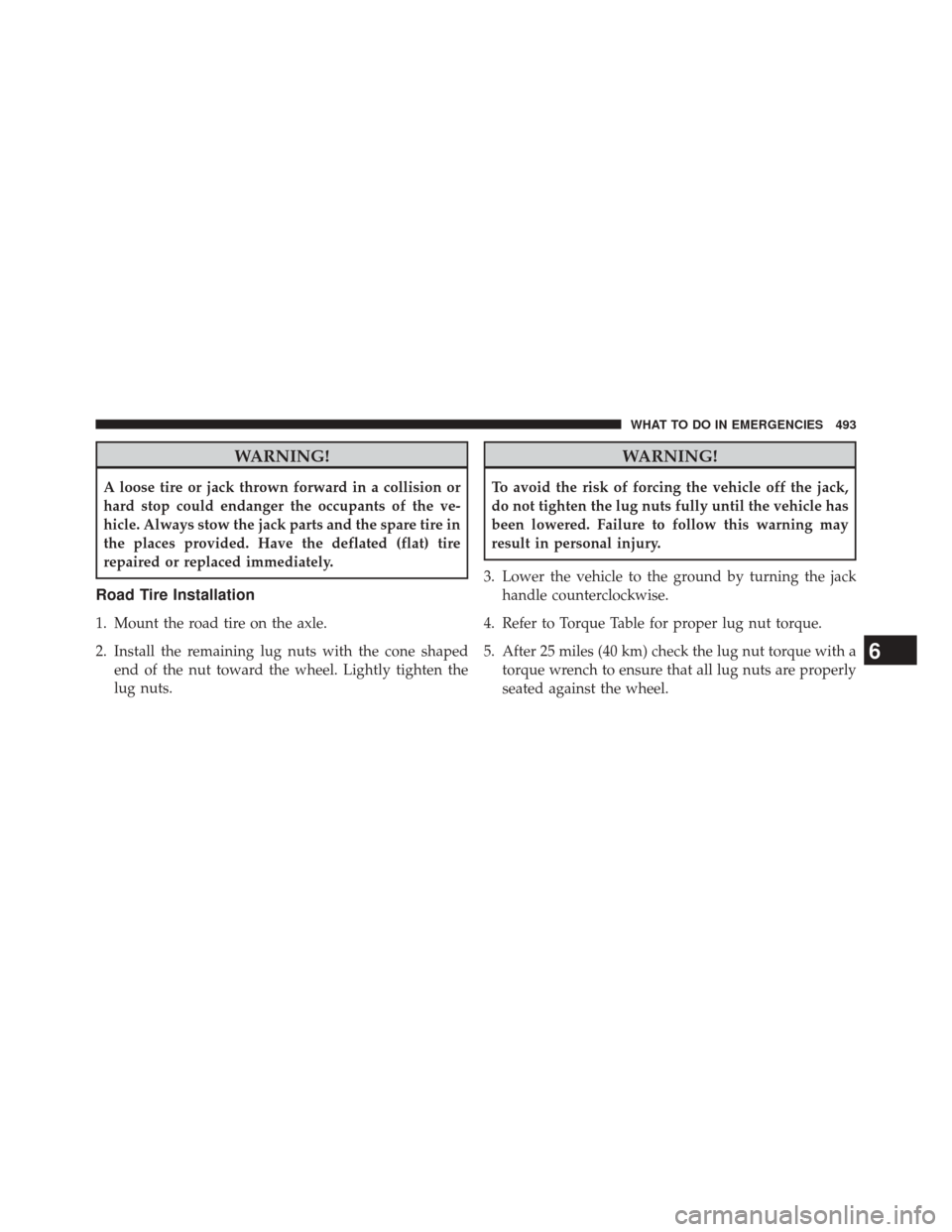
Road Tire Installation
1. Mount the road tire on the axle.
2. Install the remaining lug nuts with the cone shapedend of the nut toward the wheel. Lightly tighten the
lug nuts.
WARNING!
To avoid the risk of forcing the vehicle off the jack,
do not tighten the lug nuts fully until the vehicle has
been lowered. Failure to follow this warning may
result in personal injury.
3. Lower the vehicle to the ground by turning the jack handle counterclockwise.
4. Refer to Torque Table for proper lug nut torque.
5. After 25 miles (40 km) check the lug nut torque with a torque wrench to ensure that all lug nuts are properly
seated against the wheel.
6
WHAT TO DO IN EMERGENCIES 493
Page 552 of 615
CavityCartridge Fuse Mini-Fuse Description
3 50 Amp Red –Power Steering #1
4 30 Amp Pink – Starter
5 40 Amp Green –Anti-Lock Brakes
6 25 Amp Natural –Anti-Lock Brakes
7 –– Fuse – Spare
8 –– Fuse – Spare
9 –20 Amp Yellow All-Wheel Drive Module – If Equipped
10 –5 Amp Tan Security
11 –20 Amp Yellow Horns
12 –10 Amp Red Air Conditioning Clutch
13 –– Fuse – Spare
14 –– Fuse – Spare
15 –– Fuse – Spare
16 –– Fuse – Spare
18 50 Amp Red –Radiator Fan #2
550 MAINTAINING YOUR VEHICLE
Page 559 of 615
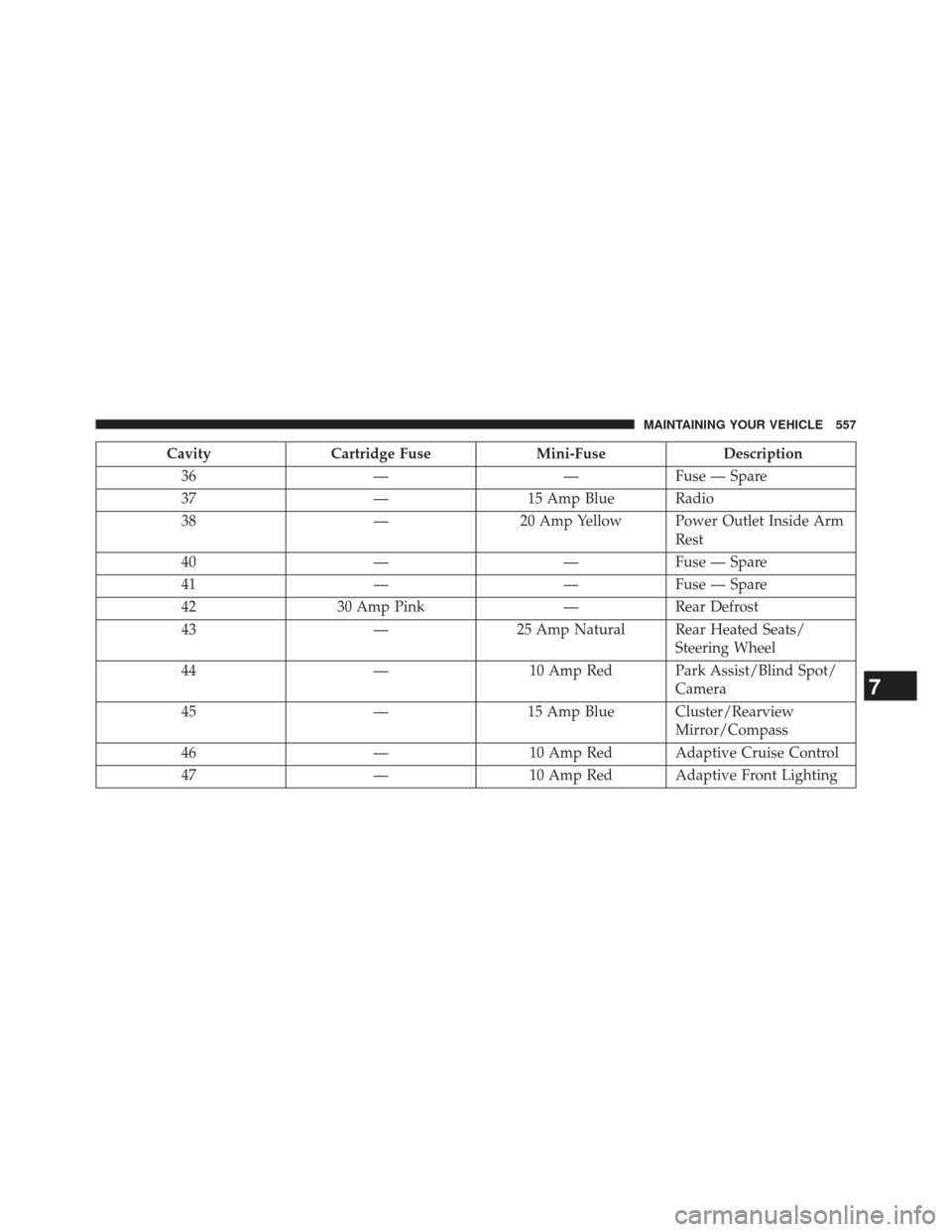
CavityCartridge Fuse Mini-FuseDescription
36 ——Fuse — Spare
37 —15 Amp Blue Radio
38 —20 Amp Yellow Power Outlet Inside Arm
Rest
40 ——Fuse — Spare
41 ——Fuse — Spare
42 30 Amp Pink —Rear Defrost
43 —25 Amp Natural Rear Heated Seats/
Steering Wheel
44 —10 Amp Red Park Assist/Blind Spot/
Camera
45 —15 Amp Blue Cluster/Rearview
Mirror/Compass
46 —10 Amp Red Adaptive Cruise Control
47 —10 Amp Red Adaptive Front Lighting
7
MAINTAINING YOUR VEHICLE 557