2014 BMW M235I Ron
[x] Cancel search: RonPage 163 of 218
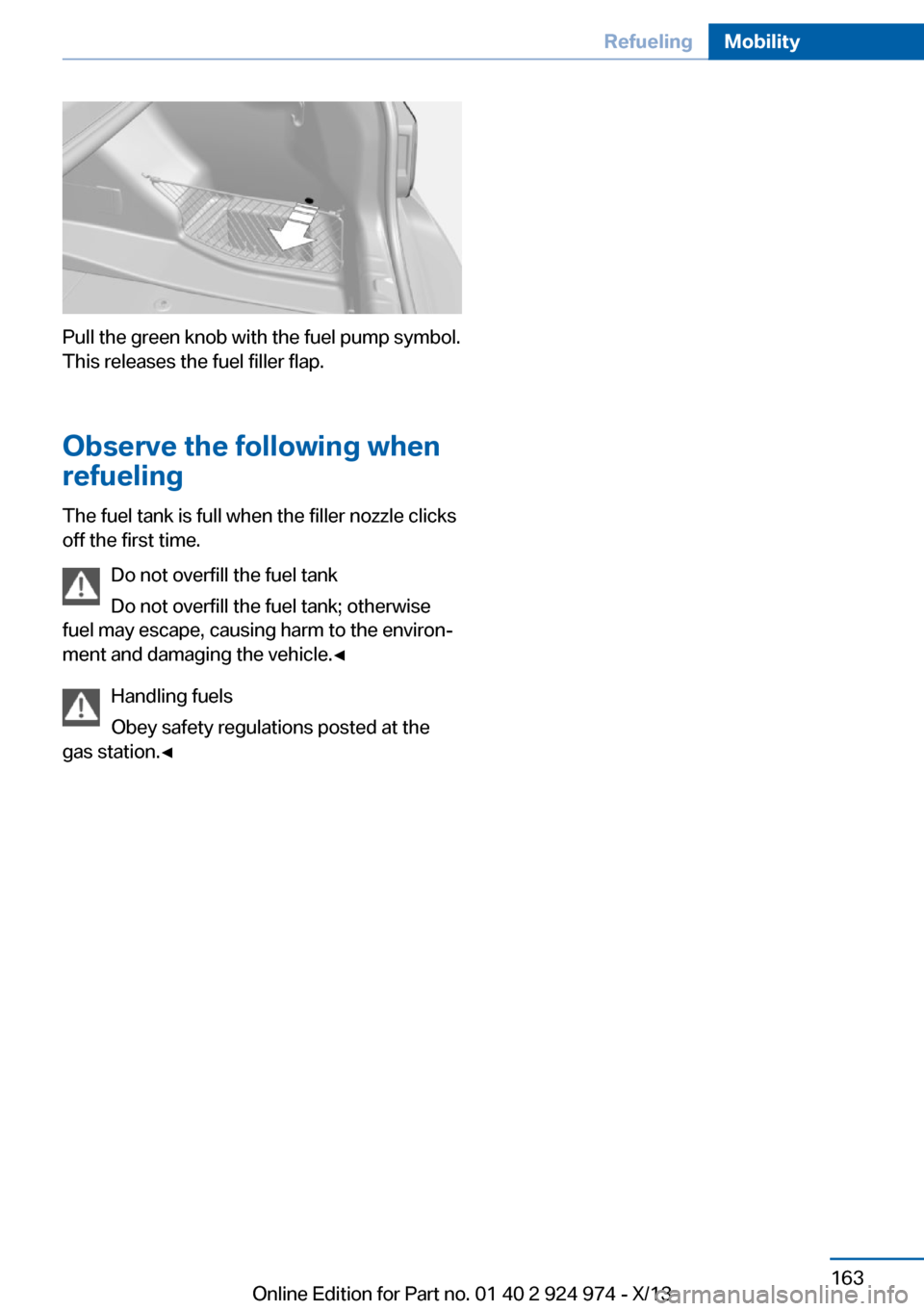
Pull the green knob with the fuel pump symbol.
This releases the fuel filler flap.
Observe the following when
refueling
The fuel tank is full when the filler nozzle clicks
off the first time.
Do not overfill the fuel tank
Do not overfill the fuel tank; otherwise
fuel may escape, causing harm to the environ‐
ment and damaging the vehicle.◀
Handling fuels
Obey safety regulations posted at the
gas station.◀
Seite 163RefuelingMobility163
Online Edition for Part no. 01 40 2 924 974 - X/13
Page 164 of 218
FuelVehicle equipmentAll standard, country-specific and optional
equipment that is offered in the model series is
described in this chapter. Therefore, equip‐
ment is also described that is not available in a
vehicle, e. g., because of the selected optional
equipment or country variant. This also applies
for safety-related functions and systems.
Fuel recommendation Note General fuel quality
Even fuels that conform to the specifica‐
tions can be of low quality. Switch gas stations
or use fuel from brand name producers having
a higher octane level; otherwise, engine prob‐
lems, such as poor engine starting perform‐
ance, poorer handling characteristics or driving
performance may occur.◀
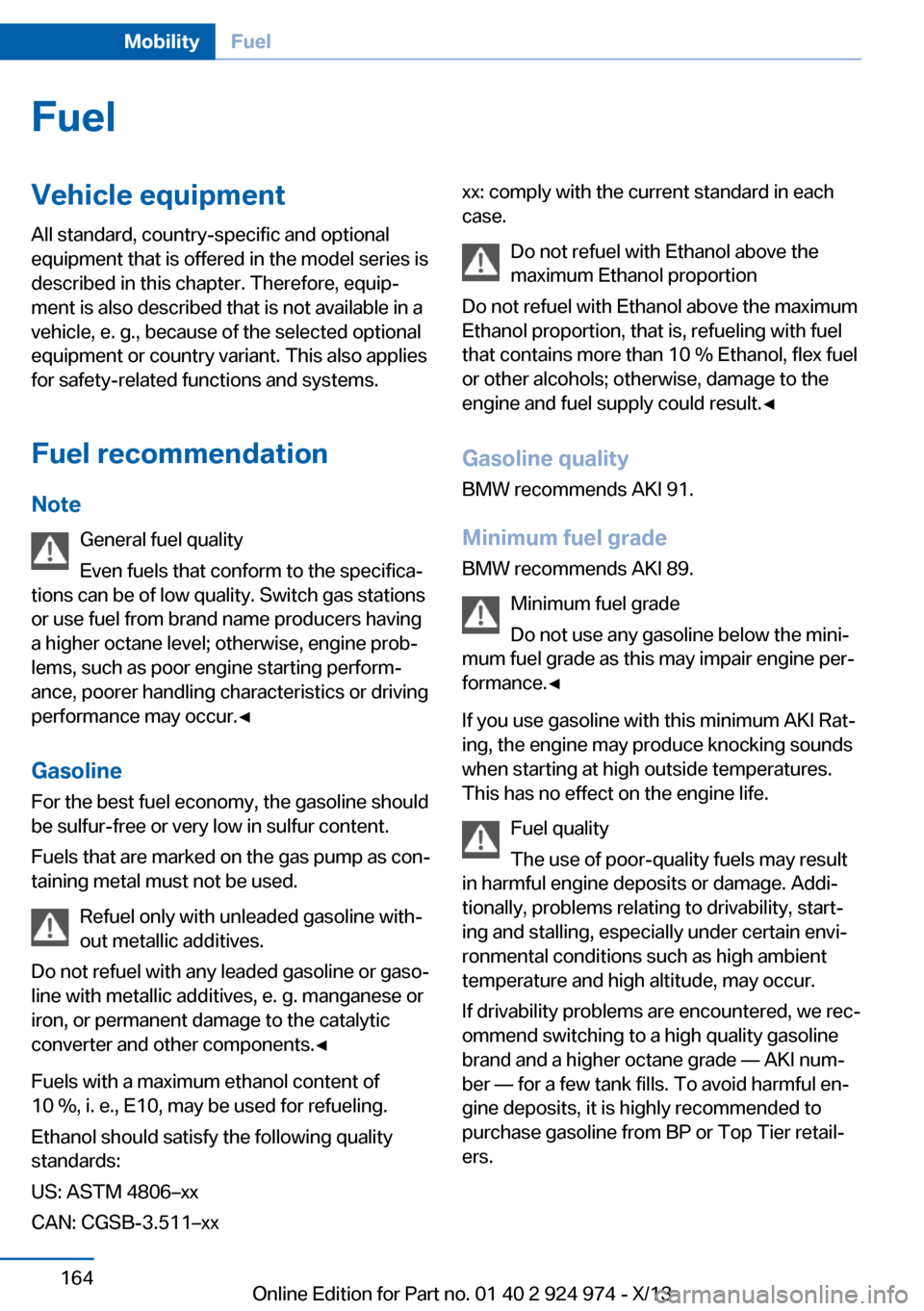
Gasoline For the best fuel economy, the gasoline should
be sulfur-free or very low in sulfur content.
Fuels that are marked on the gas pump as con‐
taining metal must not be used.
Refuel only with unleaded gasoline with‐out metallic additives.
Do not refuel with any leaded gasoline or gaso‐
line with metallic additives, e. g. manganese or
iron, or permanent damage to the catalytic
converter and other components.◀
Fuels with a maximum ethanol content of
10 %, i. e., E10, may be used for refueling.
Ethanol should satisfy the following quality
standards:
US: ASTM 4806–xx
CAN: CGSB-3.511–xxxx: comply with the current standard in each
case.
Do not refuel with Ethanol above the
maximum Ethanol proportion
Do not refuel with Ethanol above the maximum
Ethanol proportion, that is, refueling with fuel
that contains more than 10 % Ethanol, flex fuel
or other alcohols; otherwise, damage to the
engine and fuel supply could result.◀
Gasoline quality BMW recommends AKI 91.
Minimum fuel grade
BMW recommends AKI 89.
Minimum fuel grade
Do not use any gasoline below the mini‐
mum fuel grade as this may impair engine per‐
formance.◀
If you use gasoline with this minimum AKI Rat‐
ing, the engine may produce knocking sounds
when starting at high outside temperatures.
This has no effect on the engine life.
Fuel quality
The use of poor-quality fuels may result
in harmful engine deposits or damage. Addi‐
tionally, problems relating to drivability, start‐
ing and stalling, especially under certain envi‐
ronmental conditions such as high ambient
temperature and high altitude, may occur.
If drivability problems are encountered, we rec‐
ommend switching to a high quality gasoline
brand and a higher octane grade — AKI num‐
ber — for a few tank fills. To avoid harmful en‐
gine deposits, it is highly recommended to
purchase gasoline from BP or Top Tier retail‐
ers.Seite 164MobilityFuel164
Online Edition for Part no. 01 40 2 924 974 - X/13
Page 167 of 218
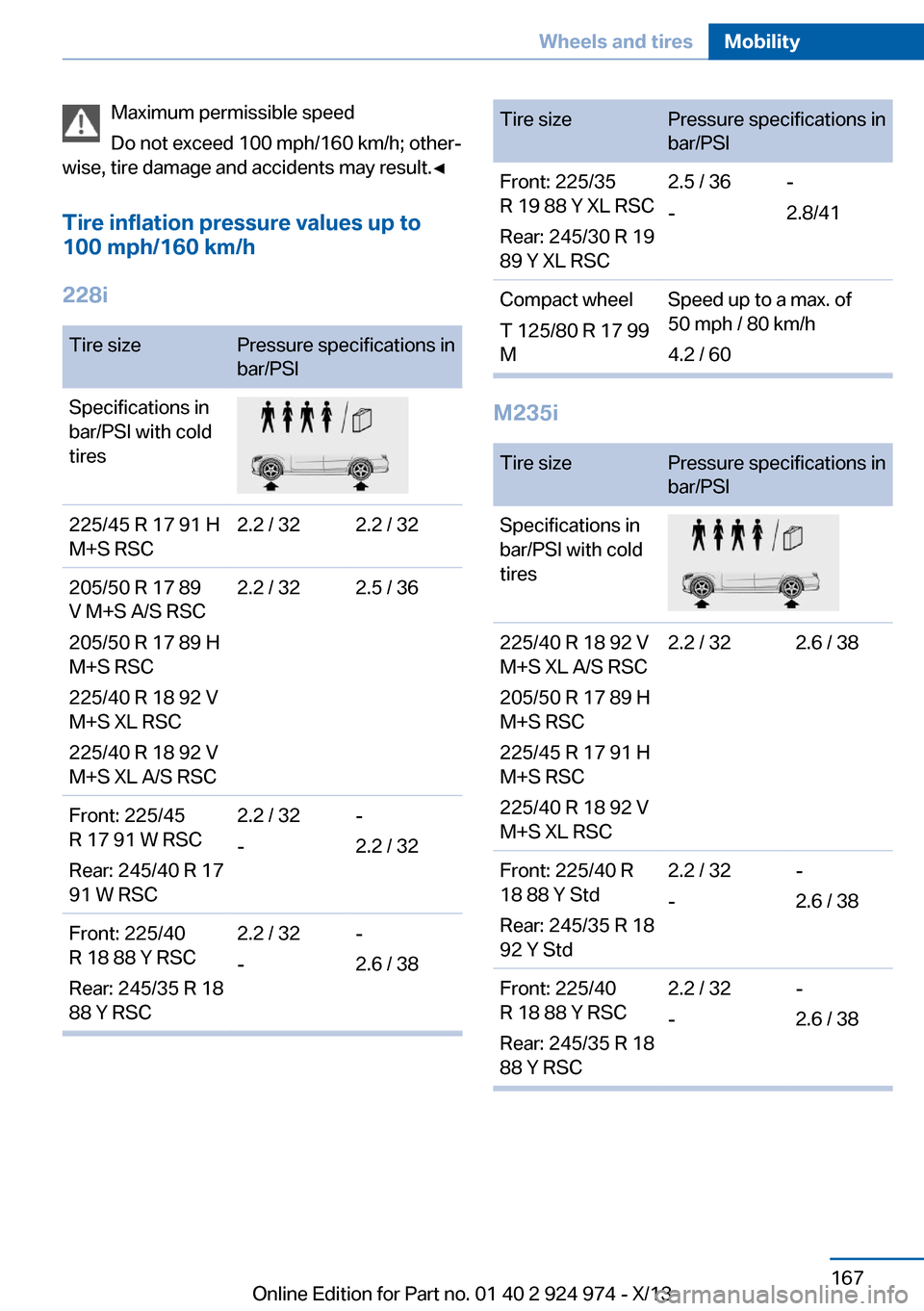
Maximum permissible speed
Do not exceed 100 mph/160 km/h; other‐
wise, tire damage and accidents may result.◀
Tire inflation pressure values up to
100 mph/160 km/h
228iTire sizePressure specifications in
bar/PSISpecifications in
bar/PSI with cold
tires225/45 R 17 91 H
M+S RSC2.2 / 322.2 / 32205/50 R 17 89
V M+S A/S RSC
205/50 R 17 89 H
M+S RSC
225/40 R 18 92 V
M+S XL RSC
225/40 R 18 92 V
M+S XL A/S RSC2.2 / 322.5 / 36Front: 225/45
R 17 91 W RSC
Rear: 245/40 R 17
91 W RSC2.2 / 32
--
2.2 / 32Front: 225/40
R 18 88 Y RSC
Rear: 245/35 R 18
88 Y RSC2.2 / 32
--
2.6 / 38Tire sizePressure specifications in
bar/PSIFront: 225/35
R 19 88 Y XL RSC
Rear: 245/30 R 19
89 Y XL RSC2.5 / 36
--
2.8/41Compact wheel
T 125/80 R 17 99
MSpeed up to a max. of
50 mph / 80 km/h
4.2 / 60
M235i
Tire sizePressure specifications in
bar/PSISpecifications in
bar/PSI with cold
tires225/40 R 18 92 V
M+S XL A/S RSC
205/50 R 17 89 H
M+S RSC
225/45 R 17 91 H
M+S RSC
225/40 R 18 92 V
M+S XL RSC2.2 / 322.6 / 38Front: 225/40 R
18 88 Y Std
Rear: 245/35 R 18
92 Y Std2.2 / 32
--
2.6 / 38Front: 225/40
R 18 88 Y RSC
Rear: 245/35 R 18
88 Y RSC2.2 / 32
--
2.6 / 38Seite 167Wheels and tiresMobility167
Online Edition for Part no. 01 40 2 924 974 - X/13
Page 168 of 218
Tire sizePressure specifications in
bar/PSIFront: 225/35
R 19 88 Y XL RSC
Rear: 245/30 R 19
89 Y XL RSC2.5 / 36
--
2.8 / 41Compact wheel
T 125/80 R 17 99
MSpeed up to a max. of
50 mph / 80 km/h
4.2 / 60
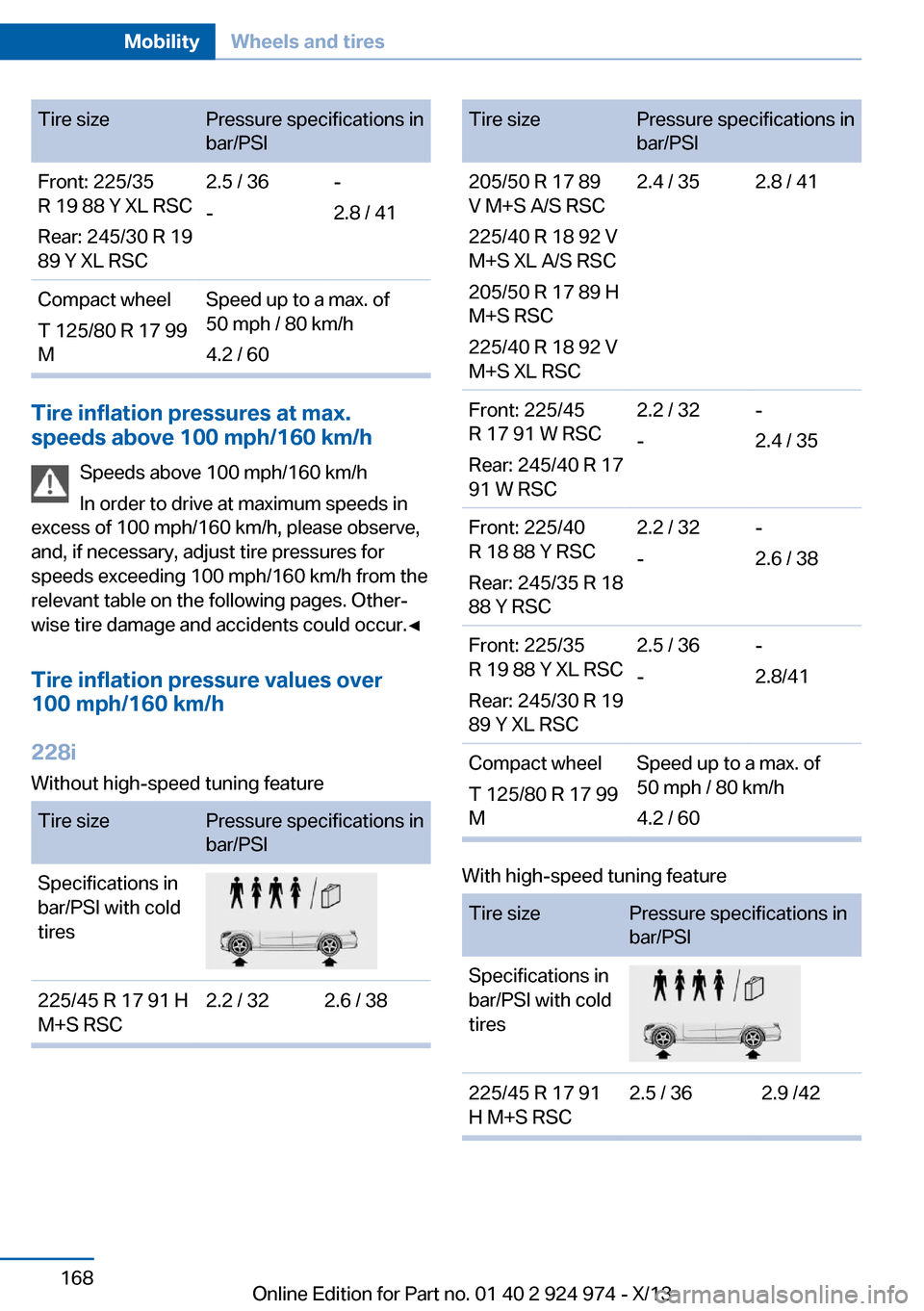
Tire inflation pressures at max.
speeds above 100 mph/160 km/h
Speeds above 100 mph/160 km/h
In order to drive at maximum speeds in
excess of 100 mph/160 km/h, please observe,
and, if necessary, adjust tire pressures for
speeds exceeding 100 mph/160 km/h from the
relevant table on the following pages. Other‐
wise tire damage and accidents could occur.◀
Tire inflation pressure values over
100 mph/160 km/h
228i
Without high-speed tuning feature
Tire sizePressure specifications in
bar/PSISpecifications in
bar/PSI with cold
tires225/45 R 17 91 H
M+S RSC2.2 / 322.6 / 38Tire sizePressure specifications in
bar/PSI205/50 R 17 89
V M+S A/S RSC
225/40 R 18 92 V
M+S XL A/S RSC
205/50 R 17 89 H
M+S RSC
225/40 R 18 92 V
M+S XL RSC2.4 / 352.8 / 41Front: 225/45
R 17 91 W RSC
Rear: 245/40 R 17
91 W RSC2.2 / 32
--
2.4 / 35Front: 225/40
R 18 88 Y RSC
Rear: 245/35 R 18
88 Y RSC2.2 / 32
--
2.6 / 38Front: 225/35
R 19 88 Y XL RSC
Rear: 245/30 R 19
89 Y XL RSC2.5 / 36
--
2.8/41Compact wheel
T 125/80 R 17 99
MSpeed up to a max. of
50 mph / 80 km/h
4.2 / 60
With high-speed tuning feature
Tire sizePressure specifications in
bar/PSISpecifications in
bar/PSI with cold
tires225/45 R 17 91
H M+S RSC2.5 / 362.9 /42Seite 168MobilityWheels and tires168
Online Edition for Part no. 01 40 2 924 974 - X/13
Page 169 of 218
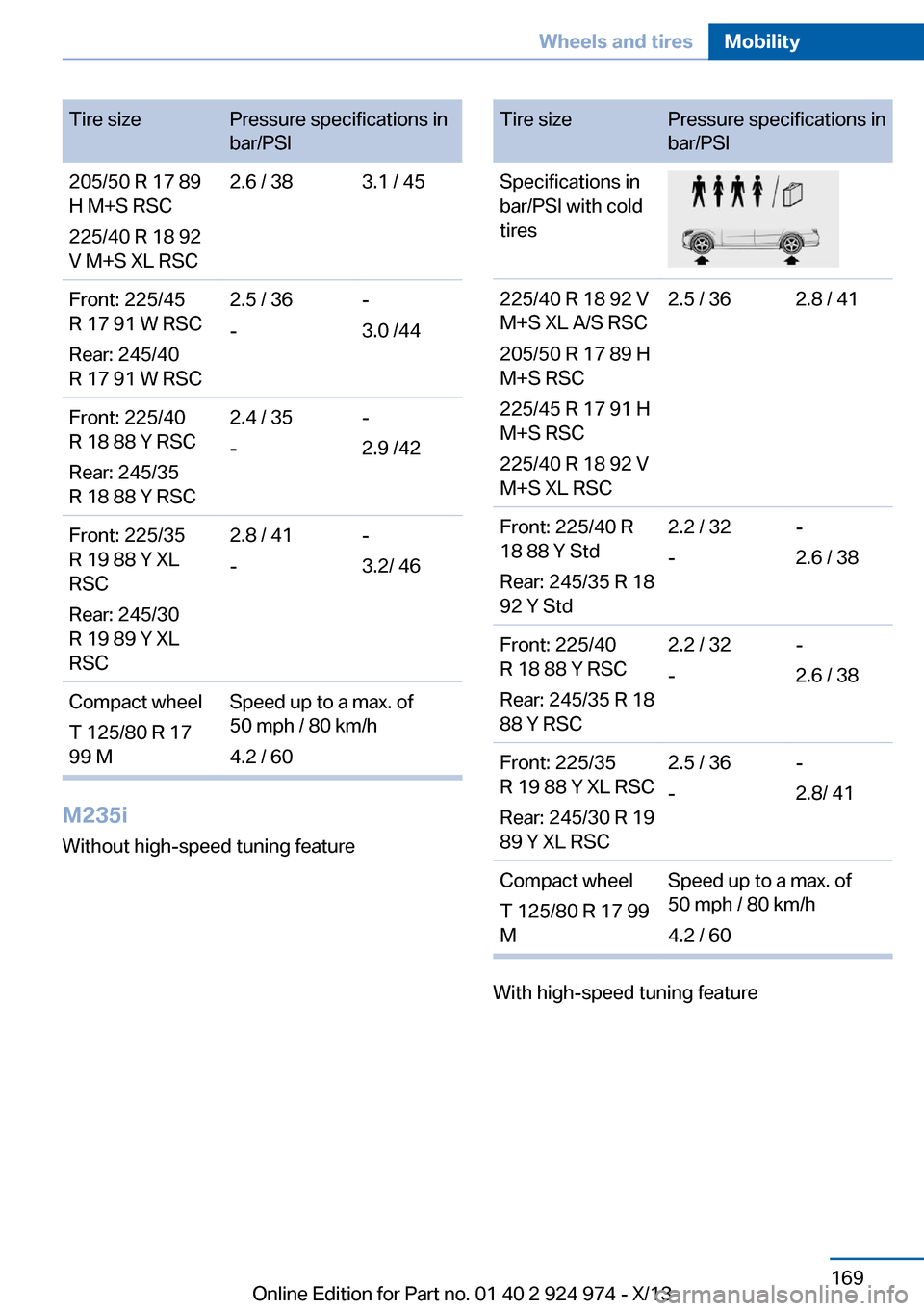
Tire sizePressure specifications in
bar/PSI205/50 R 17 89
H M+S RSC
225/40 R 18 92
V M+S XL RSC2.6 / 383.1 / 45Front: 225/45
R 17 91 W RSC
Rear: 245/40
R 17 91 W RSC2.5 / 36
--
3.0 /44Front: 225/40
R 18 88 Y RSC
Rear: 245/35
R 18 88 Y RSC2.4 / 35
--
2.9 /42Front: 225/35
R 19 88 Y XL
RSC
Rear: 245/30
R 19 89 Y XL
RSC2.8 / 41
--
3.2/ 46Compact wheel
T 125/80 R 17
99 MSpeed up to a max. of
50 mph / 80 km/h
4.2 / 60
M235i Without high-speed tuning feature
Tire sizePressure specifications in
bar/PSISpecifications in
bar/PSI with cold
tires225/40 R 18 92 V
M+S XL A/S RSC
205/50 R 17 89 H
M+S RSC
225/45 R 17 91 H
M+S RSC
225/40 R 18 92 V
M+S XL RSC2.5 / 362.8 / 41Front: 225/40 R
18 88 Y Std
Rear: 245/35 R 18
92 Y Std2.2 / 32
--
2.6 / 38Front: 225/40
R 18 88 Y RSC
Rear: 245/35 R 18
88 Y RSC2.2 / 32
--
2.6 / 38Front: 225/35
R 19 88 Y XL RSC
Rear: 245/30 R 19
89 Y XL RSC2.5 / 36
--
2.8/ 41Compact wheel
T 125/80 R 17 99
MSpeed up to a max. of
50 mph / 80 km/h
4.2 / 60
With high-speed tuning feature
Seite 169Wheels and tiresMobility169
Online Edition for Part no. 01 40 2 924 974 - X/13
Page 170 of 218

Tire sizePressure specifications in
bar/PSISpecifications in
bar/PSI with cold
tires205/50 R 17 89 H
M+S RSC
225/45 R 17 91 H
M+S RSC
225/40 R 18 92 V
M+S XL RSC2.7 / 393.1 / 45Front: 225/40 R
18 88 Y Std
Rear: 245/35 R
18 92 Y Std2.5 / 36
--
2.9 / 42Front: 225/40
R 18 88 Y RSC
Rear: 245/35
R 18 88 Y RSC2.5 / 36
--
2.9 / 42Front: 225/35
R 19 88 Y XL
RSC
Rear: 245/30
R 19 89 Y XL
RSC2.9 /42
--
3.2/ 46Compact wheel
T 125/80 R 17 99
MSpeed up to a max. of
50 mph / 80 km/h
4.2 / 60
Tire identification marks
Tire size 245/45 R 18 96 Y
245: nominal width in mm
45: aspect ratio in %
R: radial tire code
18: rim diameter in inches
96: load rating, not for ZR tires
Y: speed rating, before the R on ZR tires
Speed letter
Q = up to 100 mph, 160 km/h
R = up to 106 mph, 170 km/h
S = up to 112 mph, 180 km/h
T = up to 118 mph, 190 km/h
H = up to 131 mph, 210 km/h
V = up to 150 mph, 240 km/h
W = up to 167 mph, 270 km/h
Y = up to 186 mph, 300 km/h
Tire Identification Number
DOT code: DOT xxxx xxx 1013
xxxx: manufacturer code for the tire brand
xxx: tire size and tire design
1013: tire age
Tires with DOT codes meet the guidelines of
the U.S. Department of Transportation.
Tire age
DOT … 1013: the tire was manufactured in the
10th week 2013.
Recommendation
Regardless of wear, replace tires at least every
6 years.
Uniform Tire Quality GradingQuality grades can be found where applicable
on the tire sidewall between tread shoulder
and maximum section width.
For example: Treadwear 200; Traction AA;
Temperature A
DOT Quality Grades Treadwear
Traction AA A B C
Temperature A B CSeite 170MobilityWheels and tires170
Online Edition for Part no. 01 40 2 924 974 - X/13
Page 172 of 218
Minimum tread depth
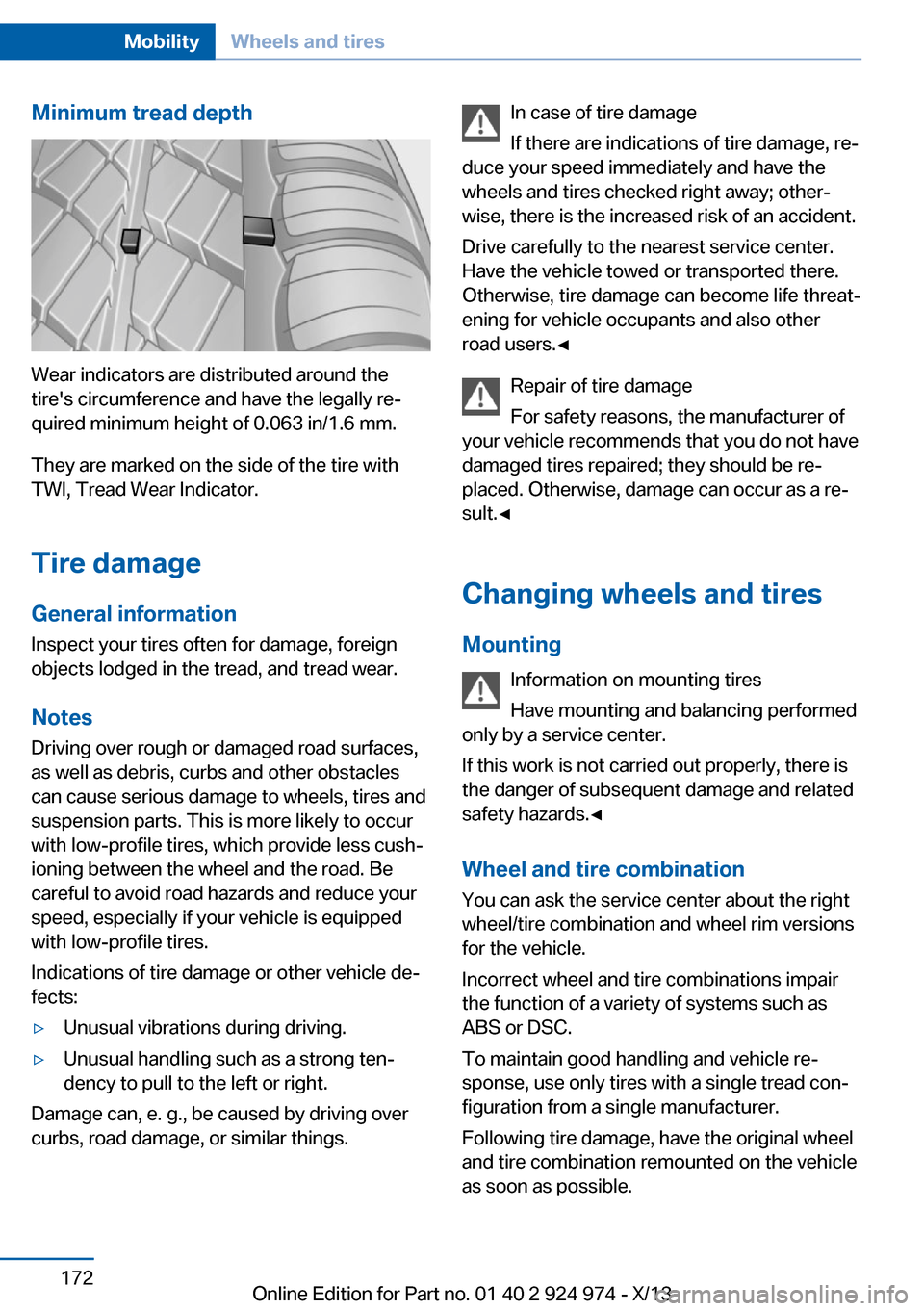
Wear indicators are distributed around the
tire's circumference and have the legally re‐
quired minimum height of 0.063 in/1.6 mm.
They are marked on the side of the tire with
TWI, Tread Wear Indicator.
Tire damage
General information
Inspect your tires often for damage, foreign
objects lodged in the tread, and tread wear.
Notes
Driving over rough or damaged road surfaces,
as well as debris, curbs and other obstacles can cause serious damage to wheels, tires and
suspension parts. This is more likely to occur
with low-profile tires, which provide less cush‐
ioning between the wheel and the road. Be
careful to avoid road hazards and reduce your
speed, especially if your vehicle is equipped
with low-profile tires.
Indications of tire damage or other vehicle de‐
fects:
▷Unusual vibrations during driving.▷Unusual handling such as a strong ten‐
dency to pull to the left or right.
Damage can, e. g., be caused by driving over
curbs, road damage, or similar things.
In case of tire damage
If there are indications of tire damage, re‐
duce your speed immediately and have the
wheels and tires checked right away; other‐
wise, there is the increased risk of an accident.
Drive carefully to the nearest service center.
Have the vehicle towed or transported there.
Otherwise, tire damage can become life threat‐
ening for vehicle occupants and also other
road users.◀
Repair of tire damage
For safety reasons, the manufacturer of
your vehicle recommends that you do not have
damaged tires repaired; they should be re‐
placed. Otherwise, damage can occur as a re‐
sult.◀
Changing wheels and tires
Mounting Information on mounting tires
Have mounting and balancing performed
only by a service center.
If this work is not carried out properly, there is
the danger of subsequent damage and related
safety hazards.◀
Wheel and tire combination
You can ask the service center about the right
wheel/tire combination and wheel rim versions
for the vehicle.
Incorrect wheel and tire combinations impair
the function of a variety of systems such as
ABS or DSC.
To maintain good handling and vehicle re‐
sponse, use only tires with a single tread con‐
figuration from a single manufacturer.
Following tire damage, have the original wheel
and tire combination remounted on the vehicle
as soon as possible.Seite 172MobilityWheels and tires172
Online Edition for Part no. 01 40 2 924 974 - X/13
Page 173 of 218
Approved wheels and tires
The manufacturer of your vehicle recom‐
mends that you use only wheels and tires that
have been approved for your particular vehicle
model.
For example, despite having the same official
size ratings, variations can lead to body con‐
tact and with it, the risk of severe accidents.
The manufacturer of your vehicle cannot eval‐
uate non-approved wheels and tires to deter‐
mine if they are suited for use, and therefore
cannot ensure the operating safety of the vehi‐
cle if they are mounted.◀
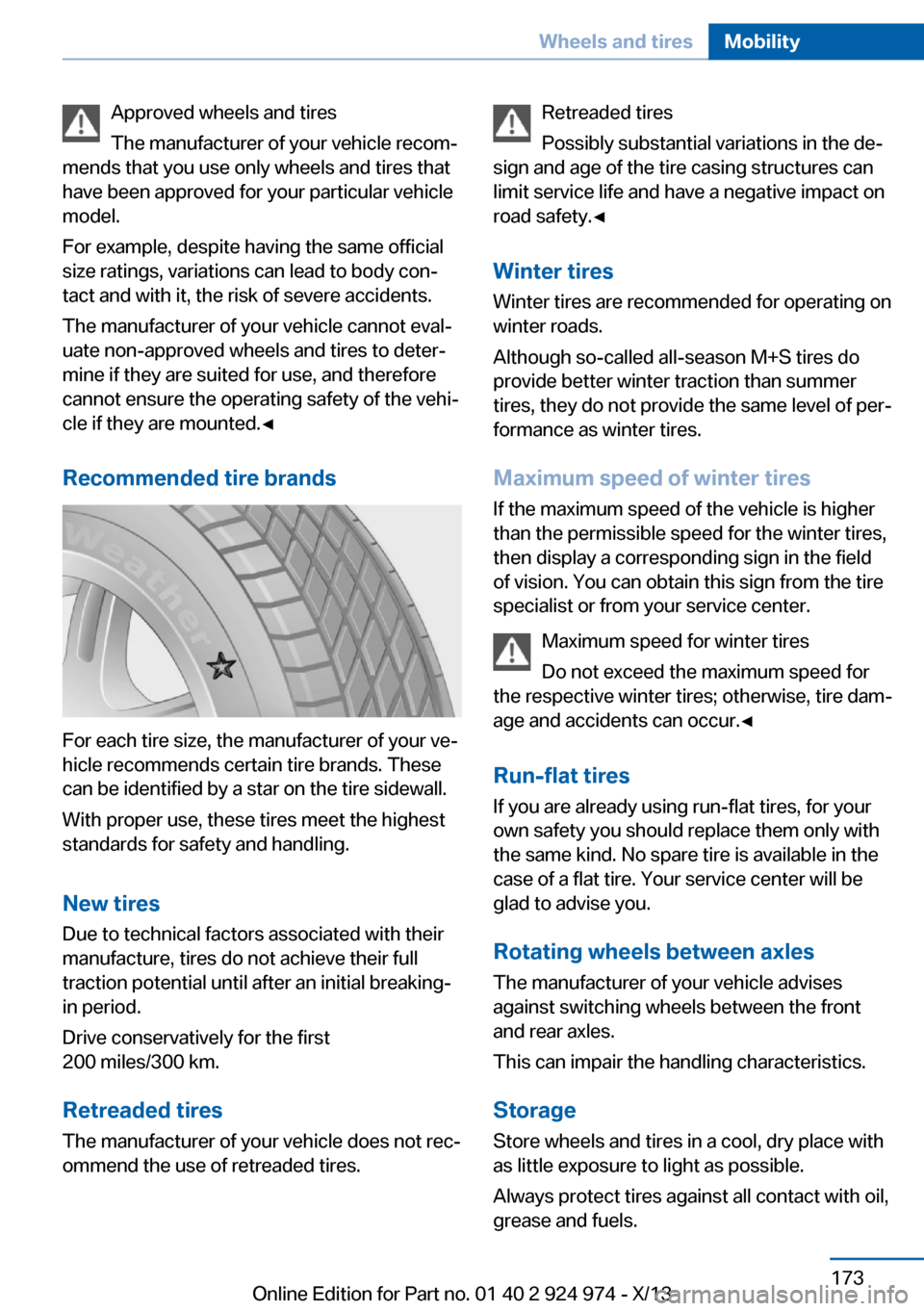
Recommended tire brands
For each tire size, the manufacturer of your ve‐
hicle recommends certain tire brands. These
can be identified by a star on the tire sidewall.
With proper use, these tires meet the highest
standards for safety and handling.
New tires Due to technical factors associated with their
manufacture, tires do not achieve their full
traction potential until after an initial breaking-
in period.
Drive conservatively for the first
200 miles/300 km.
Retreaded tires
The manufacturer of your vehicle does not rec‐
ommend the use of retreaded tires.
Retreaded tires
Possibly substantial variations in the de‐
sign and age of the tire casing structures can
limit service life and have a negative impact on
road safety.◀
Winter tires
Winter tires are recommended for operating on
winter roads.
Although so-called all-season M+S tires do
provide better winter traction than summer tires, they do not provide the same level of per‐
formance as winter tires.
Maximum speed of winter tires If the maximum speed of the vehicle is higher
than the permissible speed for the winter tires,
then display a corresponding sign in the field
of vision. You can obtain this sign from the tire
specialist or from your service center.
Maximum speed for winter tires
Do not exceed the maximum speed for
the respective winter tires; otherwise, tire dam‐
age and accidents can occur.◀
Run-flat tires If you are already using run-flat tires, for your
own safety you should replace them only with
the same kind. No spare tire is available in the
case of a flat tire. Your service center will be
glad to advise you.
Rotating wheels between axles The manufacturer of your vehicle advises
against switching wheels between the front
and rear axles.
This can impair the handling characteristics.
StorageStore wheels and tires in a cool, dry place with
as little exposure to light as possible.
Always protect tires against all contact with oil,
grease and fuels.Seite 173Wheels and tiresMobility173
Online Edition for Part no. 01 40 2 924 974 - X/13