2014 AUDI TT ROADSTER ABS
[x] Cancel search: ABSPage 178 of 244
176 Check ing and filling
Have the battery checked when you take your
vehicle in for service. You are well advised to replace a battery that is older than S years .
Disconn ect ing the battery terminals
Some veh icle functions (power w indow regu
lators, for example) are lost if the battery ter
minals are disconnected . These functions have
to be re learned after the battery terminals are
connected again. To prevent this, the battery
should only be d isconnected from the vehicle
electr ical system when absolutely necessary
for repairs .
V ehicles not dri ven for l ong period s
If you do not drive your vehicle over a period
of several days or weeks, electrical compo nents are gradually cut back or switched off .
This reduces energy consumption and main tains starting capab ility over a longer period
c:::>
page 147. Some of the convenience func
tions may not operate, suc h as the inte rior
l ights or power seat adjustme nt. The conven
i ence functions wi ll be ava ilable aga in whe n
you switch on the ignition and start the en
gine.
Winter operati on
During the winter months, batte ry capacity
tends to decrease as tempe ratu res d rop . This
is because more powe r is also consumed while
start ing , and the headlights, rea r window de
fogger, etc., are used more often.
Avoid unnecessary power consumption, par
ticularly in c ity traffic or when t rave ling on ly
short distances. Let you r authorized Aud i
dea ler check the capacity of the vehicle bat
tery before winter sets inc:::>
page 179 . A we ll
charged battery w ill not only prevent starting
prob lems when the weather is cold, but will
a lso last longer .
Replacing battery
The new battery must have the same capaci
ty, vo ltage (12 volts), amperage, construction
and p lug sealing, as the origina l battery. Spec
if ications are listed on the battery housing.
Batteries specially developed by Audi fulfill the maintenance, outp
ut, and safety require
ments .
When install ing the battery, m ake su re the ig
ni tion and a ll ele ct rical consumers are switch
ed off
c:::> (i) .
We recommend that you use maintenance
free or
cy cle-re si stant /leak -proof b atter ies
accord ing to the s tanda rds TL 825 06 (from
Apri l 2008) and VW 7 SO 73 (from April
2010) .
Rep lac ing the bat tery shou ld be car ried by a
qualified wo rkshop. Please fo llow the instruc
tions on the battery cover .
(D Note
- All wo rk on the ba tte ry req uire s techn i
c al know ledge . Please con ta ct an Aud i
dealership o r another authorized faci lity
for questions abo ut the batte ry -danger
o f ac id burns and exp losion hazard!
- The battery must not be opened! Do not
try to change the battery's liquid level,
otherwise detonating gas will escape
from the battery - explosion hazard!
- The AGM battery in the l uggage com
partment cannot leak, because the elec
tro lyte for this battery is absorbed into a
special glass mat. This leak-proof battery
must not be replace with a convent ional
battery.
- Make sure the ventilation hose on the
side of the battery is connected, other
w ise fumes or battery ac id can leak out .
- Batte ry holder and termina ls always
have to be secured correctly .
- Before all work on the battery follow the
warnings be low c:::> .&. in Working on the
battery on page 177.
@ For the sake of the environment
Because of the prob lem of proper disposal
of a battery, we recommend your author
iz ed Audi dealer change the battery for
you. Batteries contain sulfur ic acid and
l ead and must a lways be disposed o f prop-
erly in compliance wi th al l envi ronmental ..,.
Page 202 of 244

200 Tires and wheels
remain continuo usly illuminated . This se
quence will continue upon subsequent vehicle
start-ups as long as the ma lfunction ex ists.
When the malfunction indicator is illuminat
ed, the system may not be able to detect or
signal low tire pressure as intended. TPMS
malfunctions may occur for a variety of rea
sons, including the installation of replace ment or alternate tires or wheels on the vehi
cle that prevent the TPMS from functioning properly . Always check the TPMS malfunction
tellta le after replacing one or more t ires or
wheels on your veh icle to ensure that the re
placement or alternate tires and wheels allow
the TPMS to continue to function properly.
Tire pressure indicator appears
Applies to vehicles: with tire pressure monitoring system
The tire pressure indicator in the instrument
cluster informs you if the tire pressure is too
low or if there is a system malfunction.
F ig. 143 Display : underi nflat io n warn ing
Using the ABS sensors, the tire pressure moni
toring sys tem compares the t ire tread circum
ference and vibration characteristics of the in
d iv idual tires . If the pressure decreases in one
or more tires, th is is indicated in the instru
ment clus ter with a warning symbo l
ail and a
message<>
fig. 143. The dr iver message in the
display goes out after 5 seconds . The driver
message can be displayed again by pressing
the
! CHECK I button @¢ page 10, fig . 3 . If on
l y one tire is affected, the display will indicate
its pos ition.
The tire press ure monitoring m ust be reset in
the menu display each time the pressures are
ad justed (e.g. when switching between parti- al and fu
ll load pressure) or after changing or
replacing a tire on your vehicle<>
page 201.
The TPMS indicator only mon itors the t ire
pressure that you have previously stored . You
can find the recommended tire pressures for
your vehicle on the label on the driver's door
pillar
¢ page 185.
Tire tread circumference and vibration charac
teristics can change and cause a tire pressure
warning if:
- the t ire pressure in one or more tires is too
low,
- the tire has structural damage,
- the tire pressure was changed, wheels rotat -
ed or replaced but the TPMS was not reset
¢ page 201.
Warning symbols
ail Loss of pressure in at least one tire¢& .
Check the tire or tires and replace or repa ir if
necessary . The indicator light
HE in the instru
ment cluster also illuminates
<>page 13.
Check/correct the pressures of all four tires
and reset TPMS in the menu display .
ffim (T ire Pressure Monitoring System) Tire
pressure! System malfunction. Ifffim
ap
pears after switching the ignition on or while
driv ing and the indicator lig ht
HE in the in
strument cluster blinks for approx ima tely one
minute and then stays on, there is a system
malfunction .
At tempt to store the correct tire pressure
¢ page 201. Ifthe indicator light does not
turn
off or if it turns on shortly thereafter, im
med iate ly drive your vehicle to an author ized
Audi dealer or author ized repair facility to
have the malfunction corrected.
_&. WARNING
-
- If the tire pressure indicat or appears in
the instrument cluster display, one or
more of your tires is significant ly under
inflated . Reduce your speed immediately
and avoid any hard steer ing or braking
maneuvers. Stop as soon as possible and
check the tires and their pressures.
IJJ,,
Page 203 of 244

Inflate the tire pressure to the proper
pressure as indicated on the vehicle's tire
pressure label¢
page 185. Driving on a
significantly under-inflated tire causes
the tire to overheat and can lead to tire
failure . Under-inflation also is likely to
impair the vehicle's handling and stop
ping ability.
- The driver is responsible for mainta ining
the correct tire pressures. You must
check the tire pressures regularly.
- Under certain conditions (such as a spor
ty driving style, wint er conditions or un
paved roads), the pressure monitor indi
cator may be delayed .
- Ask your authorized Audi dealer if run
flat tires may be used on your vehicle.
Your vehicle registration becomes invalid if you use these tires when not permit
ted. Damage to your vehicle or accidents
could also result.
- If you switch between standard and run
flat tires, an authorized Audi dealer or
qualified workshop must reprogram the
control module .
@ Tips
-The tire pressure monitoring system
stops working when there is an ESC/ABS
malfunction.
- Using snow chains may result in a system
malfunction.
- The tire pressure monitoring system on
your Audi was developed using tires with the "AO" or "RO" identification on the
tire sidewall¢
page 192. We recom
mend using these tires.
Tires and wheels 201
Reset tire pressure monitoring system
(Stepl)
Appl ies to vehicles: wi th tire p ress ure mo nito ring system
If the tire pressure is adjusted, wheels ore ro
tated or changed, the TPMS must be reset in
the menu display.
--- ®
Fig. 144 Wiper lever : Controls for the menu display
Fig. 145 Display: Start menu
I Reset I button @ and rocker switch @
¢
fig. 144 functions:
To open the menu
.,. Press the I Reset I button @ until the menu
disp lay
9 fig. 145 appears
Selections and settings
.,. Press the rocker switch@ to reach a menu
disp lay. The switch is operated the same as
the display (up/down) .
Entering and confirming
.,. Press the I Reset I button @.
Returning to the Start menu
.,. Press the I Reset I button longer than 2 sec
onds to return from any menu level to the
Start menu. "'
Page 216 of 244

214 Fuses and bulbs
Fuse Location, Instrument Panel left
0
Fi g. 163 Fuse carrier behind the instrument panel end
face, cove r removed
Some of the equipment items listed are op
tional or only available on certain model con
figurations .
Note that the following table is accurate at
the time of going to press and is subject to
change. In the event of discrepancies, the la
bel on the inside of the cover always takes
preceden ce .
The power seats are protected by circuit
breaker s,
which automatically reset after a
few seconds after the overload has been rem
ed ied.
No . Equipment Amps
Engine relay, fuel tank control
1
unit, A irbag Off light, light
10 switch (sw itch illumination), d i-
agnos tic connector
2
ABS, ASR, ESC, brake light
5 switch
3 AFS headlight (left) s
No.
4
5
6
7
8
9
10
11
12
13
14
15
16
17
18
19
20
21
22
23
Equipment Amps
Oil level sensor (extended main-
tena nce interval) (WIV), tire
pressure monitoring system,
switch for Electronic Stabiliza-
s tion Control (ESC), AFS head-
lights (control unit), A/C system
(pressure sensor), backup light
sw itch
Automatic headlight range con-
trol, AFS headlight (right) /
5/10
manual headlight range con-
trol, halogen headlights
Control unit for CAN data trans-
fer (gateway), electromechani-
s cal steering, automatic trans-
mission shift gate
Acoustic Park Assist, automatic
dipping interior rear view mir- ror, garage door opener, heata-
s ble windshield washer nozzles,
washer pump, wind deflector
relay (Roadster)
H aldex clutch/Ha ldex clutch
5/10 (T TS)
Control un it Audi magnetic ride
s
Airbag contro l unit s
Mass airflow sensor, crankcase 5/10
heating
Door control unit (central lock-
10 ing driver/passenger)
Diagnostic connector
10
Rain sensor, automatic trans-
s miss ion shift gate
Roof light (interior lighting)
5
A/C system (control unit) 10
Tire pressure monitoring sys-
5 tern (control un it)
Not used
Not used
Not used
Fuel injectors (gasoline engine)
10
Wind deflector (Roadster) 30
Horn 20
Page 222 of 244
220 Emergency situations
Front towing loop (Version A)
Do not install the front towing loop until it is
needed.
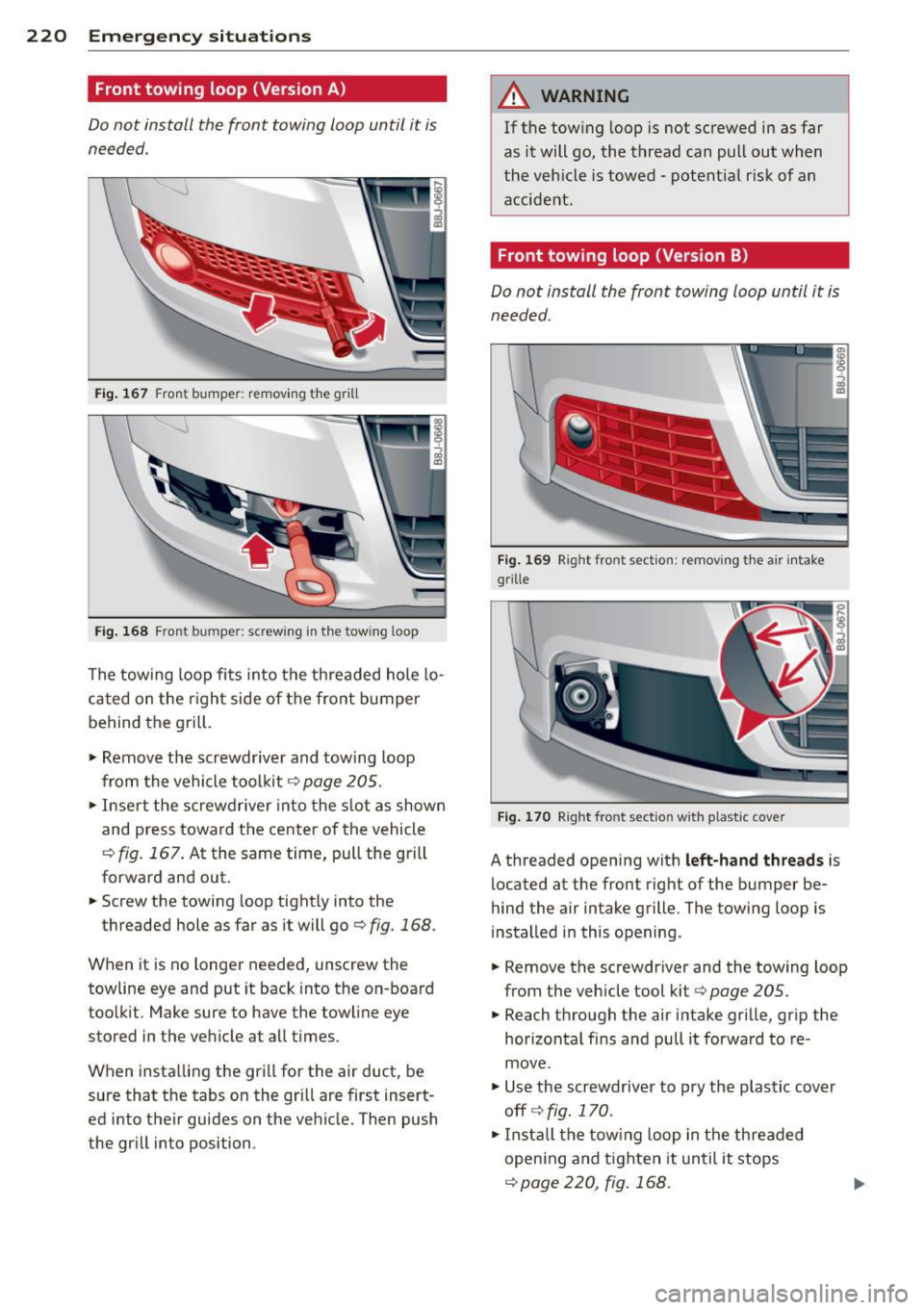
Fig. 1 67 Fro nt bumper : rem ov ing t he grill
Fi g. 16 8 Fron t bumper: screw ing in the tow ing loop
The towing loop fi ts into the th readed hole lo
c at ed on the r igh t si de of the fron t bumper
behind the g rill .
... Remove the screwdrive r and tow ing loop
from the vehicle tool kit
~ page 205 .
... Inse rt the screw driver into the s lot as show n
and press toward the ce nte r of the vehicle
¢
fig. 167 . At the same time, pull the grill
forward and out .
.,. Screw the towing loop tight ly into the
t h readed hole as far as it will go¢
fig. 168.
When it is no longer needed, unscrew the
towline eye and put it back into the on -board
too lkit . Make sure to have the towline eye
stored in the vehicle at a ll times.
When insta lling the gri ll for the air duct, be
sure that the tabs on the gr ill are first insert
ed into the ir guides on the veh icle. Then push
the gr ill into position .
A WARNING
-
If the towing lo op is not screwed in as far
as it will go, the t hread can pull out when
the veh icle is towed - potent ia l risk of an
accident.
Front towing loop (Version B)
Do not install the front towing loop until it is
needed .
Fig. 169 Right fro nt sect io n : r em ov ing the air in take
g ri lle
Fi g. 170 Rig ht fro nt sect io n w it h plastic cove r
A threaded opening with left-hand threads is
located at the front right of the bumper be
hind the air intake grille. The towing loop is
insta lled i n this opening .
.,. Remove the screwdriver and the towing loop
from the vehicle tool kit¢
page 205 .
... Reach through the air intake grille, grip the
hor izontal fi ns and pull it forward to re
move.
... Use the screwdrive r to pry the plastic cov er
off ¢
fig. 170.
... In stall th e tow ing loop in the threade d
open ing and tighten it un til it stops
¢ page 220, fig . 168 . .,..
Page 223 of 244
Remove the towing loop when you are done
using it and place it back in the vehicle tool
kit. A lways keep the tow ing loop in the vehi
cle.
When insta lling the air intake grille, insert the
tabs on the grille in the mounts on the vehicle
first . Then press the gri lle in to secure it.
A WARNING
If the towing loop is not tightened until it
stops when installing, the threads may be
pulled out when tow ing the veh icle and
that could cause an accident.
Rear towing loop
Do not install the rear towing loop until it is
needed.
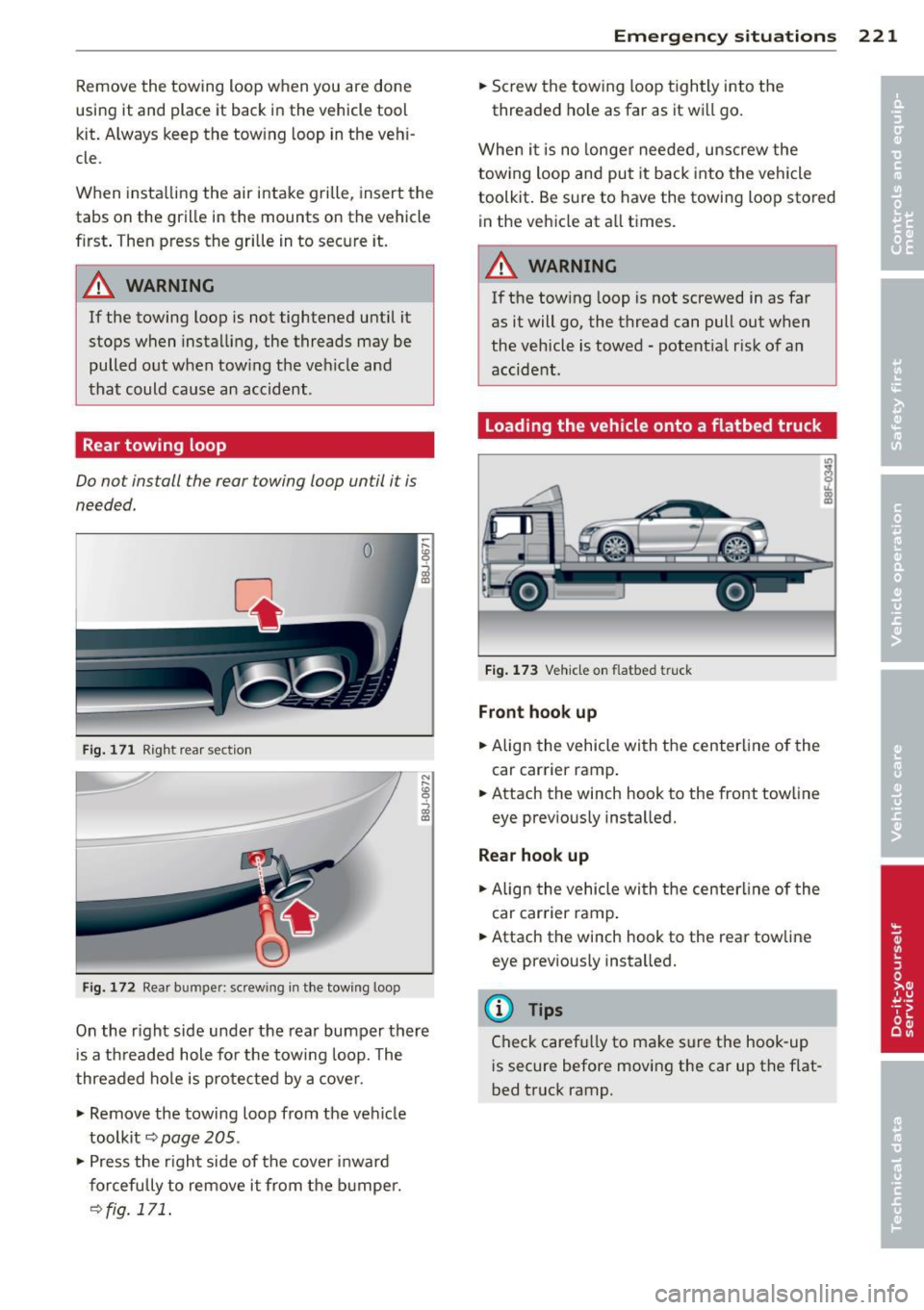
Fig. 171 Right rea r sect ion
Fi g. 17 2 Rear bumper: screwing in t he tow ing loop
On the r ight side under the rear bumper there
i s a t hreaded hole for the tow ing loop. The
threaded hole is pro tected by a cover.
"' Remove the towing loop from the vehicle
toolkit~
page 205 .
"'Press the right side of the cover i nward
f orcefully to remove it from the b umper.
¢fig. 171.
Emergenc y situ ation s 221
"'Screw the towing loop t ightly into the
threaded ho le as far as it wi ll go.
When it is no longe r needed, unscrew the
towing loop and put it back into the vehicle
toolkit . Be sure to have the towing loop sto red
in the vehicle at all times.
A WARNING
If t he tow ing loop is not screwed in as far
as it will go, the thread can pull out when
the vehicle is towed -potent ia l risk of an
accident.
loading the vehicle onto a flatbed truck
Fi g. 17 3 Vehicle on flatbed truck
Front hook up
"'Align the vehicle wi th the centerline of the
car carrier ramp.
"' Attach the winch hook to the front towline
eye prev iously insta lled.
Rear hook up
"' Alig n the vehicle wi th the center line of the
car car rier ramp .
"' Attach the winch hook to the rear tow line
eye previously insta lled.
(D Tips
Check caref ully to ma ke s ure the hook-up
i s secure before moving the car up the flat
bed truck ramp.
Page 242 of 244

24 0 Index
Vehicle literature . . . . . . . . . . . . . . . . . . . . . 5
Vehicle shut-down ............. .. ... 152
Veh icle too l kit ... ...... ..... .. .. .. . 205
Vent ilation
Vinyl Cleaning ·
... .... .... .... ... .. .. .. 68
158
w
War ning/ ind ic a tor ligh ts . . . . . . . . . . 10, 12
Airbag system .............. ... .... 15
Anti-lock brake system (ABS) .... ..... 18
Brake system . . . . . . . . . . . . . . . . . . . . . . 14
Conve rtible top . . . . . . . . . . . . . . . . . . . . 17
Cruise control . . . . . . . . . . . . . . . . . . . . . . 21
E lectronic power contro l ... .. .. .... .. 19
Elec tronic Stabilizat ion Control (ESC) . . . 18
Gen erator .. ............ ... .. .... .. 16
M alfunction Ind icator Lamp (M IL) . .. .. 19
Pa rk ing br ake . .... .... ..... .. .. .. .. 14
Safety belt . .... ...... ... .... .. .. .. 16
Safety sy stems .............. ... .... 15
Turn signals .................. ..... 21
Warn ing/ Ind icato r lights
Re ar spoile r . . . . . . . . . . . . . . . . . . . . . . . 21
Warn ing lights
Red symbols in the center disp lay .... .. 13
Yellow symbols in the cente r disp lay ... 13
Warranty coverages ........ .. .. .. .. . 226
w h . as e r reservoir ... ... .. .. .. .. .. .. . 180
Wear indicator .... ....... ... .. .... . 191
Weights ... .. ... ... .... ..... .. .. .. . 223
Wh at happens if you wear your s afety be lt
t oo loose? . .... ... ..... ... .. .. .. .. . 105
What happens to unbelted occupants? .. 102
What impairs driving safety? ........... 93
What should I do aft er chang ing a
wheel? .. .. .. .... .. ... ...... .. .. .. . 188
What should I do after rep lacing wheels? 188
Wheel bolts Torque ... .. ... ... .... ... .. .. .. .. . 198
Wheels . .. .... ..... ... ... .. .. .. .. . 181
Che ck ing tir e pre ssure ..... .. .. .. .. . 187
Cleaning . ...... ... .. ...... .. .. .. . 156
Cold t ire inflat ion pressure ...... .... 185
General notes ......... ........ .... 181 G
lossary of tir e and loading terminolo-
gy ... .. .. .... .. .. ... .. ..... ... .. 182
New t ires and whee ls . .. ..... ... .. .. 192
Ti res and veh icle lo ad limi ts . .... .... 189
When must the a irbag system be inspec t-
ed? . ... .. .. .... .. .. ... .. ..... ... .. 119
When should I adjust the t ire pressures? 188
When should I check the tire press ures? . 188
Where can I find the t ire pressures for my
car? ... .. .. .... .. ... .. .. ..... ... .. 187
Why safety belts? . . . . . . . . . . . . . . 101, 102
Wind deflector .... ... .. ..... ... .. .. . 44
Cleaning .. .. .. .. ... ... .... ... .... 157
Windows Cleaning/removing ice .. ..... ... .. .. 157
Convenience close/open feature . ... .. . 40
D efrost ... .... .. ... .. .. ..... .. . .. . 71
Windsh ie ld washer fluid ... .. .. .. .. .. . 20
Windsh ie ld wiper s
Cleaning . . . . . . . . . . . . . . . . . . . . . . . . . . 56
Fold ing up .. .. ....... ........... .. 57
Replacing windsh ield wiper b lades .. .. . 57
Se rv ice posi tion . . . . . . . . . . . . . . . . . . . . 56
W ashe r fl uid reservo ir . ..... .... .. .. 180
Winter operation Battery . . . . . . . . . . . . . . . . . . . . . . . . 175
Car was hes .. .. .. .. ... ..... .... ... 155
Cooling system . ... ........ ... ..... 172
Defrost ing windows . .... .... ... .. .. . 71
Heated seats (climate control) ... .. .. . 72
Removing ice from windows ... ... . .. 157
Tires ... .. .... .. .. ... .. ..... ... .. 147
Win ter tires . .. .. .. ...... ....... .... 196
All-wheel drive . .. ....... ..... ..... 196
Wiper and washer system . ............ 54
Intermittent wiping . . . . . . . . . . . . . . . . . 54
One-tap wiping . .. ................ .. 54
X
Xenon -Lights .. .. ....... ........... . 216